Exploring the Hallstatt Culture: The Dawn of the Early Iron Age in Europe
Step into the shimmering world of the Hallstatt Culture, the foundational society of the European Early Iron Age (c. 800–450 BCE). This subcategory on ArchaeologyHub.org delivers a comprehensive, artifact-rich examination of the chieftains, salt miners, and traders who shaped Central and Western Europe. From the iconic necropolis of Hallstatt, Austria, to the lavish burial mounds of Hochdorf and Vix, we decode the social hierarchy, technological innovations, and long-distance exchange networks that defined an era. Whether you are a student, a heritage professional, or a passionate enthusiast, this detailed study offers temporal timelines, site analyses, and interpretive narratives to illuminate how these 'princely seats' forged the cultural trajectory toward the Celtic world.
🏛️ Princely Seats and Chieftain Burials: The Power Centers
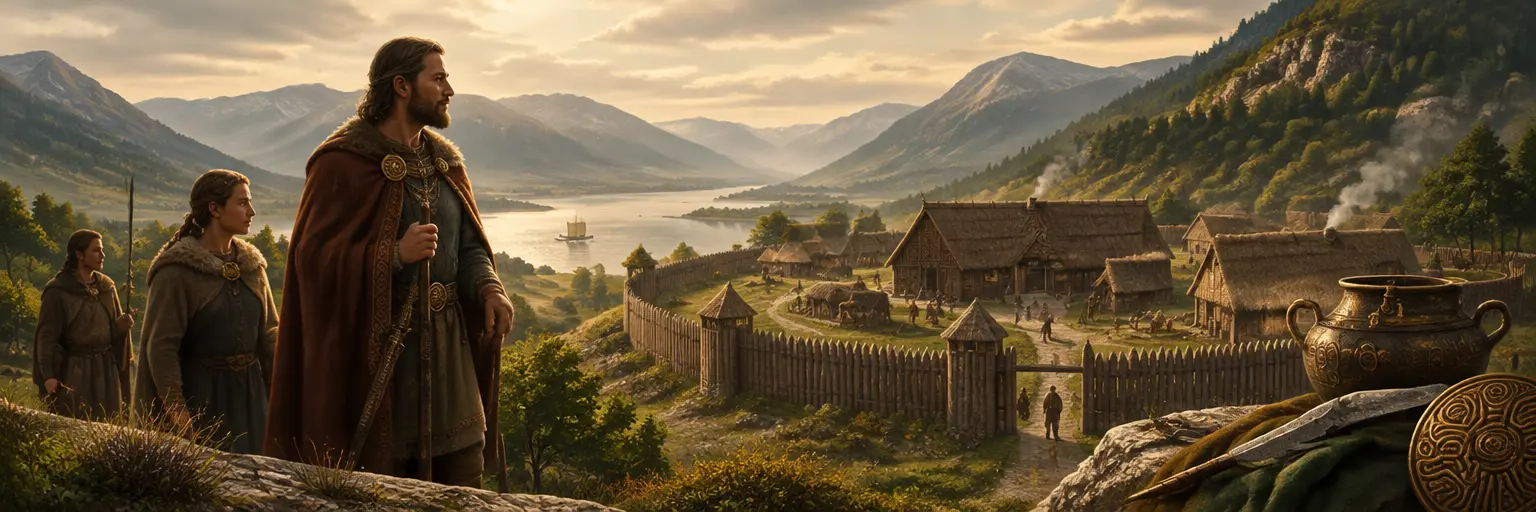
Dive into the heart of Hallstatt political organization through its most spectacular archaeological signature: the princely seats (Fürstensitze) and their accompanying elite burials. These fortified hilltop settlements, such as Heuneburg and Mont Lassois, were more than mere residences—they were administrative, economic, and ritual hubs controlling regional trade. Here, you will explore the architecture of power, including mudbrick fortifications inspired by Mediterranean designs, and the sprawling tumuli filled with imported bronze vessels, gold torcs, and four-wheeled wagons.
Our interpretive analyses reveal how grave goods functioned as status markers, reflecting a hierarchical society where chieftains negotiated power through feasting and exotic displays. You will learn about the meticulous excavation methods used to preserve organic materials like textiles and leather, and how modern bioarchaeology, including isotope analysis, traces the mobility of these elites. Expect detailed profiles of key sites, including the famous Hochdorf burial chamber, complete with its iron-tipped ceremonial wagon and a cauldron capable of holding 500 liters of mead.
⚒️ Salt, Trade, and the Hallstatt Economy: Engines of Wealth
The Hallstatt culture’s name derives from the Austrian salt mines at Hallstatt, a UNESCO World Heritage site where salt extraction created unprecedented wealth and sustained long-distance trade. This section unravels the complex economic webs connecting the Alps to the Mediterranean and Baltic worlds. You will find evidence of amber from the north, ivory and coral from the south, and local production of high-quality pottery, iron tools, and ornate bronze fibulae. We also analyze the role of the horse, a symbol of prestige, in facilitating these exchanges.
By studying settlement patterns and hoard finds, we reconstruct a trading system that was not merely commercial but deeply embedded in social rituals. Discover how the control of salt and metal resources empowered local lineages, leading to the emergence of a 'warrior aristocracy.' Our artifact profiles include the iconic situla art, decorated bronze buckets that depict scenes of feasting, combat, and daily life, offering a rare visual narrative of Hallstatt society. This economic lens helps explain the cultural uniformity across a vast geographic area, from France to the Balkans.
⚱️ Daily Life, Craftsmanship, and Technology in Hallstatt Society
Beyond the elites, this subcategory explores the daily rhythms of commoners—farmers, potters, weavers, and metalworkers—whose labor sustained the Hallstatt world. We present detailed reconstructions of hillfort villages and open settlements, including house layouts, storage pits, and hearths. You will learn about the technological leap from bronze to iron metallurgy, including the smelting processes and the creation of the first steel-like alloys. Experimental archaeology findings, such as reconstructed kilns and looms, are featured to show how ancient crafts were practiced.
Our content emphasizes the gendered division of labor, using burial goods to identify roles: women often buried with jewelry and weaving tools, men with weapons and razors. We also delve into dietary habits, analyzing carbonized seeds and animal bones to reveal a diet rich in millet, barley, and pork. For those interested in ritual, we cover votive offerings deposited in lakes and bogs, shedding light on religious beliefs and cosmology. This holistic approach provides a vivid, ground-level view of a society often overshadowed by its aristocratic monuments.
🗺️ Regional Variations and the Transition to the La Tène Period
The Hallstatt culture was not monolithic. This section maps out its regional facies, contrasting the eastern zone, with its tumulus burials and inhumation practices, with the western zone, where cremation was more common. We profile key geographic nodes—from the Slovenian Dolenjska group to the French Jura—highlighting local adaptations in pottery styles, fortification techniques, and settlement patterns. You will see how climate shifts and population pressures contributed to internal restructuring around 600 BCE, leading to the florescence of the princely seats in the later phase (Ha C and D).
Equally crucial is the examination of the decline and transformation into the La Tène culture around 450 BCE. We discuss theories of climate change, the exhaustion of trade routes, and internal social conflicts that may have prompted a shift from large hillforts to smaller, more dispersed communities. Through settlement archaeology and chronological refinements, we show how elements like the painted pottery and the long sword persisted, while new styles emerged. This dynamic perspective allows you to appreciate the Hallstatt culture not as a static era but as a fluid, evolving bridge between the Bronze Age and the Celtic expansion.
🔍 Key Archaeological Sites and Discovery Methods
For the field-enthusiast, this subcategory offers a curated tour of iconic excavation sites that define Hallstatt archaeology. Beyond Hallstatt and Heuneburg, we feature the Vix burial in France, the Býčí Skála cave in Czechia, and the Magdalenenberg necropolis with its astronomical alignment. Each site profile includes stratigraphic data, radiocarbon dating results, and geophysical survey maps, illustrating modern investigative techniques. You will learn how aerial photography and LiDAR have revealed hidden enclosures, and how dendrochronology provides precise dating for wooden structures.
We also detail the history of archaeological thought, from the 19th-century antiquarian digs to modern interdisciplinary projects. Interviews with leading researchers and case studies on conservation challenges—such as preserving fragile iron artifacts or UNESCO site management—offer insider perspectives. Moreover, we provide practical links to museum collections and open-access databases, enabling you to examine high-resolution images of artifacts like the gold-foil covered vessels. This section essentially functions as a mini-field guide, empowering you to connect theoretical knowledge with tangible remains.
Frequently Asked Questions
What is the difference between Hallstatt C and Hallstatt D?
Hallstatt C (c. 800–600 BCE) marks the early Iron Age with a dominance of bronze and the introduction of iron swords. It is distinguished by richer warrior burials and a lesser degree of Mediterranean trade. Hallstatt D (c. 600–450 BCE) is the mature phase, featuring the floruit of princely seats, extensive Greek and Etruscan imports, and monumental burial chambers like Hochdorf.
Why is the Hallstatt culture considered a 'chieftain society'?
Archaeologists infer a chiefdom structure from the concentration of wealth in a few burial mounds, the existence of centralized hillforts, and control over strategic resources like salt and metals. The presence of exotic goods and feasting paraphernalia suggests a hereditary elite that hosted communal events to legitimize power, fitting the anthropological model of a chiefdom.
How did salt mining shape the Hallstatt economy?
Salt was a precious preservative and dietary essential. At Hallstatt, miners extracted salt in large blocks using bronze tools, creating profound wealth that funded trade for luxury items like amber, coral, and wine. This economic surplus allowed the community to support specialized artisans and maintain long-distance exchange networks, making salt the true currency of the era.
Were Hallstatt people the same as Celts?
Not exactly. The Hallstatt culture is generally considered the proto-Celtic or early Celtic horizon, laying the linguistic and cultural foundations for the later La Tène culture, which is unequivocally associated with the historical Celts. The material culture of Hallstatt shows similarities but also marked regional differences, so the label 'Celt' is applied cautiously.
What is the best museum to see Hallstatt artifacts?
Several museums hold exceptional collections. The Naturhistorisches Museum in Vienna displays the original Hallstatt finds, including textiles and tools. The Württemberg State Museum in Stuttgart houses Hochdorf artifacts, while the Musée du Pays Châtillonnais in France exhibits the Vix burial treasures. Many are available online via virtual tours for remote study.