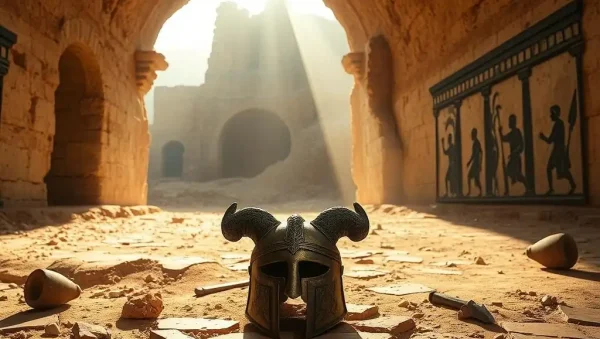
The Psychological Impact of Mycenaean Warrior Iconography
🧠 Explore how Mycenaean warrior symbolism reveals insights into ancient psyche, reflecting values of strength, loyalty, and identity. This article delves into…
Read article
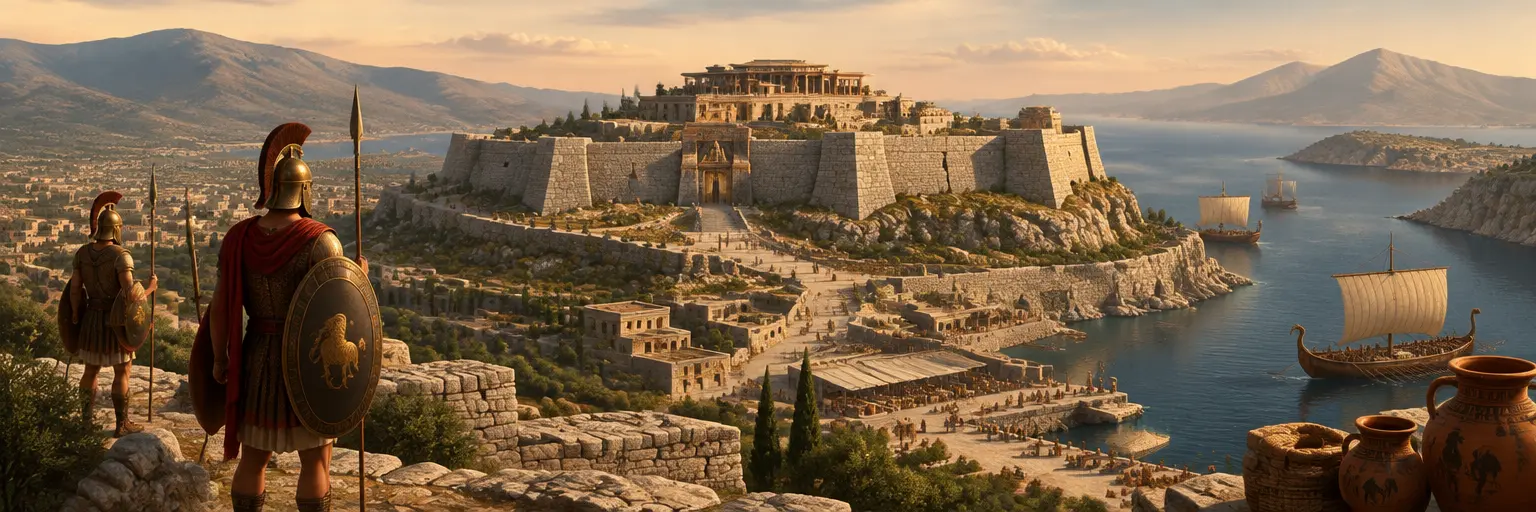
Step into the world of the Mycenaean Civilization, the legendary era immortalized in Homer’s epics, where mighty citadels of massive stone, fierce warrior elites, and a far-reaching trade network defined the Bronze Age Aegean. From the iconic Lion Gate of Mycenae to the fortified palaces of Tiryns and Pylos, these awe-inspiring strongholds were not just royal residences but command centers of power and protection. Uncover the secrets of their formidable architecture, the art of warfare that saw bronze armor and chariots dominate the battlefield, and the intricate maritime routes that exchanged goods from amber to ivory across the Mediterranean. This detailed study reveals how the Mycenaeans blended martial prowess with cosmopolitan commerce, leaving a rich archaeological legacy that bridged the Minoan world and the dawn of Classical Greece. Explore the rise and fall of these ancient powerhouses right here on ArchaeologyHub.org.
Welcome to ArchaeologyHub.org’s deep dive into the Mycenaean Civilization, the bronze-clad forerunners of classical Greece. Flourishing from roughly 1600 to 1100 BCE on the Greek mainland, the Mycenaeans built formidable citadels like Tiryns and Mycenae, dominated the Aegean through military prowess, and established vast trade networks that stretched from the Levant to Italy. This subcategory unpacks the archaeological evidence behind their fortified palaces, their warrior culture immortalized in Homeric epics, and the intricate exchange systems that fueled their wealth. Prepare to explore the material culture, linear B tablets, and lavish shaft graves that define this pivotal era, offering a rich narrative for both enthusiasts and serious students of ancient history.
Enter the world of Cyclopean masonry, where massive limestone boulders, some weighing several tons, were fitted together without mortar to create impenetrable fortresses. The citadels of Mycenae, Tiryns, and Gla reveal sophisticated defensive architecture, including corbelled galleries, secret water cisterns, and the iconic Lion Gate of Mycenae. These structures were not mere refuges but political and religious centers, housing megaron palaces adorned with frescoes and storerooms for tribute. Excavations show how these fortifications evolved over centuries, responding to both internal dynastic shifts and external threats, providing a tangible timeline of Mycenaean power and architectural innovation.
For the visitor to this subcategory, expect detailed site plans, photogrammetry reconstructions, and analysis of building phases. We break down the logistics of quarrying and transporting stone, the defensive strategies against siege warfare, and the symbolic role of monumental gates as displays of royal authority. Through comparative studies with Hittite and Minoan fortifications, you’ll gain insight into how Mycenaean citadels were unique, blending utilitarian defense with ceremonial grandeur. This section serves as your virtual tour guide for understanding how these stone giants shaped the political landscape of the Late Bronze Age.
The Mycenaean elite defined themselves through martial valor, as evidenced by the rich burial goods in Shaft Grave Circles A and B at Mycenae. Here, archaeologists unearthed bronze Naue II swords, spearheads, arrowheads, and the famous Dendra panoply—a full suit of bronze armor dating to 1400 BCE. Iconography on pottery and frescoes depicts warriors in boar’s tusk helmets, chariot riders, and dueling scenes, suggesting a highly organized military aristocracy. Isotopic analyses of skeletal remains from warrior graves also reveal injuries consistent with hand-to-hand combat, offering a gritty reality behind the heroic ideal.
Delve into our tactical analyses of Mycenaean warfare, including the disputed role of the chariot—whether as a mobile platform or a transport to the battlefield. We examine the logistics of bronze production, the trade of tin and copper, and the presence of mercenaries in Egyptian and Ugaritic texts. You’ll find detailed catalogs of weapon types, their metallurgical composition, and wear-pattern analyses that tell stories of actual combat. This subcategory bridges the gap between Homer’s epic heroes and the physical evidence of a society that bred warriors for centuries.
When Michael Ventris deciphered Linear B in 1952, the Mycenaeans spoke to us directly, not in poetry but in administrative records. Found baked in the destruction layers of Pylos, Knossos, and Thebes, these clay tablets record inventories of wool, textiles, grain, and slaves. They reveal a highly centralized palatial economy where scribes tracked everything from chariot wheels to perfumed olive oil. The tablets list specialized workers, their rations, and their supervisors, exposing the bureaucratic backbone of Mycenaean power. Surprisingly, they contain little on religion or history, but they offer an unparalleled snapshot of real-time economic management.
Explore our interactive database of Linear B signs, syllabograms, and ideograms, with transliterations and translations of key tablets. We break down the palatial redistribution system, tracing goods from production centers to distant provinces. Learn how the tablets document the ta-ra-si-ja system (allotments of raw materials to artisans) and the collection of o-ka (military contingents). By cross-referencing archaeological finds of storage jars and sealings, we reconstruct the inflow and outflow of commodities, offering a data-rich perspective on Mycenaean economic complexity that challenges older narratives of a purely agrarian society.
Mycenaean merchants were not isolationists; they were the connective tissue of the Late Bronze Age Mediterranean. Shipwrecks like the Uluburun and Cape Gelidonya carry cargoes of copper ingots, tin, glass, ivory, and terebinth resin that match Mycenaean demand. Pottery analyses, especially stirrup jars used for oil and wine, have been found from Cyprus to Sardinia, indicating strong export markets. Conversely, imports of Baltic amber, Egyptian faience, and Levantine silver demonstrate a vast import network. The Amarna letters mention a "Land of Mycenae" (Tanaja), confirming diplomatic and commercial exchanges with pharaohs and vassal kings.
In this section, we map the sea routes, docking sites, and seasonal navigation patterns using wind data and ancient harbor reconstructions. We discuss the role of elite gift exchange versus commercial trade, analyzing weight systems (such as the Minoan/Masson standard) and the presence of foreign merchants in Mycenaean ports. You’ll find case studies of specific artifact transfers, like the ivory pyxides carved in Crete that ended up in mainland graves. By integrating underwater archaeology, ceramic petrography, and textual evidence, we paint a vivid picture of the complex, risk-laden maritime economy that sustained Mycenaean palatial societies until their collapse around 1200 BCE.
Beyond walls and weapons, the Mycenaeans left a rich artistic legacy that reveals their values and contacts. Their pottery evolved from the intricate Palace Style to the simplified Mycenaean pictorial style, featuring octopuses, chariots, and bull-leaping scenes—many borrowed and adapted from Minoan Crete. Frescoes at Pylos and Tiryns depict processions, banquets, and hunters, showing a society fond of display. Burial customs are equally telling: from shallow shaft graves to massive tholos tombs like the "Treasury of Atreus," the dead were outfitted with gold death masks, diadems, and ceremonial weapons, reflecting a strong ancestor cult and status competition.
Our archives include high-resolution imagery of vessel fragments, thermoluminescence dating, and chemical fingerprinting (pXRF) of clay sources to trace production centers. We analyze iconographic motifs for religious symbolism, such as the goddess with raised arms, and compare them with Minoan and Near Eastern traditions. For burials, we provide osteological analyses of grave populations, identifying sex, age, and pathologies to infer social stratification. This subcategory is a treasure trove for art historians and bioarchaeologists alike, offering a multisensory appreciation of Mycenaean daily life and mortuary rituals through rigorous archaeological description.
The collapse around 1200 BCE was likely a combination of systemic internal stresses (palatial economic over-centralization, social unrest) and external shocks like invasions (the so-called "Sea Peoples"), earthquakes, and climate-induced crop failures. Many citadels were destroyed or abandoned, and literacy ceased, but recent evidence suggests a gradual decline rather than a single catastrophic event.
Homer’s Iliad and Odyssey were composed centuries later, but they preserve authentic Mycenaean memories, such as the boar’s tusk helmet and chariot warfare. However, they blend Bronze Age realities with later Iron Age practices. Archaeologically, the Mycenaeans spoke an early form of Greek, as confirmed by Linear B, but Homer’s poems are creative reimaginings, not historical records.
Linear B tablets show women engaged in textile production, food preparation, and religious duties as priestesses with property rights. Elite women are depicted in frescoes, and some warrior graves contain female burials, though their military role is debated. Overall, women were vital to the palatial economy and ritual life, but likely held subordinate official status.
The Minoans (Crete, 2000-1450 BCE) were more peaceful, with unfortified palaces and a maritime focus, while Mycenaeans were mainlanders with a militaristic, hierarchical aristocracy and heavy fortifications. Mycenaeans adopted Minoan writing, art, and religion but reoriented them toward martial and palatial administration, eventually conquering Crete and absorbing its culture.
Yes, major sites like Mycenae, Tiryns, Pylos, and Gla are open to the public, with museums in nearby towns (e.g., Nafplio and Mycenae Archaeological Museum) displaying artifacts. They offer well-marked paths, reconstructed gates, and visitor centers. For a more immersive experience, consider a guided tour or check for seasonal access to restricted areas like underground cisterns.