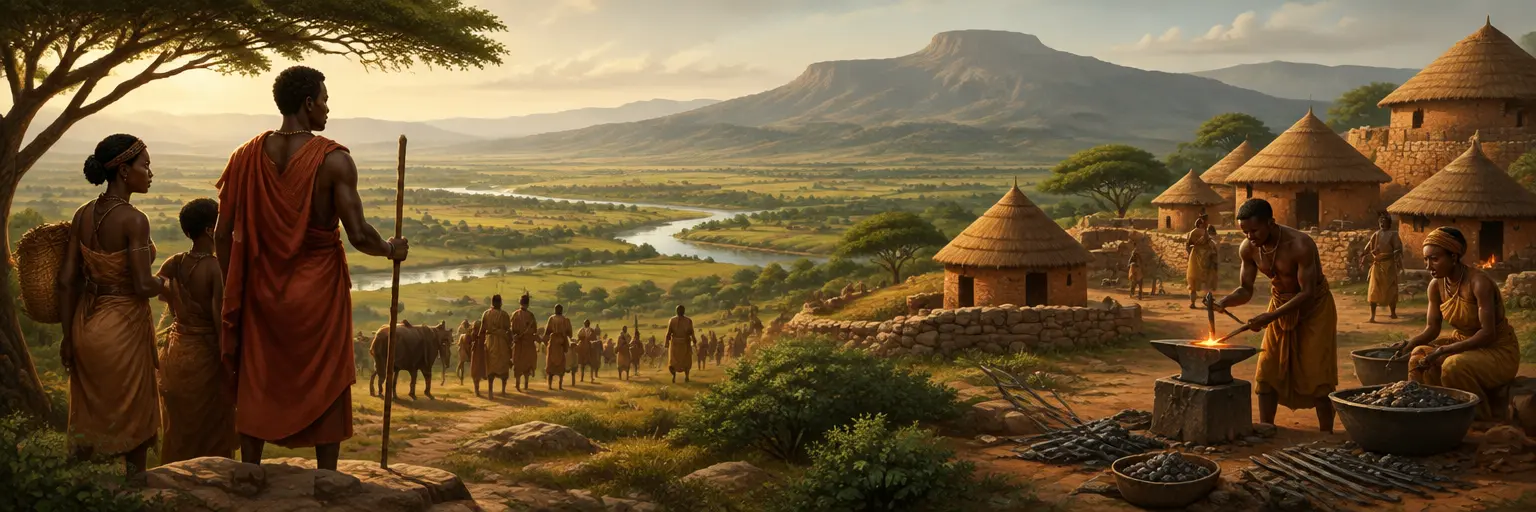
Explore the Dawn of African Civilizations: Bantu Migrations & Early Iron Age
Welcome to ArchaeologyHub.org’s detailed study of the Bantu Migrations and the Early Iron Age in Africa. This subcategory unpacks one of the most transformative yet underappreciated chapters in human history—a period roughly spanning 3000 BCE to 500 CE. Here, you will journey through the gradual dispersal of Bantu-speaking peoples across sub-Saharan Africa, their mastery of iron smelting, and the profound cultural, linguistic, and agricultural shifts they triggered. Our interpretive analyses draw on excavation sites, pottery typologies, and linguistic reconstructions to reveal how these migrations laid the foundations for later kingdoms from the Great Lakes to Southern Africa. Expect clear timelines, artifact profiles, and geographic breakdowns that align with our encyclopedic taxonomy, making complex archaeological evidence accessible to students, enthusiasts, and researchers alike.
🔍 Unraveling the Bantu Expansion: Routes and Causes
This section delves into the archaeological and linguistic evidence tracing Bantu-speaking communities’ origin in the Nigeria-Cameroon borderlands around 3000 BCE. We examine the dual-wave hypothesis—first moving south through the rainforest, then eastward across the savanna—using pottery shards (e.g., Chifumbaze complex) and lexical reconstructions of yam cultivation. Understand why factors like climate shifts, population pressure, and the adoption of iron tools accelerated their spread.
Key insight: The Bantu expansion was not a single event but a series of slow, intergenerational movements, often absorbing or displacing hunter-gatherer groups. Our site maps the corridor of migration, highlighting how river networks like the Congo served as highways. By cross-referencing carbon-dated hearths and grindstones, you’ll see how early settlers adapted their subsistence strategies, shifting from forest foraging to cereal farming. This foundational knowledge helps contextualize later African empires, proving that mobility and innovation were central to Africa’s ancient past.
⚒️ Forging a New Era: Early Iron Age Technologies
Here, we focus on the technological revolution that defined the Early Iron Age (circa 1000 BCE to 500 CE) in Africa. Unlike the Mediterranean or Near East, sub-Saharan iron smelting emerged independently, with bloomery furnaces found at sites like Nsongezi in Uganda and Taruga in Nigeria. We profile the furnace types—bowl, shaft, and domed—plus the crucial role of tuyeres and bellows in reaching temperatures above 1100°C.
Technical highlight: Early ironworkers didn’t just make tools; they produced specialized hoes, spears, and axes that increased agricultural efficiency and warfare capability. Our artifact profiles include detailed photos and metallurgical analyses, revealing how slag composition varied by region. This technology enabled deforestation for farming, which in turn supported larger, sedentary populations—a prerequisite for complex societies. Explore our interactive timeline to see how iron smelting spread alongside Bantu languages, linking technological change directly to demographic movement.
🌾 Agricultural Transformations and Settlement Patterns
This segment examines how Bantu migrants introduced new crops and livestock, fundamentally reshaping African landscapes. They brought pearl millet, sorghum, and oil palm cultivation, later integrating bananas and plantains from Southeast Asia via Indian Ocean trade. We analyze pollen cores and macrobotanical remains from sites in Zambia and Kenya, demonstrating a shift from wild foraging to managed fields and agroforestry.
Cultural impact: Settlements evolved from small kin-based hamlets to larger village clusters with defensive ditches, as seen at Urewe in Kenya. Pottery styles—like the distinctive Urewe ware with beaded rims—serve as markers of cultural identity and trade networks. Our pages include settlement layout diagrams and ecofact tables, showing how cattle herding became central in drier regions. By understanding these patterns, you’ll see how food surpluses fueled population growth and occupational specialization, creating social hierarchies that would later give rise to chieftaincies and kingdoms.
🗣️ Linguistic and Genetic Echoes: Tracking the Migrants
Here, we integrate historical linguistics and archaeogenetics to corroborate the material record. Over 500 modern Bantu languages belong to a single subfamily of Niger-Congo, and glottochronology helps date their divergence. We present genetic studies that reveal a gradual admixture of Bantu-speaking farmers with indigenous hunter-gatherers (e.g., San and Pygmy groups), visible in Y-chromosome and mtDNA haplotypes.
Interdisciplinary approach: This section is a model for how ArchaeologyHub bridges disciplines. For instance, the spread of the *nki* root for “goat” aligns with faunal remains at early Iron Age sites. We also debunk the myth of a homogeneous takeover, showing reciprocal cultural exchanges—such as adopted click consonants in some Bantu languages. Through maps and cladograms, you’ll visualize the branching patterns that link distant communities, from Cameroon to South Africa. This genetic-linguistic convergence confirms the migration’s historical reality and highlights Africa’s deep internal connections.
🏺 Case Studies: Key Sites and Excavations
Dive into our detailed profiles of pivotal archaeological sites, each with stratigraphy, radiocarbon dates, and artifact catalogs. Notable examples include the Engaruka complex in Tanzania (terraced irrigation), the Kwale site in Kenya (early iron smelting), and the Broederstroom site in South Africa (early farming communities). We include virtual tours and downloadable excavation reports.
Practical value: For students, these case studies illustrate standard field techniques like flotation sampling and ceramic seriation. For enthusiasts, they provide a “you are there” narrative—imagine uncovering a 2,000-year-old furnace that still holds charcoal. We also highlight ongoing excavations, linking to live fieldwork blogs and museum collections. By examining these micro-regional examples, you’ll appreciate the diversity within the broader migration, from coastal fisher-farmers to highland pastoralists. Each site is a puzzle piece in reconstructing daily life, trade, and ritual practices.
Frequently Asked Questions
What exactly were the Bantu Migrations?
The Bantu Migrations were a series of gradual population movements by Bantu-speaking peoples, beginning around 3000 BCE in West-Central Africa. Over millennia, they expanded east and south, carrying farming, iron-smelting, and language skills. This spread fundamentally changed sub-Saharan Africa’s cultural and ecological landscape, connecting distant regions through shared technologies.
Why is the Early Iron Age important for African history?
The Early Iron Age (circa 1000 BCE–500 CE) marks Africa’s first widespread production of iron tools and weapons. This innovation boosted agriculture, enabled land clearance, and supported denser populations. It underpinned the formation of complex societies and long-distance trade networks, setting the stage for later kingdoms like Great Zimbabwe and Mapungubwe.
How do archaeologists date Bantu migration sites?
Archaeologists rely primarily on radiocarbon dating of charcoal, bone, and plant remains found in hearths, furnaces, and midden layers. They also use thermoluminescence on baked clay pottery. Cross-referencing multiple samples and stratigraphic sequences ensures accurate timelines, while typological comparisons with dated artifacts refine regional chronologies.
Did the Bantu migrants replace or assimilate indigenous groups?
Generally, they assimilated rather than replaced. Genetic studies show significant admixture between Bantu-speaking farmers and indigenous foragers like the San and Pygmy peoples. While some groups were displaced or integrated, many cultural traits, including language clicks and hunting techniques, were adopted, creating a mosaic of blended identities.
What evidence supports the migration theory beyond artifacts?
Linguistics provides strong support: the remarkable similarity among over 500 Bantu languages suggests a recent common origin. Genetics, particularly paternal lineages (Y-chromosome) and maternal (mtDNA), show clear geographic gradients aligning with migration routes. Combined with ethnographic parallels in traditional farming, these disciplines corroborate archaeological findings.