Mycenaean Religion: Deities, Sanctuaries, and Ritual Practices
🌟 Explore the fascinating world of Mycenaean religion rituals practices, uncovering their deities, sanctuaries, and ceremonial traditions that reveal the spiritual life…
Read article
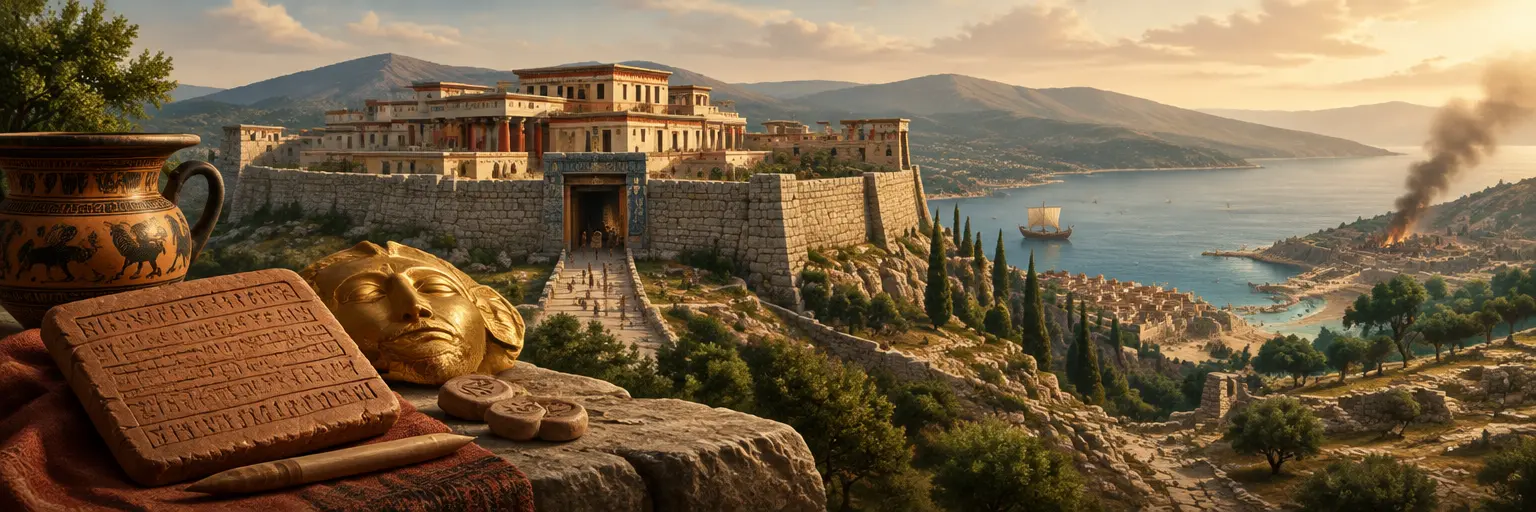
Unlock the mysteries of the Mycenaean world, the legendary era of Homer’s epics, through a focused lens on Linear B script, intricate social hierarchies, and the enigmatic collapse that ended a Bronze Age powerhouse. From palatial administrative tablets to warrior graves, this detailed study dissects how the Mycenaeans managed their agrarian economy, organized wanax-led kingdoms, and traded across the Mediterranean—before a systemic crisis erased their citadels. Perfect for enthusiasts of ancient history, this synthesis bridges archaeological evidence with scholarly debates on societal resilience and upheaval. Explore artifact profiles, decode syllabic symbols, and trace the fall’s ripple effects on the Aegean’s Iron Age dawn.
Welcome to ArchaeologyHub.org’s deep dive into the Mycenaean Civilization, the powerful Bronze Age culture that dominated the Aegean from roughly 1600 to 1100 BCE. Famous for its monumental citadels like Mycenae and Tiryns, this advanced society left behind the earliest deciphered Greek script, a complex palatial economy, and an enduring mystery: its sudden collapse. Here, we unravel the intricacies of Linear B tablets, the rigid social hierarchies, and the multifaceted theories explaining the Late Bronze Age catastrophe that reshaped the ancient world.
Linear B stands as the earliest known writing system for the Greek language, used primarily for administrative records. Discovered on clay tablets preserved by fire, this syllabic script was famously deciphered in 1952 by Michael Ventris, revealing a bureaucratic world meticulously recording goods, personnel, and land tenure. Unlike the heroic epics of Homer, Linear B provides a mundane yet invaluable ledger of state-level management, listing everything from chariot wheels and bronze ingots to grain rations and sheep flocks.
For readers, understanding Linear B offers a direct window into how Mycenaean palatial centers operated. Each tablet is a time capsule, showing a highly centralized economy where scribes tracked resources from periphery to palace. The script’s presence across sites like Pylos, Knossos, and Thebes indicates a shared administrative language, despite political fragmentation. This system was not for literature or history, but for control—a practical tool for kings to tax, redistribute, and mobilize labor, making it an essential key for reconstructing Mycenaean governance and daily life.
The Mycenaean world was profoundly hierarchical, with the wanax (king) at the apex, wielding religious, military, and economic authority. Beneath him sat the lawagetas (military leader), followed by a class of nobles, priests, and high-ranking officials, all supported by a broad base of artisans, farmers, and enslaved people. Linear B tablets reveal specific job titles, such as telestai (landholders) and damos (community groups), showing a society where land tenure and labor duties were tightly regulated by palace scribes.
This structured inequality is visible archaeologically through lavish tholos tombs, such as the “Treasury of Atreus,” and the massive Cyclopean walls that separated rulers from the ruled. Notably, women held specialized roles in textile production and religious offices, though their status was secondary to men. For enthusiasts of social history, examining these strata explains how the palaces mobilized thousands of workers for construction projects, military campaigns, and trade. The system’s complexity also hints at its fragility, as the entire economy depended on the central authority and long-distance networks that would later fail, leading to societal upheaval.
The collapse of the Mycenaean palatial civilization around 1200–1100 BCE remains one of history’s greatest puzzles. Traditional explanations include invasions by the “Sea Peoples,” internal revolts, and natural disasters such as earthquakes. Modern scholarship, however, points to a systemic failure: a combination of climate change, drought, and over-reliance on fragile trade routes may have triggered food shortages and fiscal crises, causing palatial administrations to destabilize. Archaeological evidence shows widespread destruction layers, abandoned settlements, and a sharp drop in writing usage after the palaces fell.
For archaeology fans, debating these theories highlights how interdisciplinary research—using paleoclimatology, isotope analysis, and pottery seriation—provides nuanced answers. What is certain is that the collapse was not uniform; some sites like Lefkandi were resettled, but the centralized state structure vanished. This period birthed the Greek “Dark Ages,” yet it also set the stage for the later Iron Age renaissance. Understanding the collapse helps us appreciate the resilience and transformation of human societies in the face of multidimensional crises, a lesson that echoes into current concerns about sustainability and globalization.
The material remains of the Mycenaeans—from intricate gold death masks to utilitarian stirrup jars—offer a tangible connection to their world. Excavations at major citadels have uncovered stunning frescoes, ivories, and bronze weaponry, illustrating an elite culture deeply influenced by Minoan Crete yet distinctly warlike. The famous “Mask of Agamemnon,” though possibly predating the Trojan War era, exemplifies their funerary artistry. Additionally, the presence of imported amber, ivory, and faience attests to far-reaching trade networks stretching to Egypt, the Levant, and the Baltic.
For visitors to ArchaeologyHub.org, exploring this subcategory provides a visual and analytical tour of key sites like Pylos, with its impressive “Nestor’s Palace,” and the fortified citadel of Gla. Our detailed artifact profiles and excavation summaries help you interpret grave goods, pottery styles (such as Late Helladic IIIB), and architectural innovations like corbelled tombs. By studying these objects, you can trace cultural exchanges, technological advances, and regional identities, giving a richer context to the famous myths of Agamemnon and Odysseus that were born from these very communities.
Despite its collapse, the Mycenaean era profoundly shaped subsequent Greek culture, language, and identity. The Greek language, preserved in Linear B, evolved into Classical Greek, while Mycenaean deities like Zeus, Hera, and Poseidon appear in later religious practices. Epic poetry, though composed centuries later, likely drew upon memories of Mycenaean palaces, heroes, and warfare, creating a golden age narrative for later Greeks. Moreover, the administrative and architectural achievements set a benchmark that later city-states would reference, albeit with new social structures.
For our readers, tracing this legacy reveals how “civilizational collapse” does not erase a culture’s core contributions. Instead, the Mycenaeans bequeathed a linguistic and mythological toolkit that enabled the rise of Archaic Greece. Their defensive architecture, such as at Tiryns, influenced fortress designs for millennia. By connecting Linear B, tomb construction, and palace economics to historical memory, this subcategory bridges archaeology with literary studies, offering a holistic view of how a vanished society remains eternally relevant in Western history.
Linear B is a syllabic script used by the Mycenaeans for palace record-keeping. Its importance lies in being the earliest attested form of Greek, proving a continuous linguistic link to later antiquity. It offers a primary source for studying ancient economies, social structures, and religious practices, essential for historical reconstruction.
No single cause explains the collapse. Evidence suggests a convergence of systemic failures: prolonged droughts, disruptions in Eastern Mediterranean trade, possible internal revolts, and invasions by Sea Peoples. Palatial dependencies on centralized redistribution made them especially vulnerable, leading to rapid deurbanization and abandonment of writing.
Not exactly, but they were historical ancestors. Homer’s epics, written centuries later, preserve some authentic memories of Mycenaean places and customs, but they also mix Iron Age details. The historical Mycenaeans were a real, bureaucratic civilization; Homeric depictions are poeticized and stylized, not literal historical records.
Key museums include the National Archaeological Museum in Athens, which houses the gold treasure from Mycenae, and the Mycenae Archaeological Museum at the site. Significant collections also exist at the British Museum and the Pergamon Museum in Berlin. Many artifacts, including Linear B tablets, are displayed alongside explanatory panels for public education.
While the Mycenaeans adopted Minoan writing, art, and trade customs, they were more militaristic and centralized. Minoan palaces at Knossos lacked fortifications, whereas Mycenaean citadels had massive defensive walls. Mycenaean society emphasized warrior elites and male chauvinism, while Minoan art often highlighted nature and possibly matriarchal elements, reflecting divergent political and social priorities.