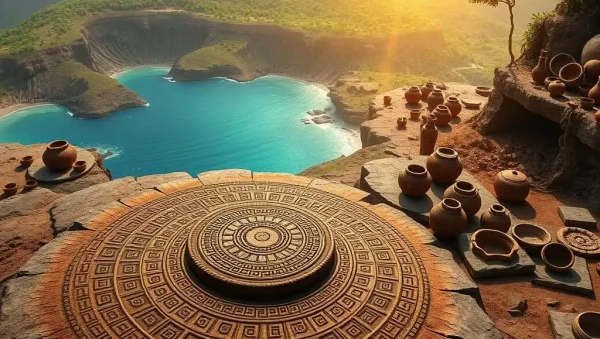
Oceanian & Australian Prehistory: Lapita Pottery & Austronesian Migrations
Step into the vast blue expanse of the Pacific and explore one of history’s most remarkable maritime feats: the Austronesian expansion. This subcategory on ArchaeologyHub.org dissects the material culture—especially the intricate, dentate-stamped Lapita pottery—that traces these voyagers from Southeast Asia to the remote islands of Oceania. Here, you’ll find artifact profiles, radiocarbon-dated timelines, and archaeological interpretations that illuminate how language, genetics, and clay vessels chart human migration across the world’s largest ocean.
🏺 The Diagnostic Power of Lapita Pottery
Lapita pottery is the archaeologist’s fingerprint for identifying early Austronesian settlements in the Pacific. Characterized by complex geometric dentate-stamped designs, this ceramic tradition appears abruptly in the archaeological record around 1500 BCE in the Bismarck Archipelago. Its distinctive motifs—combinations of notches, zigzags, and curvilinear patterns—are not just decorative; they encode social identity and regional variation, enabling researchers to trace how communities moved and interacted across islands.
Understanding Lapita’s stylistic evolution is crucial for dating sites and reconstructing migration routes. By analyzing clay temper and decorative techniques, archaeologists can distinguish locally made pots from imported ones, revealing exchange networks that spanned hundreds of kilometers. This subcategory explores the latest studies on manufacturing techniques, firing temperatures, and residue analysis, giving you a granular view of how a simple vessel became a cultural signature of one of humanity’s greatest expansions.
🌊 Austronesian Maritime Technology & Voyaging
The Austronesian migration was not a random drift but a directed, sophisticated exploration using advanced outrigger canoes and celestial navigation. Archaeological evidence from Taiwan, the Philippines, and Island Southeast Asia shows a stepwise progression of settlements, each leap testing new seafaring capabilities. This section examines the construction of these watercraft—from lashed-lug hulls to crab-claw sails—and the experimental voyages that replicate ancient routes, providing tangible insights into navigation techniques using stars, swells, and bird flight patterns.
Beyond the boats themselves, this subcategory highlights the ecological adaptations that made long-distance colonization viable. Austronesians transported domesticated animals (pigs, chickens, dogs), cultivated crops (taro, yams, breadfruit), and introduced new fishing technologies. Archaeological sites like the Reef/Santa Cruz Lapita settlements in the Solomon Islands offer rich faunal remains that reconstruct dietary practices and environmental impact. Here, you’ll learn how maritime expertise and agricultural resilience synergized to sustain populations on isolated atolls and high islands.
🧬 Genetics, Language, and the Double Migration Model
Modern bioarchaeology has revolutionized our understanding of Austronesian origins, revealing a complex blend of ancestry. Ancient DNA studies of Lapita-associated burials indicate a “double migration” model: an initial movement from Taiwan and Southeast Asia intermingled with indigenous Papuan populations in Near Oceania before the rapid dispersal to Remote Oceania. This subcategory synthesizes genomic, linguistic, and archaeological datasets to present a cohesive narrative of admixture and cultural exchange.
Linguistic phylogenetics further enrich this picture, tracing the Austronesian language family from its Formosan roots to over 1,200 daughter languages. By correlating language divergence with pottery types and settlement patterns, you’ll see how material culture and spoken word evolve in tandem yet sometimes diverge due to contact. This integrated approach—what archaeologists call “triangulation”—offers a more nuanced story than single-discipline studies, addressing debates about the speed of the Lapita expansion and the degree of interaction with existing Melanesian communities.
🏝️ Regional Case Studies: From the Bismarcks to Polynesia
Not all Lapita sites are equal; regional variability is key to understanding social complexity and adaptive strategies. This section dives into major excavations, such as the Mulifanua site in Samoa, the oldest known settlement in Polynesia, and the Teouma cemetery in Vanuatu, which yielded over 60 inhumations with elaborate shell ornaments. Each site offers a unique lens on mortuary practices, trade networks, and local environmental adaptation, from lagoon-focused economies to inland horticulture intensification.
Comparing these case studies reveals a pattern of rapid colonization followed by localized cultural divergence. For instance, pottery styles in Fiji show early diversification into distinct wares, while in Tonga and Samoa, Lapita pottery quickly degenerated into plainware—a phenomenon linked to resource scarcity and reduced need for social signaling. This subcategory provides detailed artifact profiles, site maps, and stratigraphic diagrams, allowing you to visually trace these transformations and understand the socio-political dynamics that shaped early Pacific societies.
🔍 Interpreting Extinctions and Human Impact
The arrival of Austronesians dramatically altered island ecosystems, often leading to extinctions of endemic species. Archaeological middens filled with bird bones, tortoise remains, and giant iguanas document a rapid “blitzkrieg” effect on naïve fauna. This subcategory examines the evidence from New Caledonia, Fiji, and the Cook Islands, where stratigraphic layers show a clear sequence: initial human arrival, faunal decline, and subsequent landscape modification through burning and agriculture.
Beyond direct overhunting, this section analyzes the introduction of invasive species like rats, which preyed on ground-nesting birds and contributed to forest regeneration changes. By integrating paleoecological proxies—pollen cores, charcoal records, and sediment analysis—archaeologists reconstruct the demographic and environmental history of each island. This research is not merely historical; it informs modern conservation efforts, offering lessons on resilience and collapse that resonate in today’s discussions of biodiversity loss and island sustainability.
Frequently Asked Questions
What is the origin of Lapita pottery?
Lapita pottery originated in the Bismarck Archipelago (Papua New Guinea) around 1500 BCE, developed by Austronesian-speaking migrants who mixed with local Melanesian populations. Its distinctive dentate-stamped designs spread rapidly eastward, reaching as far as Tonga and Samoa by 900 BCE, marking the initial human settlement of Remote Oceania.
How did Austronesians navigate without modern instruments?
Austronesians used a sophisticated system of wayfinding based on observations of stars, ocean swells, wind patterns, and bird flight. They navigated using a star compass, where specific named stars at their rising and setting points served as directional markers. Experienced navigators also read wave interference and cloud formations over islands, passed down through oral traditions.
Why did Lapita pottery designs simplify over time?
As Austronesians moved further east into Polynesia, pottery quality and decorative complexity declined. This likely occurred due to a lack of suitable clay sources on small coral atolls, reduced population size requiring less social signaling, and a shift toward portable, non-ceramic containers for storage. In some islands, pottery production ceased entirely shortly after colonization.
Did Austronesians have contact with indigenous Australians?
Limited contact occurred between Austronesians and indigenous northern Australian communities, primarily in the Arnhem Land region. Evidence includes introduced dingoes (arriving ~4,000 years ago), Macassan trepanger trade in later periods, and some cultural exchanges in rock art. However, the relationship was sporadic and did not lead to significant settlement or population replacement in Australia.
What is the most significant Lapita archaeological site?
Teouma in Vanuatu is arguably the most significant Lapita cemetery site, discovered in 2004. It contains over 60 burials with intact skulls, revealing mortuary rituals involving head removal and secondary burial. Its excellent preservation has provided ancient DNA data, linking Lapita people to both Taiwanese indigenous and Papuan populations, resolving long-standing debates about migration origins.