European Prehistory: Neolithic Europe – Megaliths, Ritual & Social Change
Welcome to ArchaeologyHub.org’s deep dive into Neolithic Europe, a transformative era when hunter-gatherers became farmers, monumental stone architecture emerged, and complex ritual landscapes reshaped human society. Here, we explore the archaeological evidence behind megalithic tombs, causewayed enclosures, and votive deposits, revealing how social hierarchies, kinship networks, and cosmological beliefs evolved across the continent. This subcategory offers chronological timelines, site-specific artifact profiles, and interpretive analyses of key excavations—from Orkney’s Ness of Brodgar to Malta’s Ġgantija temples—designed to enrich your understanding of Europe’s first large-scale communal projects.
🏛️ Origins of Megalithic Architecture
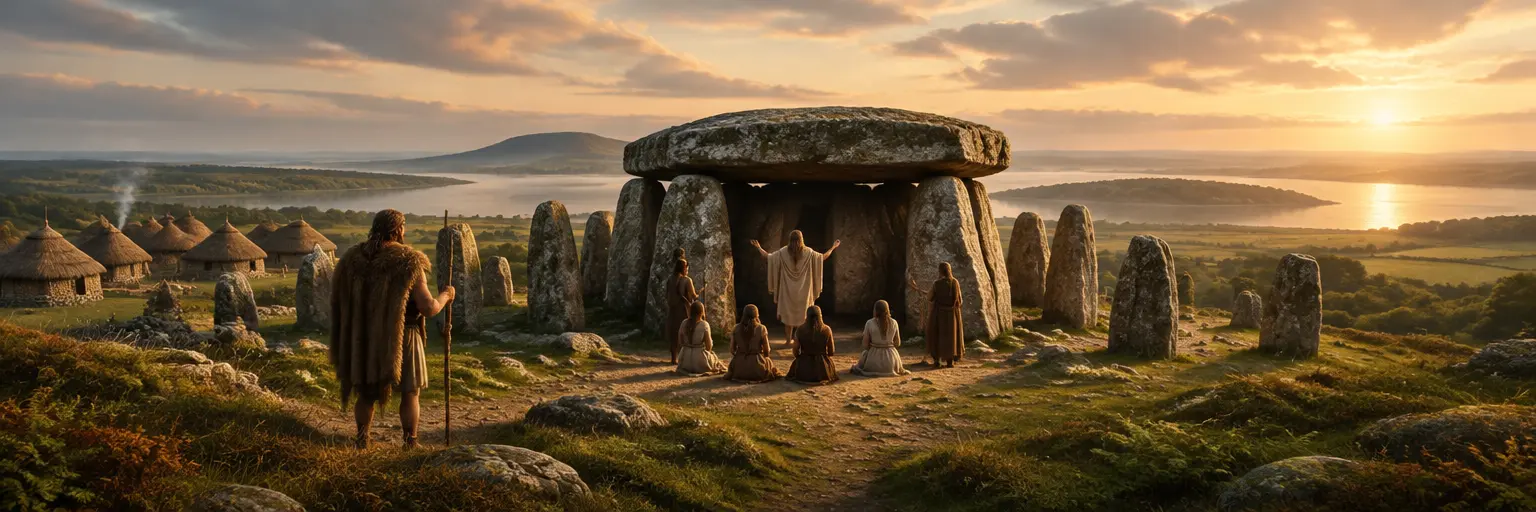
Neolithic megaliths—massive stone structures like dolmens, passage graves, and standing stones—first appeared around 4500 BCE along Europe’s Atlantic façade, from Portugal to Denmark. These monuments were not merely tombs but territorial markers, ancestral shrines, and astronomical observatories. Excavations at sites like Poulnabrone in Ireland reveal collective burials with grave goods, while isotopic analyses suggest that communities traveled long distances to participate in construction. Key insight: megalithic building likely emerged independently in several regions, then spread via maritime networks, symbolizing shared ritual identities across diverse ecological zones.
For SEO-focused readers, this section details the geological sourcing of stones (e.g., bluestones at Stonehenge from Wales), construction techniques such as corbelled roofs, and the social labor required to move multi-ton boulders. We also compare contemporary non-megalithic cultures in eastern Europe to highlight why monumental architecture became a pan-European phenomenon. By understanding these origins, you can trace how ritual practices solidified communal bonds, paving the way for later Bronze Age chiefdoms.
🌾 Ritual Landscapes & Causewayed Enclosures
Beyond megaliths, Neolithic Europe boasted vast ritual landscapes—causewayed enclosures, henges, and timber circles—designed for procession, feasting, and seasonal gatherings. Sites like Windmill Hill in England feature concentric ditches filled with animal bones, pottery, and flint tools, suggesting repeated ceremonial deposition. Dendrochronology at Irish wooden henges shows rebuilding every few decades, indicating cyclical renewal of cosmic order. Ritual centrality: these spaces often aligned with solstices or river confluences, connecting agricultural fertility to ancestral spirits.
This subcategory examines how enclosure ditches served as boundaries between domestic and wild spaces, with structured deposits of human skulls or polished axes indicating votive offerings. Through GIS mapping and residue analysis, we reconstruct processional routes and feasting practices, demonstrating that ritual was not separate from daily life but integral to managing surplus, conflict, and social alliances. For archaeologists, these findings challenge simplistic views of early farming communities as egalitarian, revealing nuanced power dynamics.
👥 Social Change & Emerging Hierarchies
Neolithic Europe witnessed profound social reorganization—from egalitarian band societies to ranked lineages controlling land, livestock, and ritual knowledge. Osteological studies of collective burials show differential health, diet, and trauma, hinting at status distinctions. At sites like Varna in Bulgaria, rich graves with gold artifacts alongside simple burials indicate early elites, while isotopic strontium data reveal female exogamy, linking alliances between regional groups. Social stratification: monumental construction likely required leaders who organized labor, stored surplus grain, and mediated with supernatural forces.
This section explores the role of domesticated animals as mobile wealth, the shift from circular to rectangular houses signaling patrilineal inheritance, and the emergence of specialized crafts like flint mining. We also discuss genetic evidence (ancient DNA) showing large-scale migrations, cultural mixing, and occasional replacement of populations—yet continuity in ritual sites suggests ideological persistence. By analyzing settlement patterns and burial rites, we decipher how inequality became institutionalized without writing or cities.
🔮 Symbolism, Cosmology & Art
Neolithic Europeans expressed complex cosmologies through portable art, rock carvings, and decorated pottery. Spiral motifs on Irish passage tombs (Newgrange), carved anthropomorphic figures from Malta, and clay figurines across the Balkans indicate shared symbolic vocabularies—snakes, suns, fertility goddesses, and ancestors. Symbolic power: these images often appeared only in ritual contexts, suggesting restricted knowledge controlled by emerging shamans or priestly classes. Acoustic studies in megalithic chambers reveal resonance effects (echoes, bone conduction) that may have induced altered states during ceremonies.
Here, we analyze pigment residues (ochre, cinnabar) on stones, the positioning of art relative to light movements (equinox alignments), and the widespread use of personal ornaments like disc beads. Through ethnographic analogy, we interpret motifs as mnemonic devices for oral traditions, perhaps encoding genealogies or seasonal cycles. For content creators and educators, this section offers rich visual descriptions and comparative tables linking regional styles, aiding visitor engagement with abstract archaeological theory.
📜 Regional Case Studies & Excavation Insights
To ground general trends, this subcategory presents in-depth case studies from key regions: the Orkney Islands’ Heart of Neolithic Orkney, the Carnac stones of Brittany, the Swedish rock art of Tanum, and the Cucuteni–Trypillia mega-settlements of Ukraine. Each case includes excavation diaries, stratigraphic diagrams, and artifact catalogs, showcasing modern techniques like LiDAR, microscopic use-wear analysis, and phytolith sampling. Practical application: these examples demonstrate how archaeologists infer ritual behavior from fragmentary evidence—e.g., deer antlers in ditches as tools versus offerings.
We also feature interviews with field directors and drone tours of ongoing digs, explaining how preservation challenges (peat, plowing, looting) are mitigated. For students, we provide chronological charts and glossary terms, while enthusiasts enjoy virtual reconstructions of processional routes. By comparing regional trajectories—e.g., why megalithism thrived in Atlantic but not Balkan zones—this section illuminates the diversity within Neolithic Europe, countering monolithic narratives.
Frequently Asked Questions
What is the difference between a megalith and a monolith?
A megalith is any large stone used in prehistoric construction, often forming part of a structure like a tomb or circle. A monolith is a single upright standing stone, often viewed as a type of megalith. Not all megaliths are monoliths; for example, a dolmen combines several megalithic slabs.
How did Neolithic people move and erect massive stones without machinery?
They likely used wooden sledges, rollers, ropes, and earthen ramps, with hundreds of laborers pulling in coordinated efforts. For upright stones, they dug pits, tilted stones using levers, and backfilled soil. Recent experiments, like those at Stonehenge, show feasible methods with known Neolithic technology.
Were all megaliths used for burial? If not, what else were they for?
No. While many passage graves served as collective burial places, others like standing stones or henges had no burial evidence. They likely functioned as territorial markers, astronomical calendars, ceremonial gathering sites, or ancestors’ shrines, sometimes with multiple uses over centuries.
How did Neolithic Europeans first adopt farming, and did it spread everywhere?
Farming arrived via two main routes: from Anatolia through the Balkans into central Europe (around 6000 BCE) and along the Mediterranean coast using seafaring. However, some regions like Scandinavia adopted farming later or blended it with hunting-gathering—a process called cultural diffusion versus migration based on ancient DNA evidence.
What role did women play in Neolithic ritual and social life?
Osteological and artifact evidence suggests women held varied roles, from household heads and potters to ritual specialists, particularly in figurine-rich cultures. Strontium isotope studies reveal that women often moved between communities upon marriage, creating kinship ties. However, leadership in monument-building likely remained male-dominated in many areas, though exceptions exist (e.g., high-status female burials in Iberia).