East Asian Civilizations: Shang Dynasty - Bronzes, Oracle Bones & Capitals
Welcome to ArchaeologyHub.org’s deep-dive into the Shang Dynasty (c. 1600–1046 BCE), China’s earliest historically verified civilization. This subcategory explores the material grandeur and ritual complexity of a society built on bronze metallurgy, divination, and urban power. From the colossal ritual vessels cast for ancestral worship to the cryptic oracle bones that record royal anxieties, we unpack how the Shang left an indelible mark on East Asian culture. Expect artifact analyses, site excavations, and capital-city blueprints that reveal a sophisticated, stratified world—one that continues to reshape our understanding of ancient statecraft.
🏺 Mastery of Shang Bronze Casting: Ritual Vessels & Power
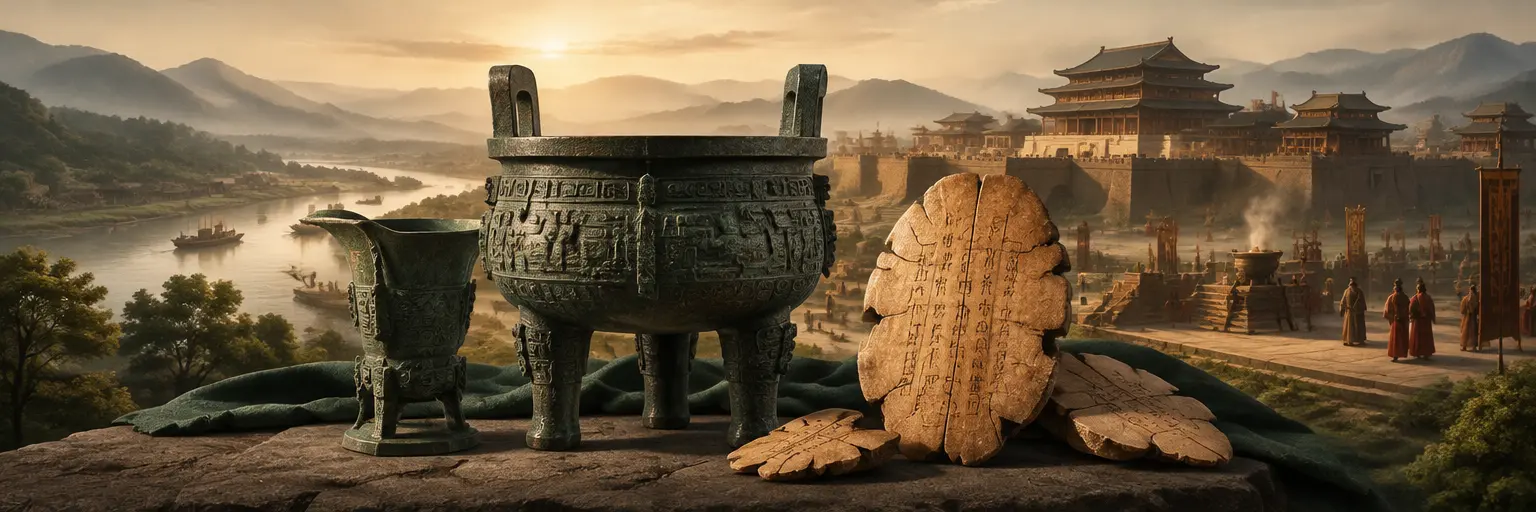
Shang bronzes are not merely art; they are political and religious statements. The piece-mold casting technique allowed craftsmen to produce intricate ding tripods, gu beakers, and you vessels, often decorated with taotie masks and dragon motifs. These objects were buried in elite tombs or used in ancestral rites, cementing the king’s role as intermediary between the living and the dead. For SEO-focused readers, expect detailed descriptions of alloy ratios (copper-tin-lead), mold fragments from Anyang’s workshops, and how bronze hoards reveal trade networks.
Our content highlights specific excavations, such as the Fu Hao tomb’s 468 bronze objects, proving female military leaders wielded immense ritual authority. You will also learn how inscriptions on bronzes—often 20–50 characters—provide historical records unmatched by later texts. We compare Shang casting with contemporary cultures, showing why their vessels reached a technical peak that later dynasties emulated. Whether you are a student, collector, or enthusiast, this section decodes how metal shaped governance and identity in the Yellow River basin.
🔮 Oracle Bones: Decoding the Earliest Chinese Writing
Oracle bones—ox scapulae and turtle plastrons—are the Rosetta Stone of ancient China. Priests applied heat to cracked bones, then transcribed queries to ancestors or deities regarding weather, harvests, warfare, and royal health. The resulting jiaguwen script, with over 4,000 identified characters, is a direct ancestor of modern Chinese. Our subcategory offers step-by-step guides on reading bone preparation, crack interpretation, and how royal archivists standardized script over centuries. We also analyze the Zhouyuan discoveries that shifted the timeline of writing’s spread.
Expect interactive timelines linking specific inscriptions to historical events, such as a recorded solar eclipse in 1179 BCE. We dive into the social implications: only the king or his diviners could “read” the gods’ replies, centralizing authority. For archaeology professionals, we detail residue analysis that confirms these bones were also used for record-keeping, not just divination. This section balances tactile artifact study with philological insights, ensuring you grasp why these fragments are the backbone of Shang historiography and a cornerstone of East Asian linguistic archaeology.
🏛️ Capital Cities: Anyang, Zhengzhou & the Urban Blueprint
The Shang shifted capitals—archaeologists now count at least six—but the pinnacle was Anyang (Yinxu), the “Ruins of Yin,” excavated since 1928. We map the city’s layout: palace-temple complexes, royal cemeteries, craft quarters, and residential wards, all enclosed by rammed-earth walls (at Zhengzhou, walls span 7 km). Our content explains how water management via moats and wells shaped settlement, and why Huan River proximity was strategic for defense and agriculture. Compare with earlier Erlitou culture to see the evolution of urban planning.
Dive into new geophysical surveys that reveal underground streets and bronze foundries, previously hidden from aerial photography. We discuss the Haojia tomb clusters and the mass sacrifice pits that suggest ritualized violence at capitals, reinforcing royal hegemony. For travelers, we provide virtual tours of reconstructed gates and rammed-earth sections. This subcategory ensures you understand that Shang capitals were not just seats of power but experimental laboratories for urbanization—patterns echoed in later Chinese dynasties and across modern East Asian city design.
⚱️ Artifact Profiles: Tombs, Ritual & Daily Life
Beyond bronzes, Shang material culture includes jade carvings, ceramics, bone tools, and chariots with horses, uncovered in elite burials. We profile the Fu Hao tomb in depth—the only royal tomb left intact—revealing 1,928 grave goods, including ivory goblets and turquoise-inlaid ornaments. Our artifact pages use high-resolution 3D models and metadata (dimensions, material, excavation site) to aid researchers. We also compare elite vs. commoner graves, showing status gaps through ceramic types and burial pits.
Learn about non-royal production: how standard pottery used fast wheels, and how clay molds for bronzes were reused, indicating centralized workshops. We include forensic analyses of human sacrifices, differentiating prisoners of war from voluntary retainers, based on isotopic diets. This section is designed for those who prefer object-led history, offering "artifact of the week" features and scholarly bibliographies. Every profile cross-links to geological sourcing (e.g., turquoise from Hubei), proving long-distance exchange networks that connected the Shang to the wider ancient world.
🗺️ Excavation Histories & Modern Research Methods
The Shang’s discovery is a saga of scientific progress. From the 1928 Academia Sinica expeditions that ended a period of tomb looting to modern stratigraphic digs using flotation for plant remains, we narrate how fieldwork evolved. We highlight key archaeologists—Li Ji, Dong Zuobin, and current teams from the Institute of Archaeology, CASS—who transformed our understanding. Expect a timeline of major findings: the 1976 Fu Hao tomb, the 1999 Huayuanzhang oracle bone corpus, and 2020s Liujiazhuang chariot pits.
Our content addresses ethical debates: reburial of excavated human remains, repatriation discourse, and community engagement. We explain remote sensing techniques like magnetometry to detect pit outlines, and isotopic analyses that trace lead in bronzes to specific mines. For students, we provide methodological guides to dating (e.g., radiocarbon combined with typology) and how DNA studies on pig bones reveal domestication practices. This section bridges archaeology and heritage science, ensuring you appreciate the Shang’s ongoing relevance in contemporary research—and why its preservation matters.
Frequently Asked Questions
What is the most famous Shang bronze artifact?
The Houmuwu Ding (also called Simuwu Ding) is arguably the most iconic. Weighing over 832 kilograms, it was cast during the reign of King Wen Ding and discovered in 1939 near Anyang. Its massive scale proves advanced casting logistics, but its inscription dedicates it to his mother, showcasing filial piety’s political value. Today, it resides in the National Museum of China.
How do oracle bones help date the Shang Dynasty?
Oracle bones contain records of royal divinations, often mentioning specific kings, wars, and astronomical events. By cross-referencing a recorded lunar eclipse or planetary alignment with modern astronomical calculations, scholars can anchor reigns to absolute dates. This method, combined with radiocarbon dating, places the dynasty’s end around 1046 BCE, though debates continue over the start date.
Were all Shang capitals located at Anyang?
No. The dynasty is known for moving capitals, with at least six identified, including Zhengzhou, Yanshi, and Huanbei. Anyang, however, served as the final and longest-lasting capital (about 255 years) and is the richest archaeological site. Early capitals were smaller, but all showed similar rammed-earth walls and palace structures, reflecting a shared political model.
Did the Shang engage in human sacrifice?
Yes, evidence is extensive. Royal burials often included human retainers, sacrificial victims, and animal offerings. At Anyang, sacrificial pits with decapitated skeletons suggest ritual killings, likely for ancestral rites or upon a king’s death. Estimates suggest thousands died this way, but the practice was not universal—it was reserved for high-status events.
Can I see Shang artifacts outside China?
Absolutely. Major collections include the Asian Art Museum in San Francisco, the British Museum in London, and the Musée Guimet in Paris. However, the finest pieces remain in Chinese institutions like the Anyang Museum and the Palace Museum in Beijing. For virtual access, ArchaeologyHub.org links to high-resolution scans and 360-degree galleries.