East Asian Civilizations: Prehistoric Japan - Jomon & Yayoi Periods
Dive deep into the dawn of Japanese civilization at ArchaeologyHub.org, where we unravel the transformative journey from the Paleolithic to the agrarian state. This subcategory offers a granular, artifact-driven examination of the Jomon (c. 14,000–300 BCE) and Yayoi (c. 300 BCE–300 CE) periods, focusing on material culture, subsistence strategies, and social complexity. Whether you are a student, enthusiast, or researcher, our interpretive analyses—backed by the latest excavation data and chronological models—provide a definitive resource for understanding how prehistoric Japan evolved from hunter-gatherer bands to stratified, rice-producing societies.
🏺 Jomon Ceramics & Early Pottery Traditions
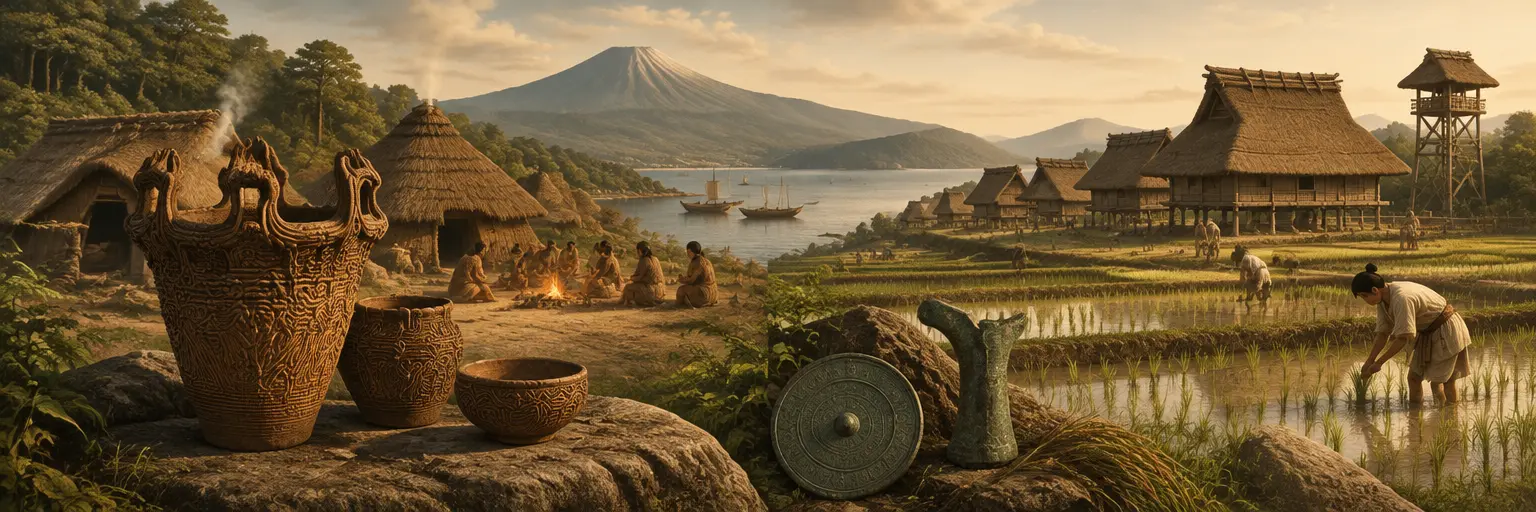
The Jomon period boasts some of the world’s earliest pottery, with the oldest shards dating to around 14,000 BCE. Our subcategory details the stylistic evolution from flat-bottomed jars of the Incipient phase to the ornate, flame-style vessels of the Middle Jomon. We explore how cord-marking techniques—the very namesake "Jomon"—were applied and how these ceramics served not only for cooking and storage but also for ritual and burial practices.
You will find artifact profiles with high-resolution imagery, chemical fingerprinting of clay sources, and thermoluminescence dating results. Key excavation sites like Sannai Maruyama and Aoyakamijichi are dissected to show how pottery production scaled with sedentism. Expect to learn how regional variations in vessel forms reflect environmental adaptations, from coastal fishing communities to inland nut-foraging groups, and how these innovations laid the groundwork for later cultural complexity.
🌾 Yayoi Agriculture & Rice Paddy Society
The Yayoi period marks a revolutionary shift with the introduction of wet-rice agriculture, metalworking, and social stratification. Our coverage traces the arrival of these practices from the Korean Peninsula, using both archaeological evidence and paleobotanical analysis. We examine the construction of paddy fields, irrigation systems, and the development of storage granaries that enabled surplus accumulation and population growth.
Discover how settlement patterns transformed from small pit-dwelling clusters to large moated villages, such as the famous Yoshinogari site. Key innovations include bronze and iron tools, which we analyze through typological studies and metallurgical assays. We also interpret burial mounds—including jar coffins and bronze mirror accompaniments—to reconstruct emerging chieftain hierarchies, offering a clear picture of how resource control and inter-village warfare shaped the political landscape of prehistoric Japan.
🗿 Ritual Landscapes & Shamanic Practices
Both Jomon and Yayoi cultures erected complex ritual sites, from stone circles and shell mounds to elevated ceremonial platforms. This section explores the spiritual worldview of prehistoric peoples, using excavated figurines (dogū), clay masks, and phallic stones as primary evidence. We interpret these artifacts through the lens of animistic beliefs, fertility rites, and ancestor veneration, contextualizing them within the broader Austronesian and Altaic cultural spheres.
Learn how ritual landscapes were intentionally aligned with solar solstices and lunar cycles, as evidenced by the Chūsei site’s stone arrangements. We also cover the role of shamans, who likely mediated between human and spirit realms, as inferred from grave goods and distinctive burial postures. Comparative analysis with contemporaneous cultures across East Asia illuminates shared cosmological frameworks, while our interpretive essays challenge older diffusionist theories, proposing indigenous innovation blended with continental influences.
⚒️ Lithic Technology & Subsistence Economy
From chipped stone arrowheads to polished stone axes, tool technology underpinned survival and adaptation. Our subcategory presents a systematic typology of Jomon and Yayoi lithic assemblages, including projectile points, scrapers, and grinding stones. We explore raw material procurement networks, emphasizing the use of obsidian from sources like Honshu’s Hoshino site, and trace trade routes via X-ray fluorescence analysis.
Subsistence strategies are reconstructed using zooarchaeology and archaeobotany—examining faunal remains (deer, boar, fish) and floral evidence (nuts, millet, rice). We discuss seasonal mobility patterns, storage practices, and the calorie budgets of prehistoric diets. Experimental archaeology is highlighted, where modern flintknappers replicate ancient techniques to test functional hypotheses, giving you a tangible sense of how daily life was sustained across millennia of environmental change.
📜 Chronology & Regional Chronology Debates
Establishing precise timelines is crucial for understanding cultural interactions. This section provides an up-to-date synthesis of radiocarbon dating, dendrochronology, and tephrochronology (volcanic ash layers) that anchor the Jomon-Yayoi transition. We critically examine the controversial "overlap hypothesis" suggesting a longer coexistence of the two cultures, using Bayesian statistical modeling of published dates.
Regional variations are charted across Kyushu, Honshu, and Hokkaido, showing how ecological zones influenced cultural trajectories. Key debates include the timing of rice’s introduction and the pace of social stratification. Our interpretive essays also address the "Yayoi migration" question, evaluating genetic and linguistic evidence alongside archaeology to present a balanced picture of population replacement versus acculturation. By engaging with these scholarly controversies, you’ll gain a nuanced appreciation of how prehistoric chronologies are constructed and refined.
Frequently Asked Questions
What are the main differences between Jomon and Yayoi pottery?
Jomon pottery is typically hand-formed, cord-marked, and often highly decorative, with deep, flame-like rims, reflecting a hunter-gatherer aesthetic. Yayoi pottery is simpler, thinner, and more uniform, usually undecorated with a reddish-brown color, produced using more controlled firing techniques. This shift mirrors the functional needs of settled rice farmers for large storage and cooking vessels.
How did the Yayoi people introduce rice farming to Japan?
Wet-rice agriculture arrived from the Korean Peninsula around 900 BCE, likely through a combination of small-scale migration and cultural diffusion. Archaeobotanical evidence shows rice phytoliths in Kyushu paddies before spreading eastward. The Yayoi adopted and adapted Korean irrigation techniques, constructing dikes and channels, which allowed surplus yields and supported population growth and social elites.
Were there significant cultural contacts between Jomon and Yayoi peoples?
Yes, rather than a sudden replacement, recent studies suggest a prolonged overlap with cultural exchange. Radiocarbon dates indicate Jomon communities persisted in northern Honshu and Hokkaido for centuries after Yayoi culture emerged in the south. Artifacts show trade goods like jade and obsidian moving between them, while some Yayoi sites contain Jomon-style pottery, indicating coexistence and intermarriage.
What are some key archaeological sites to visit for these periods?
For the Jomon, visit Sannai Maruyama in Aomori (c. 3900–2900 BCE), a UNESCO World Heritage site with large pit dwellings and storage pits. For the Yayoi, the Yoshinogari Historical Park in Saga Prefecture features reconstructed moated settlements, watchtowers, and burial mounds. Both offer immersive museum exhibits with original artifacts from ongoing excavations.
How do archaeologists date the Jomon-Yayoi transition accurately?
They combine radiocarbon dating of wood charcoal, charred food remains, and rice grains with Bayesian statistical analysis to narrow date ranges. Tephrochronology from volcanic eruptions like the Kikai-Akahoya (7,300 BP) provides absolute markers. Recent accelerator mass spectrometry (AMS) dates on short-lived samples have pushed the Yayoi start earlier, around 1000 BCE, refining our timeline.