Exploring Central Asian & Steppe Cultures: Sogdian Art, Religion & Diaspora at ArchaeologyHub.org
Welcome to our deep-dive into the fascinating world of the Sogdians, the Silk Road’s most influential merchants, artists, and spiritual conduits. At ArchaeologyHub.org, this subcategory within "Civilizations & Cultures (Detailed Studies)" unravels the intricate tapestry of Sogdian civilization—from their vibrant wall paintings at Panjakent to their Zoroastrian, Buddhist, Manichaean, and Nestorian practices. Here, you’ll discover how a people from the Zeravshan Valley forged a cultural diaspora stretching from Samarkand to Chang’an, shaping art and religion across Central Asia and beyond. Prepare to explore archaeological finds, textual evidence, and the lingering echoes of their steppe legacy.
🏛️ Sogdian Art: Iconography, Murals, and Material Culture
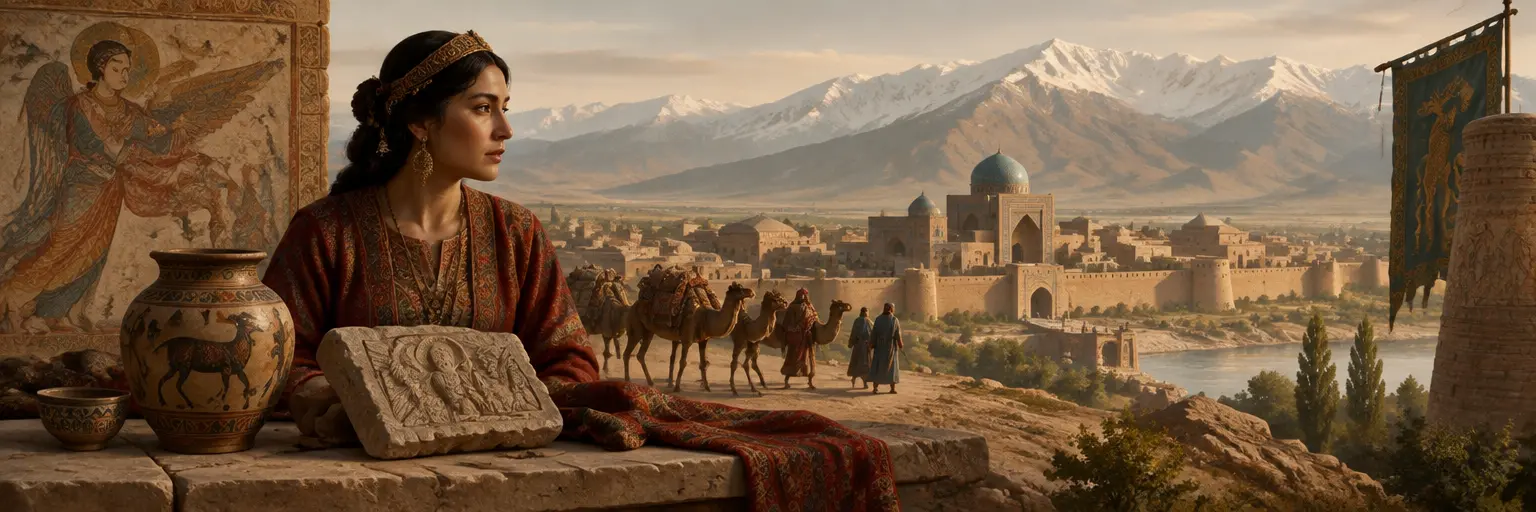
This section focuses on the visual vocabulary of the Sogdians, richest in mural cycles from sites like Panjakent, Varakhsha, and Afrasiab. You’ll learn about their unique blend of Persian, Indian, and Chinese motifs, evident in elaborate banquets, hunting scenes, and processions. We examine the famous Ambassadors’ Painting at Afrasiab, revealing diplomatic networks, plus silverware, textiles, and ossuary carvings that show cultural synthesis.
Our archaeological profiles highlight how Sogdian artists used local clay, mineral pigments, and gilding to create layered narratives. The art often served religious and political propaganda, with figures dressed in gendered steppe fashions—tight caftans and patterned trousers for men, flowing dresses for women. You’ll also explore how trade brought Byzantine coins, Indian ivory, and Chinese silk into their workshops, producing hybrid objects. Expect high-resolution images, condition reports, and conservation notes for key artifacts.
🕉️ Religious Syncretism: Zoroastrianism, Buddhism, Manichaeism & More
Sogdians were religious chameleons, absorbing and transmitting faiths as they traveled. This segment details their indigenous Zoroastrian practices—fire temples, exposure burials, and the cult of Sraosha—while showing how Buddhism took root in their homeland along with Manichaean communities. We present epigraphic evidence from Mount Mugh and Turfan that reveals prayers, rituals, and clerical structures.
You’ll discover how Sogdian religious art adapted to local doctrines: Avalokiteśvara becomes a Sogdian protector deity, while Mani’s teachings are visualized in colorful book illustrations. Their funerary customs, from lidded ossuaries at Samarkand to hypo-gea in China, demonstrate a pragmatic blend of steppe, Iranian, and Indian beliefs. Our interpretive essays use archaeological context to show how these interactions fueled theological creativity, influencing later Turkic and Uyghur religious systems.
🌍 The Sogdian Diaspora: Trade Networks, Settlements, and Identity
Here, we map the Sogdian diaspora across the Silk Road, from their urban heartlands to distant colonies in Dunhuang, Turfan, and even northern China’s capitals. You’ll investigate how they established caravanserais, inns, and merchant guilds, controlling the exchange of silk, glass, and slaves. Our case studies include the Sogdian Ancient Letters and the tomb of An Jia in Xi’an, showing social integration without assimilation.
This section emphasizes archaeological markers: distinct ceramic styles, Sogdian-language contracts, and burial designs that retain Central Asian identity abroad. You’ll learn about their political autonomous quarters, such as the Sogdian suburb of Chang’an, and their role as cultural brokers in diplomatic missions. Through settlement excavation reports and DNA/isotope analyses, we reconstruct kinship, migration patterns, and multilingual daily life, revealing a tightly knit yet adaptive network that influenced Turkic mercantile empires.
⚔️ Sogdian Interaction with Steppe Nomads: Image and Influence
This facet examines the dynamic relationship between Sogdian urbanites and the nomadic Turkic and Hephthalite steppe societies around them. Their partnership is documented in Rouran and later Göktürk inscriptions, where Sogdian scribes handled diplomacy and taxation. You’ll explore archaeological evidence from the Bykovo cemetery and Sogdian-style coins minted with Turkic tamgas, illustrating political compromise.
Our articles reveal how Sogdian culture influenced nomad elite display—adopting silk robes, pavilions, and hunting gear—while reciprocally, steppe weaponry and horse gear infiltrated Sogdian military practice. Ritual aspects include the adoption of Turkic sky-burial practices in some Sogdian communities. By analyzing burial goods and petroglyphs, we show a symbiotic economy: nomads supplied horses and safe passage; Sogdians provided exotic market goods and literacy. This exchange becomes a model for understanding frontier transculturation.
🏺 Excavation Highlights: Panjakent, Afrasiab, and Surkhan Darya
Final core section spotlights major Soviet and modern excavations, offering virtual field journals. We dissect the stratified layers of Panjakent, a Sogdian city destroyed by Arabs in 722 CE, with its two-to-three-story houses, wooden carvings, and advanced irrigation. Learn about the discovery of the Sogdian language documents at Mount Mugh, a fortress treasury that rewrote history.
We also present the Afrasiab excavations, showing how a site’s geomorphology can be read through aerial LiDAR and magnetometry. At Surkhan Darya, newer digs uncovered a Zoroastrian temple complex with fire altars, ceramic vessels for haoma rituals, and seal impressions. Our reopening of these reports includes artifact inventories, radiocarbon dates, and interpretative debates, plus a comparison with Central Asian museology. Expect actionable data if you’re an advanced student or researcher aiming for synthesis.
Frequently Asked Questions
What is the primary source for Sogdian religion besides archaeology?
The Sogdian Ancient Letters and the Mount Mugh documents, both manuscript corpora, provide direct religious evidence—prayers, contracts, and letters—revealing Zoroastrian, Buddhist, and Christian practices. These are complemented by later travel accounts from Chinese pilgrims like Xuanzang.
How did Sogdians influence Chinese art?
Sogdian artists introduced new iconographies, such as double-headed eagles, grape motifs, and specific dance styles like the Sogdian whirl, visible in Tang ceramics and murals. Their fashions, particularly embroidered caftans, became adopted by Tang elites, seen in tomb figurines.
Why did Sogdian settlements decline?
Arab conquests after 712 CE disrupted core trade routes and imposed Islamic rule, causing many urban centers to shrink. Meanwhile, the rise of maritime Silk Road routes and political fragmentation further marginalized the Sogdian land corridor, though their diaspora communities persisted in China until the 10th century.
What is a unique Sogdian burial practice?
They widely used ossuaries—ceramic or stone boxes for cleaned bones—following Zoroastrian exposure rituals. These were often decorated with astral imagery or door motifs, reinforcing the idea of passage to the afterlife, a practice found across their diaspora.
Are there any modern DNA studies of Sogdians?
Yes, ancient DNA from Sogdian-era burials in Xinjiang and Turkmenistan shows mixed Iranian, East Asian, and steppe ancestry. This supports historical texts about intermarriage and admixture, with Y-lineages indicating complex patrilineal flows from both sedentary and nomadic groups.