Exploring the Archaic Period: The Birth of the Polis and Greek Expansion
Welcome to ArchaeologyHub.org’s detailed study of the Ancient Greece: Archaic Period (c. 800–480 BCE), a transformative era when fragmented tribal communities coalesced into the polis (city-state) and when ambitious seafarers scattered Greek culture across the Mediterranean and Black Sea. This subcategory offers a scholarly yet accessible excavation of political innovation, colonial networks, and material culture. Here, you will uncover how urbanization, law codes, and overseas trade reshaped the ancient world, laying the groundwork for Classical brilliance.
🏛️ The Rise of the Polis: Urban Centers and Political Identity
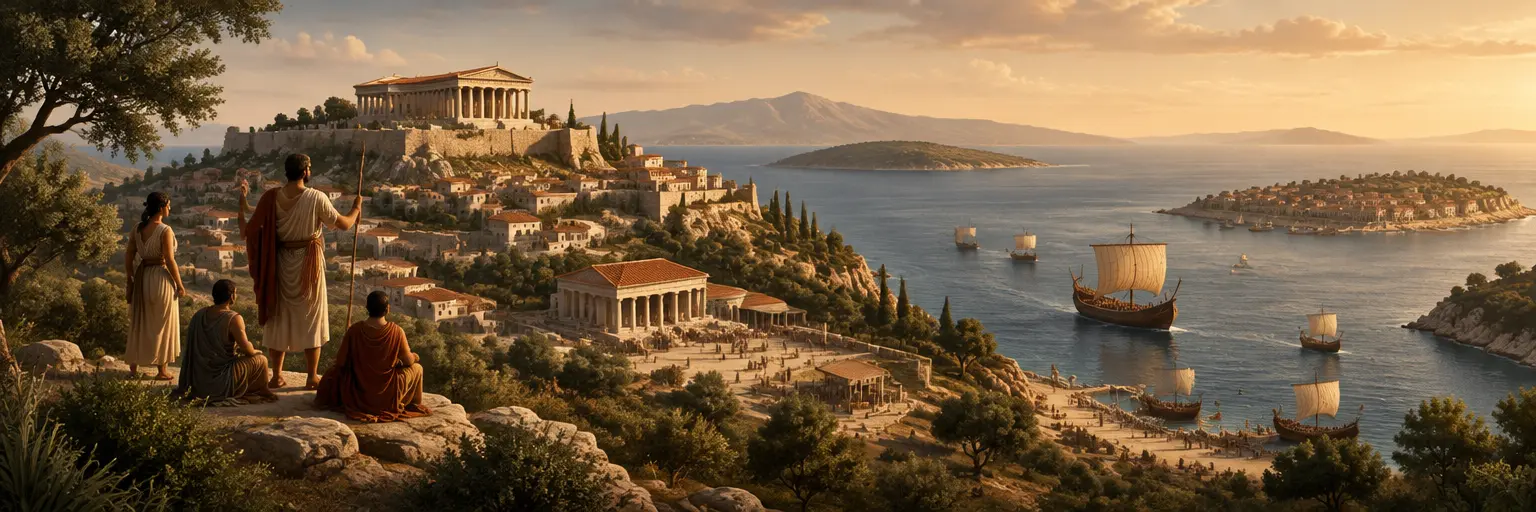
Dive into the architectural and social anatomy of the early city-state. From the acropolis to the agora, you will explore how synoecism—the merging of villages—created centralized governments, fortified citadels, and public spaces. Expect analysis of temple construction, such as the early Heraion of Samos, and how civic cults forged a shared identity among citizens.
This section also dissects the emergence of hoplite warfare and its link to political rights, as well as the varied constitutions—from oligarchy to early tyranny. Through pottery, inscriptions, and sanctuary remains, you’ll see how the polis became the defining unit of Greek life, influencing everything from law (Draco, Solon) to theater and philosophy.
⛵ Colonization Waves: Trade, Overpopulation, and Diaspora
Understand why between 750 and 550 BCE, Greeks founded over 500 colonies, including Syracuse, Massalia (Marseille), and Byzantion. This section examines push factors—land scarcity and political strife—and pull factors like fertile soil and trade routes. You will analyze settlement patterns through imported pottery, coinage, and burial goods, revealing how apoikiai (colonies) maintained ties to mother cities.
Expect a deep dive into emporia (trading posts) in Egypt and the Levant, where Greek goods met Phoenician and Lydian influences. The result is a nuanced view of cultural exchange, from alphabet adoption to artistic Orientalizing styles, proving colonization was not just expansion but a complex network of mobility and identity negotiation.
⚖️ Lawgivers, Tyrants, and the Birth of Citizen Rights
This part profiles legendary figures like Lycurgus of Sparta, Solon of Athens, and early tyrants such as Cypselus of Corinth. You will explore how written law codes replaced aristocratic whim, evidenced in fragments like the Gortyn Code. This was an era of social ferment, where stasis (civil strife) led to reforms that redefined citizenship based on property, not birth.
Here, archaeology meets political theory via inscriptions on stone stelae and public buildings. Expect to compare Sparta’s militaristic agoge with Athens’ proto-democratic measures, understanding how tyranny often paved the way for broader participation. This section reveals the fragile balance between individual ambition and collective governance—a legacy that still echoes in modern political systems.
🏺 Material Culture: Pottery, Sculpture, and Sanctuaries
Unpack the artistic revolution of the Archaic period, from Geometric to Orientalizing and black-figure pottery. You will learn to “read” vessel shapes and painted scenes—mythological, funerary, and daily life—as primary evidence for social values. Key sites like the Potters’ Quarter in Athens and the Panathenaic amphorae are dissected to show production, trade, and iconographic shifts.
Beyond pottery, this section covers early kouros and kore statues, reflecting ideals of youth, piety, and aristocratic display. Sanctuaries like Delphi and Olympia are analyzed as centers of competitive dedication, where bronze tripods and treasuries showcased civic pride. This material lens helps reconstruct the sensory world of Archaic Greeks—their gods, dead, and living aspirations—through artifact profiles and site reports.
🌍 Regional Variations: Athens, Sparta, Corinth, and Ionia
Compare the distinct paths of major and minor city-states, highlighting how geography shaped governance and culture. Athens grew through trade and early democracy, Sparta through military conquest and helotage, Corinth through luxury goods and colonization, and Ionia through intellectual ferment. Each regional case study uses excavation data to illustrate unique trajectories.
Expect detailed profiles of lesser-known poleis like Megara, Eretria, and Miletus, showing that the Archaic world was a mosaic of experimentation. From urban planning grids in Smyrna to the acropolis of Argos, this section emphasizes that there was no single “Greek” model—only shared language and religion. This comparative approach enriches your understanding of how local identities coexisted with pan-Hellenic ties.
Frequently Asked Questions
What caused the start of the Archaic Period?
The Archaic Period began around 800 BCE following the Greek Dark Ages, marked by population growth, renewed contact with the Near East, and the rediscovery of writing. The end of isolation led to the formation of the first poleis and the re-emergence of monumental architecture, setting the stage for colonization and political reorganization.
How did colonization affect mainland Greece?
Colonization relieved land pressure and social tensions, as disenfranchised aristocrats or surplus populations founded new settlements. It also stimulated trade, introducing new resources like grain, metals, and slaves back to the mainland. This influx of wealth helped finance temple building and supported the rise of a merchant class, eventually challenging aristocratic dominance.
What is the difference between a polis and a colony?
A polis is an independent city-state with its own government, territory, and laws, typically consisting of a central urban area and surrounding countryside. A colony (apoikia) was a separate, self-governing settlement founded by one or more mother cities, but it maintained religious and cultural ties, often honoring its founders through rituals.
Why are tyrants important in Archaic Greece?
Tyrants, who often rose from elite factions or discontented classes, seized power without hereditary right but frequently implemented popular reforms. They broke aristocratic monopolies on justice, built public works, and encouraged trade and the arts. Their rule paved the way for wider political participation, even though many were eventually overthrown or turned hereditary.
What archaeological evidence best shows Archaic Greek life?
The most revealing evidence includes pottery (for trade, rituals, and daily activity), temple foundations (for religion and civic finance), and cemetery goods (for social status). Inscriptions on law codes, treaties, and dedications offer direct textual insights. Additionally, settlement layouts and fortifications demonstrate urban planning and defense priorities, creating a holistic picture of Archaic society.