Economic Policies of Gupta Rulers: Fostering Prosperity and Stability
🌟 The Gupta rulers' economic policies were pivotal in fostering prosperity and stability, laying the foundation for a golden age of cultural…
Read article
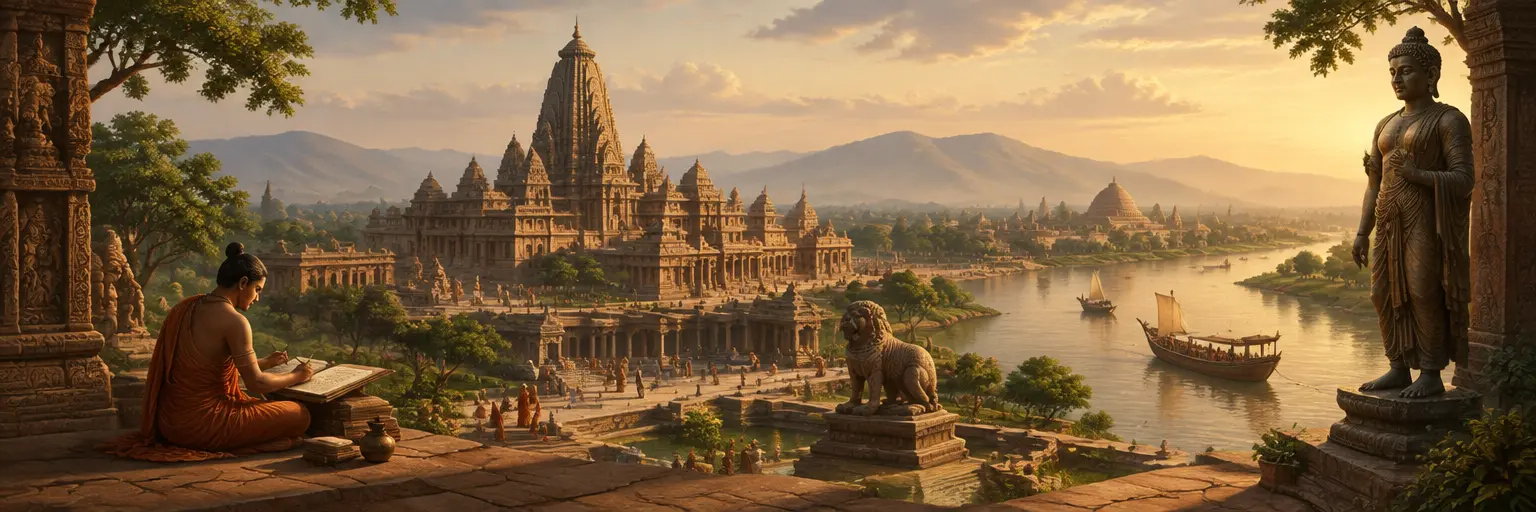
The Gupta Empire (c. 320–550 CE) stands as the unrivaled Golden Age of India, a period when art, science, mathematics, and literature flourished under enlightened rulers like Chandragupta II and Samudragupta. At ArchaeologyHub.org, this era is celebrated for its monumental contributions—from the invention of the decimal system and the concept of zero by brilliant scholars like Aryabhata to the sublime frescoes of Ajanta and the iron pillar of Delhi that defies rust. This dynasty transformed the subcontinent through stable governance, thriving trade networks, and a renaissance in Sanskrit poetry and drama. For archaeologists and history enthusiasts alike, the Gupta era offers a treasure trove of numismatic evidence, temple architecture, and urban planning that reveals a sophisticated society balancing spiritual depth with worldly innovation. Explore our detailed studies to uncover how this civilization’s legacy subtly shapes modern science, philosophy, and cultural identity across South Asia.
🌟 The Gupta rulers' economic policies were pivotal in fostering prosperity and stability, laying the foundation for a golden age of cultural…
Read article
🌟 Explore how Gupta era public welfare initiatives are evidenced through inscriptions and archaeological findings, revealing the empire's commitment to infrastructure, social…
Read articleDive into the resplendent era of the Gupta Empire, often hailed as the Golden Age of India—a period from roughly 320 to 550 CE when art, science, mathematics, and literature flourished under enlightened rulers. On ArchaeologyHub.org, this subcategory serves as your scholarly gateway to understanding how the Gupta dynasty transformed the Indian subcontinent into a beacon of intellectual and cultural achievement. Explore excavated cities, numismatic evidence, and temple architecture that reveal a sophisticated society whose innovations shaped the world for centuries.
Begin with the archaeological and epigraphic evidence tracing the Gupta ascendancy, from Chandragupta I’s consolidation in Magadha to Samudragupta’s expansive conquests documented in the Allahabad Pillar Inscription. You will learn how strategic marriages, coinage standardization, and administrative reforms—uncovered through fieldwork at sites like Pataliputra—cemented a dynasty that controlled much of northern India.
Excavations at Kaushambi and Sarnath provide material proof of Gupta governance, including fortified capitals and trade networks. Key finds such as the gold dinaras and clay seals highlight a centralized yet flexible rule, while contemporary chronicles from Chinese pilgrims like Faxian offer an external lens on social order. Expect detailed analysis of royal genealogies, land grant charters, and the fiscal policies that underpinned this golden age.
This section uncovers the Gupta contributions to astronomy, mathematics, and medicine through archaeological artifacts and manuscripts, though many texts survive only in later copies. You will discover how Aryabhata’s works, possibly compiled at Nalanda, introduced concepts like zero, decimal notation, and solar calculations—revolutionary ideas that radiated outward to the Islamic world and Europe.
Terracotta seals and inscribed copper plates from excavations at Bhita and Vaishali reveal practical applications of geometry in land measurement and construction. Numerical systems found on temple inscriptions demonstrate a robust mathematical culture. Additionally, archaeological evidence of surgical instruments and herbal remedies from sites like Taxila (a later tradition) shows an advanced medical understanding. This content critically evaluates which intellectual achievements can be attributed to the Gupta period versus earlier eras.
Marvel at the aesthetic pinnacles of Gupta art, as preserved in the murals of Ajanta Caves, the elegant Buddhas of Sarnath, and the structural temples at Deogarh and Bhitargaon. This subtopic focuses on stylistic evolution—from the softer, refined faces of Gupta-era sculptures to the first major stone-built Hindu temples in India, which you’ll examine through high-resolution imagery and 3D reconstruction models.
Artifacts such as intricately carved terracotta plaques and bronze figurines, excavated from sites like Ahichchhatra, illustrate daily life, religious iconography, and royal patronage. Iconographic innovations, including the introspective gaze of Buddhist images and the organic ornamentation of Vishnu temples, are analyzed for symbolism. You’ll also understand how trade with the Roman world influenced Gupta art, evidenced by motifs in ivory and imported luxury goods.
Unearth the economic prosperity of the Gupta Empire through its flourishing urban centers, monetized exchanges, and long-distance trade routes connecting India to the Mediterranean, Southeast Asia, and China. Archaeological layers at Mathura and Ujjain reveal planned streets, drainage systems, and market complexes stocked with imported pottery, glass, and spices, indicating a vibrant mercantile society.
Numismatic studies are central here: Gupta gold coins, depicting kings in martial or ceremonial poses, provide clues to imperial ideology and wealth. Punch-marked silver coins and cowrie shells served lower-value transactions, reflecting a multi-tiered economy. Additionally, harvest-dependent rural settlements, explored at Atranjikhera, show agrarian surplus fueling towns. This section also addresses the role of guilds, craft production centers, and maritime archaeology at ports like Bharuch.
Examine the dynamic religious landscape where Hinduism, Buddhism, and Jainism coexisted and evolved under Gupta sponsorship. Major sites like Sanchi and Mathura provide evidence of continuous Buddhist worship, while the construction of Hindu temples and the rise of Puranic cults, particularly Vaishnavism and Shaivism, are documented through inscriptions and iconographical surveys.
This subtopic highlights how royal patronage shaped worship practices—Samudragupta’s Ashvamedha sacrifices versus later Buddhist endowments. Literary renaissance in Sanskrit, from Kalidasa’s plays to the Panchatantra, is partly preserved in manuscript evidence from monastic libraries. Also, explore Gupta-era pilgrimage networks and the archaeology of religious festivals, using excavated ritual deposits and votive offerings to reconstruct devotional habits across society.
The Gupta period (c. 320-550 CE) is termed the Golden Age due to unprecedented achievements in mathematics (invention of zero), astronomy, literature (Kalidasa), and art (Ajanta murals). Politically stable and prosperous, the empire fostered intellectual freedom, evidenced by trade wealth and monumental temple architecture, setting a cultural benchmark for subsequent Indian civilizations.
Key sites include Pataliputra (ancient capital, now Patna), Sarnath (Buddhist sculptures), Deogarh (Dashavatara Temple), and Ajanta Caves (murals and monastic halls). Excavations at Mathura and Kaushambi have yielded coins, seals, and pottery, while Bhitargaon’s brick temple exemplifies early structural engineering. These locations provide material culture that anchors historical texts.
Gupta mathematicians, especially Aryabhata, developed the decimal system, concept of zero as a placeholder, and approximations of pi. This numeral system, transmitted via Arabic scholars, revolutionized computation globally, replacing cumbersome Roman numerals. Astronomical models of planetary motion also laid groundwork for later Islamic and European science, demonstrating a profound intellectual export.
Archaeological finds include Roman gold coins in south Indian hoards, Mediterranean amphorae, and Chinese silk fragments at Gupta sites. Maritime ports like Bharuch exported spices, textiles, and ivory, while overland Silk Road routes carried goods through Taxila and Kashmir. Literary and epigraphic references to seafaring merchants corroborate an extensive interconnected world economy.
Unlike the Mauryas’ state Buddhism, Guptas practiced balanced tolerance, patronizing Hinduism for legitimacy (ashvamedha rituals) while funding Buddhist monasteries and Jain temples. This syncretic approach reduced sectarian conflict, allowing religious pluralism. Their support of Sanskrit classics and temple construction also shifted devotional focus toward bhakti movements, shaping Hinduism’s medieval evolution.







