Later Australian Prehistory: Technology & Art
Delve into the transformative eras of Australia’s deep past, where innovation in stone tools, maritime adaptation, and symbolic expression reshaped human lifeways long before European contact. This subcategory on ArchaeologyHub.org dissects the technological ingenuity and artistic flowering of Aboriginal societies from the terminal Pleistocene through the Holocene, linking material culture to environmental shifts, social complexity, and enduring cultural landscapes.
🔨 Lithic Innovation & Tool Assemblages
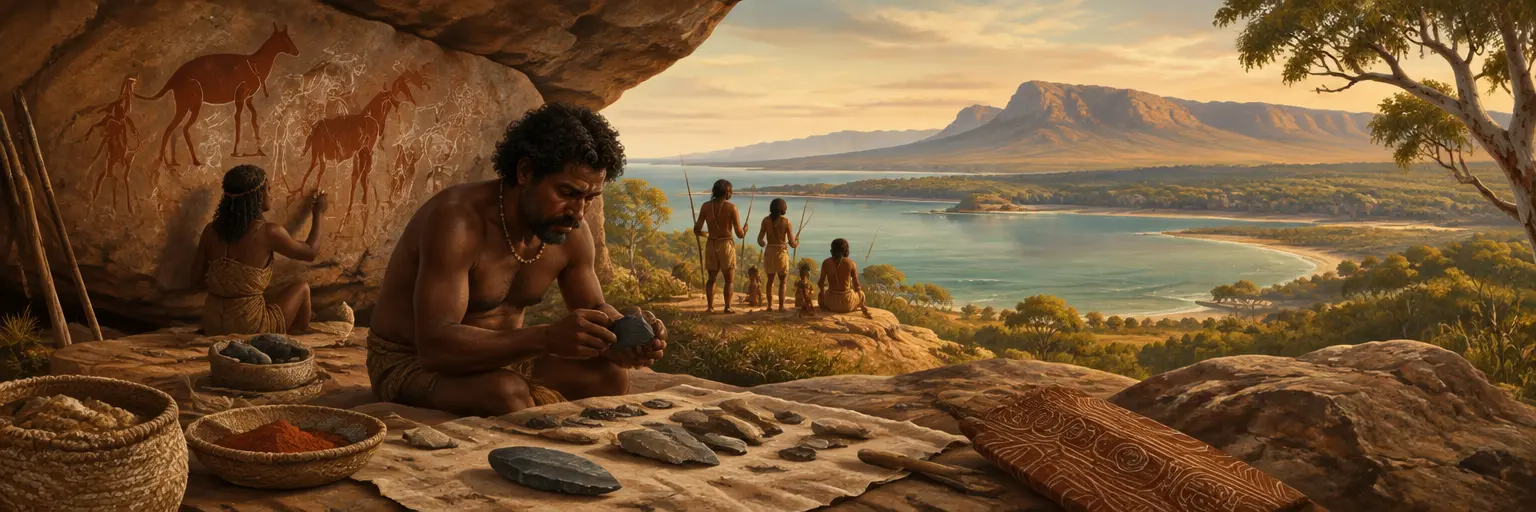
Australian lithic technology evolved from core-and-flake industries to regionally distinct backed blades, points, and ground-edge axes. The appearance of backed microliths around 5,000–3,000 BP signals a major adaptation to changing climates and resource use, often linked to hafted composite tools. Ground-edge axes, appearing earlier in northern Australia (c. 35,000 BP), demonstrate independent innovation in woodworking and forest clearance. Stone raw material selection—from silcrete to quartz—reflects sophisticated knowledge of outcrops, seasonal mobility, and trade networks spanning hundreds of kilometres.
Archaeologists interpret changing tool kits alongside faunal remains and charcoal sequences to infer shifts in hunting strategies, plant processing, and fire management. The small tool tradition contrasts with earlier large scrapers and horsehoof cores, suggesting not simply functional change but possibly new social identities and ceremonial exchange. Detailed use-wear analysis reveals that many tools served multiple purposes—from butchering kangaroos to shaping wooden spears and digging sticks. Such analyses provide a window into daily life, seasonal camps, and the intellectual frameworks that guided stone technology for over 50,000 years.
🎨 Rock Art Chronologies & Symbolic Worlds
Australia holds one of the world’s longest continuous rock art traditions, with sites like Kimberley’s Gwion Gwion and Arnhem Land’s Dynamic Figures dating potentially to 15,000–20,000 BP. Styles shifted from naturalistic animals to anthropomorphic figures, geometric motifs, and X-ray art of recent millennia. The Panaramitee style—featuring dots, circles, and tracks—appears widely across arid regions, suggesting shared symbolic vocabularies over vast distances. Pigments include red and yellow ochre, charcoal, and white kaolin, each sourced from specific quarries with ritual significance.
Chronometric dating via uranium-series on calcite crusts and optically stimulated luminescence on sediments has revolutionised rock art chronology, overturning earlier assumptions of shallow antiquity. Art is not mere decoration; it encodes ancestral narratives, territorial boundaries, and ecological knowledge, such as depictions of extinct megafauna and changing sea levels. Ethnoarchaeological studies among contemporary Aboriginal communities reveal that rock art sites are active locales for initiation, rainmaking, and sorcery. Thus, technology and art intertwine—pigment grinding tools, ochre processing, and scaffolding techniques are all part of a complex technical system embedded in social practice.
🛶 Maritime Technology & Coastal Adaptations
Later Australian prehistory showcases remarkable maritime ingenuity, particularly after sea levels stabilised around 6,000 BP. Bark canoes and dugout canoes (introduced in northern regions) enabled offshore fishing, turtle hunting, and island colonisation, as evidenced by sea-level archaeological sites on islands like Kangaroo Island and the Torres Strait. Coastal middens reveal complex harvesting of shellfish, fish, and marine mammals, with fish traps built from stone weirs still visible in Queensland and New South Wales. The manufacture of shell fishhooks (c. 1,000 BP) demonstrates specialised craft knowledge, possibly driven by gendered labour and trade.
Technological choices reflect environmental knowledge—such as using paperbark for canoe caulking and resin from spinifex for hafting. Seasonal mobility along coastlines corresponded with monsoon rhythms and fish spawning cycles. Recent studies of archaeological fish remains indicate selective fishing and the management of aquatic resources, challenging earlier narratives of passive foraging. Maritime technology also facilitated long-distance exchange of obsidian (from Papua New Guinea) and pearlshell, linking Australian communities to wider Pacific networks. These adaptations demonstrate that later Australian societies were not isolated but dynamic participants in regional exchange and innovation.
🏺 Ceramics, Fibre & Organic Technologies
While pottery was largely absent in mainland Australia until colonial contact, ceramic industries appeared in Torres Strait and Cape York around 2,000 BP, reflecting Melanesian influence. More prevalent were sophisticated fibre technologies: woven bags, nets, and baskets made from plant fibres, animal sinew, and human hair. These artefacts, preserved in dry caves and swamps, reveal complex knotting, twining, and looping techniques. Ground-edge hatchets with wooden handles, spear-throwers (woomera), and boomerangs—both returning and non-returning—show deft woodworking, often decorated with incised geometric patterns and ochre paint.
Organic materials like animal skins for cloaks and water containers, gum for adhesive, and bone for needles and points broaden our understanding of technological repertoires. Fire-making using the fire drill and fire-stick farming—the deliberate burning of vegetation—was a landscape-scale technology shaping ecosystems for millennia. These technologies are not inferior to metallurgy; they are highly adapted, lightweight, and repairable with local materials. Archaeologists increasingly study use-wear on wooden artefacts and residue analysis to reconstruct manufacturing sequences. The absence of pottery, once seen as a “lack”, is now interpreted as an informed choice favouring mobility and low-cost storage in a variable environment.
🗿 Ornamentation, Body Art & Meaning Systems
Technological skill extended to personal adornment: shell beads from Mandu Mandu Rockshelter (c. 30,000 BP) and ochre crayons from Carpenter’s Gap demonstrate early symbolic behaviour. Later, tooth avulsion, scarification, and body painting with ochre patterns were complex social signals. Cicatrices (raised scars) encoded age, clan, and marital status. Feather ornaments, nose pegs, and headbands made from possum fur and plant fibres were traded across long distances. These artefacts, though rarely preserved, are known through ethnographic analogy and rare wet-site finds.
Art and ornamentation are intertwined with technology—ochre grinding stones, shell scrapers for polishing, and bone awls for piercing. Rock engravings (petroglyphs) on coastal platforms and inland ridges align with astronomical events, water sources, and dreaming tracks. The Wadi Wadi and Mungo Lady burials, with red ochre and grave goods, highlight ceremonial technologies. Tjurunga—sacred wooden or stone objects—are intricately carved with abstract motifs, used in rituals to transmit knowledge. Thus, technology is not merely utilitarian; it is a carrier of memory, law, and cosmology, linking past and present Aboriginal identities to place and ancestry.
Frequently Asked Questions
What is the earliest evidence of ground-edge axes in Australia?
The earliest ground-edge axes are from Nawarla Gabarnmang in Arnhem Land, dated to ~35,000–40,000 BP. These tools were made from basalt, shaped by grinding on sandstone, and are among the oldest in the world. Their presence suggests early sophisticated woodworking, likely for making canoes, spears, or clearing vegetation.
How do archaeologists date rock art in Australia?
Archaeologists use three main methods: uranium-series dating of calcium carbonate crusts that form over pigments, optically stimulated luminescence on quartz grains in associated sediments, and radiocarbon dating of charcoal pigments or organic binders. Relative dating uses superimposition and style changes, informed by ethnographic records and early European contact imagery.
Did Aboriginal Australians have pottery before European contact?
Mainland Aboriginal communities generally did not produce pottery, likely due to high mobility and preference for lightweight containers. However, ceramic sherds appeared in the Torres Strait Islands and Cape York around 1,500–2,000 years ago, linked to Melanesian influences. Most water and food storage used bark containers, woven bags, and skins instead.
What is the “small tool tradition” and when did it appear?
The “small tool tradition” refers to the appearance of backed blades, points, and microliths starting around 6,000–5,000 BP. These small, often heat-treated stone implements were set into handles or spears using resin. Their spread across Australia suggests increased regional exchange, new hunting techniques, and possibly social shifts toward more complex ceremonial exchange networks.
How did maritime technology differ between northern and southern Australia?
Northern Australia had access to dugout canoes from Indonesian contact and used bark canoes for river and coastal travel, supporting trade with Torres Strait. Southern Australia relied on simpler bark canoes and rafts, but employed sophisticated fish traps and shell hooks for deeper fishing. These differences reflect ecology, available timbers, and cultural influences.