Oceanian & Australian Prehistory: Early Human Occupation of Australia & Megafauna
Dive into the deep archaeological record of the world’s oldest living continent. This subcategory on ArchaeologyHub.org unearths the dramatic story of the first humans to reach Sahul (the Pleistocene landmass of Australia and New Guinea), their survival strategies, and their fateful encounters with the continent’s giant megafauna. Explore rigorous timelines, excavation evidence from sites like Madjedbebe and Lake Mungo, and cutting-edge paleoenvironmental reconstructions that explain how a unique island ecosystem was transformed.
🦴 First Arrivals: The Great Coastal and Inland Migrations
Uncover the latest evidence shaping the debate on when humans first set foot in Australia. Recent dating at Madjedbebe in Arnhem Land pushes occupation back to at least 65,000 years, challenging older models of a later 50,000-year arrival. Here, you’ll find detailed artifact profiles—from ground-edge axes to ochre crayons—that illustrate sophisticated maritime technology and rapid inland dispersal along ancient river corridors. These findings reframe Australia not as the end of a journey, but as a thriving early frontier of human adaptation.
Expect detailed analyses of stone tool reduction sequences and shell middens that reveal seasonal coastal foraging. We compare genetic data from Aboriginal DNA with archaeological stratigraphy to clarify the route taken by those first mariners—whether via Timor or the northern Sahul shelf. For educators and enthusiasts, this section provides an accessible yet rigorous chronological framework, including animated maps of coastline changes during lowered sea levels. This content is essential for understanding the deep time of Indigenous Australian history.
🐘 Megafauna Encounters: Hunters, Climate, or Both?
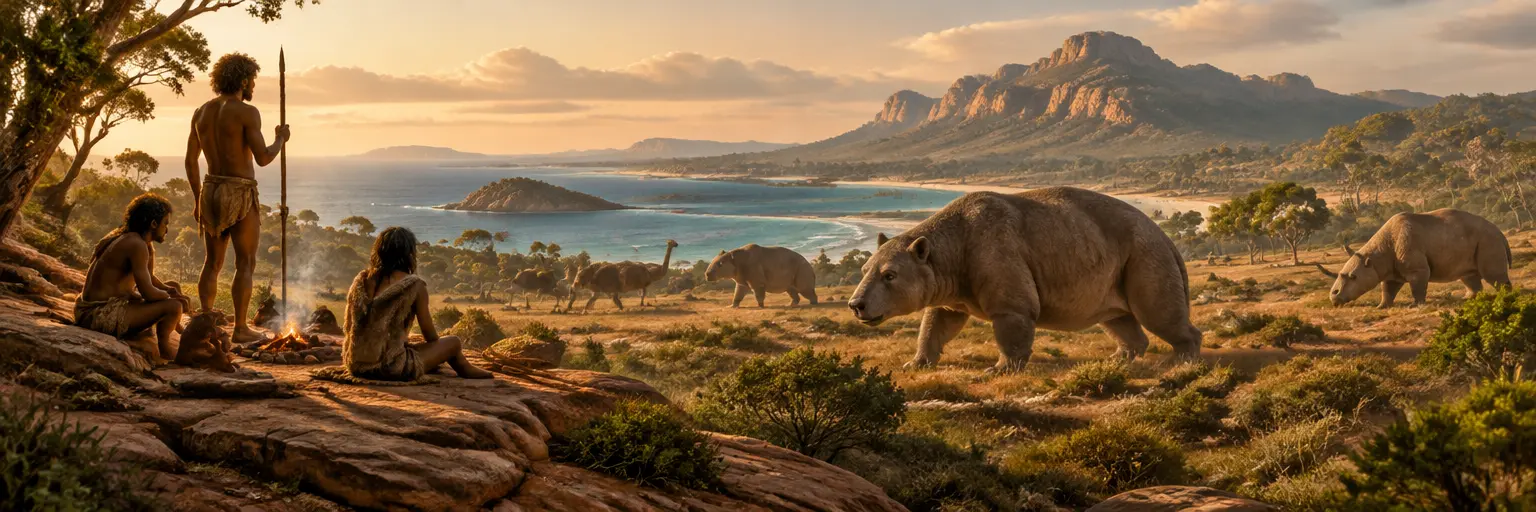
Explore the great extinction debate that fuels modern archaeological discourse: did early humans drive Australia’s giant marsupials and reptiles to extinction? Species like Diprotodon optatum, the rhino-sized wombat, and Megalania prisca, a six-metre monitor lizard, vanished roughly 40,000 years ago. Here, we dissect the evidence of direct hunting—cut marks on bones, exploitation of carcasses—versus climate-driven habitat loss. The site of Cuddie Springs provides rare, controversial evidence of apparent butchery, sparking heated academic exchange we present impartially.
Discover the role of firestick farming in reshaping vegetation, which may have starved these giants. We profile each megafauna species with fossil images, estimated body mass, and known distributions. By examining pollen cores and charcoal records alongside bone deposits, you’ll gain a holistic view of a catastrophic landscape change. This section is a prime example of interdisciplinary archaeology, linking paleontology, ecology, and human behavior to answer one of prehistory’s biggest whodunits.
🏜️ Iconic Sites: Lake Mungo and the Willandra Lakes
Focus on the UNESCO World Heritage Willandra Lakes Region, home to the oldest known human remains in Australia—the Mungo Man and Mungo Lady. These 42,000-year-old bones, ritually buried and adorned with ochre, stand as global landmarks for the study of early ceremonial behavior. We detail the geological formation of lunettes (dune ridges) that preserved countless artifacts and hearths, offering a stratified record of 50,000 years of human adaptation to fluctuating lake levels. This is archaeology at its most cinematic.
This section provides virtual stratigraphic logs and dating methodologies, including OSL (Optically Stimulated Luminescence) and radiocarbon calibration. You’ll learn how the discovery of Mungo Lady in 1968 rewrote theories of human evolution and cultural complexity. We also include ethnoarchaeological comparisons with modern Aboriginal communities to interpret burial practices and stone arrangements. Perfect for those seeking a case-study deep dive into a world-renowned archaeological site.
🪓 Technology & Adaptation: Rewriting Survival Skills
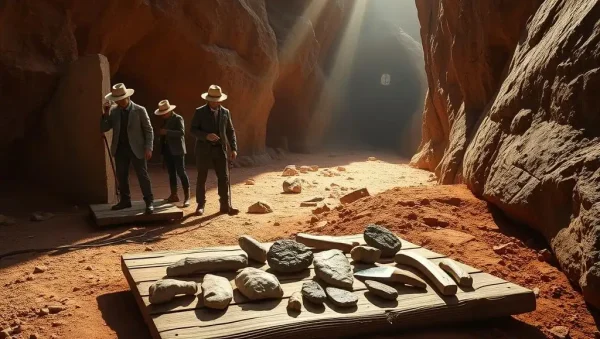
Examine the fascinating toolkit that enabled early Australians to thrive in harsh, variable environments. Key technologies include the backed blades and microliths of the mid-Holocene, the development of the woomera (spear-thrower), and the world’s earliest evidence of edge-ground hatchets (found at Madjedbebe) predating similar tools in Europe by millennia. Here, we analyze raw material sourcing, trade networks that moved stone over thousands of kilometers, and the specialized fish traps and weirs that indicate complex social organization.
We also highlight rock art as a technological and cultural artifact—from the Bradshaw (Gwion) figures to Kimberley relief carvings—that illustrate evolving perception and storytelling. Detailed replicas and flintknapping guides let you understand tool function through experimental archaeology. This content helps you see past the shells and bones to the minds that engineered survival in a land of drought and plenty, offering a nuanced perspective on innovation independent of Eurasian influences.
🌊 Sahul and the Great Barrier Coastlines
Travel back to a time when lower sea levels exposed vast plains linking Australia, New Guinea, and Tasmania—the continent of Sahul. This section reconstructs those submerged landscapes using marine geophysical surveys and bathymetric mapping. We present evidence of human occupation on the now-drowned continental shelf, including stone tools dredged from the Gulf of Carpentaria and shell middens on raised terraces. Understanding these coastal zones is critical, as they likely served as the primary pathways of initial colonization.
We compare settlement patterns across different bio-regions—from tropical rainforests of northern Queensland to arid deserts of the interior—showing how humans adapted to each ecosystem’s unique resources. Discussions on island migrations to places like Timor and the Solomons round out the picture of a highly mobile seafaring culture. This integrative chapter allows you to visualize Australia’s palaeogeography and its role as both a bridge and a barrier to human expansion.
Frequently Asked Questions
How old is the earliest evidence of humans in Australia?
The oldest confirmed archaeological site is Madjedbebe in Arnhem Land, with dates of approximately 65,000 years ago. This is based on optically stimulated luminescence (OSL) dating of sediment layers containing stone tools and ochre. Earlier claims of 80,000+ years from other sites remain contested. Overall, the consensus points to maritime arrival between 50,000 and 65,000 years ago.
Did humans wipe out all Australian megafauna?
Not all, but evidence strongly implicates human activity, possibly combined with climate change. Species like diprotodonts and giant kangaroos went extinct around 40,000 years ago, shortly after human arrival. While direct hunting evidence is scarce, habitat alteration via fire and prey competition likely disrupted ecosystems. Some smaller megafauna survived until the last ice age. The debate continues, with sites like Cuddie Springs offering controversial overlap.
What is Lake Mungo’s significance in prehistory?
Lake Mungo, part of the Willandra Lakes, contains the world’s oldest human cremation (Mungo Lady, ~42,000 years ago) and one of the oldest ritual burials (Mungo Man) with ochre. These remains demonstrate advanced symbolic behavior, including complex funeral practices. The site also provides a continuous 50,000-year environmental and archaeological record through its layered lunette dunes.
What tools did early Australians use that were unique?
Early Australians pioneered the edge-ground axe, a hatchet with a sharpened polished stone head, used at least 65,000 years ago—far earlier than in Europe. They also developed the woomera (spear-thrower) for extra velocity, sophisticated fish traps, and tula adzes for woodworking. Their backed microliths appear earlier than similar technologies in Africa or Europe, showing independent innovation.
How did sea level changes affect migration to Australia?
During glacial periods, sea levels fell up to 120 meters, exposing the Sahul shelf, which connected Australia to New Guinea and Tasmania. This reduced crossing distances from Asia to around 90 kilometers, enabling successful maritime crossings. Major rivers and extensive coastlines on the shelf provided lush corridors for rapid inland migration. The post-glacial sea rise then drowned these routes, isolating Australia about 8,000 years ago.