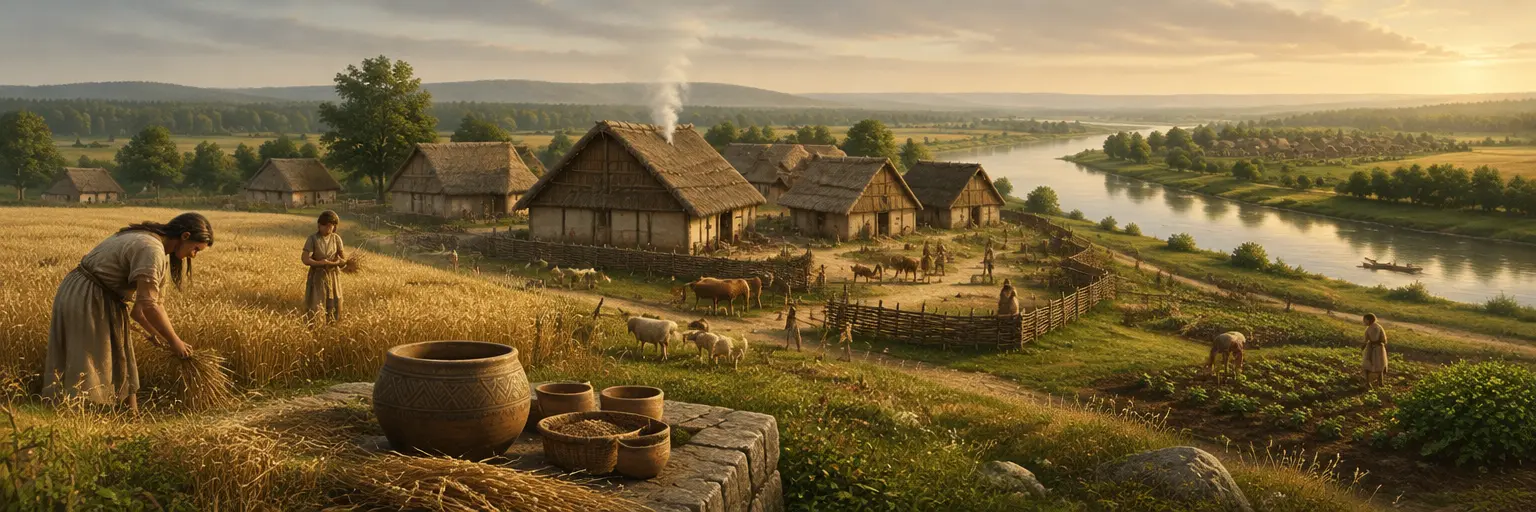
European Prehistory: Neolithic Europe - Farming, LBK & Early Settlements
Welcome to ArchaeologyHub.org’s deep dive into Neolithic Europe, a transformative era when hunter-gatherer lifestyles gave way to farming, permanent villages, and complex social structures. This subcategory focuses on the revolutionary shift from 7000 to 3000 BCE, with a special emphasis on the Linear Pottery Culture (LBK), early agricultural practices, and the emergence of settled life across the continent. Here, you’ll find rich, evidence-based content designed to satisfy both casual readers and serious archaeology enthusiasts.
🌾 Origins of Farming in Europe: The Neolithic Revolution
The transition to agriculture, often called the Neolithic Revolution, did not happen overnight. It began in the Fertile Crescent and spread westward through Anatolia into Southeast Europe around 7000 BCE. Early farmers introduced domesticated wheat, barley, cattle, sheep, and goats, fundamentally altering human diets and settlement patterns. This page explores the diffusion routes—both maritime and overland—and the genetic evidence showing how migrating farmers mixed with indigenous hunter-gatherers.
Readers can expect detailed timelines of crop and animal domestication, site-by-site evidence from early farming villages like Nea Nikomedeia in Greece and Sesklo, and discussions on how farming changed social organization. We also examine the environmental impact, including deforestation and soil erosion, which set the stage for later Bronze Age societies. Use our curated maps and artifact profiles to trace the spread of barley, emmer wheat, and flint sickle blades across the continent.
🏺 The Linear Pottery Culture (LBK): Europe’s First Farmers
The LBK culture (Linearbandkeramik), named for its distinctive banded pottery decoration, flourished between 5500 and 4500 BCE across Central Europe—from the Danube to the Rhine. This subcategory provides a comprehensive analysis of LBK settlements, which were often longhouses built from timber and daub, arranged in small hamlets. We highlight key sites like Vráble in Slovakia and Langweiler in Germany, showcasing their layout, storage pits, and burial practices.
Expect detailed artifact galleries, including shoe-last adzes, antler combs, and clay figurines, alongside interpretations of LBK spirituality and social hierarchy. We also address the LBK expansion paradox: how a relatively peaceful farming culture rapidly spread 1,500 km in under three centuries, possibly through pioneering groups and land availability. Learn about the first signs of violence and communal defense, as evidenced by mass graves at Talheim and Schletz, which challenge the romantic image of early farming life.
🏘️ Architecture and Settlement Layouts in Early Neolithic Europe
Neolithic architecture is a cornerstone of understanding early social structures. This section examines the evolution from simple pit dwellings to substantial longhouses that served as residential, storage, and ceremonial spaces. In LBK settlements, longhouses could reach 30-50 meters in length, oriented toward the sun, with internal partitions for humans and livestock. We compare regional variations, from Balkan tells (mounded settlements) to Swiss pile dwellings and Mediterranean courtyard houses.
Readers will gain insights into building materials, construction techniques, and the symbolic meaning of house orientation and size. We provide 3D reconstruction visuals and floor plans, plus a comparative analysis of how settlement density changed over time. Posts also cover the “Neolithic house as ancestor” concept, where houses were deliberately burned or abandoned to mark lineage, as seen in sites like Oslonki in Poland. This section is ideal for students of prehistoric architecture and social archaeology.
🌿 Subsistence Strategies: Crops, Livestock, and Seasonal Cycles
A deep dive into Neolithic diets reveals a complex interplay between farming and foraging. While domesticated crops like einkorn, emmer, and peas formed the staple calorie base, early European farmers also relied heavily on wild fruits, nuts, and game. This page details the development of slash-and-burn agriculture, crop rotation, and the use of cattle for meat, milk, and traction. You’ll find isotope analyses from human bones that illuminate individual diets and mobility patterns.
Expect practical explanations of early farming tools—from wooden ard plows to flint hoes—and the seasonal calendar of sowing and harvesting. We also discuss the role of dairying and the genetic mutation for lactase persistence, which appeared later. Evidence from dung beetles and pollen cores shows how Neolithic people managed their environments. This subcategory is perfect for those interested in archaeobotany and zooarchaeology, with downloadable data sets from key sites like Goseck and Ripoli.
⚰️ Burial Practices, Rituals, and Early Neolithic Beliefs
Death and ritual in Neolithic Europe are of paramount importance for understanding worldviews. This section explores varied burial customs, from single inhumations under house floors to communal ossuaries and crouched burials with grave goods. In LBK communities, bodies were often positioned on their sides with legs flexed, accompanied by pottery, shell beads, and stone axes. We analyze the Talheim massacre and other violent events, contrasting them with peaceful burials that suggest ancestor veneration.
Readers can explore detailed case studies of ritual sites, including the Goseck circle enclosure and the Strettweg cult wagon. We also cover the emergence of megalithic tombs in the later Neolithic, such as dolmens and long barrows, and their connection to territorial claims and lineage. This content integrates iconography, such as the “Venus” figurines and spiral motifs, with ethnographic analogies to interpret early spiritual life. Ideal for those fascinated by prehistoric religion and social memory.
Frequently Asked Questions
What is the LBK culture and why is it important?
The Linear Pottery Culture, or LBK, emerged around 5500 BCE in Central Europe and represents the first major farming communities north of the Alps. It is crucial because it showcases how agriculture spread rapidly from the Balkans into temperate Europe, introducing longhouse architecture, pottery, and domesticated plants and animals, thereby laying the foundation for later European societies.
How did the first farmers in Europe impact the environment?
Early farmers caused significant deforestation through slash-and-burn techniques to create fields, which increased soil erosion and altered local wildlife. They also introduced invasive species like domesticated cattle and weeds. Pollen records show a marked decline in forests and an increase in grasses, indicating a human-driven shift that permanently changed the landscape and biodiversity.
Were Neolithic Europeans peaceful or warlike?
Evidence is mixed. Many LBK settlements were unfortified and show little violent trauma, suggesting peaceful trade networks. However, mass graves like Talheim and Schletz contain individuals killed by blunt-force trauma and arrow wounds, indicating periods of conflict, possibly over land or resources. Thus, Neolithic life included both cooperative farming and episodic warfare.
What tools did Neolithic Europeans use for farming?
They used polished stone axes for clearing, wooden digging sticks and antler hoes for planting, and flint-bladed sickles with wooden handles for harvesting. The bow and arrow were used for hunting, while animal bones were shaped into tools like spades and scrapers. Later, the ard, a simple plough, was pulled by cattle to prepare larger fields.
How did people live in Neolithic settlements?
Neolithic people lived in multi-family longhouses with separate areas for sleeping, cooking, and storing crops. They bred cattle, pigs, sheep, and goats, and cultivated grains and peas. Settlements were often occupied for several generations, with houses rebuilt or extended. They made pottery for storage, weaving, and basketry, and traded for flint, seashells, and exotic stones.