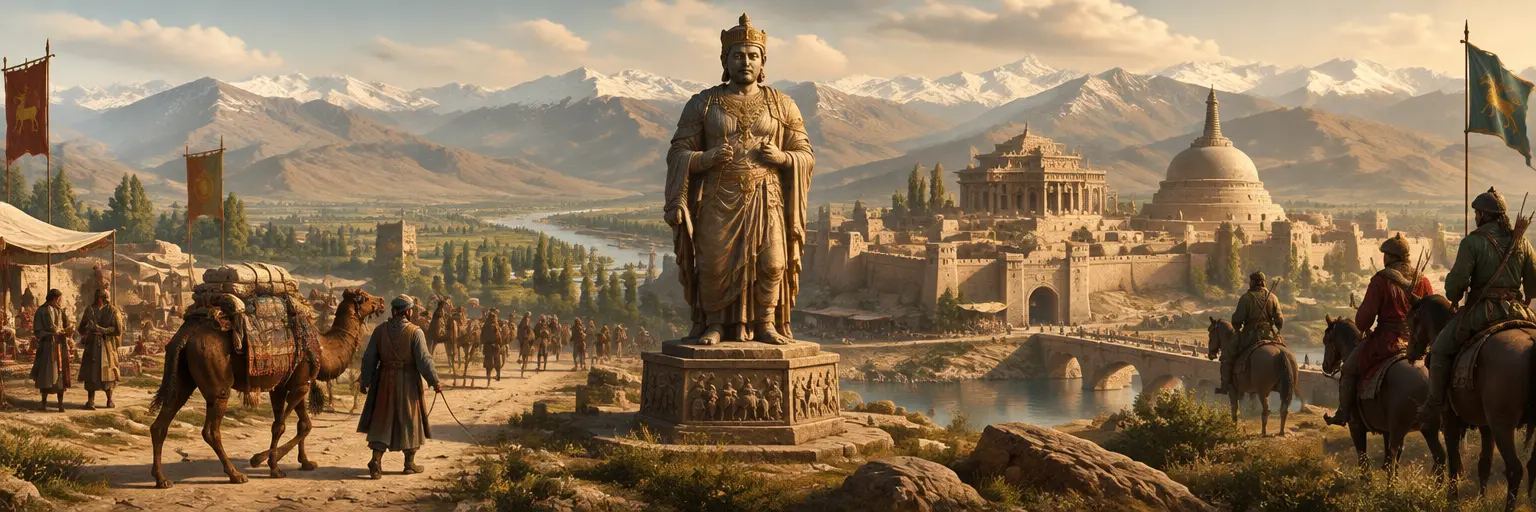
Central Asian & Steppe Cultures: Kushan Empire – Crossroads of Eurasia
Welcome to ArchaeologyHub.org’s deep dive into the Kushan Empire, a powerful yet often overlooked civilization that bridged the nomadic steppe and the sedentary worlds of China, India, and Rome. This subcategory uncovers how a Central Asian dynasty forged a unique cultural and commercial hub, leaving behind coins, monasteries, and art that still puzzle historians. Explore artifacts, trade routes, and religious syncretism that defined this ancient powerhouse.
🏛️ The Rise of a Steppe Superpower
Discover how the Yuezhi nomads transformed from pastoralists into the rulers of a vast empire stretching from the Aral Sea to the Ganges. Our articles detail the military campaigns and political marriages that cemented Kushan dominance, with a focus on Kanishka I’s expansion and the empire’s strategic capital at Mathura and Peshawar. Expect timelines, map reconstructions, and analysis of primary sources like the Rabatak inscription.
This section is essential for understanding how a nomadic confederation adapted to administer a multi-ethnic realm. We break down the empire’s administrative divisions, tribute systems, and road networks that enabled rapid troop movement and tax collection. Learn how the Kushans leveraged their steppe heritage—horse-riding, archery, and clan loyalty—to overcome regional rivals, while adopting settled bureaucracies to sustain their new urban centers. Historical context from Han Chinese chronicles and Roman trade records enriches every narrative.
🪙 Coinage & Economy: The Kushan Monetary Revolution
Kushan coins are among the most informative artifacts in Central Asian archaeology. This subcategory showcases gold dinars, copper tetradrachms, and their bilingual legends in Greek and Kharoshthi scripts. We explain how the Kushans pioneered a unified currency standard that facilitated long-distance trade, and why coins often depicted Greek, Zoroastrian, and Indian deities simultaneously—a testament to their cosmopolitan approach.
Expect in-depth profiles of minting techniques, weight standards, and hoard discoveries from sites like Begram and Taxila. Our economic analyses reveal the empire’s control over the Silk Road’s southern branch, with silk, spices, and glass flowing between Rome and Han China. Learn how taxation policies funded monumental architecture, and how coin imagery served as imperial propaganda to legitimize rule across diverse religious communities. Each coin is a micro-document of political and religious priorities.
🕌 Religious Syncretism: Buddhism Meets Zoroastrianism
The Kushan Empire is famed for its role in spreading Mahayana Buddhism along Central Asian trade routes. Here, we explore the archaeological evidence from Buddhist monasteries, stupas, and the famous Gandharan art style that blended Greco-Roman realism with Indian iconography. Simultaneously, our articles examine the persistence of Zoroastrian and local steppe cults in royal patronage, creating a pluralistic religious landscape.
From the grand monastery at Takht-i-Bahi to the colossal Buddha statues of Bamiyan (though later), we provide virtual tours and artifact analyses. Understand how monks, merchants, and missionaries traveled alongside caravans, establishing religious networks that linked the Mediterranean to China. Our interpretive pieces discuss the Kushan king’s role as a mediator between faiths, using temples and donations to bind together a diverse population, and how this syncretism influenced later Islamic and Hindu cultures in the region.
🖼️ Gandharan Art & Hellenistic Legacies
Kushan-era Gandharan art represents a fascinating fusion of East and West, featuring Hellenistic naturalism in depictions of the Buddha, bodhisattvas, and everyday life. This subcategory catalogs schist and stucco sculptures, relief panels, and architectural fragments from sites like Hadda and Sirkap. We analyze stylistic shifts, workshop techniques, and the use of classical motifs such as Corinthian capitals and Heracles-like imagery.
Delve into the iconographic development of the Buddha’s image—from aniconic symbols to anthropomorphic forms—and the regional variations that emerged. Our comparative studies place Gandharan art beside Roman, Parthian, and Indian examples, demonstrating the flow of artisans and ideas. Each artifact profile includes provenance, dating methods (typology, stratigraphy), and digital 3D reconstructions. This section is a visual feast for enthusiasts of cross-cultural aesthetics.
🏺 Urban Centers & Everyday Life
Beyond monumental art, this subcategory explores the daily life of Kushan citizens through excavations of cities, homes, and marketplaces. Learn about urban planning in capitals like Kapisa (Begram) and Mathura, including drainage systems, residential quarters, and artisan workshops. We present ceramic typologies, glassware, and jewelry discoveries that reveal social hierarchy, trade networks, and culinary practices.
Our detailed site reports include stratigraphic layers and radiocarbon dates, helping you understand chronological changes. Reconstructed life narratives—from a potter’s studio to a merchant’s courtyard—offer a human dimension to the empire. We also discuss agricultural practices, water management, and the role of pastoralism in a mixed economy. This section connects archaeological data with ethnographic parallels, making ancient lives tangible and relatable.
🗺️ Geopolitical Networks & Legacy
Finally, we examine the Kushan Empire’s international relations, from diplomatic missions to the Han court to confrontations with the Sasanian Persians. Our articles map trade routes, tributary states, and conflict zones, using Paleo-environmental data and historical records. We assess the empire’s decline after the 3rd century CE, focusing on invasions, economic shifts, and the rise of new powers like the Gupta Empire.
This section also traces the Kushan legacy in later Central Asian cultures, including the Sogdians and the spread of Buddhism into East Asia. Understand how their coinage, art, and religious tolerance influenced subsequent empires. Our synthetic analyses incorporate genetic studies of ancient skeletons and stable isotope analysis to reveal migration patterns. End with a comprehensive timeline that ties together all threads of the Kushan story, from nomadic origins to medieval memory.
Frequently Asked Questions
What factors enabled the Kushan Empire to control the Silk Road?
The Kushans positioned themselves at the geographic crossroads between China, India, and the Mediterranean, controlling key passes and oasis cities. Their military strength, rooted in steppe cavalry, protected caravans, while their standardized currency and multilingual administration reduced trade barriers. They invested in infrastructure like roads and rest stops, and their religious tolerance attracted merchants of all faiths, ensuring a steady flow of goods and taxes.
How did Kushan coinage reflect their multicultural identity?
Kushan coins often bore Greek inscriptions and images of Greek, Zoroastrian, and Indian deities simultaneously, such as the Buddha or Shiva. This was a deliberate political strategy to appeal to diverse subjects and trading partners. The use of both Greek and Kharoshthi scripts on the same coin facilitated economic transactions across linguistic boundaries, while gold and copper denominations mirrored Roman and Indian standards, easing international exchange.
Why is Gandharan art important for understanding ancient globalization?
Gandharan art demonstrates the earliest large-scale fusion of Hellenistic and Indian visual cultures, driven by centuries of cross-cultural contact. Sculptures show realistic human anatomy and drapery borrowed from Greek art, but with Indian religious symbolism. This synthesis arose due to the movement of artisans, patrons, and pilgrims along the Silk Road, making Gandharan pieces physical evidence of ancient globalization and cultural hybridization.
What was the religious policy of Kushan kings, especially Kanishka?
Kanishka is known for patronizing Buddhism, convening a major council in Kashmir, and building monasteries, yet he also sponsored Zoroastrian and local deities, as shown on his coins. This inclusive approach was pragmatic—unifying a diverse empire under a royal umbrella while maintaining support from various priesthoods. Religious tolerance reduced rebellion and facilitated trade, making it a cornerstone of Kushan governance and regional stability.
How did the Kushan Empire decline, and what was its lasting impact?
The empire weakened from the late 3rd century due to Sasanian invasions, internal revolts, and the loss of western territories. Economic pressures from shifting trade routes and the rise of rival states sped fragmentation. However, the Kushans left enduring legacies: the spread of Mahayana Buddhism into China, the preservation of Gandharan art, and administrative models for later Central Asian empires.