Ancient Persia: The Achaemenid Empire – From Cyrus to Darius
Step into the heart of the first true superpower in world history. The Achaemenid Empire (c. 550–330 BCE) stretched from the Indus Valley to the Aegean Sea, unifying diverse peoples under a sophisticated system of governance, law, and culture. This subcategory offers a deep, archaeology-driven exploration of its founding monarchs—Cyrus the Great and Darius I—through monumental ruins, cuneiform inscriptions, and artifact evidence. Whether you are a student, researcher, or history enthusiast, you will uncover how Persian innovation in infrastructure, religion, and imperial administration shaped the ancient world for centuries.
🏛️ The Rise of Cyrus the Great – Foundations of an Empire
Cyrus II, known as Cyrus the Great, created the Achaemenid dynasty from a minor kingdom in modern Fars province. Archaeological evidence from the Cyrus Cylinder, discovered in Babylon in 1879, reveals his policy of religious tolerance and repatriation of exiled peoples—a revolutionary approach for the time. Excavations at Pasargadae, his ceremonial capital, showcase early Persian columned halls and the famous tomb of Cyrus, built with limestone blocks and a gabled roof, reflecting a fusion of Elamite, Assyrian, and Median traditions. Expect to analyze how his conquests—particularly the fall of Babylon in 539 BCE—were legitimized through both military might and strategic propaganda.
This section dives into the material culture of Cyrus’ reign: from the Four-Winged Guardian relief at Pasargadae to palatial gardens that may be the earliest evidence of the charbagh layout. You will learn how royal inscriptions in Old Persian, Elamite, and Akkadian functioned as imperial messaging, establishing a blueprint for later Persian kings. By tracing trade routes and tribute lists, you will see how Cyrus integrated local elites, creating a model of multi-ethnic governance that Darius would later perfect.
🏺 Darius I and the Administrative Marvel of Persepolis
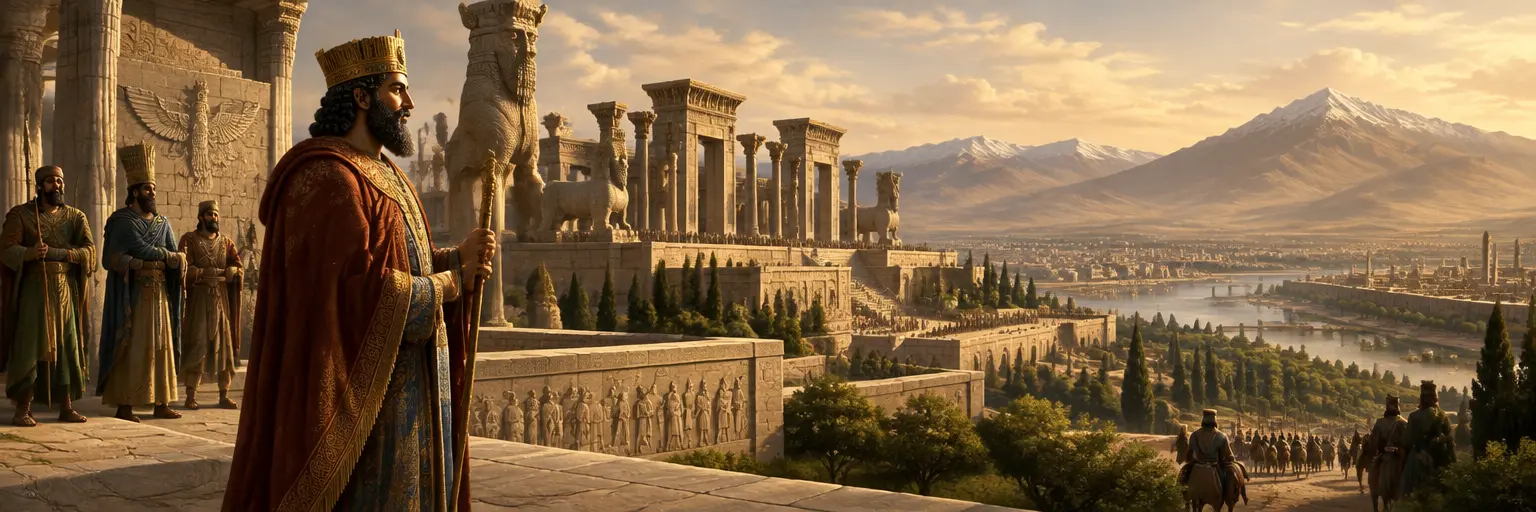
Darius I (r. 522–486 BCE) transformed the empire into a centralized bureaucracy. His crowning architectural achievement is Persepolis, the ceremonial capital built on a massive stone terrace. Excavations have revealed monumental staircases adorned with reliefs of delegations from 23 subject nations bringing tribute—each figure carved with distinct clothing, hairstyles, and animal gifts, serving as a visual census of imperial diversity. The Apadana Palace, with its 72 columns and intricate carvings, exemplifies Achaemenid engineering using cedar, gold, and lapis lazuli sourced from across the empire. Inscriptions like the Behistun Inscription, carved 100 meters above a cliff, document Darius’s victory over rebellions in three languages, offering a Rosetta Stone-like key to Old Persian cuneiform.
Here, you will explore administrative innovations such as the royal road (2,500 km from Susa to Sardis) and the qanat irrigation system, which boosted agricultural productivity. Archaeological finds from the Persepolis Treasury, including clay tablets and seal impressions, reveal a complex economy of rations, wages, and gift exchange. You will also examine the Elamite fortification tablets, whose 15,000 texts offer rare insights into daily life, ritual feasting, and labor organization—making this section a gateway to understanding how Darius sustained control over a realm of 50 million people.
⚔️ Military Campaigns and the Greco-Persian Wars
The Achaemenid military machine, as documented by Herodotus and confirmed by battlefield archaeology, was a multi-ethnic force combining elite Immortals with levied soldiers and cavalry. Darius’s campaigns into Scythia (513 BCE) and the Ionian Revolt (499–493 BCE) set the stage for the Greek invasions under his successors Xerxes I and Artaxerxes. At the site of Mardonius’ camp at Plataea (479 BCE), recent surveys have found arrowheads, human remains, and bronze scale armor, confirming ancient accounts of a catastrophic defeat. The Xerxes Canal across Mount Athos—cut 20 meters wide and bordered by fortification walls—demonstrates tremendous land-moving effort, verified by modern aerial photography and sediment cores.
This section angles on how Persian logistics, siege engineering, and naval bases were organized, using supply depots like those excavated at Daskalio. You will compare the Greek hoplite panoply with Persian wicker shields and short spears, noting tactical advantages and vulnerabilities. Interpretive analysis will focus on why the empire, despite superior resources, failed to conquer Greece—drawing on studies of climate, terrain, and leadership decisions—while linking to broader debates about imperial overstretch and cultural misunderstanding.
📜 Art, Religion, and Daily Life in Achaemenid Context
Achaemenid art is a deliberate collage of conquered cultures: Egyptian cornice moldings, Mesopotamian lamassu, and Ionian volute capitals coexist in palatial architecture. Archaeological layers at Susa reveal that artisans from across the empire were deported to work on royal projects, creating a hybrid aesthetic that signified universal rule. Religious practice is evidenced through fire altars at sites like Naqsh-e Rostam—where Darius’s tomb is carved into a cliff face—and the dahyu (divine favor) ideology inscribed in royal texts. Depictions of Ahuramazda, the “wise lord,” appear in winged disks above kingly scenes, suggesting a state-sponsored, but not exclusive, cult.
Daily life for commoners is illuminated by excavation of village sites, such as Hajji Firuz Tepe, where middens contain imported wine jars and local pottery. You will discover how cylinder seals, used to mark clay bullae, acted as signatures for officials, merchants, and even women managing estates. This section provides a window into non-elite households, foodways (barley, dates, and goat meat), and textile production, showing that the empire’s success relied not just on palaces but on the labor of ordinary subjects whose craftsmanship is often visible in tool marks and storage pits.
🏺 The Fall of the Empire and Its Enduring Legacy
The defeat of Darius III by Alexander the Great in 331 BCE at Gaugamela did not erase Achaemenid influence; rather, it transformed it. Archaeological evidence shows Alexander’s troops looted and burned Persepolis, but much was preserved—arguably because of stone walls and clay tablets. Post-Achaemenid sites like Sar-e Pol-e Zahab reveal continuities in road systems, taxation methods, and coinage under the Seleucids. The Persian administrative legacy (satrapies, chancelleries) was adopted by later Islamic empires, persisting into the Safavid era. Excavations at Bishapur and Taq-e Bostan show Sasanian kings explicitly mimicking Achaemenid rock reliefs to claim legitimacy.
You will trace how archaeology has challenged the “decadent empire” narrative by uncovering resilience in provincial centers, such as Kandahar and Babylon, where Achaemenid weights and measures remained in use for decades. The final section synthesizes how modern nation-building in Iran, as well as European Orientalism, shaped interpretations of these ruins—from the racist “Aryan” myths of the 19th century to contemporary heritage management. This legacy is visible in UNESCO World Heritage listings for Persepolis, Pasargadae, and Susa, making this an essential read for anyone interested in the politics of archaeology.
Frequently Asked Questions
What is the difference between Cyrus and Darius in terms of governance style?
Cyrus relied on local autonomy and personal charisma, appointing native governors (satraps) and allowing freedom of religion, as shown in the Cyrus Cylinder. Darius institutionalized the system, creating fixed provinces, standardized coinage, and a royal road for couriers. Cyrus was a conqueror-legitimizer; Darius was an administrator-lawgiver, formalizing tribute and law codes.
How did the Behistun Inscription help decode Old Persian cuneiform?
The trilingual inscription (Old Persian, Elamite, Akkadian) on a cliff at Behistun was copied by Henry Rawlinson in 1835. By comparing the proper names (like “Darius”) across all three scripts, he deduced phonetic values of Old Persian symbols, which then unlocked Akkadian and Sumerian. This breakthrough enabled reading thousands of other cuneiform texts.
Why is Persepolis considered a ceremonial rather than a residential capital?
Excavations show no substantial residential quarters or kitchens, unlike Susa or Babylon. Instead, the Apadana’s reliefs and platforms indicate it was used for the annual New Year festival where delegations presented tribute. Empty treasury chambers and limited storage further suggest it was a symbolic showpiece, not a daily governance hub.
What evidence exists for religious tolerance under Achaemenid rule?
The Cyrus Cylinder explicitly records the return of Jewish exiles and restoration of temples in Babylon. In Egypt, Darius funded the reconstruction of the temple of Amun at Hibis. Legal papyri from Elephantine mention Jewish, Aramaic, and Egyptian cults operating freely. Zoroastrian texts, however, show state favoritism toward Ahuramazda.
Did Alexander the Great really burn Persepolis, and can archaeology confirm it?
Classical sources say Alexander burned the palace after a drunken feast, but excavation reveals widespread ash layers and fire damage on wooden roof beams in the Treasury and on columns—consistent with rapid burning. However, some scholars argue it was a calculated act to signal the end of Persian power, not mere debauchery. Charred artifacts date to 330 BCE, confirming the event.