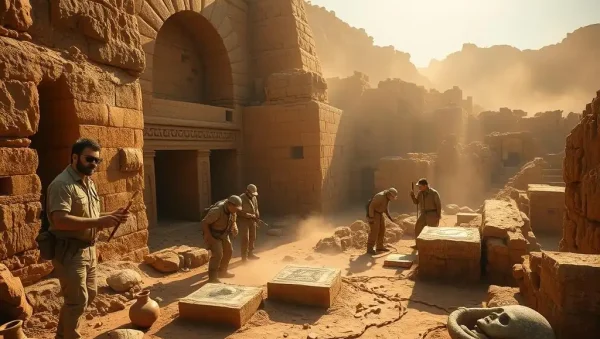
Archaeological Excavations at Babylon: Uncovering the Old Babylonian Levels
🌟 Discover the fascinating world of Babylon archaeological excavation techniques as recent excavations at the ancient site reveal new insights into Old…
Read article

Delve into the heart of Mesopotamia with an in-depth exploration of the Old Babylonian Period, a golden age of law, literature, and imperial power. This detailed study brings to life the reign of King Hammurabi, whose famous legal code—one of history’s most complete and best-preserved legal documents—shaped justice for millennia. Uncover the daily realities of Babylonian society through its clay tablets, from economic records and family contracts to royal correspondence, and examine how a centralized state managed vast irrigation networks and complex trade routes. Perfect for students, archaeology enthusiasts, and history buffs, this analysis bridges archaeology and ancient scholarship, revealing how Hammurabi’s legacy laid the groundwork for modern jurisprudence and governance. Whether you are tracing the evolution of cuneiform or decoding the famous stele’s laws on property, family, and criminal justice, this resource offers a comprehensive, artifact-based window into an era that forged the blueprint of urban civilization. Discover why the Old Babylonian period remains a cornerstone for understanding the ancient Near East and its enduring influence on Western legal thought.
Welcome to ArchaeologyHub.org’s detailed study of the Ancient Near East: Old Babylonian Period & Hammurabi's Code. This subcategory delves into one of history’s most transformative eras (c. 2000–1595 BCE), where Babylon rose from a minor city-state to a mighty empire. Here, you’ll uncover the political innovations, legal reforms, and cultural achievements of King Hammurabi, whose famous law code remains a cornerstone of legal history. Our content bridges archaeology, philology, and history to offer a complete portrait of Mesopotamian life, power, and justice.
This section focuses on the military and diplomatic strategies that allowed Hammurabi to unify Mesopotamia under a single rule. You’ll explore how he leveraged alliances, irrigation networks, and administrative reforms to consolidate power, transforming Babylon into a commercial and religious hub. Archaeological evidence from sites like Mari and Larsa provides rich letters and treaties that illuminate his campaigns.
Expect detailed timelines of his conquests, including the pivotal defeat of Elam and the kingdom of Larsa. We also analyze how Babylonian art and architecture, such as the ziggurat of Etemenanki, reflected imperial ideology. By understanding the political landscape, you’ll grasp why this period became a blueprint for later empires, including the Kassites and Assyrians.
Here, we dissect the stele of Hammurabi, now in the Louvre, to understand its legal categories: property, trade, family, slavery, and personal injury. The laws follow a distinctive casuistic format (“If... then...”), with penalties varying by social class—free persons, commoners, and slaves. We break down famous clauses, such as the lex talionis (“an eye for an eye”), and show how they were applied in real courts.
You’ll also find comparisons with earlier Sumerian law codes, like Ur-Nammu, to highlight Hammurabi’s innovations, including the presumption of innocence and the use of written evidence. Each law is cross-referenced with archaeological contracts, court records, and letters from Nippur and Sippar, offering a ground-level view of legal practice. This section is essential for students of jurisprudence and ancient social stratification.
Using thousands of cuneiform tablets from temple archives and private households, we reconstruct economic and social routines. You’ll learn about agriculture, trade networks, and the role of silver as currency, alongside the barter systems. This section covers family law—marriage contracts, inheritance, adoption—and how women could own property, engage in commerce, or serve as priestesses (nadītu).
We highlight the vibrant marketplaces of Babylon, Sippar, and Ur, including price lists and loan documents that reveal inflation and debt cycles. You’ll also discover the daily diet, housing layouts, and craft production (textiles, pottery, metalwork) based on excavation reports from Tell Harmal and Tell ed-Der. This holistic view connects legal codes to real human experiences, making the era tangible.
This part showcases major excavations that defined our knowledge of the period: Babylon’s Ishtar Gate (reconstructed in Berlin), the royal archives of Mari (over 20,000 letters), and the city of Larsa with its massive temple complexes. We detail the methods—stratigraphy, radiocarbon dating, and ceramic typology—used to date artifacts and buildings accurately, including the famous Hammurabi stele itself, rediscovered in 1901 at Susa.
You’ll explore lesser-known sites like Khafajah and Tell Asmar, where early dynastic layers predate Hammurabi, and contrast them with later Babylonian levels. We also discuss the looting and repatriation issues surrounding Mesopotamian antiquities. This section provides a virtual tour, with maps, elevation diagrams, and artifact photographs, helping you visualize the physical remnants of this golden age.
Finally, we trace how Hammurabi’s Code influenced later legal systems—from Hittite and Neo-Babylonian laws to biblical covenants and even modern civil codes. We examine its symbolic use in royal propaganda, as the stele was erected publicly for all to read, unlike earlier hidden laws. This section also connects the code to broader cultural achievements: literature (the Epic of Gilgamesh), mathematics, and astronomy.
Expect a critical analysis of the “justice” concept, noting that penalties varied by class and gender, reflecting an unequal society. We compare Hammurabi’s reforms with contemporary Near Eastern practices, such as the Middle Assyrian Laws, to highlight regional variations. Our synthesis uses comparative history to show why this code remains a benchmark for studying ancient governance and morality.
The stele was discovered in 1901 by French archaeologists at Susa, Iran (ancient Elam), where it had been taken as plunder centuries earlier. It is now housed in the Louvre Museum in Paris, displayed prominently. The black diorite monolith stands over 2.25 meters tall, with cuneiform text covering its face, and it remains one of the most studied artifacts of ancient law.
No, they were explicitly tiered. Penalties differed among awīlum (free persons), muškēnum (commoners), and wardum (slaves). For example, harming an awīlum’s eye required the same injury, but harming a commoner’s eye only required a fine. This reflects a stratified society where legal rights and obligations were tied to social status, not universal equality.
Law #196, “If a man destroys the eye of another man, they shall destroy his eye,” exemplifies the lex talionis (retributive justice). However, its application was class-dependent. This law has become iconic for representing retaliatory punishment, though many other laws focus on economic compensation, property rights, and family disputes, showing a nuanced legal system.
Earlier codes, like Ur-Nammu’s (c. 2100 BCE), were milder, often using fines rather than physical punishment. Hammurabi’s Code introduced more severe retributive penalties and a broader scope, covering 282 laws versus Ur-Nammu’s ~30. It also emphasized written evidence and witnesses, making legal procedures more systematic and publicly accessible via the stele.
Beyond law, it was an age of literary and scientific flowering: the standard Babylonian version of the Epic of Gilgamesh was compiled, and mathematical texts like Plimpton 322 (Pythagorean triples) emerged. Babylonian astronomy and divination (omens) systematized knowledge. Trade and diplomacy expanded, creating a cosmopolitan culture that shaped the entire Near East.







