Deciphering Tiwanaku's Gateway of the Sun: Iconography and Cosmic Interpretations
🌄 Unlock the mysteries of the Tiwanaku Gateway of the Sun, exploring its intricate iconography and cosmic symbolism that reveal profound insights…
Read article
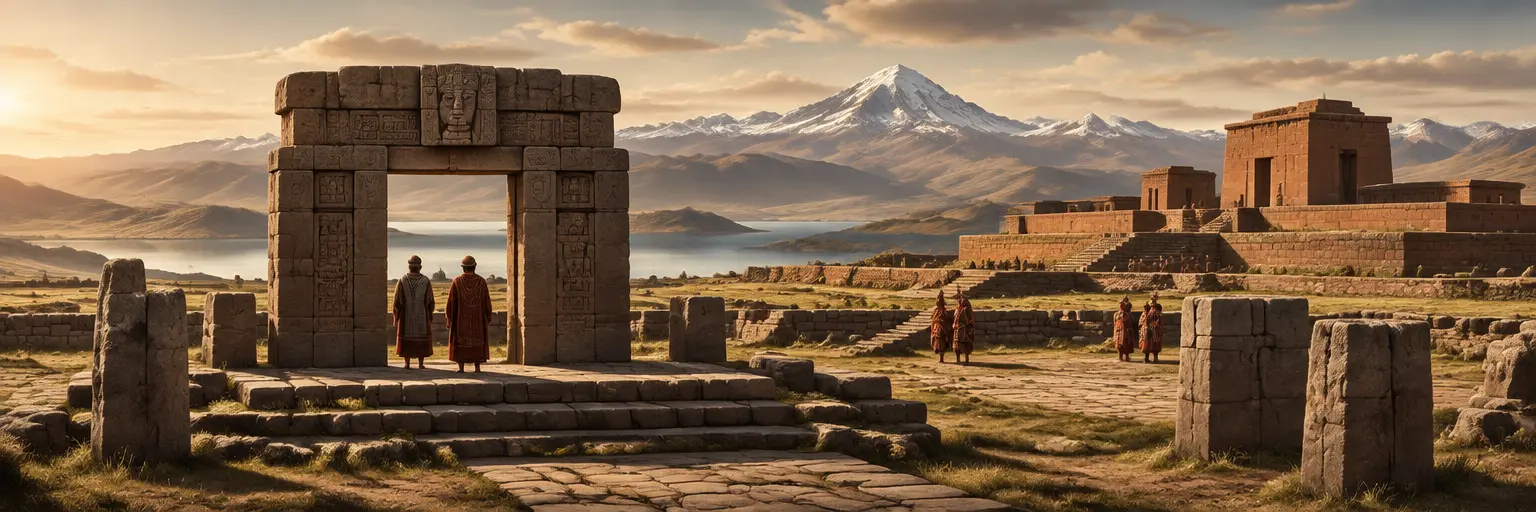
Explore the monumental legacy of the Tiwanaku & Wari Empires, two of the Andes’ most influential pre-Columbian civilizations, through expertly curated archaeological insights. Uncover how these Andean cultures engineered vast urban centers, advanced hydraulic agriculture, and forged intricate trade networks long before the Inca rose to power. Delve into iconographic textiles, ceremonial monoliths, and the mysteries of their collapse, with artifact profiles and interpretive analyses that bring their world to life. Perfect for enthusiasts of ancient history, this digital encyclopedia offers a deep dive into the geopolitical dynamics and spiritual life of the Tiwanaku heartland along Lake Titicaca and the expansive Wari administrative apparatus across the Peruvian highlands. From the Gateway of the Sun to the excavated city of Huari, every find is contextualized within a broader regional timeline, making complex cultural exchanges accessible and engaging. Journey into a pivotal era of Andean civilization and witness how these twin powers shaped the landscape of South American prehistory.
Dive into the heart of the pre-Columbian Andes with ArchaeologyHub.org’s detailed study of the Tiwanaku and Wari Empires. These two monumental civilizations, flourishing between 500 and 1000 CE, predated the Inca and laid the foundational urban, agricultural, and religious frameworks of the highlands and coastal Peru. This subcategory explores their intricate stonework, vast road networks, and complex sociopolitical systems, offering a comprehensive digital encyclopedia of their rise, apex, and eventual transformation. Explore how these contemporaneous powers interacted, traded, and influenced the vast Andean landscape through our interpretive analyses and artifact profiles.
Here, we dissect the monumental architecture that defines these empires. Tiwanaku’s ceremonial core at the site of Tiwanaku, near Lake Titicaca, showcases precision-cut stone blocks fitted without mortar, exemplified by the Gateway of the Sun and the Akapana pyramid. In contrast, the Wari expanded urban planning with sprawling administrative centers like Huari and Pikillacta, featuring high-walled compounds, D-shaped temples, and extensive terrace systems. Expect detailed site profiles, excavation blueprints, and virtual reconstructions that reveal how their architecture reflected cosmic and political order. You will gain insight into the engineering feats that allowed these cultures to thrive in extreme altitudes and arid coastal zones.
Our interpretive analyses focus on the symbolic meaning embedded in their layouts—from Tiwanaku’s alignment with solstices to Wari’s grid patterns signifying state control. We provide artifact profiles of carved stone heads, ceramic vessels, and textiles found within these structures, linking daily life to monumental grandeur. Archaeological discoveries from recent Lidar surveys and excavations are included, updating the canonical narratives with fresh data. This section is essential for students and enthusiasts seeking to understand pre-Inca urbanism and ritual landscapes.
Explore the agricultural backbone that sustained millions. The Tiwanaku perfected raised-field waru waru agriculture around Lake Titicaca, creating elevated planting beds with canals that mitigated frost and retained moisture, dramatically boosting crop yields. Meanwhile, the Wari engineered extensive hillside terracing and irrigation canals across the central highlands, transforming marginal lands into productive maize and potato fields. This subcategory offers detailed case studies on field systems, hydrology, and crop remains recovered through paleoethnobotany. Learn how these innovations supported urbanization and state-sponsored feasting, creating surpluses that financed monumental projects and trade networks.
Through excavation reports and experimental archaeology, we illustrate how these techniques were adapted to diverse microclimates—from Lake Titicaca’s cold plains to the warmer valleys of Ayacucho. The environmental impact and sustainability of these ancient practices are analyzed, providing lessons for modern agroecology. Artifact profiles of farming tools, such as foot plows (chaquitaclla) and stone hoes, are featured alongside isotopic studies of human remains that reveal dietary patterns. This content deepens your appreciation for how these empires conquered altitude to feed vast populations.
Uncover the trade and diplomatic networks that linked these two superpowers with coastal cultures like the Moche and Nasca. We examine the distribution of Tiwanaku’s iconic kero drinking vessels and hallucinogenic snuff trays, which spread across the altiplano and into the Atacama Desert. Simultaneously, Wari’s polychrome ceramics and woven tunics traveled along a strategic road system that later influenced the Inca Qhapaq Ñan. Our mapping tools and trade-route analyses highlight exchange hubs and the movement of precious goods such as obsidian, Spondylus shells, coca, and camelid fiber. Interpretive essays assess whether this interaction was hostile, cooperative, or a mix, drawing on settlement patterns and iconography.
Within this section, you’ll find detailed artifact profiles for traded items, complete with provenance and chemical sourcing data. We also discuss the presence of Tiwanaku enclaves in Wari territories and vice versa, suggesting elite alliances or colonization. Excavation techniques like neutron activation analysis are explained to demonstrate how archaeologists trace origins. This subcategory enriches your understanding of complex heterogeneity in pre-Columbian geopolitics, showing that the Andes were a dynamic web of interdependence long before European contact.
Delve into the shared spiritual universe of these empires. Central to both cultures was the "Staff God" figure, a front-facing anthropomorphic deity holding staffs, prominently carved on Tiwanaku’s Gateway of the Sun and replicated on Wari textiles and ceramics. This iconography suggests a common religious ancestry and possibly a cult that transcended political boundaries. We provide interpretive analyses of iconographic motifs, including condors, pumas, and mythological serpents, linking them to shamanic practices and cosmology. Artifact profiles of ritual paraphernalia—snuff tubes, offering plates, and effigies—reveal how beliefs were enacted in daily and ceremonial life.
Our content examines the role of religious pilgrimage, as Tiwanaku’s capital became a sacred center attracting worshippers from distant regions. For the Wari, religion was channeled through state-infused decorative arts, reinforcing hierarchy and ethnic solidarity. We also address the transformation of these beliefs after 1000 CE, following their collapse, and how their deities persisted in later cultures like the Huari and Inca. This section synthesizes art history, ethnohistory, and archaeological evidence to paint a vivid portrait of Andean ideology, making it a cornerstone for comparative mythology studies.
This segment is your digital museum gallery, featuring meticulously documented artifact profiles. Examine Tiwanaku’s finely crafted polychrome ceramics, often decorated with geometric bands and feline or bird motifs, and Wari’s administrative pottery, including large urns and face-neck jars. Textiles, arguably the finest of the Pre-Columbian world, are showcased through high-resolution images of intricately woven tunics and tapestries using camelid and cotton fibers. Our guides explain manufacturing techniques, dyes, and iconographic variations that help date and attribute objects to specific regions or periods. Additionally, we cover stone vessels, gold ornaments, and carved wooden items, each with contextual excavation notes.
For every artifact, we provide extensive metadata—dimensions, context, and current museum location—and interpretive essays linking them to social status, warfare, or ritual. We also discuss the challenges of looted artifacts and the repatriation efforts in modern archaeology. Enhanced with 3D models and zoomable scans, this subcategory supports detailed study for collectors, students, and educators. Whether you are researching kero styles or the iconography of Wari mirror frames, you’ll find exhaustive data and authoritative references here.
The Tiwanaku, centered in the Lake Titicaca basin, focused on ritual monumental architecture and raised-field agriculture, likely exercising influence through religious prestige. The Wari, based in the central highlands of Peru, expanded territorial control with administrative cities, road networks, and more aggressive militarism, creating a more centralized state. Their material cultures—ceramics, textiles, and stonework—also differed stylistically, though they shared iconographic motifs.
Evidence suggests limited but significant contact, primarily through trade and ideological exchange. Tiwanaku ceramics appear in Wari sites, and vice versa, particularly in frontier zones like the Moquegua Valley. They likely shared religious concepts, such as the Staff God, and may have negotiated spheres of influence rather than engaging in direct warfare. Some scholars argue for a peaceful coexistence based on complementary economies and distance.
A mix of prolonged drought, internal social unrest, and possibly overpopulation is blamed. Paleoclimate data indicates a severe multi-decade dry period around 950-1050 CE, devastating Tiwanaku’s raised fields. The Wari faced similar climate stress, plus potential rebellion from provincial groups. Neither empire collapsed overnight; rather, their urban centers were gradually abandoned, and populations dispersed into smaller settlements, leading to a period of fragmentation.
Yes, several major sites are accessible. Tiwanaku, near La Paz, Bolivia, is a UNESCO World Heritage Site with standing monuments and a museum. The Wari site of Pikillacta, near Cusco, Peru, is open with visible walls and compounds. Additionally, the Bonampak-style murals at Huaca de la Luna (Moche) show some Wari influence. Always check local tourism advisories and site access permissions before visiting.
The Inca absorbed much from these predecessors. They adopted Wari’s road systems and administrative practices, including storage facilities (qollcas), and their architectural techniques like precisely fitted stonework. The Inca revered Tiwanaku as a mythical origin site, incorporating its Staff God into their own cosmology as Wiracocha. Agricultural terraces, state-driven labor (mit’a), and ceramic styles all show direct continuity from Tiwanaku-Wari traditions.







