Divine Patronage and City Identity: Enki in Eridu, Inanna and Anu in Uruk
🌟 Explore how divine patronage shaped ancient city identities, focusing on Enki's central role in Enki Eridu city identity and the influences…
Read article
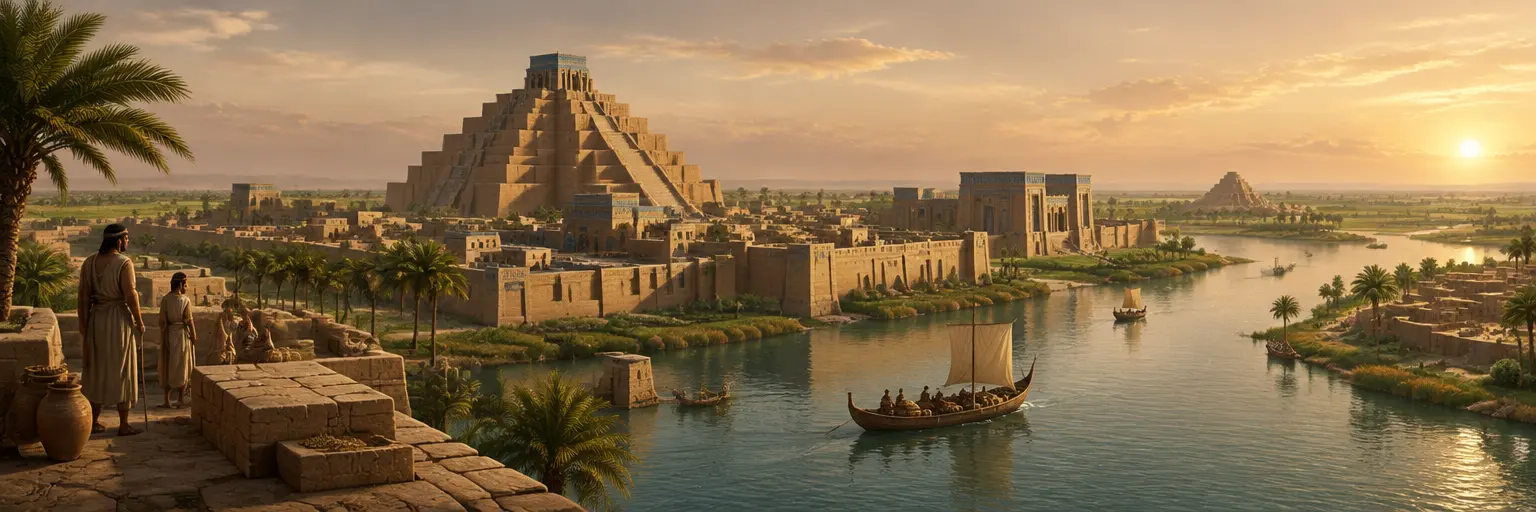
Explore the cradle of urban civilization at Uruk and Eridu, two of Mesopotamia’s most transformative Near Eastern sites. Here, the first true cities rose from the desert, pioneering monumental temple architecture and centralized governance before 3000 BCE. Uruk, the world’s largest early metropolis, showcases the legendary White Temple and the invention of cuneiform writing, while Eridu—considered the oldest city in Sumerian myth—reveals a sequence of 18 superimposed temples that trace the evolution of religious practice from simple shrines to massive ziggurats. Early urbanism comes alive through mud-brick walls, intricate cylinder seals, and ritual artifacts, offering unmatched insight into the social, economic, and spiritual foundations of later Babylonian and Assyrian empires. Whether you’re an archaeology enthusiast, student, or traveler, these sites deepen your understanding of how sacred spaces shaped the very concept of the city—both in the ancient world and today. Perfect for academic research, virtual exploration, or trip planning to southern Iraq.
🌟 Explore how divine patronage shaped ancient city identities, focusing on Enki's central role in Enki Eridu city identity and the influences…
Read article
🌟 Explore the fascinating uruk population dynamics 4th millennium BCE, unveiling insights into demographic shifts, urban growth, and societal changes during this…
Read articleWelcome to ArchaeologyHub.org’s dedicated deep-dive into the Mesopotamian heartland, where the first cities in human history rose from the alluvial plains of southern Iraq. This subcategory focuses on Uruk and Eridu, the twin pillars of Sumerian civilization, and how their monumental temples and urban layouts defined the very concept of city life around 4000–3000 BCE. Here, you will find layered analyses of excavation records, temple architecture, cuneiform evidence, and the socio-political shifts that turned small farming villages into sprawling metropolises—an essential resource for students, researchers, and enthusiasts of ancient urbanism.
At Uruk, the White Temple (dedicated to Anu, the sky god) and the massive Eanna district showcase the transition from simple mud-brick shrines to elevated, stepped platforms that prefigure later ziggurats. Excavations reveal carefully planned courtyards, cone-mosaic façades, and cultic installations that emphasize public ritual over private worship. This architectural leap illustrates how religious authority became the central organizing force in early urban life.
For Eridu, the sequence of eighteen superimposed temples—from a tiny 3rd-millennium hut to the grand E-abzu—demonstrates an unbroken tradition of sacred rebuilding on the same spot for over a millennium. Each layer added structural complexity, with buttressed walls and offering tables. These remains allow us to trace the codification of temple engineering, where divine presence was literally raised above the city, visually dominating the skyline and reinforcing priestly power.
The invention of cuneiform around 3200 BCE at Uruk is arguably humanity’s greatest informational leap. Thousands of clay tablets from the Uruk IV and III layers record grain distribution, livestock counts, and labor allocations—evidence that temples operated as economic redistribution hubs. The numerical tablets and pictographic signs show the shift from tally marks to abstract symbols, laying the groundwork for written history.
Beyond text, cylinder seals and their impressions on clay bullae reveal a bureaucratic elite standardizing transactions. Iconography of the priest-king (often shown in ritual hunting scenes) suggests a fusion of secular leadership with divine mandate. These administrative artifacts provide a granular view of daily operations, from beer production quotas to textile workshop outputs, proving that urbanism was sustained by a highly organized, temple-centric economy that predates any true palace bureaucracy.
Eridu holds a special place in Sumerian mythology as the first city created by the god Enki, the lord of the abyss and wisdom. Its siting near the ancient Persian Gulf shoreline made it a hub for maritime trade and freshwater fishing, but also demanded sophisticated irrigation. Excavated canals, clay water-lifting devices, and elevated residential mounds indicate early mastery of water control, vital for supporting a dense population in an arid region.
The temple’s placement over a natural freshwater spring was no accident—it symbolized the abzu, the cosmic underground ocean. This geological feature explains why Eridu remained a religious center long after its political decline. Modern geoarchaeology has used soil coring to reconstruct ancient shorelines, confirming that the city’s prosperity hinged on a delicate balance of river flow and tidal access, offering valuable lessons on sustainability and environmental adaptation in early complex societies.
Uruk’s pottery, particularly the ubiquitous beveled-rim bowls, appears in massive quantities—suggesting standardized rations for laborers or soldiers. These mass-produced bowls are a signature of Uruk’s economic reach, found as far afield as Iran, Syria, and Anatolia. Alongside them, Uruk-period collar-rimmed jars and imported obsidian and lapis lazuli highlight long-distance exchange routes controlled by temple elites.
Eridu’s earlier pottery, from the Ubaid period (c. 5300–4000 BCE), features distinctive painted geometric designs and terra-cotta sickles, indicating agricultural intensification. The presence of female figurines with exaggerated features points to fertility cults, while stone amulets and copper fishhooks reveal a diversified subsistence base. These material signatures help archaeologists differentiate local traditions from external influences, showing that Eridu was a cultural innovator, not just a receiver of Uruk’s later dominance.
In both cities, the New Year festival (Akitu) was the apex of the religious calendar, featuring processions, animal sacrifices, and the sacred marriage between the king and the goddess Inanna (Uruk) or a priestess and Enki (Eridu). Textual sources from the third millennium describe the king’s ritual role in ensuring fertility and agricultural abundance. Temple hymns and liturgical calendars reveal a complex pantheon where each deity had a specific domain and cultic calendar.
Archaeologically, the presence of cult vessels, libation tables, and large open courtyards indicates that these festivals were public spectacles designed to unify the city’s inhabitants. Clay plaques depicting the king in dramatic poses, alongside remnants of feasting pits, show that religious indulgence doubled as political propaganda. Comparing the festival structures at Uruk and Eridu illuminates how shared mythologies were adapted to local patroN gods, fostering regional identity while maintaining a pan-Mesopotamian worldview.
Unlike the haphazard growth of earlier villages, Uruk’s central district was deliberately zoned: religious (Eanna), administrative (limestone temples), and residential quarters separated by walls and alleys. Excavations of private houses reveal courtyard-centered layouts with multi-roomed dwellings, kitchens, and ovens, indicating nuclear family units within larger clan compounds. Streets were often unpaved but bordered by drainage canals, showing advanced municipal engineering.
Eridu’s urban form was more compact, with a single massive temple mound at its core, surrounded by dense residential districts and a massive cemetery. Stratigraphic studies show that houses were repeatedly rebuilt on the same foundations, indicating hereditary property rights and social stratification. The lack of large public squares compared to Uruk suggests a more exclusive priestly governance. Comparing these layouts provides insights into how different social structures—commercial versus theocratic—shaped the physical morphology of the first cities.
Eridu is older in terms of earliest occupation, with its foundation dating to around 5400 BCE during the Ubaid period. Uruk’s early levels begin around 4000 BCE, but it grew to greater size and prominence. Eridu’s temple sequence shows continuous rebuilding from a small shrine to a monumental complex, while Uruk became the larger and more influential city in the later Uruk period.
The White Temple, perched on a massive platform, was dedicated to Anu, the sky god. Its purpose was likely ceremonial and ritual, serving as a stage for divine appearances and priestly rites. The elevated position allowed the deity to “look down” upon the city, reinforcing the religious hierarchy. No living quarters were found, so it was not a residence but a performance space for cultic activities.
Builders used sun-dried mud bricks, which were strong but required constant maintenance. They employed a core-and-facing technique, with a solid mud-brick core and a baked brick skin. Internal drainage channels and bitumen waterproofing protected the structure from rain. Labor was organized through the temple’s administrative system, mobilizing thousands of workers who used ramps and sledges to transport bricks.
Yes, Eridu’s later temple of Enki (E-abzu) was built on an elevated platform, though it never reached the massive tiered scale of Uruk’s Anu ziggurat. Its structure was more of a stepped base with a single shrine, reflecting an earlier architectural style. Over time, the ziggurat form became standardized, and Eridu’s simpler design marks a transitional stage in Mesopotamian religious architecture.
Uruk’s decline around 2900 BCE is linked to climate shifts, salinization of soils from over-irrigation, and the rise of competing city-states like Ur. Eridu lost political power much earlier, around 2000 BCE, but remained a cultic center. Shifting river courses and the silting of the Persian Gulf coastline also reduced their trade advantages, leading to gradual abandonment.







