Minoan Stone Vases: Masterpieces of Lapidary Art
🌟 Discover the exquisite Minoan stone vases, showcasing masterful lapidary craftsmanship and diverse styles. This article explores how Minoan pottery techniques and…
Read article
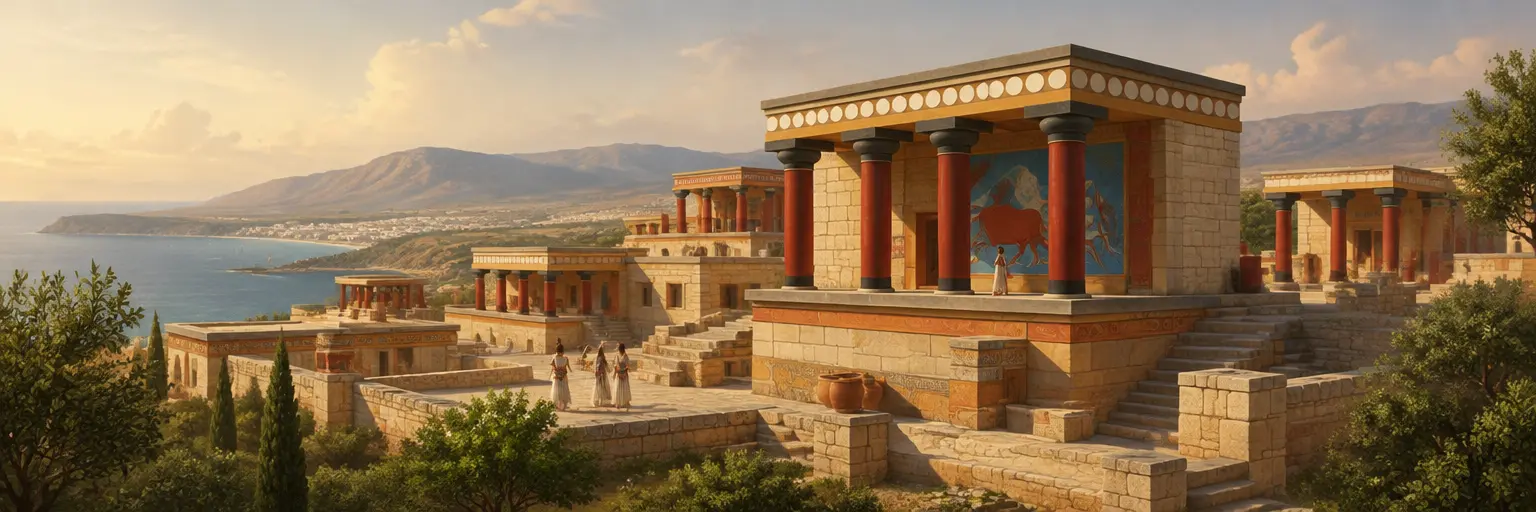
Step into the legendary heart of Europe’s first advanced civilization. The Minoan palaces of Crete—most famously Knossos—offer a breathtaking glimpse into a Bronze Age world of labyrinthine architecture, vivid frescoes, and sophisticated urban planning. Associated with the myth of the Minotaur and King Minos, these sprawling complexes like Phaistos, Malia, and Zakros reveal a maritime empire that thrived over 3,500 years ago. From advanced drainage systems and storerooms brimming with giant pithoi jars to ceremonial spaces and vibrant bull-leaping art, each site deepens our understanding of Minoan society, religion, and daily life. Whether you are tracing the origins of Western art or unraveling the mystery of the island’s sudden decline, exploring these Aegean marvels is an unforgettable journey through time. Dive into our detailed guides, excavation histories, and artifact spotlights to decode the legacy of a people who still captivate the modern imagination.
🌟 Discover the exquisite Minoan stone vases, showcasing masterful lapidary craftsmanship and diverse styles. This article explores how Minoan pottery techniques and…
Read article
🌟 Discover how the Crete protopalatial palace society emerged during the Protopalatial Period, marking the rise of complex social structures, advanced architecture,…
Read articleWelcome to ArchaeologyHub.org’s dedicated portal on Aegean Sites: Knossos & Minoan Palaces of Crete, a cornerstone of our Archaeological Sites (Global Coverage) category. Here, we delve into the labyrinthine wonders of Europe’s first advanced civilization, uncovering the architectural brilliance, vibrant frescoes, and complex socio-economic structures that defined Minoan Crete. From the legendary Palace of Minos at Knossos to the lesser-known gems of Phaistos, Malia, and Zakros, this subcategory offers a curated journey through Bronze Age majesty. Expect in-depth artifact profiles, cutting-edge excavation insights, and interpretive analyses that connect these ruins to broader Mediterranean trade networks.
Knossos, the largest Bronze Age site on Crete, was not merely a royal residence but a sprawling administrative, religious, and economic hub spanning over 20,000 square meters. Our content explores its innovative multi-story layout, advanced drainage systems, and the iconic Throne Room with its alabaster seat and griffin frescoes. You’ll understand how the palace’s labyrinthine corridors—likely the origin of the Minotaur myth—facilitated storage, ritual, and bureaucratic control.
We also analyze Sir Arthur Evans’ controversial 20th-century restorations, using reinforced concrete that shapes today’s visitor experience. Through detailed floor plans and 3D reconstructions, we separate original Minoan masonry from modern interventions. This section emphasizes how architectural orientation toward sacred mountains and the central court influenced ceremonial processions, while also revealing evidence of earthquake resilience—a testament to Minoan engineering prowess.
Minoan palaces are renowned for their vivid frescoes depicting dolphins, saffron gatherers, and bull-leaping rituals. Here, we decode the iconographic language of these murals, illustrating how they communicated divine authority, seasonal cycles, and maritime wealth. The famous La Parisienne and Prince of the Lilies are examined as evidence of elite fashion and ceremonial roles.
Our artifact profiles extend to ritual objects like the Horns of Consecration, double axes (labrys), and libation tables found in palace sanctuaries. We explain the possible function of pillar crypts and lustral basins, linking them to purification rites and chthonic deities. By comparing symbols across sites, we reveal a unifying Minoan religious system that blended nature worship with ancestral veneration, offering fresh interpretations of female priestesses’ roles.
While Knossos dominates popular imagination, this subcategory provides balanced coverage of Crete’s other major palaces. Phaistos, with its majestic western court and the famous Phaistos Disc, showcases a distinct urban layout and advanced water management. Malia, located on the fertile north coast, reveals a palace with exceptional storage magazines and a nearby “hypostyle crypt” that may have served communal feasting.
At Zakros—the “palace of the east”—we highlight its unusually well-preserved workshops, exotic ivory imports, and harbor-side orientation, suggesting it was a gateway for Levantine trade. For each site, we offer comparative timelines, excavation histories, and current conservation challenges. This comparative approach helps readers grasp the decentralized yet interconnected nature of Minoan political power, moving beyond a “Knossos-centric” narrative to understand regional variations in ceramic styles, seal carving, and burial practices.
This section immerses you in the methodologies that have shaped our understanding of these palaces. From Evans’ pioneering stratigraphic digging to modern non-invasive geophysical surveys, we detail how ground-penetrating radar and magnetometry have located undiscovered structures at Malia. Learn about the meticulous process of restoring fragmented wall paintings, including pigment analysis using portable X-ray fluorescence (pXRF) to identify original materials.
We also showcase cutting-edge photogrammetry and LiDAR used to create high-resolution 3D models of the Knossos bull-leaping fresco and palace courtyards. Virtual reality tours allow remote users to “walk” through reconstructed corridors, while GIS mapping correlates artifact distribution with linear B tablets (found at Knossos) to reveal economic zones. Ethical discussions cover the repatriation of artifacts and the impact of mass tourism on fragile plaster floors, ensuring you appreciate both technological triumphs and preservation dilemmas.
Beyond monumental architecture, our research explores the day-to-day existence within palace economies. Excavations of storage pithoi (large jars) and stirrup jars at Knossos reveal olive oil, wine, and wool as major exports, while imported Egyptian faience and Canaanite amphorae prove extensive maritime links. We analyze Linear A script (still undeciphered) through computational pattern recognition to hypothesize about taxation records and land tenure.
Daily life is illuminated through household pottery, loom weights, and bronze tools found in palace workshops. This section answers questions like: What did Minoans eat? How were craft specialists organized? What role did women play in textile production? By integrating zooarchaeological data (cattle bones for feasting) and botanical remains (grains, legumes), we paint a vivid picture of social hierarchies, communal labor, and seasonal festivals. The collapse of these palaces around 1450 BCE is then examined through new evidence of volcanic ash, possible invasion, and internal revolt.
No, the earliest palace structures appear at Phaistos and Malia around 1900 BCE, slightly before Knossos’ first palace phase. However, Knossos became the largest and most influential during the Neopalatial period (1700–1450 BCE), with its iconic layout and population reaching an estimated 20,000 inhabitants.
Yes, the Throne Room is part of the standard visitor route at the archaeological site of Knossos, though access is restricted to viewing from a barrier to protect the original gypsum floor and frescoes. The alabaster throne and griffin murals are original, while the roof and some columns are reconstructions.
The Minoans are celebrated for their advanced plumbing (including flush toilets), vibrant frescoes, maritime trade dominance, and the first writing systems in Europe (Linear A and later Linear B). Their peaceful, nature-oriented art contrasts with contemporary warlike cultures, leading scholars to call them a “thalassocracy” or sea-based civilization.
Archaeologically, no maze matching the myth has been found, but the palace’s complex ground plan—with corridors, staircases, and over 1,000 rooms—likely inspired the Greek myth of the Minotaur’s labyrinth. The bull-leaping frescoes at Knossos reinforce the connection to bull symbolism central to the legend.
Around 1450 BCE, most palace sites were destroyed by fire, likely due to a combination of the Thera eruption’s tsunamis, subsequent earthquakes, and possible invasion by Mycenaeans from mainland Greece. Knossos alone continued operating under Mycenaean administration until roughly 1375 BCE, when it too was abandoned.