Explore the Multi-Layered History of Troy
Welcome to ArchaeologyHub.org’s dedicated guide to Aegean Sites: Troy - Layers of a Legendary City. This page unravels one of the most storied archaeological landscapes in the world, where myth and history converge. Here, you will discover how excavations by Heinrich Schliemann and modern researchers revealed not one city, but at least nine distinct settlements stacked over millennia. We focus on the stratigraphy, architectural phases, and artifacts that define each layer, from the Early Bronze Age to the Roman era. Dive into our curated excavations, artifact analyses, and timeline interpretations that illuminate the real city behind Homer’s epic, optimizing your learning with precise, keyword-rich insights.
🏛️ The Stratigraphic Sequence: Unearthing Troy I to Troy IX
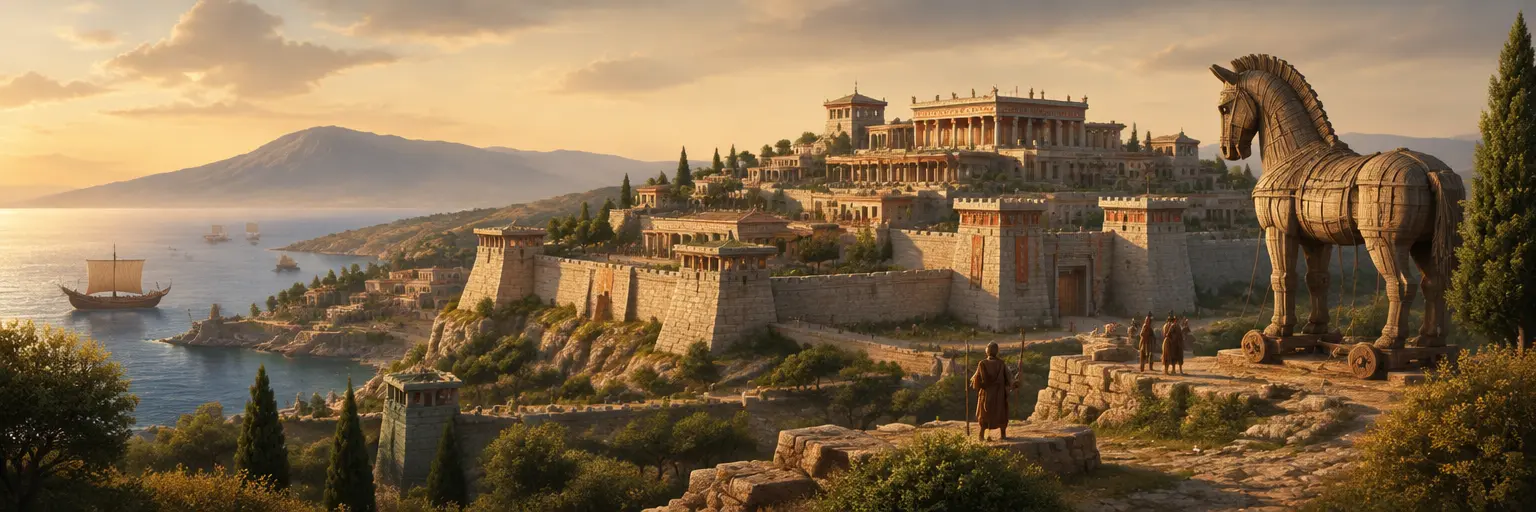
Understanding Troy requires grasping its complex vertical history. Excavators identified a sequence of nine primary layers, each representing a distinct habitation phase. Troy I (c. 3000-2500 BCE) was a small fortified village, while Troy II (c. 2500-2200 BCE) expanded with massive walls and monumental gateways, famously dubbed the “Burnt City” by Schliemann. Later layers, such as Troy VI (c. 1700-1250 BCE), show a powerful, well-fortified citadel with sloping walls, likely the setting for the Trojan War in popular imagination. Troy VIIa reveals signs of siege and destruction, while Troy VIII and IX transition into Greek and Roman sanctity.
For readers, expect a chronological breakdown that clarifies how each layer’s pottery, architecture, and destruction levels relate. We analyze radiocarbon dates, pottery typologies, and architectural modifications to help you distinguish between mythic associations and concrete archaeological evidence. This section serves as your foundational map for exploring the site, ensuring you can connect significant finds like the “Priam’s Treasure” to their proper stratigraphic context, rather than a single legendary narrative.
🏺 Iconic Artifacts and Their Provenance
Artifacts from the Trojan layers provide tangible links to daily life, trade networks, and ritual practices. The famous “Treasure of Priam” (actually from Troy II) includes gold diadems, silver vessels, and bronze weapons, though its association with the Homeric king is widely disputed. More reliable finds include Mycenaean pottery imported from mainland Greece, local Anatolian wares, and Hittite-style seals that evidence cross-cultural exchange. Recent excavations at the site have uncovered lead anchors, stone anchors, and spindle whorls, suggesting a bustling port economy alongside its martial reputation.
Expect detailed profiles of each artifact class, including their material composition, stylistic parallels, and current museum locations. We also discuss the ethical debates around Schliemann’s removal of objects and their eventual return to Turkey. This section enhances your understanding of how objects are dated via typology and context, reinforcing the importance of provenance in archaeological interpretation. By the end, you’ll appreciate how everyday items, not just gold, reveal Troy’s cosmopolitan character.
🗺️ The Historical Context: Troy in the Bronze Age Aegean
Troy’s significance extends beyond its walls; it was a crucial node in the Late Bronze Age trade network linking the Aegean, Anatolia, and the Near East. Historical records from the Hittite archives reference a polity called Wilusa, widely considered to be Troy, highlighting its political importance. This subcategory explores the evidence for Troy’s role in regional conflicts, such as the alleged Trojan War, and its interactions with neighboring powers like the Mycenaean kingdoms. We analyze inscriptions, diplomatic correspondence, and the distribution of imported luxury goods to reconstruct its geopolitical standing.
For the user, this context provides a broader narrative that situates the archaeological layers within real-world history. You will learn how scholars use contemporary textual sources to cross-reference physical evidence, thus moving beyond pure legend. The emphasis is on critical evaluation of both ancient texts and archaeological remnants, enabling you to see Troy not as a static ruin but as a dynamic participant in a larger Mediterranean world. This historical lens enriches your comprehension of why the site was repeatedly rebuilt and fortified.
🔍 Excavation Techniques and Interpretation Challenges
Studying Troy presents unique methodological challenges, from early destructive digging to modern scientific precision. Schliemann’s methods in the 1870s, which involved trenching through upper layers to reach virgin soil, inadvertently destroyed much of the later stratification. Modern teams, led by the University of Tübingen’s Manfred Korfmann and others, use remote sensing, micro-stratigraphy, and archaeobotanical analysis to recover data lost to earlier excavations. This subcategory covers the evolution of fieldwork practices, including careful sieving, flotation, and digital recording of every soil layer.
Here, you’ll find explanations of how archaeologists date layers via pottery seriation, architectural phases, and absolute dating methods like dendrochronology. We also address interpretive hurdles, such as separating destruction layers caused by earthquakes versus human conflict. This section is invaluable for aspiring archaeologists or enthusiasts who want to understand the science behind the stories. You’ll learn how teamwork across disciplines—from geology to botany—creates a holistic picture of life at Troy over thousands of years.
🌍 Comparative Analysis with Other Aegean Sites
To fully appreciate Troy, one must compare it with contemporaneous sites across the Aegean. This subcategory places Troy in parallel with citadels like Mycenae, Tiryns, and Miletus to highlight both shared cultural traits and unique local adaptations. For instance, while Mycenae features cyclopean walls and megaron palaces, Troy’s massive limestone fortifications and sloped masonry represent a distinct Anatolian tradition. Similarly, pottery from Troy shows links to both the Greek mainland and the Cyclades, revealing its role as a cultural bridge.
Readers can expect side-by-side comparisons of fortification styles, house plans, burial customs, and craft production. We discuss how trade in tin, copper, and ivory flowed through Trojan markets, connecting distant regions. This comparative lens allows you to see what was typical for the eastern Aegean versus what was uniquely Trojan. By understanding these parallels and contrasts, you gain a deeper appreciation for the region’s interconnectedness and the factors that made Troy a legend in its own right.
Frequently Asked Questions
Is the Trojan War a real historical event?
Many scholars believe the Trojan War may be based on a real conflict around 1200 BCE, likely corresponding to the destruction of Troy VIIa. However, no definitive evidence ties Homer’s narrative to a single event. Archaeologists have found destruction layers, but the cause—war, earthquake, or internal strife—remains debated. Thus, while the setting is plausible, the epic’s specifics are unverified.
What is the best artifact to see from Troy?
The “Priam’s Treasure” from Troy II remains iconic, though its provenance is contested. More instructive are the Mycenaean pottery sherds and local Anatolian seal stones, which show trade links. Modern museum displays in Turkey, such as at the Troy Museum, showcase these items with clear stratigraphic context, offering a richer, scientifically accurate viewing experience than earlier museum exhibits.
Why was Troy built on a hill?
The hill, called Hisarlik, provided a defensible vantage point overlooking the Dardanelles strait. This strategic location controlled maritime trade between the Aegean and Black Seas, allowing inhabitants to charge tolls or protect against pirates. The natural elevation also offered protection from flooding and easier fortification, making it an ideal settlement site for millennia.
How many layers of Troy exist?
Archaeologists have identified at least nine primary layers, labeled Troy I through IX, each with sub-phases. Troy I (c. 3000 BCE) is the earliest known settlement, while Troy IX (c. 300 BCE–500 CE) represents the Roman city of Ilium. These layers are not continuous, as some periods show abandonment, but they collectively span over 5,000 years.
Can I visit Troy today?
Yes, the archaeological site of Troy is a UNESCO World Heritage site open to the public. Visitors can walk through the excavated ruins, including the famous city walls, a reconstructed wooden horse, and the Sanctuary of Athena. The nearby Troy Museum offers extensive exhibits and artifacts, making it an accessible and educational experience for all ages.