The Uluburun Cargo: A Royal Consignment of Unprecedented Richness
🌟 Discover the Uluburun shipwreck cargo details revealing an unparalleled collection of ancient artifacts, shedding light on Bronze Age trade networks and…
Read article
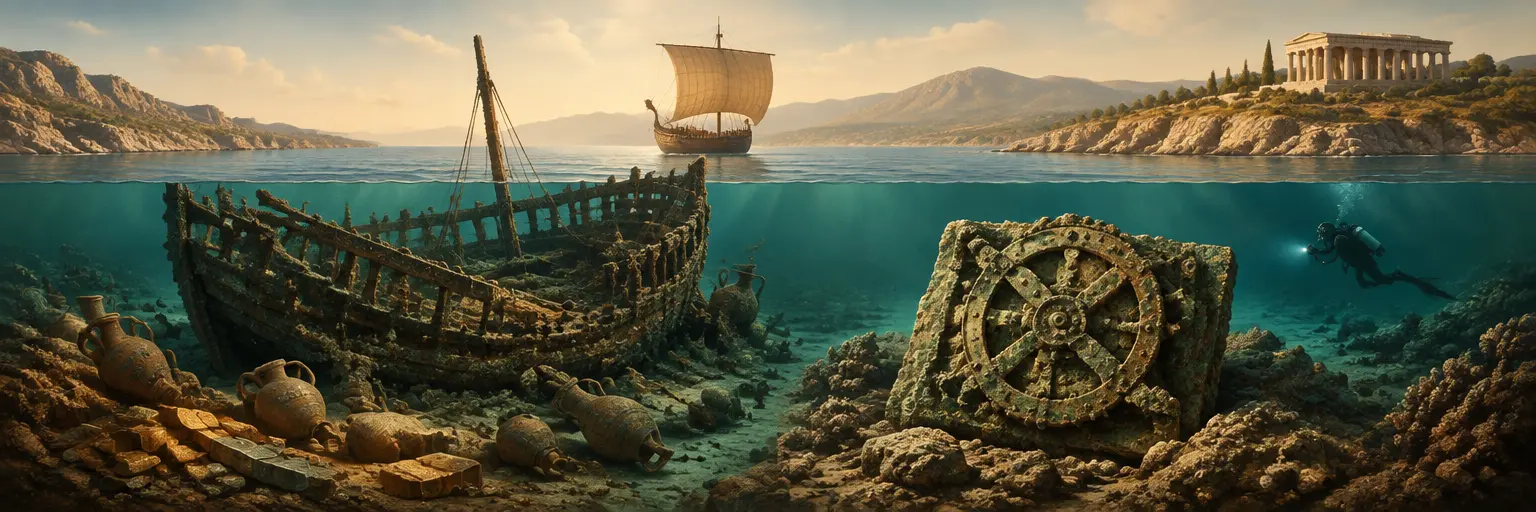
Explore the world’s most iconic underwater time capsules, where ancient trade routes and tragic voyages meet modern discovery. From the Uluburun shipwreck – a Late Bronze Age marvel laden with copper, tin, and exotic luxuries – to the famed Antikythera mechanism’s celestial remnants, these submerged sites reveal unparalleled secrets of maritime history. Dive into the depths of archaeology, where preserved cargoes, navigation tools, and daily life artifacts rewrite our understanding of ancient economies and technology. Perfect for history buffs and ocean enthusiasts alike, this digital treasure trove highlights excavation breakthroughs and the enduring allure of lost vessels. Uncover how these wrecks illuminate global connections across millennia—one artifact at a time.
🌟 Discover the Uluburun shipwreck cargo details revealing an unparalleled collection of ancient artifacts, shedding light on Bronze Age trade networks and…
Read article
🔍 Dive into the fascinating world of the Uluburun shipwreck materials analysis, revealing a diverse array of raw materials and finished goods…
Read articleWelcome to ArchaeologyHub.org’s dedicated portal for two of the most transformative underwater discoveries in history—the Uluburun shipwreck (14th century BC) and the Antikythera shipwreck (1st century BC). These famous shipwrecks are not just resting places for ancient cargo; they are time capsules that redefined our understanding of Bronze Age trade networks and Hellenistic technology. Here, we dissect their excavation, artifact profiles, and enduring mysteries, positioning you at the cutting edge of maritime archaeology.
Discovered off the southern coast of Turkey in 1982, the Uluburun wreck dates to roughly 1300 BC and yielded over 18,000 artifacts. This site is a cornerstone for understanding Late Bronze Age international commerce, showcasing a cargo of raw copper and tin ingots, Canaanite jars, ivory, ostrich eggs, and a golden scarab of Egyptian Queen Nefertiti. The vessel’s mixed provenance—Cypriot, Mycenaean, Levantine, and Egyptian—proves a complex, interconnected Mediterranean economy long before classical antiquity.
For archaeology enthusiasts, Uluburun offers a rare glimpse into shipbuilding techniques of the period, including the use of mortise-and-tenon joinery and a unique stone anchor system. The careful excavation, conducted by George Bass and Cemal Pulak, set new standards for underwater documentation. Expect detailed analyses of cargo weight distribution, navigational routes, and the social status of the crew, making this subcategory a goldmine for students of maritime logistics and cultural exchange.
Found in 1900 by sponge divers and excavated by Greek authorities, the Antikythera wreck (circa 70–60 BC) is most famous for the Antikythera Mechanism—an analog computer that predicted astronomical positions and eclipses. This site, off the Greek island of Antikythera, also yielded bronze sculptures, glassware, and a unique ship’s hull, providing insights into late Hellenistic luxury goods and Roman-era maritime design.
Our content here goes beyond the mechanism to explore the wreck’s current scientific re-evaluations. Recent 2024 dives have uncovered new skeletal remains and vessel fragments, prompting updated theories on the ship’s final moments. We break down how radiocarbon dating, 3D imaging, and conservation methods are revealing that the Antikythera wreck was a massive cargo vessel, possibly up to 50 meters long, carrying aristocratic plunder from the eastern Mediterranean to Rome. Expect a deep dive into the technology of the mechanism’s gears, dials, and inscriptions.
In this section, we juxtapose the material cultures from both wrecks. Uluburun’s cargo is utilitarian yet exotic—Israeli turquoise, Afghan lapis lazuli, and Baltic amber—indicating a long-distance exchange driven by royal demand. In contrast, Antikythera’s cargo features high-end art, such as the bronze “Philosopher” statue and marble horses, pointing to collection and display rather than raw trade. This comparison illuminates how wealth was expressed differently across 1,200 years of Mediterranean history.
We provide meta-analyses of ceramic typologies (e.g., Cypriot pithoi vs. Rhodian amphorae) and metallurgical compositions (copper-tin ratios) to show how production centers shifted. For casual readers, our visual guides with labeled diagrams help distinguish a Mycenaean stirrup jar from a Levantine storage jar. For professionals, we offer downloadable datasets of artifact dimensions and provenance, making this a vital resource for comparative archaeological studies.
Underwater excavation is a discipline of precision. For Uluburun, archaeologists used a grid system of nylon lines and airlifts to remove sediment without disturbing fragile organic remains like twine and food residues. We detail the step-by-step process of mapping each artifact’s position, which allowed reassembly of the ship’s layout and cargo stowage sequence—critical for understanding the captain’s loading strategy.
For Antikythera, the focus shifts to state-of-the-art conservation laboratories. The project has pioneered the use of palaeogenomics on skeletal remains to identify the crew’s ancestry, plus high-resolution CT scanning to virtually “unwrap” the corrosion layers of the mechanism. Our tutorials cover ethical dilemmas, such as the balance between in situ preservation and retrieval for study, and the threats from illegal looters. These case studies serve as a benchmark for any aspiring maritime archaeologist.
Visualize the chronological trajectories of both wrecks with our interactive maps anchored on radiocarbon dates and thermoluminescence data. Uluburun falls into the late 14th century BC, yet debates continue on whether the ship was a royal gift or a private trading venture. Antikythera’s date is equally contested—some scholars argue it sank on a voyage carrying treasure for Julius Caesar’s triumph, while others suggest it was a commercial liner.
We also revisit iconic controversies, like the “Pharaoh’s ship” theory for Uluburun and the possibility that the Antikythera mechanism’s display features were bugged, altering its astronomical accuracy. Our curated bibliography includes George Bass’s “Beneath the Seven Seas” and Derek de Solla Price’s “Gears from the Greeks,” giving you primary sources to challenge or support the current orthodoxy. This is the perfect springboard for academic essays or personal research projects.
These shipwrecks have lept from academic journals into popular culture—featured in documentaries like “Ancient Impossible” and blockbuster museum exhibitions at the Bodrum Museum and the National Archaeological Museum in Athens. We analyze how these sites have shaped public perceptions of maritime history, from romanticized pirate tales to realistic depictions of complex logistics and skilled craftsmanship.
We also track ongoing digital preservation projects, including 3D printed replicas for tactile museum experiences and virtual reality tours that let you “dive” without leaving home. Our site aggregates news on new finds, such as the 2025 discovery of a bronze ram near Antikythera, and explains how these items are responsibly repatriated or loaned. By connecting scholarship to storytelling, we empower visitors to see themselves as part of a living, evolving archaeological narrative.
The Uluburun wreck lies about 60 meters deep off the coast of Kaş, Turkey, near Cape Uluburun. The Antikythera wreck is just off the small Greek island of Antikythera, at a depth of roughly 45–70 meters, in the Aegean Sea near Crete.
Uluburun’s cargo includes ten tons of copper and tin ingots, ebony logs, ivory tusks, and a gold scarab of Nefertiti. Its diversity—spanning at least seven cultures—makes it a singular reference for understanding Late Bronze Age royal gift-exchange and interregional trade routes.
The mechanism’s wooden casing and ceramic housing protected its bronze gears from complete corrosion. It lay encrusted with sediment, which effectively sealed it from oxygen. Modern conservation using CT scans and chemical stabilization has preserved its remaining fragments for future study.
Yes, both sites are periodically revisited. Recent expeditions to Antikythera (2022–2025) have found new ceramic shards and a bronze spear. Uluburun’s site is considered nearly fully excavated, but micro-sampling of sediment continues to recover seeds and pollen for paleoenvironmental research.
Absolutely. Bodrum Museum in Turkey holds the best Uluburun collection, while Athens’ National Archaeological Museum has the Antikythera salvaged artifacts. Many international museums, like the Field Museum in Chicago and the British Museum, have hosted traveling exhibitions, and virtual 3D tours are available online.







