Tell Aswad: Early Agricultural Practices and Settlement in the Damascus Basin
🌱 Discover Tell Aswad early agriculture Damascus, a pivotal site revealing the origins of farming and settlement in the Damascus Basin. This…
Read article
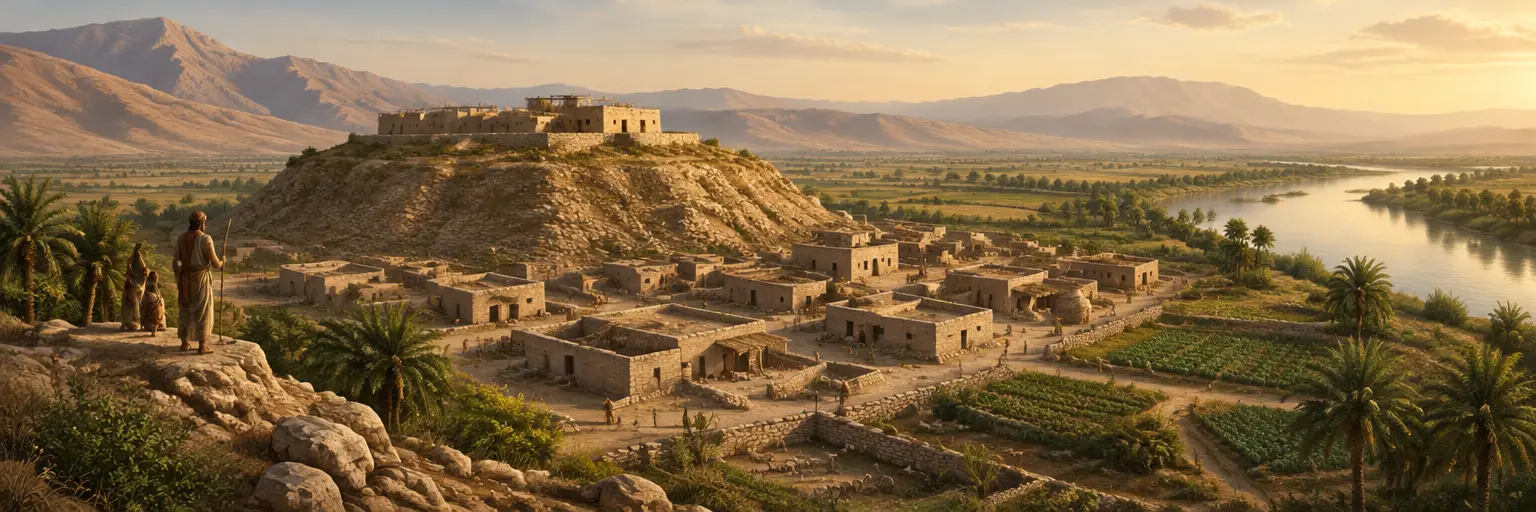
Jericho, often hailed as the world’s oldest continuously inhabited city, anchors our exploration of the Levant’s earliest settlements, where Neolithic innovation meets mythic history. Here, uncover the 10,000-year-old tower that defied time, the plastered skulls that whisper ancestral rituals, and the dramatic shifts from hunter-gatherers to pioneering farmers along the Jordan Valley. This digital archive pieces together stratigraphic layers—from Pre-Pottery Neolithic A to Bronze Age fortifications—revealing how early communities harnessed water, domesticated plants, and built communal defenses. Dive into excavation reports, artifact close-ups, and interactive timelines that decode the region’s role as a cradle of urbanism, while comparing contemporaneous sites like ‘Ain Ghazal and Tell es-Sultan. Whether you’re a student of archaeology or a curious traveler, these profiles illuminate the resilience, trade networks, and ceremonial life that shaped Levantine societies long before written records. Explore the evidence, challenge assumptions, and trace the roots of human settlement in one of the most contested and captivating archaeological landscapes on Earth.
🌱 Discover Tell Aswad early agriculture Damascus, a pivotal site revealing the origins of farming and settlement in the Damascus Basin. This…
Read article
🌱 Explore the Jordan Valley Neolithic village environment, revealing how early communities adapted to and shaped their surroundings. This article provides insights…
Read articleWelcome to ArchaeologyHub.org’s dedicated section on Levantine Sites: Jericho & Early Settlements, a cornerstone of our global coverage of archaeological treasures. This subcategory delves into the cradle of urbanization, where the world’s earliest known continuous settlements emerged along the Jordan Valley. Here, you’ll discover how hunter-gatherers transitioned to complex agricultural societies, the engineering marvels of ancient defensive walls, and the cultural shifts that shaped the Levant. Our curated content combines cutting-edge excavation data, artifact analyses, and regional timelines to illuminate the profound legacy of places like Tell es-Sultan (ancient Jericho). Perfect for students, researchers, and history enthusiasts, this resource bridges millennia of human innovation.
In this section, we unpack the transformative period from 10,000 to 6,000 BCE, when early Levantine communities abandoned nomadic lifestyles for permanent dwellings. Expect detailed profiles of Pre-Pottery Neolithic A and B sites, including round mud-brick houses, communal storage pits, and early domestication of emmer wheat and barley. Our timelines highlight climate shifts and technological breakthroughs, such as plaster production and flint sickle blades.
You’ll also find interpretative essays on the social implications of sedentism—how surplus food enabled craft specialization, trade networks, and ritual practices. We compare Jericho’s famed tower (circa 8000 BCE) with other regional settlements like Netiv Hagdud and Gilgal, offering a nuanced view of early urban planning. Each article is cross-referenced with excavation reports, making this a vital resource for understanding humanity’s first leap into city life.
Here, we focus on the iconic stone walls and ditch of Jericho, dating to the Pre-Pottery Neolithic period, and their later Bronze Age iterations. Learn about the pioneering excavation work of Kathleen Kenyon and the recent radiocarbon reframing that challenges traditional destruction narratives. We dissect the strategic location of the spring of Ein es-Sultan, which sustained continuous occupation for over 10,000 years.
Our content reveals sophisticated water systems, including plastered channels and reservoirs, that supported dense populations. We also explore the function of the 8.5-meter-high tower—whether defensive, ceremonial, or astronomical—through current scholarly debates. Visual reconstructions and 3D models help you visualize successive building phases, while our artifact galleries showcase imported obsidian and shells, proving early long-distance exchange.
Dive into the botanical and zooarchaeological evidence that makes the Levant a global center of origin for agriculture. This subcategory features analysis of charred seeds, legumes, and pulses recovered from early settlement floors, tracing the genetic shift from wild to domesticated varieties. We explain experimental archaeology methods—like reaping wild cereals with flint blades—that test ancient harvest efficiency.
Beyond crops, we examine animal domestication of goats, pigs, and cattle, and their role in sustainable living. Detailed charts show gradual morphological changes that signal human selection. You’ll also encounter case studies on land use, soil fertility, and the emergence of permanent field systems. These insights are crucial for archaeologists linking climate data to neolithic expansion across the Mediterranean.
Stay current with our updates on fieldwork at Jericho and nearby sites like Tell Aswad and Dhra’. We showcase lidar scanning, micro-stratigraphy, and lipid analysis of pottery residues, which have revolutionized our understanding of early food processing. Expect interviews with principal investigators and behind-the-scenes logs from active digs, offering a real-time glimpse into archaeological practice.
We also present controversies, such as the possibility of earlier settlement phases predating the current 9000 BCE bracket. Our dating methodology explainers—from optically stimulated luminescence to Bayesian modeling—help readers evaluate conflicting chronologies. This section ensures you’re not just learning static facts but witnessing the dynamic evolution of archaeological science in the Levant.
Finally, we contextualize Jericho’s innovations within a wider network of pre-pottery cultures across the Fertile Crescent. Compare parallel developments in Anatolia (Çatalhöyük) and the Zagros, highlighting shared symbolic motifs like plastered skulls and fertility figurines. Our maps illustrate trade routes linking the Levant to the Red Sea and Anatolia, based on raw material sourcing.
We also assess the lasting impact on later Biblical-era Jericho, including the famous wall stories and their archaeological validation. This broader perspective helps you appreciate how these early settlements influenced Bronze Age urbanization and even modern concepts of community resilience. Through comparative timelines and cultural exchange diagrams, you’ll see the Levant as a pivotal connector of ancient worlds.
The earliest evidence at Tell es-Sultan dates to around 10,000 BCE, belonging to the Natufian culture’s transitional phase. However, substantial permanent architecture appears in the Pre-Pottery Neolithic A (circa 8500 BCE), including round houses and the famous tower. Radiocarbon dates place these early levels firmly within the settled hunter-gatherer era.
Scholars propose multiple functions: defense against floods, a ceremonial structure for communal rituals, or an astronomical observatory to track solar solstices. Recent excavations suggest it was likely a communal rallying point or a platform for status displays, given its imposing size and central location near the spring.
They relied on the perennial spring of Ein es-Sultan, accessed via stepped channels and plastered basins. Evidence shows deliberate management of runoff, including sediment traps and diversion systems, which supported intensive agriculture. These engineering feats sustained populations of several hundred, a remarkable density for the time.
Excavations have uncovered multiple wall systems, but the famous collapsed walls date to the Late Bronze Age (around 1550 BCE), not the Biblical conquest timeframe. Kathleen Kenyon’s work found no destruction layer matching Joshua’s story. Modern archaeology views the narrative as symbolic, with earlier Neolithic walls being far more substantial.
Jericho’s early settlers domesticated emmer wheat, barley, lentils, and figs, while goats and possibly pigs were herded. Morphological changes like non-shattering rachises indicate human selection by 8000 BCE. Sheep domestication came later, around 7000 BCE, likely from Anatolia, showing dynamic exchange networks.







