Explore the Panhellenic Sanctuaries of Delphi & Olympia
Welcome to our dedicated subcategory on Greek Sites: Delphi & Olympia, two of the most revered Panhellenic sanctuaries in the ancient world. At ArchaeologyHub.org, we dive deep into the archaeological evidence, religious practices, and athletic traditions that defined these sacred spaces. Here, you will uncover how these sanctuaries unified the Greek city-states through shared cults and competitions, offering a unique window into classical antiquity and its enduring legacy.
🏛️ The Oracle of Delphi: Religious Centrality and Ritual Practice
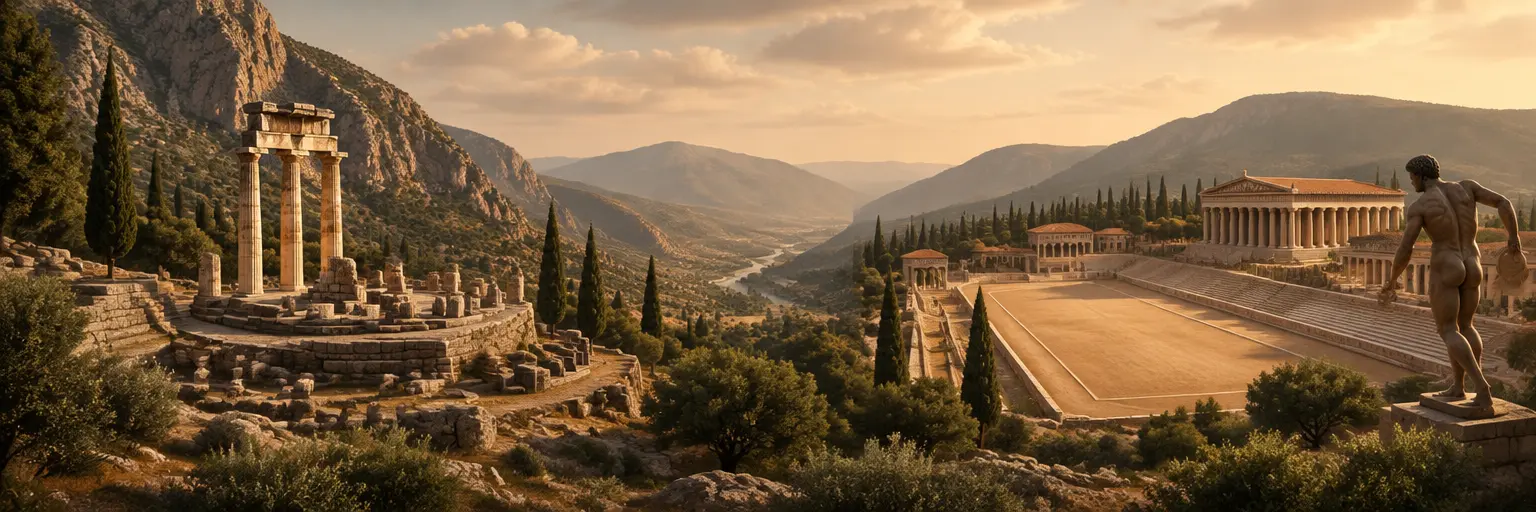
Our coverage of Delphi focuses on its role as the navel of the world (omphalos), where the Pythia delivered prophecies that shaped political and personal decisions across the Mediterranean. Expect detailed analyses of the Temple of Apollo, the Sacred Way, and the treasuries built by competing city-states. We also examine the geological evidence of ethylene gas emissions, which may explain the oracle’s trance-like states, blending archaeology with interdisciplinary science.
You will find interpretive guides on votive offerings, processional routes, and the symbolic landscape of Mount Parnassus. Each artifact profile, from the Sphinx of Naxos to the Charioteer, is contextualized within the sanctuary’s ritual calendar. Our resources help you understand how Delphi functioned not just as a religious hub, but as a political and economic center where embassies, artists, and pilgrims converged, making it a microcosm of ancient Greek identity.
🏅 Olympia: Origins of the Games and Athletic Ideology
This section breaks down the archaeological layers of Olympia, from the prehistoric cult of Pelops to the monumental Altis grove. We highlight the temple of Zeus and his chryselephantine statue, one of the Seven Wonders, alongside the stadium, hippodrome, and gymnasium. Expect insights into the pentathlon, foot races, and combat sports, as well as the rituals of victory, including olive wreath crowns and commemorative poems by Pindar.
Our analyses also cover the socio-political role of the Olympic truce (ekecheiria) and how the games fostered a pan-Hellenic identity. We explore recent excavations of the workshop of Pheidias, where the statue was crafted, and the Palaestra’s training routines. By combining artifact profiles with historical texts, you will see how Olympia’s material culture reveals the evolving ideals of physical excellence, religious devotion, and civic pride.
🛕 Shared Architectural and Iconographic Traditions
Discover the architectural parallels and regional variations between Delphi and Olympia, including Doric and Ionic orders, peripteral temples, and treasuries. We compare the metopes of the Temple of Zeus—illustrating the Labors of Heracles—with the Siphnian Treasury friezes at Delphi, showcasing mythological narratives as political allegory. Our guides decode the iconography of Nike, Apollo, and Zeus, explaining how these sanctuaries transmitted shared myths across city-states.
You will also learn about water management systems, altars, and building materials sourced from local quarries, reflecting both technological adaptation and artistic exchange. We provide visual reconstructions and 3D models that bring these sanctuaries to life, helping you visualize the sensory experience of ancient worshippers and athletes. This comparative approach enhances your ability to identify common Greek religious patterns and local innovations.
📜 From Excavation to Interpretation: Historical Methodologies
Here we detail the excavation histories of both sites, from the 19th-century French and German missions to modern geophysical surveys. We discuss the methodological challenges of dating organic materials, reconstructing fragmented sculptures, and interpreting literary sources like Pausanias’ travelogue. Expect case studies on the use of archaeometry, including stable isotope analysis of bones from sacrificial altars, which reveals dietary and sacrificial practices.
Our content also addresses the ethical management of heritage sites, including conservation threats from tourism and earthquakes. You will gain insight into how archaeologists distinguish between later Roman interventions and classical Greek phases, ensuring accurate chronological frameworks. By presenting both triumphs and controversies, we emphasize that our understanding of Delphi and Olympia is constantly evolving through new evidence and interdisciplinary collaboration.
🌍 Cultural Legacy and Modern Reception
The final major section explores the enduring impact of these sanctuaries on modern movements, from the revival of the Olympic Games in 1896 to philosophical debates on democracy and sportsmanship. We analyze how 18th-century travelers and Neoclassical architects appropriated Greek forms, shaping Western cultural ideals. Expect discussions on the Nazi propaganda misuse of Olympia’s torch relay, contrasting it with contemporary Olympic values of peace and solidarity.
We also cover the ongoing archaeological projects, such as the restoration of the Philippeion and the study of Roman baths, linking ancient practices to present-day spectator culture. Our resources include interviews with modern archaeologists, virtual tours, and reading lists that connect the ancient world to current issues of multiculturalism and heritage preservation. This section ensures you leave with a comprehensive appreciation of how these Panhellenic sanctuaries continue to inspire global imagination.
Frequently Asked Questions
Why were Delphi and Olympia considered Panhellenic sanctuaries?
They were open to all Greek-speaking peoples, unlike city-specific temples. Their festivals and oracles drew participants from every polis, fostering a shared cultural identity. Both sites hosted major games—the Pythian and Olympic—and served as neutral grounds for diplomatic negotiations, reinforcing their role as unifying forces in a fragmented political landscape.
What is the best time of year to visit these archaeological sites?
Spring (April-June) and autumn (September-October) offer mild temperatures and fewer crowds. Summer is hot and busy, while winter may bring rain and closures. To avoid peak tourist congestion, visit early mornings or late afternoons. Check official schedules for holiday closures, and consider guided tours that provide deeper context.
How were the Olympic Games originally different from modern ones?
Ancient games were strictly religious, held in honor of Zeus, and included only male athletes competing nude. Events were limited to running, wrestling, boxing, pankration, pentathlon, and chariot racing. Winners received olive wreaths, not medals, and returned home as heroes. There were no team sports, and women were excluded from spectating, except for priestesses.
Can you explain the role of the Pythia at Delphi?
The Pythia was a priestess who delivered oracle responses in a trance-like state, possibly induced by ethylene gas. She sat on a tripod above a chasm, and her utterances were interpreted by priests into hexameter verse. She consulted only on specific days, and her advice influenced colonizations, wars, and laws, making her one of the most powerful women in antiquity.
Are there any ongoing conservation efforts at these sites?
Yes, both sites have continuous restoration programs. At Olympia, the roof of the Temple of Zeus is being reconstructed, and at Delphi, the Tholos is under structural monitoring. UNESCO supports these efforts, focusing on drainage systems and seismic retrofitting. Public donations and digital documentation help mitigate wear from millions of annual visitors, ensuring preservation for future generations.