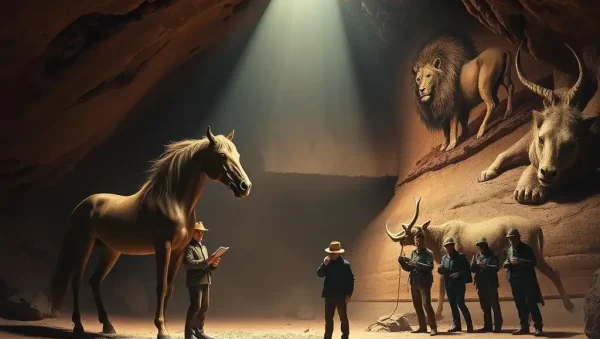
The Hillaire Chamber, Chauvet Cave: Layout and Artistic Highlights
🌟 Explore the Chauvet Cave Hillaire Chamber Layout, a remarkable archaeological site showcasing stunning prehistoric art and complex cavern structures. This detailed…
Read article
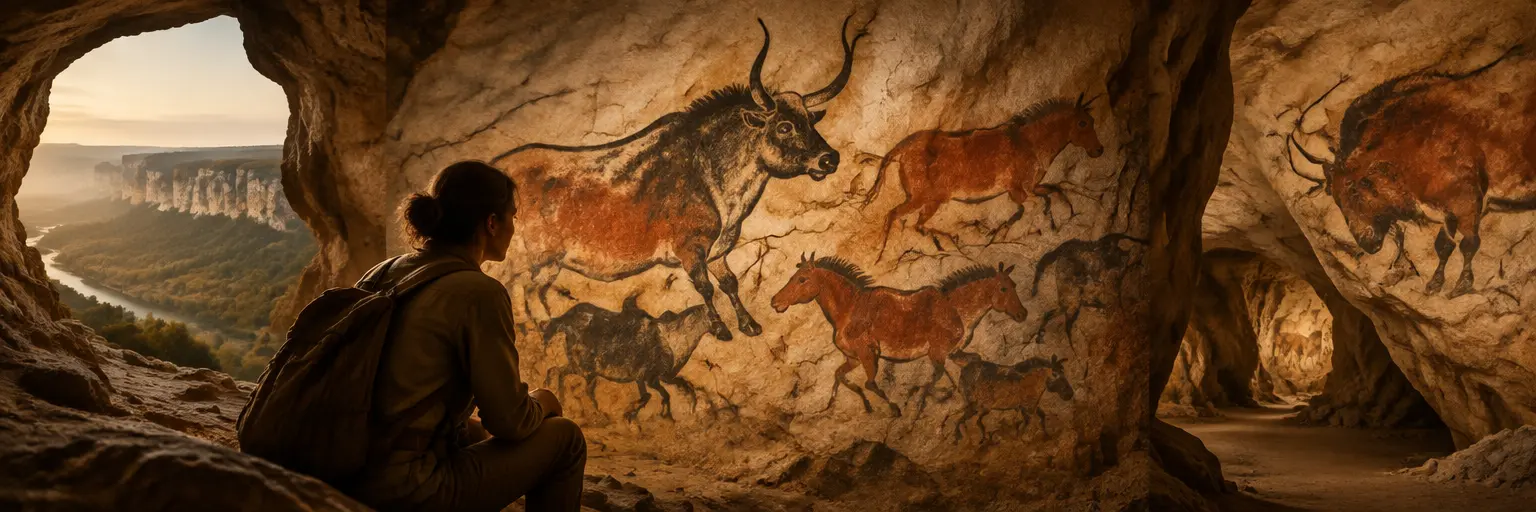
Dive into the earliest masterpieces of human creativity with our deep exploration of Paleolithic Cave Art, featuring the iconic sanctuaries of Lascaux, Chauvet, and Altamira 🎨🕰️. These European prehistoric sites, often called the “Sistine Chapels of the Stone Age,” preserve breathtaking paintings of mammoths, lions, and bison that date back over 30,000 years. Journey through the staggering realism and symbolic complexity of Ice Age artistry, and understand the *advanced techniques*—from charcoal sketching to mineral pigment shading—used by our ancient ancestors. Discover how recent archaeological dating and advanced imaging are reshaping our understanding of human cognitive evolution, ritual behavior, and the origins of storytelling. Whether you are a student of archaeology, an art history enthusiast, or a curious traveler, this digital encyclopedia entry brings you chronological timelines, detailed artifact profiles, and interpretive analyses of these UNESCO World Heritage treasures. Unlock the mysteries of a time when caves served as both canvas and cathedral, and see why these parietal artworks remain a cornerstone of global heritage.
Welcome to ArchaeologyHub.org’s definitive guide to the most profound artistic expressions of the Ice Age. This subcategory delves into the painted sanctuaries of Lascaux, Chauvet, and Altamira, offering an immersive journey into the minds of our prehistoric ancestors. Here, we decode the symbolism, techniques, and cultural significance behind these ancient masterpieces, providing a rich, SEO-optimized resource for students, researchers, and virtual travelers. Discover how these caves, hidden for millennia, have reshaped our understanding of early human cognition and creativity.
Discover why the Lascaux Cave in southwestern France, discovered in 1940, is revered as the pinnacle of Paleolithic artistry. Our detailed analysis covers the Hall of the Bulls, featuring lifelike aurochs, horses, and stags painted with astonishing dynamism. You’ll learn about the sophisticated use of mineral pigments like ochre and manganese dioxide, and the innovative spray-painting techniques via hollow bones. We also explore the challenging conservation history, including the 1963 closure to the public due to fungal damage, and the precision-built replica, Lascaux IV, which allows visitors to experience the cave without harming the original.
This section is meticulously crafted to highlight the compositional complexity and spatial awareness of these ancient artists. Expect a deep dive into the iconography of the wounded man and the disemboweled bison, a rare human representation in cave art, which fuels ongoing debates about shamanic rituals and narrative storytelling. For archaeology enthusiasts, we provide a comparative timeline linking Lascaux’s style (Magdalenian period, ~17,000 years old) with other contemporary sites, enriching your global perspective on prehistoric migration and shared symbolic languages.
Challenge your assumptions about artistic progress with our deep examination of Chauvet Cave in the Ardèche region of France. Unlike Lascaux, Chauvet’s art is shockingly sophisticated yet dates back approximately 36,000 years (Aurignacian period), making it one of the oldest known narrative artworks on Earth. We dissect the charcoal drawings of rhinos, lions, and mammoths, which exhibit perspective, shading (gradation), and a unique “twisted perspective” that rivals Renaissance techniques. Our content explains how revolutionary carbon-14 dating in the 1990s shattered the theory that art evolved linearly from crude to refined.
Here, you’ll find expert interpretations of the cave’s spatial layout, where bears’ claw marks and fire pits suggest a complex ritualistic use. We also cover the groundbreaking 3D mapping projects and climate-controlled access policies that protect this UNESCO World Heritage site. By juxtaposing Chauvet’s advanced artistry with its extreme antiquity, we invite you to ponder the cognitive capabilities of early Homo sapiens, and whether Neanderthals might have created some symbolic marks, a topic of fierce academic contention that we present with balanced evidence.
Step into the “Sistine Chapel of Cantabria” with a thorough exploration of the Altamira Cave in northern Spain. Unlike the charcoals and reds of French sites, Altamira’s ceiling bursts with vivid polychrome paintings—bison in shades of red, black, and ochre, created using the natural contours of the rock to add three-dimensional relief. You’ll learn about Marcelino Sanz de Sautuola’s 1879 discovery and the initial rejection by the scientific community, who believed prehistoric humans lacked such intellect. We trace the eventual acceptance, driven by the discovery of similar art in France, marking Altamira as a cornerstone of modern archaeology.
Our guide provides a technical breakdown of the Solutrean and Magdalenian layers, showing how artists used engraving before painting and employed animal fat mixed with pigments. We also discuss the ongoing delicate preservation efforts and the public access controversy, including the controversial 2011 reopening for limited visits. For travelers, we highlight the Museo de Altamira’s exacting facsimile, which offers a sensory experience of the cave’s acoustics and humidity, making this resource indispensable for planning both physical and virtual pilgrimages.
Broaden your horizon with our cross-referential analysis of Paleolithic cave art beyond the Big Three. We compare the dotted handprints of Pech Merle (France), the geometric signs of Cosquer (France, now partially submerged), and the engraved animals of Cueva de las Manos (Argentina, as a global extension). This section reveals recurring motifs—hands, horses, and abstract tectiform signs—that suggest a pan-European symbolic language. Through our interactive timelines, you’ll see how environmental factors like the Last Glacial Maximum influenced site choices, favoring limestone caves deep within river valleys.
This comparative hub is optimized for researchers seeking connections between cave art and early astronomical knowledge or seasonal hunting calendars. We dissect the statistical distribution of species depicted—why bison and aurochs dominate over reindeer, despite the latter being a dietary staple. You’ll also find a curated bibliography linking to raw excavation reports and archaeoacoustic studies, positioning ArchaeologyHub as your reliable gateway for primary sources. Whether you’re a student writing a dissertation or a curious amateur, this synthesis will illuminate currents of migration and cultural exchange across Ice Age Europe.
Uncover the ingenious engineering and artistic methods of Paleolithic painters. Our technical deep-dive covers the scaffolding systems implied by high, unreachable panels, and the use of animal fat lamps (as replicated experimentally) for light. We explain the pigment-grinding processes using quartzite mortars, the binding agents like plant sap or egg white, and the “spitting” technique for spraying pigment. Learn how the artists manipulated natural rock surfaces—using bulges as bison humps and cracks as animal backs—to create an early form of 3D cinematography. We also detail modern X-ray fluorescence analysis that reveals hidden layers and mineral salts, showing that many images were created in multiple phases over centuries.
Expect a hands-on understanding of the “paint kit” found in certain caves, including shells for mixing and bone tubes for stenciling. This section answers practical questions: How did they achieve such fine lines without brushes? (Answer: Charcoal sticks and fur applicators). We also link to experimental archaeology programs where modern flintknappers replicate the tools, demonstrating the physical dexterity required. For educators, this content provides clear diagrams and step-by-step activity suggestions, while for conservationists, it outlines the chemical changes that atmospheric CO2 and visitor heat induce on the rock surfaces.
The oldest currently accepted cave art is in the El Castillo Cave in Spain, with a red dot dating to over 40,800 years ago. However, for figurative art, Chauvet-Pont d’Arc is often cited as the oldest complex animal paintings, at roughly 36,000 years old. These dates come from uranium-thorium and radiocarbon analyses, and ongoing discoveries may push the timeline back further.
Geological conditions are the primary factor. These regions have extensive limestone karst systems, which naturally form caves with stable, dry interiors that preserve pigments. Additionally, Ice Age human populations in Western Europe were dense and culturally linked. Similar caves exist in other regions but may have collapsed or eroded, while global sites like Indonesia also feature ancient art but aren’t as well-surveyed.
No. The original Lascaux and Chauvet caves are closed to tourists to prevent fungal growth and CO2 damage. Instead, visitors can see exact full-scale replicas: Lascaux IV (Montignac, France) and Chauvet 2 (Vallon-Pont-d’Arc, France). Altamira in Spain allows a small, lottery-based public entry of a few visitors per week, but most people see the Museum of Altamira’s replica.
They primarily use Uranium-Thorium dating for calcite crusts that form over paintings, and radiocarbon dating for organic pigments like charcoal. Both require tiny samples (milligrams). Non-invasive techniques include portable X-ray fluorescence (pXRF) and digital 3D scanning, which map pigment chemistry and engraving depth without contact.
Likely psycho-symbolic, hand stencils may indicate individual identity or group membership. Studies of finger lengths suggest many are female or juvenile hands, challenging the male-hunter stereotype. They might also represent “signatures” by shamans during trance rituals, or serve as apotropaic symbols to ward off predators, though no consensus exists.







