InterCity Trade Networks in Sogdiana: Beyond Samarkand's Central Role
🌍 Explore the Sogdian trade routes history, highlighting how intercity networks in Sogdiana extended beyond Samarkand, revealing a complex web of commerce…
Read article
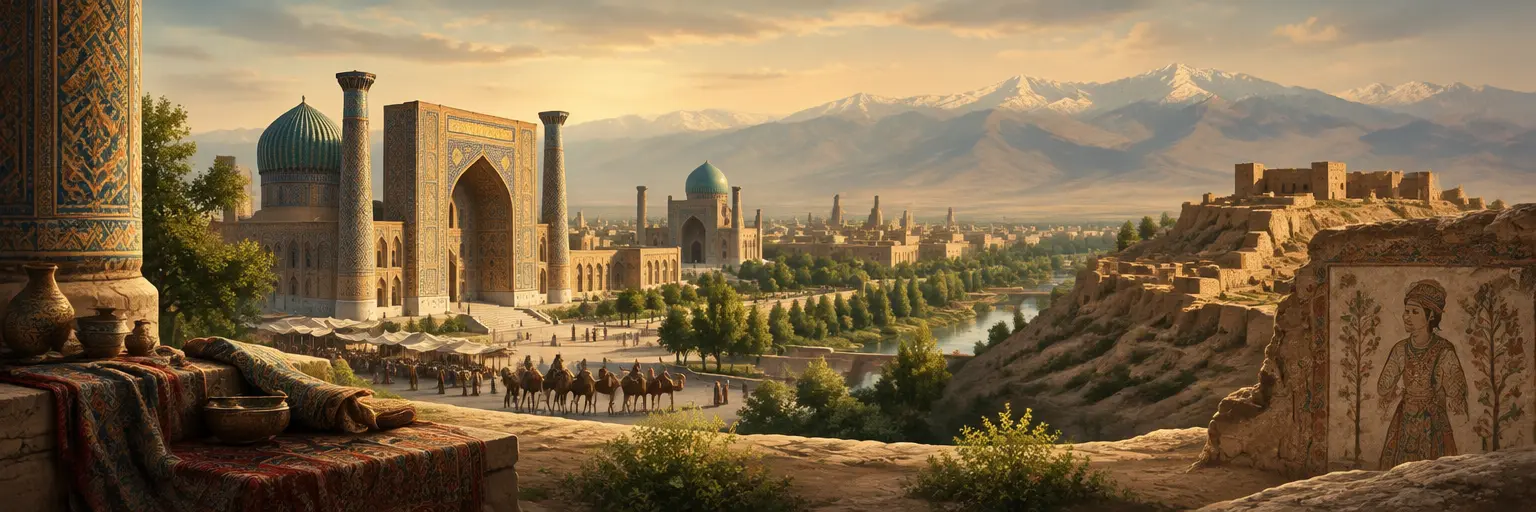
Step into the heart of the Silk Road with our in-depth exploration of Samarkand and the Sogdian Cities, focusing on the legendary site of Afrasiab. This ancient settlement, the precursor to modern Samarkand, unlocks the vibrant world of the Sogdians—master merchants, artists, and cultural intermediaries who connected China, Persia, and the Mediterranean. Discover the famous Afrasiab murals, a stunning 7th-century masterpiece depicting embassies from across Asia, offering a rare, colorful window into political alliances and courtly life. Our coverage includes the site’s archaeological stratification, from its first millennia BCE foundations to its destruction by Genghis Khan, alongside artifact profiles of Sogdian ossuaries, coins, and intricate textiles. Whether you are a student of Central Asian history, a traveler planning a visit to Uzbekistan, or a devoted archaeology enthusiast, this digital encyclopedia brings the dusty trenches to life with interactive timelines, high-resolution imagery, and contextual analyses of how these cities served as melting pots of Zoroastrianism, Buddhism, and early Islam.
🌍 Explore the Sogdian trade routes history, highlighting how intercity networks in Sogdiana extended beyond Samarkand, revealing a complex web of commerce…
Read article
🌟 Discover the archaeological remnants of Zoroastrian fire temples in Sogdiana, with key findings from Samarkand and Panjakent. This article explores the…
Read articleWelcome to ArchaeologyHub.org’s dedicated guide on Central Asian Sites: Samarkand & Sogdian Cities (Afrasiab). This subcategory delves into the urban marvels and cultural crossroads of pre-Islamic Sogdiana, focusing on the legendary city of Samarkand and its ancient predecessor, Afrasiab. Here, you’ll uncover the archaeology of a civilization that thrived along the Silk Road, blending Persian, Turkic, and Hellenistic influences into a unique mosaic of art, architecture, and daily life. From vibrant murals to complex irrigation systems, we dissect the latest excavations and scholarly interpretations to bring you a nuanced view of these UNESCO-recognized landscapes.
Afrasiab, located on the northern outskirts of modern Samarkand, was the city’s heart from the 6th century BCE until its destruction by Genghis Khan in the 13th century. This archaeological mound, spanning over 200 hectares, reveals layers of Sogdian, Hellenistic, and early Islamic occupation. Our content explores the defensive walls, palatial complexes, and residential quarters unearthed by Uzbek and international teams. You’ll learn how recent geophysical surveys have mapped street grids and public spaces, offering a clearer picture of urban planning in a Silk Road metropolis.
Excavations at Afrasiab have yielded ceramic workshops, coin hoards, and fire temples that attest to a cosmopolitan society. We analyze the transition from Sogdian rule to Arab conquest, using stratigraphy and carbon dating to reconstruct periods of prosperity and decline. By studying animal bones and botanical remains, our articles explain dietary habits and trade networks that connected this inland city to China, India, and the Mediterranean. Expect detailed artifact profiles and 3D reconstructions that make this ancient citadel accessible to both students and enthusiasts.
Discovered in 1965 in a Sogdian ruler’s palace, the Afrasiab murals are among the most significant finds in Central Asian archaeology. These wall paintings, dating to the 7th century CE, depict ambassadors from China, Korea, and Persia, alongside hunting scenes and religious processions. Our subcategory offers high-resolution image galleries and iconographic analyses, decoding the political messages woven into each figure’s costume, gesture, and accompanying inscriptions. You’ll understand how these murals served as a visual declaration of Sogdian authority and international alliances.
Beyond aesthetics, we investigate the pigment chemistry and painting techniques used by Sogdian artists, comparing them with contemporaneous works in Panjakent and Varakhsha. Conservation challenges, including salt damage and humidity control, are discussed alongside innovative restoration efforts. By linking mural imagery to textual sources like the Chinese Tang annals, our articles provide a multidisciplinary perspective on diplomacy, fashion, and ritual in 7th-century Central Asia. This section is a treasure trove for art historians and those fascinated by cross-cultural exchange.
The Sogdian civilization extended far beyond Samarkand, with major centers like Panjakent (in Tajikistan) and Varakhsha (near Bukhara) revealing parallel urban traditions. This subcategory expands your exploration to these satellite cities, comparing their fortifications, temples, and domestic architecture with Afrasiab. Panjakent’s well-preserved houses, complete with murals and wooden carvings, offer an intimate glimpse into Sogdian domestic life, while Varakhsha’s palace complex showcases royal iconography tied to the Bukhara oasis. We provide interactive maps and virtual tours to guide your comparative study.
Our articles highlight irrigation canals and agricultural hinterlands that sustained these urban centers, drawing on paleobotanical and hydrological research. You’ll discover how Sogdian merchants managed caravanserais and markets, creating a networked economy that rivaled contemporary empires. Recent excavations at Panjakent have uncovered Zoroastrian ossuaries and Buddhist relics, proving religious diversity. By synthesizing settlement patterns and trade routes, we aim to show how Sogdian cities functioned as interconnected nodes in a vast exchange system, influencing later Islamic urbanism.
Delve into the everyday objects that defined Sogdian society, from intricately painted ceramics to silver coins imitating Sassanian prototypes. This section catalogs vessel forms, decorative motifs, and manufacturing techniques, linking them to specific workshops and chronological phases. Our database includes 3D scans of amphorae, jugs, and ritual bowls, emphasizing how pottery styles shifted with political changes and trade influxes. You’ll also explore terracotta figurines, glassware, and bone tools that reveal domestic rituals, gender roles, and craft specialization.
Numismatics forms a core focus, with analyses of coin hoards from Afrasiab and Panjakent that illuminate economic stability and external influences. We decode countermarks, weights, and iconography to trace Byzantine, Chinese, and Sassanian connections. Additionally, evidence of textile production—from spindle whorls to dye vats—is examined to understand luxury goods trade. By integrating these material remains with textual records, our articles reconstruct daily life from street vendors to royal courts, offering a tactile connection to the past that purely textual histories cannot provide.
Preserving the fragile remains of Afrasiab and nearby Sogdian cities is a race against time, threatened by urban sprawl, looting, and climate change. This subcategory details ongoing conservation projects funded by UNESCO and international bodies, including structural stabilization of mudbrick walls and protective shelters for murals. We discuss the ethical dilemmas of reconstructing vs. preserving original fabric, using case studies from recent restoration campaigns. You’ll learn how local communities are involved in site management, balancing tourism with archaeological integrity.
Digital preservation plays a pivotal role, with photogrammetry, LiDAR, and virtual reality creating high-fidelity archives of at-risk structures. Our content reviews open-access platforms where 3D models of Sogdian palaces and artifacts can be downloaded for educational use. We also address the impact of war and political instability, such as the Tajikistan civil war’s effect on Panjakent’s excavations. By highlighting successful public archaeology initiatives, we aim to inspire support for these irreplaceable treasures, ensuring that future generations can engage with Sogdian heritage through both physical and virtual means.
Afrasiab is the ancient precursor to Samarkand, serving as a major Sogdian urban center from the 6th century BCE to the 13th century CE. It was a vital Silk Road hub where cultures from China, Persia, and Greece interacted, evidenced by its murals, coinage, and diverse artifacts. Its destruction by Genghis Khan marked the end of a prosperous era that shaped later Islamic Samarkand.
The murals were discovered in 1965 during Soviet-era excavations in the palace of the Sogdian ruler Varkhuman. They were found in a remarkable state, with pigments intact. Preservation efforts include environmental controls, protective coatings, and careful documentation. Recent digital imaging has created high-resolution records for study and conservation, addressing ongoing threats from moisture and salt crystallization.
Afrasiab was a larger, more cosmopolitan administrative center, while Panjakent was a smaller but artistically rich merchant city. Panjakent’s domestic architecture and murals are better preserved, revealing daily life, whereas Afrasiab offers more monumental palatial and defensive works. Both share similar Sogdian cultural traits, but Panjakent’s remote location led to less later overbuilding, preserving more original structures.
Yes, the Afrasiab Museum, located adjacent to the archaeological site in Samarkand, houses the famous murals, artifacts, and a scale model of the ancient city. Visitors can walk the exposed excavation areas, though guided tours are recommended for context. The site is open year-round, with some areas restricted for conservation. Check ArchaeologyHub.org for current visitor guidelines and virtual tour options.
Sogdian material culture, including ceramics, coins, and textiles, provides direct evidence of long-distance exchange networks. For instance, Sassanian coin imitations show monetary influence, while Chinese silks and mirrors found in Sogdian sites indicate trade flows. These artifacts also reveal how Sogdians adapted foreign styles, acting as cultural intermediaries who spread Buddhism, Manichaeism, and artistic techniques along the Silk Road.







