
Modern Archaeological Methods at Olduvai Gorge: New Discoveries
🌍 Discover groundbreaking insights in Olduvai Gorge archaeological method, as recent excavations unveil new artifacts and refine dating techniques. This article highlights…
Read article
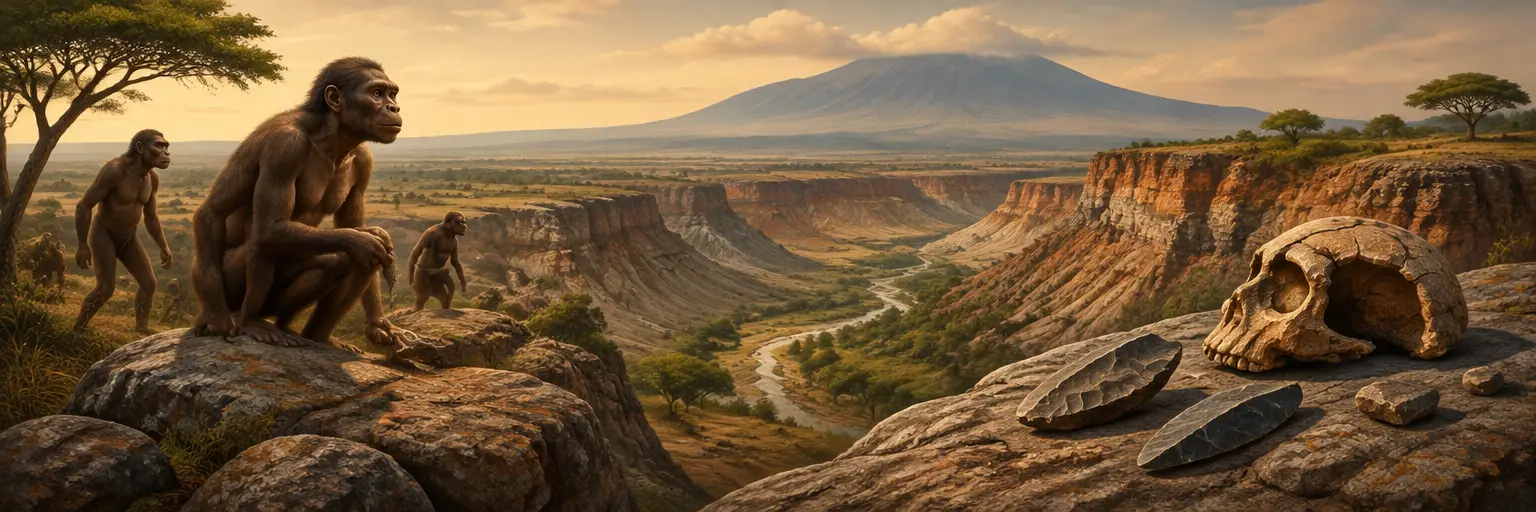
Journey back millions of years to the cradle of humankind with ArchaeologyHub.org’s deep dive into the iconic Olduvai Gorge and the dawn of early hominin discoveries. This legendary African site, nestled in Tanzania’s Great Rift Valley, has reshaped our understanding of human evolution, unearthing fossils of *Australopithecus boisei* and *Homo habilis*—the earliest toolmakers. Explore how groundbreaking finds like the Leakey family’s excavations and the famous “Nutcracker Man” skull reveal our ancestors’ adaptive leaps, from stone tool craftsmanship to social behavior. Perfect for students, researchers, and curious explorers, this resource connects global archaeological narratives with region-specific breakthroughs, offering detailed timelines, artifact profiles, and interpretive analyses that bring ancient landscapes to life. Uncover the geological layers that preserve 2 million years of history, and see why this UNESCO World Heritage site remains a cornerstone of paleoanthropology. Whether you’re tracking the rise of bipedalism or the spread of early technologies, our curated insights make complex science accessible and thrilling.
Welcome to ArchaeologyHub.org’s dedicated guide to Olduvai Gorge, a paleoanthropological treasure trove in Tanzania that rewrote our understanding of human evolution. This subcategory within our African Sites collection dives deep into the stratigraphic layers, iconic fossils, and stone tools that define the Early Stone Age. Whether you are a student, researcher, or curious traveler, this page serves as your definitive digital field notebook for the cradle of humankind. Explore how millions of years of volcanic ash preserved evidence of Australopithecus boisei, Homo habilis, and Homo erectus, while unraveling the geological forces that made this gorge a global reference point for paleoanthropology. Our curated content integrates chronological timelines, excavation histories, and interpretive analyses to position Olduvai within the broader narrative of hominin dispersal across Africa.
Olduvai Gorge is not just a dig site; it is a natural cross-section of over 2 million years of Earth’s history. The gorge’s walls, carved by the Olduvai River, expose seven principal beds (Bed I to Bed IV and the Masek Beds), each containing volcanic tuffs, lake sediments, and riverine gravels. These layers are precisely dated using potassium-argon and argon-argon methods, offering a calibrated timeline for early hominin activity. For enthusiasts, this subcategory unpacks how fluvial and lacustrine depositional environments preserved footprints and bone fragments under anaerobic conditions, preventing decay.
Understanding this stratigraphy is crucial for interpreting the Oldowan tool industry, as changes in sediment type correlate with shifts in hominin behavior and habitat. Learn how Mary Leakey’s meticulous excavation of the FLK Zinj site in 1959 revealed butchered animal bones alongside tools, proving that early hominins were active hunters or scavengers. Our analyses also highlight the role of geochemical fingerprinting of volcanic ashes, which allows researchers to correlate Olduvai’s findings with other African sites, such as Koobi Fora and Hadar, creating a unified paleoenvironmental puzzle.
The Oldowan toolkit is humanity’s first technological tradition, named after Olduvai Gorge itself. Mary Leakey’s groundbreaking work in the 1960s classified these simple flakes, choppers, and hammerstones, demonstrating a deliberate knapping technique that required forward planning and motor skills. In this section, you’ll discover how microscopic use-wear analysis on quartz and basalt tools reveals tasks like meat slicing, bone breaking, and plant processing. The gorge’s DK site, with its famous circular stone arrangement, has been interpreted as an early shelter or windbreak, indicating social organization.
We also explore the cognitive implications: the Oldowan record at Olduvai shows a gradual refinement from crude percussion to more controlled flaking, setting the stage for the later Acheulean handaxes found in Bed II. By comparing these artifacts with experimental archaeology, our content demonstrates how replication studies replicate Leakey’s methods to estimate prehistoric learning curves. This subcategory bridges the gap between geological context and material culture, providing a hands-on virtual lab for understanding the earliest human ingenuity.
Olduvai Gorge yielded two of the most famous early hominin fossils: Paranthropus boisei (OH 5), nicknamed “Nutcracker Man” for its robust masticatory apparatus, and Homo habilis (OH 7), the “handy man” associated with the Oldowan tools. Here, we profile each specimen with detailed anatomical descriptions, dental microwear analyses, and cranial capacity measurements. You’ll learn how Zinjanthropus (OH 5) challenged previous assumptions that robust australopiths were direct ancestors, instead representing a side branch in the hominin family tree. We also cover OH 8, a nearly complete foot, and OH 24, a cranium that exhibits transitional features between early Homo and Australopithecus.
Beyond the fossils themselves, this subcategory explains the taphonomic history—how bones were transported, fragmented, and buried by crocodile and hyena activity. We provide interpretive reconstructions of paleoecology using isotope evidence from tooth enamel to infer diets of C4 grasses versus C3 woodlands. For educators, we offer downloadable comparative charts of dental morphology and locomotion, making complex evolutionary biology accessible. Each profile is enriched with 3D scan links and excavation photos from the Leakey archives, ensuring a multimedia learning experience.
The Early Pleistocene environment of Olduvai was a dynamic patchwork of saline lakes, freshwater springs, and grassy plains. Our paleoecological section integrates pollen analysis, faunal assemblages, and stable isotope data from fossil soils to reconstruct a habitat that supported diverse megafauna—from giant pelorovis to ancient hippos and elephants. This subcategory examines how aridity cycles driven by orbital forcing influenced lake levels and vegetation, creating both opportunities and stressors for hominins. We highlight the famous Laetoli footprints, discovered 40 km south, which preserve the bipedal gait of Australopithecus afarensis under volcanic ash, offering direct evidence of locomotion behavior.
Understanding these ecosystems is vital for grasping why Homo erectus eventually replaced earlier hominins. Our content discusses carcass acquisition strategies, competition with large carnivores like Dinofelis, and the role of fire—though no definitive hearths are known from Olduvai proper. By comparing modern African analogs (e.g., Serengeti savannas), we illustrate the seasonal migration patterns early hominins may have followed. Additionally, we include GIS-linked maps of excavated trenches, allowing you to virtually traverse the gorge’s paleolandscapes and view skeletal accumulations in situ.
From Louis Leakey’s first expeditions in 1931 to the ongoing Olduvai Gorge Coring Project, this subcategory chronicles the evolution of archaeological practice. Learn how early stratigraphic mapping by Richard Hay, a geologist, transformed tephrochronology, while modern researchers employ micro-CT scanning, aDNA extraction, and drones for high-resolution site mapping. Our archival section includes unpublished field notebooks and photographs from the Leakey family archives, offering first-hand insights into the logistical challenges of working in remote Tanzania. We also review contemporary ethical debates about repatriation of fossils and community engagement with the Maasai people.
For aspiring field researchers, we detail the excavation grid system used at Olduvai, explaining how each square meter is sieved and each artifact’s 3D coordinates are logged. Essays on multidisciplinary collaboration show how geologists, botanists, and zooarchaeologists integrate their findings to form holistic interpretations. Our page on dating methods provides a comparative table of radiometric, paleomagnetic, and biostratigraphic techniques applied to the gorge’s deposits. By the end, you’ll appreciate how Olduvai remains a living laboratory, not a museum piece—with new discoveries still emerging from its eroding slopes each rainy season.
It earned this title because its deposits have yielded the longest continuous sequence of early hominin fossils and stone tools, spanning over 2 million years. The gorge’s volcanic layers are easily datable, providing key evidence that modern humans originated in Africa. Although other sites like Hadar are older, Olduvai’s rich, well-contextualized discoveries made it iconic in popular science.
Oldowan tools, found in the lower beds, are simple flakes and choppers made by direct percussion. Acheulean tools, appearing later in Bed II, are larger, symmetrical handaxes suggesting advanced planning. You can see both in our virtual exhibit, with side-by-side 3D models illustrating technological progression.
German entomologist Wilhelm Kattwinkel stumbled upon the gorge in 1911, but it was Louis Leakey who began systematic excavations in 1931. His wife Mary Leakey made the major finds, including OH 5 in 1959 and OH 7 in 1960, establishing the site’s scientific importance.
Yes, the gorge is a UNESCO World Heritage Site open to visitors with a permit. You can tour the museum, view the original fossil casts, and walk along marked trails to see exposed strata. Guides explain the geology, and you may even watch active excavations during certain seasons.
Discovered in 1978 by Mary Leakey’s team, these 3.6-million-year-old footprints show two hominins walking bipedally through volcanic ash. They provide indisputable evidence of upright walking long before the first stone tools, confirming that bipedalism preceded larger brains in human evolution.







