
"Priam's Treasure": Schliemann's Sensational Find, Its Context, and Controversy

Welcome to ArchaeologyHub.org, your gateway to uncovering the secrets of the past!
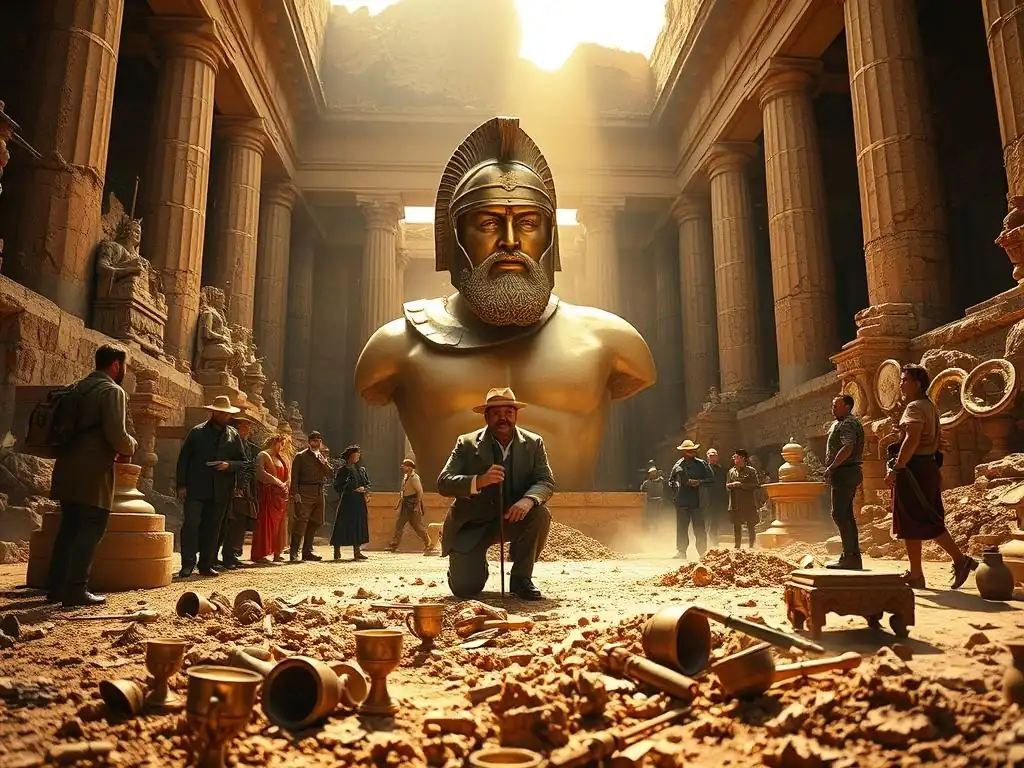
Delve into the fascinating world of archaeological discovery, from groundbreaking excavation techniques to the intricate lives of ancient civilizations. Today, we embark on a journey to explore one of archaeology's most sensational – and controversial – finds: Schliemann's Trojan treasure excavation. Was it truly Priam's Treasure? Uncover the historical context, the dramatic discovery, and the enduring debate surrounding this pivotal moment in archaeological history. Join us as we unravel the layers of truth and myth behind this legendary find and explore the questions that still linger. Are you ready to dig deeper?
- Introduction: Unearthing Priam's Treasure - A Turning Point in Archaeology
- The Discovery of Priam's Treasure: Details of the Excavation
- Contextualizing Priam's Treasure: Beyond the Initial Excitement
- The Controversy Surrounding Schliemann's Trojan Treasure Excavation
- The Fate of Priam's Treasure: A Journey Through Museums
- Schliemann's Legacy and the Treasure's Enduring Significance
- Conclusion: Reflecting on "Priam's Treasure" and the Evolution of Archaeological Practices
-
Frequently Asked Questions
- What exactly is Priam's Treasure, and why is it significant?
- Where was Priam's Treasure supposedly discovered, and what is the modern-day location of the site?
- What were some of the controversies surrounding Schliemann's excavation techniques and the discovery of Priam's Treasure?
- What happened to Priam's Treasure after its discovery by Schliemann?
- How does Priam's Treasure relate to the study of ancient civilizations and the field of archaeology?
- Final Reflection: Echoes of Ambition and Archaeological Ethics
- Unearth Your Inner Archaeologist!
Introduction: Unearthing Priam's Treasure - A Turning Point in Archaeology
The Allure of Troy and the Quest for Homer's City
For centuries, the legendary city of Troy, immortalized in Homer's epic poems, the Iliad and the Odyssey, captivated the imagination of scholars and adventurers alike. The tales of the Trojan War, Achilles, Hector, and Helen were widely considered myths, providing rich narratives but little concrete evidence of their historical veracity. This perception began to shift in the 19th century as growing interest in classical antiquity spurred a quest to locate the physical remnants of this fabled city.
The search for Troy was not merely an academic exercise; it represented a profound desire to bridge the gap between myth and history, to prove that the foundational narratives of Western civilization had tangible roots. Early explorers and geographers had proposed various locations, but it was the persistent belief in a physical Troy, particularly at the site of Hissarlik in modern-day Turkey, that set the stage for one of archaeology's most famous, and infamous, discoveries.
Heinrich Schliemann: From Businessman to Archaeologist
Heinrich Schliemann, a German businessman who amassed a fortune in indigo trade and gold speculation, harbored a lifelong obsession with Homer. Despite lacking formal archaeological training, his immense wealth and unwavering determination allowed him to pursue his childhood dream of unearthing the legendary city of Troy. His approach was driven by a literal interpretation of Homeric texts, which, while providing him with motivation, also led to significant methodological flaws.
Schliemann's transformation from a successful entrepreneur to a self-proclaimed archaeologist was remarkable. By the late 1860s, he had retired from business and dedicated his considerable resources to archaeological endeavors. His initial work at Ithaca and Mycenae, though controversial, demonstrated his commitment, culminating in his focus on the mound of Hissarlik, a site previously identified by Frank Calvert as a potential location for Troy. This marked a pivotal moment, as Schliemann's efforts would soon bring the concept of "Schliemann’s Trojan treasure excavation" into the global spotlight.
The Discovery of Priam's Treasure: Details of the Excavation
The Location of the Find: Hissarlik and the Stratigraphy of Troy
The site of Hissarlik, located in northwestern Anatolia, Turkey, is a tell – an artificial mound formed by centuries of human occupation. Beneath its surface lay layers upon layers of ancient settlements, each representing a distinct period of history. Schliemann, beginning his excavations in 1871, focused on digging deep trenches into this mound, aiming to reach what he believed was the Troy of Homer. His understanding of stratigraphy – the layering of archaeological remains – was rudimentary by modern standards, often leading him to dig through and destroy later, but still historically significant, strata.
The "Priam's Treasure" was purportedly discovered on May 31, 1873, in a layer Schliemann designated as "Troy II," approximately 8.5 meters (about 28 feet) below the surface. This layer, characterized by evidence of a massive fire, aligned with his preconceived notion of Homer's "burnt city." While later archaeological work would reveal that Troy II predated the likely period of the Trojan War by over a millennium, Schliemann's initial interpretation fueled the sensation surrounding his find and the subsequent discourse on Schliemann’s Trojan treasure excavation.
Describing Priam's Treasure: Gold, Jewelry, and Artifacts Recovered
The cache of artifacts that Schliemann famously dubbed "Priam's Treasure" was extraordinary in its richness and quantity. It comprised over 10,000 individual objects, predominantly crafted from gold, but also including silver, electrum, copper, and bronze. Among the most striking pieces were two elaborate gold diadems, adorned with thousands of delicate gold rings and chains, which Schliemann sensationally, and incorrectly, labeled as the "Jewels of Helen."
The collection also included numerous gold earrings, pendants, bracelets, and beads, along with intricately worked gold cups, silver vases, bronze shields, axes, daggers, and spearheads. One notable item was a large, elaborately decorated silver vase that contained many of the smaller gold objects. The sheer volume and exquisite craftsmanship of these items immediately elevated "Priam's Treasure" to a find of unparalleled significance, captivating the public and solidifying the narrative of Schliemann’s Trojan treasure excavation as a monumental achievement.
Schliemann’s Account of the Discovery: Inconsistencies and Exaggerations
Schliemann's personal account of the discovery of "Priam's Treasure" is a dramatic narrative, central to his self-promotion and the immediate public fascination. He famously claimed that he discovered the treasure alone, recognizing the glint of gold in the collapsing wall of a building, and that he quickly sent his workmen away to protect the find. He then supposedly used his wife, Sophia Schliemann, to wrap the jewels in her shawl and carry them to safety, even staging photographs of her wearing the most prominent gold diadems.
However, historical scrutiny and later analyses have revealed significant inconsistencies and exaggerations in Schliemann's account. Sophia was, in fact, not present at Hissarlik on the day of the discovery, having been in Athens.
Furthermore, the notion of a single, coherent "treasure" found all at once has been questioned; some scholars suggest that the items might have been collected from various locations within the Troy II layer over time and then assembled for dramatic effect. These discrepancies highlight Schliemann's flair for showmanship, which, while generating immense publicity for his work and the Schliemann’s Trojan treasure excavation, also sowed seeds of doubt about his scientific rigor.
Contextualizing Priam's Treasure: Beyond the Initial Excitement
The Trojan War: Myth, Legend, and Archaeological Evidence
The enduring appeal of the Trojan War, as depicted in Homer's Iliad, has long blurred the lines between myth and historical fact. For centuries, the epic poem was considered purely literary, a magnificent work of fiction. Schliemann, however, was convinced of its historical accuracy and dedicated his life to proving it. His discovery of a wealthy city at Hissarlik, along with impressive gold artifacts, seemed to validate his belief, leading him to immediately associate the "treasure" with the legendary King Priam of Troy.
Modern archaeology, building upon Schliemann's initial endeavors, has provided a more nuanced understanding. While the site of Hissarlik is indeed ancient Troy, the specific layer associated with the legendary Trojan War is generally identified as Troy VI or Troy VIIa, dating to the Late Bronze Age (circa 1250 BCE). This period saw a powerful citadel and evidence of conflict, aligning more closely with the Homeric narrative. Schliemann's initial excitement, while understandable, prematurely linked his finds to a specific mythical event without sufficient chronological evidence.
Dating Priam's Treasure: The Layer of Troy II and its Significance
One of the most critical aspects of contextualizing "Priam's Treasure" is its archaeological dating. Schliemann found the bulk of the treasure within the stratum he labeled "Troy II," specifically in a large building he identified as the "Palace of Priam." Subsequent, more precise stratigraphic analysis by later archaeologists, such as Wilhelm Dörpfeld and Carl Blegen, confirmed that Troy II belongs to the Early Bronze Age, flourishing between approximately 2500 and 2300 BCE.
This dating places "Priam's Treasure" roughly 1,000 to 1,300 years before the conventionally accepted period of the Trojan War, which is typically placed around 1250 BCE. Therefore, while the treasure is undeniably a spectacular find from ancient Troy, it cannot be directly associated with King Priam or the Homeric Trojan War. Its significance lies instead in illuminating the sophisticated metalworking and wealth of an Early Bronze Age civilization in Anatolia, offering invaluable insights into a period long predating the Mycenaean era.
Examining the Artifacts: Craftsmanship and Origins of the Treasure
The artifacts composing "Priam's Treasure" showcase remarkable craftsmanship, reflecting the advanced metallurgical skills of the Early Bronze Age inhabitants of Anatolia. The gold pieces, including the intricate diadems, earrings, and rings, demonstrate sophisticated techniques such as filigree and granulation, indicating a highly developed artistic tradition. The sheer quantity of gold suggests access to significant precious metal resources, either locally or through extensive trade networks.
Beyond the gold, the treasure also included silver and bronze objects, such as cups, vases, and weapons. The stylistic elements of these artifacts bear resemblances to other finds from the Early Bronze Age Aegean and Anatolian regions, suggesting cultural connections and exchanges. While some theories have proposed external influences, the consensus among archaeologists is that the treasure largely represents a local Anatolian tradition, providing a unique window into the material culture, wealth, and societal structures of Troy during this period. The examination of these objects continues to refine our understanding of Early Bronze Age economic and artistic networks.
The Controversy Surrounding Schliemann's Trojan Treasure Excavation
Accusations of Smuggling and Looting: Legal Battles and Ethical Concerns
The discovery of "Priam's Treasure" was immediately embroiled in controversy, primarily due to Heinrich Schliemann's unethical and illegal actions following its unearthing. Despite having an excavation permit from the Ottoman Empire (which then controlled the territory of modern-day Turkey) stipulating that half of all finds belonged to the Ottoman Imperial Museum, Schliemann secretly smuggled the entire treasure out of Turkey in 1873. He transported it first to Greece and then to Germany, violating the terms of his agreement.
This act led to protracted legal battles between Schliemann and the Ottoman government, which sued him for breach of contract and the return of the artifacts. Although Schliemann was eventually ordered to pay a fine, he never returned the treasure. This blatant disregard for archaeological ethics and national heritage set a problematic precedent, highlighting the destructive impact of private collectors and treasure hunters on archaeological sites and the provenance of artifacts. The legacy of Schliemann’s Trojan treasure excavation remains tainted by these accusations of smuggling and looting.
Debates on the Authenticity of the Treasure: Assemblage Theory and Later Reconstructions
Beyond the ethical breaches, the very authenticity and integrity of "Priam's Treasure" as a single, coherent find have been subject to intense scholarly debate. While the individual artifacts are undoubtedly ancient and genuine, questions have arisen regarding whether they were all discovered together in one cache, as Schliemann claimed. The "assemblage theory" posits that Schliemann might have gathered items from different locations or even different layers within Troy II, presenting them as a unified "treasure" to enhance its dramatic appeal and historical significance.
Evidence supporting this theory includes the varying states of preservation of different items, and the fact that Schliemann's own records, often inconsistent, suggest some items might have been found separately. While a complete discrediting of the treasure's unity is not universally accepted, this debate underscores the challenges of interpreting finds from early, less systematic archaeological excavations. It also emphasizes the importance of meticulous documentation and context, which were often lacking in Schliemann’s Trojan treasure excavation methods, leading to enduring questions about the precise circumstances of the discovery.
Schliemann's Methods: Destructive Excavation Techniques and Their Impact
Heinrich Schliemann's archaeological methods, driven by his singular goal of finding Homeric Troy, were notoriously destructive. Lacking formal training and operating in an era before modern archaeological standards were established, he employed large-scale, unsystematic digging, often described as "trenching." His primary approach involved digging massive, deep trenches straight through the accumulated layers of the Hissarlik mound, effectively destroying vast amounts of invaluable archaeological evidence in the upper strata.
This "Schliemann's big trench" approach, while reaching the deeper levels of Troy II where "Priam's Treasure" was found, obliterated crucial information about the later periods of Troy, including the very layers (Troy VI and VIIa) that are now believed to correspond to the Late Bronze Age Trojan War. Modern archaeological practice emphasizes careful, systematic excavation based on stratigraphy, meticulous recording, and preservation of all layers.
Schliemann's methods represent a stark contrast, serving as a cautionary tale in the history of archaeology regarding the irreversible damage that can result from unscientific excavation, even during an otherwise sensational Schliemann’s Trojan treasure excavation.
The Fate of Priam's Treasure: A Journey Through Museums
From Berlin to Moscow: The Treasure's Post-Discovery History
After its secret removal from Ottoman territory, "Priam's Treasure" eventually found its way to Germany. Heinrich Schliemann, eager for recognition and a lasting legacy, announced in 1881 that he was donating the entire collection to the German people. The treasure was subsequently housed and displayed at the Museum of Prehistory and Early History (part of the Berlin State Museums) in Berlin, where it remained a star exhibit for decades, drawing immense public interest and scholarly attention to the Schliemann’s Trojan treasure excavation.
However, the treasure's journey did not end there. During World War II, as Berlin faced intense Allied bombing, the treasure was carefully packed away for safekeeping in 1945. Following the fall of Berlin, the "Priam's Treasure" disappeared. For nearly fifty years, its whereabouts remained a mystery, leading to speculation that it had been destroyed or looted. It was only after the collapse of the Soviet Union, in 1993, that the treasure reappeared, revealed to be in the possession of the Pushkin State Museum of Fine Arts in Moscow, having been seized by Soviet troops as war reparations.
The Treasure Today: Pushkin Museum and Ongoing Research
Today, "Priam's Treasure" is prominently displayed at the Pushkin State Museum of Fine Arts in Moscow, Russia. Its public exhibition there, beginning in 1996, reignited international debates over its ownership. Germany asserts its claim based on Schliemann's original donation, while Russia maintains its right to the treasure as compensation for the immense cultural losses suffered during World War II. Turkey also maintains a claim, arguing that the treasure was illegally removed from its territory in the first place.
Despite the ongoing political and legal disputes, the treasure's presence in Moscow has allowed for renewed scholarly examination. Researchers continue to study the artifacts, employing modern analytical techniques to understand their composition, manufacturing processes, and cultural context. This ongoing research at the Pushkin Museum contributes valuable data to our understanding of Early Bronze Age metallurgy, trade, and societal organization, further solidifying the treasure's place as a cornerstone of archaeological study, irrespective of its tumultuous post-Schliemann’s Trojan treasure excavation history.
The Treasure's Impact on Understanding Early Bronze Age Culture
While "Priam's Treasure" may not be directly linked to the Homeric King Priam, its discovery has had a profound and lasting impact on our understanding of Early Bronze Age culture in Anatolia and the wider Aegean. Before its unearthing, the material culture of this specific region and period was relatively unknown. The immense quantity of gold, silver, and bronze artifacts provided unprecedented evidence of the wealth, craftsmanship, and sophisticated social structures that existed in Troy II.
The intricate goldwork, including the filigree and granulation techniques, demonstrated a high level of artistic and technical skill previously unappreciated for this early period. The presence of such valuable items also hints at extensive trade networks that must have existed, connecting Troy with other regions for the procurement of raw materials and the exchange of finished goods. Thus, despite the controversies surrounding Schliemann’s Trojan treasure excavation, the treasure itself remains an invaluable dataset for archaeologists piecing together the economic, social, and technological landscapes of the Early Bronze Age.
Schliemann's Legacy and the Treasure's Enduring Significance
Reassessing Schliemann's Contribution to Archaeology
Heinrich Schliemann's legacy in archaeology is complex and often contradictory. On one hand, he is lauded as a pioneer who, against prevailing academic skepticism, proved the historical reality of ancient Troy and Mycenae, thereby transforming the study of the Bronze Age Aegean. His sensational discoveries ignited public imagination and spurred global interest in archaeology, attracting significant funding and attention to the field. Without his relentless drive, the site of Hissarlik might not have received the attention it did for many decades.
However, Schliemann's methods were deeply flawed by modern standards. His destructive large-scale digging, lack of meticulous record-keeping, and willingness to manipulate facts for dramatic effect are widely condemned. He embodied the characteristics of a "treasure hunter" rather than a systematic archaeologist. Nevertheless, his work undeniably laid the groundwork for future, more scientific excavations at Troy by figures like Wilhelm Dörpfeld and Carl Blegen, who clarified the site's stratigraphy and provided a more accurate chronology for the Schliemann’s Trojan treasure excavation and the layers of Troy.
The Ongoing Study of Trojan Artifacts and their Cultural Value
The artifacts from Troy, including "Priam's Treasure" and countless other finds from subsequent excavations, continue to be subjects of intense study. Modern analytical techniques, such as X-ray fluorescence and lead isotope analysis, are used to determine the exact composition of metals, trace their geological origins, and understand ancient metallurgical processes. This ongoing research helps to reconstruct ancient trade routes, economic systems, and technological advancements of the Early and Late Bronze Ages.
Beyond their scientific value, these Trojan artifacts hold immense cultural significance. They are tangible links to ancient civilizations, providing insights into their daily lives, beliefs, and artistic expressions. They also serve as powerful symbols of human ingenuity and the enduring allure of the past. The continuing examination of these objects, whether in Moscow, Berlin, or Turkey, ensures that the story of Troy, and the artifacts from Schliemann’s Trojan treasure excavation, remain vital components of global cultural heritage.
Priam's Treasure: A Symbol of Archaeological Discovery and its Complicated History
"Priam's Treasure" stands as a potent symbol within the annals of archaeology, embodying both the thrill of groundbreaking discovery and the complexities of the field's early, often problematic, practices. It represents the captivating power of a single find to reshape historical understanding and ignite public fascination. Schliemann's dramatic unearthing of the treasure at Hissarlik, and his immediate, though incorrect, attribution to King Priam, forever cemented its place in popular imagination.
However, the treasure also serves as a stark reminder of the ethical challenges inherent in archaeological exploration. Its secret removal from Turkey, the subsequent legal battles, and its contentious journey through various museums highlight issues of provenance, cultural heritage, and the impact of conflict on archaeological collections. Thus, "Priam's Treasure" is not merely a collection of ancient gold; it is a layered narrative reflecting the evolution of archaeological practices, the complexities of international heritage law, and the enduring human quest to unearth and interpret the past, all stemming from the controversial Schliemann’s Trojan treasure excavation.
Conclusion: Reflecting on "Priam's Treasure" and the Evolution of Archaeological Practices
Frequently Asked Questions
What exactly is Priam's Treasure, and why is it significant?
Priam's Treasure refers to a collection of gold and other artifacts discovered by Heinrich Schliemann in the late 19th century. Schliemann believed it was the treasure of King Priam of Troy, making it a symbol of archaeological discovery and the realization of Homeric legends.
Where was Priam's Treasure supposedly discovered, and what is the modern-day location of the site?
Schliemann claimed to have found Priam's Treasure at Hisarlik, in modern-day Turkey, the site he identified as ancient Troy. This location is now a significant archaeological site open to the public.
What were some of the controversies surrounding Schliemann's excavation techniques and the discovery of Priam's Treasure?
Schliemann's excavation methods were often destructive and lacked scientific rigor, leading to damage at the Troy site. His claims about the treasure's origin and his methods of finding it have been widely questioned by modern archaeologists.
What happened to Priam's Treasure after its discovery by Schliemann?
After its discovery, Schliemann smuggled the treasure out of Turkey and eventually it was housed in the Pergamon Museum in Berlin. Following WWII, it ended up in the Pushkin Museum in Moscow, where it remains today.
How does Priam's Treasure relate to the study of ancient civilizations and the field of archaeology?
Priam's Treasure, despite the controversies, sparked great public interest in archaeology and the study of the Trojan War. It also highlighted the need for more careful and ethical excavation practices within the field.
Final Reflection: Echoes of Ambition and Archaeological Ethics
The story of Priam's Treasure, as we've explored, is not just a tale of a sensational archaeological find, but a potent reminder of the complex interplay between discovery, ambition, and ethical responsibility in the pursuit of knowledge. The echoes of Schliemann's Trojan treasure excavation continue to reverberate today, shaping how we approach archaeological endeavors and forcing us to confront the inherent biases that can cloud our judgment.
The legacy of Schliemann's work, both lauded and criticized, has profoundly shaped our understanding of early Aegean civilization and the very practice of archaeology. It serves as a constant reminder that the past is not ours to simply unearth and possess, but rather to carefully interpret and protect for future generations. Archaeology is the only branch of anthropology that destroys its own data.
- Ruth Tringham. This quote encapsulates the delicate balance we must strike between the thrill of discovery and the imperative to preserve cultural heritage.
As we close this exploration of "Priam's Treasure," I invite you to consider the lessons learned from Schliemann's controversial excavation. How can we, as individuals and as a society, ensure that our pursuit of knowledge is guided by ethical principles and a deep respect for the past? Let us strive to learn from history, not to repeat its mistakes, and to approach the exploration of our shared human story with humility, responsibility, and a genuine commitment to preservation.
Unearth Your Inner Archaeologist!
Thanks for diving into the captivating story of Priam's Treasure! Now that you've explored this incredible find and its controversies, it's time to take the next step.
Here are a few ways to further your archaeological adventure:
- Start your own research project: Choose a local historical site or artifact that interests you and begin documenting its story using online resources and community archives.
- Share this article with fellow history buffs to ignite discussions on the ethics of archaeological discoveries and cultural heritage.
- Visit a local museum with an archaeology section; focus on exhibits detailing excavation practices and cultural context.
What hidden historical treasure are you most curious to uncover, and what ethical considerations do you think are most important when preserving it?