
Triumphal Processions Through the Roman Forum: Routes and Rituals

Welcome to ArchaeologyHub.org, your gateway to unraveling the mysteries of the past. Ever wondered how emperors celebrated their victories in ancient Rome? Delve into the heart of the empire with our exploration of Triumphal Processions Through the Roman Forum, uncovering the routes and rituals that defined these spectacular displays of power. The secrets of the Roman Forum await – are you ready to discover them?
- Introduction: Understanding Triumphal Processions in Ancient Rome
- The Route of the Triumphal Procession: A Detailed Examination
- Key Landmarks and Rituals Along the Roman Forum Procession Routes
- Participants in the Triumphal Procession: A Hierarchy of Honor
- The Evolution of Triumphal Procession Routes in the Roman Forum
- Archaeological Evidence of Triumphal Processions: Unearthing the Past
- The Decline and Legacy of Triumphal Processions
- Conclusion: The Roman Forum as a Living Stage for Triumphal Rituals
-
Frequently Asked Questions
- How did the Triumphal Procession typically begin before it entered the Roman Forum?
- What was the Via Triumphalis, and what role did it play in the procession through the Roman Forum?
- What significant structures within the Roman Forum would the procession pass by, highlighting the victory?
- Besides the Triumphator and his troops, who else typically participated in the Roman Forum procession?
- What was the ultimate destination of the procession, and what ceremony took place there?
- Final Reflection: Echoes of Ancient Glory
- Unearth Your Inner Explorer!
Introduction: Understanding Triumphal Processions in Ancient Rome
The Significance of the Roman Triumph
The Roman Triumph stood as the highest honor a Roman general could achieve, a sacred and political spectacle decreed by the Senate for extraordinary military victories. It wasn't merely a parade but a profound religious ritual, a temporary deification of the victorious commander, who, for a single day, was regarded as embodying Jupiter Optimus Maximus. This rare distinction was meticulously regulated; for instance, a general typically needed to have killed at least 5,000 enemy combatants in a single battle and expanded Roman territory, making the approximately 300 recorded triumphs over a millennium a testament to their exceptional nature.
Beyond its religious gravity, the triumph served as a powerful instrument of state propaganda and political legitimization. It showcased Rome's military supremacy, reinforced civic identity, and allowed the populace to partake in the glory of conquest. The elaborate pageantry, from the display of captured spoils to the acclamation of the general, cemented the victor's authority and demonstrated the divine favor bestowed upon Rome, making it an unparalleled public spectacle in the ancient world.
The Roman Forum: A Stage for Imperial Power
The Roman Forum, nestled between the Capitoline and Palatine Hills, was the pulsating heart of ancient Rome – its political, religious, and commercial nexus. Its strategic central location, flanked by monumental temples, basilicas, and the Rostra, naturally destined it to be the ultimate stage for the grandest public spectacles, especially the triumphal processions. The Forum's very layout, with its broad open spaces and processional avenues, was conducive to accommodating vast crowds and elaborate displays.
For the Roman Forum procession routes, the Forum was not just a backdrop but an integral, active component of the ritual. It was here that the general addressed the Roman people, where the spoils of war were paraded before the citizenry, and where the climax of the procession unfolded. The architecture of the Forum, with its iconic landmarks, framed these events, transforming the entire space into a living theater where imperial power and divine favor were spectacularly affirmed.
The Route of the Triumphal Procession: A Detailed Examination
Starting Point: The Campus Martius and the Porta Triumphalis
The journey of a Roman triumph began outside the sacred boundary of Rome, the pomerium, in the vast expanse of the Campus Martius. This was a critical requirement, as armed troops were forbidden from entering the city without specific senatorial decree, thus preserving civil order. Here, the victorious general, his legions, and the immense train of captives and spoils would meticulously assemble and prepare for their grand entry.
From the Campus Martius, the procession would pass through a designated gate, possibly a temporary structure or a specific arch, known as the Porta Triumphalis. This gate was reserved exclusively for the triumphal entry, symbolizing the unique, sacred nature of the event. The organization in the Campus Martius ensured that the massive retinue was perfectly arrayed before embarking on the magnificent Roman Forum procession routes through the city.
Entering the City: The Procession's Path Through Rome
Upon passing through the Porta Triumphalis, the procession would typically cross the Tiber River, often utilizing the Pons Sublicius or the Pons Aemilius, to officially enter the urban fabric of Rome. The initial segment of the route was designed to wind through various districts, gradually building anticipation among the throngs of citizens lining the streets.
Historical accounts suggest the path would often lead through areas like the Circus Flaminius, a large public space used for games, and then through the Velabrum, a low-lying valley between the Capitoline and Palatine Hills. This initial journey, before reaching the more central Roman Forum procession routes, allowed for widespread public viewing and participation, transforming the entire city into a vibrant celebration.
The Via Triumphalis: Tracing the Triumphal Road
While not a single, continuously named road throughout its entire length, the "Via Triumphalis" referred to the ceremonial path specifically designated for triumphal processions. This route was imbued with immense symbolic importance, representing the sacred journey of the victorious general from the battlefield to the very heart of the Roman state.
This triumphal way typically guided the massive procession through key urban arteries, leading directly towards the monumental core of the city. Though archaeological evidence for a single, distinct road named "Via Triumphalis" is debated for its entirety, sections of paved roads within Rome were clearly part of these grand parades, ensuring a robust and visible passage for the Roman Forum procession routes.
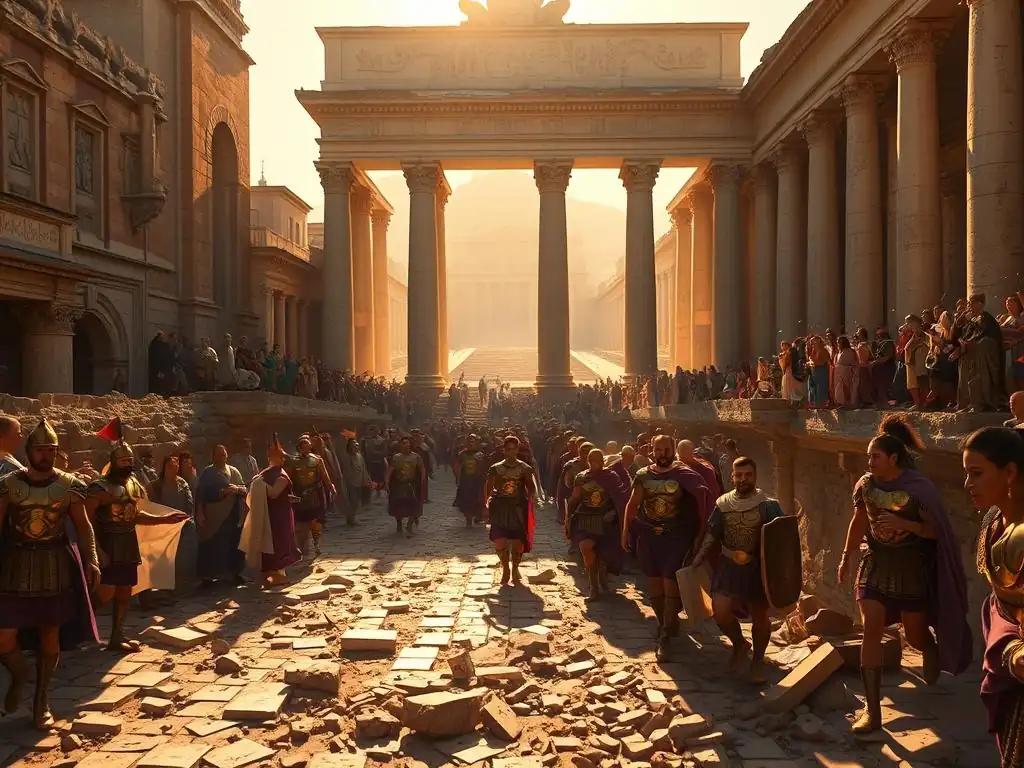
As the procession approached its climax, it would enter the Roman Forum, usually from its western side, near the Capitoline Hill. Here, the route followed the Via Sacra, the Forum's principal thoroughfare, which became the central artery of the Roman Forum procession routes. This sacred way was deliberately chosen for its historical and religious significance, connecting key monuments.
The procession would majestically traverse the Forum, passing iconic structures such as the towering Basilica Julia, the ancient Temple of Saturn, and the grand Temple of Castor and Pollux. This carefully choreographed passage ensured that the triumphant general, his army, and the impressive spoils of war were displayed to the maximum number of onlookers, who would pack the Forum's open spaces and elevated vantage points.
Key Landmarks and Rituals Along the Roman Forum Procession Routes
The Temple of Jupiter Optimus Maximus: The Climax of the Triumph
The ultimate destination and religious culmination of every Roman triumph was the majestic Temple of Jupiter Optimus Maximus, perched atop the Capitoline Hill. After navigating the Roman Forum procession routes, the triumphant general would ascend the steep Clivus Capitolinus, the only road suitable for chariots leading to the temple. Here, he would offer a solemn sacrifice, typically a white bull, to Jupiter, dedicating his victory to the supreme deity.
This act of sacrifice was the most sacred moment of the entire triumph, solidifying the general's connection to the divine and affirming the gods' favor upon Rome. The ascent to the Capitoline was itself symbolic, representing the general's temporary elevation to a near-divine status, completing the profound spiritual journey that underpinned the physical Roman Forum procession routes.
Rostra and Public Orations: Announcing Victory to the Roman People
A crucial stop along the Roman Forum procession routes was the Rostra, the prominent speaker's platform located in the heart of the Forum. From this venerable podium, adorned with the bronze prows (rostra) of captured enemy ships, the triumphant general would address the assembled Roman populace and the Senate. This was a pivotal moment for public recognition and political legitimization.
During his oration, the general would recount his military exploits, often displaying captured enemy standards or even parading high-ranking enemy leaders. This public address was not only a report of victory but also a powerful act of self-promotion, reinforcing his public image and demonstrating Rome's military might and political dominance to all who had gathered along the Roman Forum procession routes.
The Role of Triumphal Arches in Defining the Route
Triumphal arches, such as the Arch of Titus and the Arch of Septimius Severus, played a significant role in defining and commemorating the Roman Forum procession routes. These monumental structures were erected to honor specific victories and their conquering generals or emperors, often placed strategically along the traditional path of the triumph. They served as permanent, visible reminders of Rome's military successes.
More than mere monuments, these arches functioned as symbolic gateways through which the triumphant procession would pass. Their intricate sculptural reliefs, like those on the Arch of Titus depicting the spoils from Jerusalem, not only celebrated past victories but also visually reinforced the narrative of Roman dominance for all who witnessed the procession, embedding the triumph's memory within the physical landscape of the Roman Forum procession routes.
Stops and Sacrifices: Rituals Performed During the Procession
Beyond the grand sacrifice at the Temple of Jupiter, the Roman Forum procession routes often involved other ritual stops and symbolic acts. Smaller sacrifices or offerings might be made at various altars or temples along the route, acknowledging different deities or significant events. For instance, sometimes a stop at the Temple of Vesta, housing the sacred flame of Rome, was included to ensure divine protection.
The general might also perform symbolic acts, such as scattering coins to the jubilant crowds, a gesture of generosity and a tangible share of the spoils. These meticulously planned rituals underscored the profound religious and civic gravity of the triumph, transforming a mere military parade into a complex, multi-layered event that deeply resonated with the Roman people along the entire length of the Roman Forum procession routes.
Participants in the Triumphal Procession: A Hierarchy of Honor
The Triumphant General: The Central Figure
At the apex of the Roman Forum procession routes, riding in a magnificent gilded chariot typically drawn by four white horses, was the triumphant general. Clad in the toga picta—a richly embroidered purple toga—a laurel wreath crowning his head, and holding an ivory scepter topped with an eagle, he was the embodiment of Roman success. A public slave often stood behind him in the chariot, whispering "memento mori" ("remember you are mortal") to temper his temporary, almost divine, glory.
For the duration of the triumph, the general was symbolically elevated to the status of Jupiter, the king of the gods. His elaborate attire and dignified bearing were meticulously orchestrated to convey overwhelming power, divine favor, and the unparalleled success of Rome's military might. His central position along the Roman Forum procession routes was an undisputed testament to his achievements and the empire's strength.
Roman Soldiers and Legionaries: Celebrating Military Prowess
Following their general, the Roman soldiers and legionaries marched proudly, often in their finest attire, bearing their standards and displaying their battle honors. Their presence was crucial, as they were the physical manifestation of Rome's military prowess and the instruments of the victory being celebrated. As they marched, they would loudly chant "Io Triumphe!" ("Hail Triumph!") and sing bawdy songs about their commander, a tradition that offered a release after the rigors of campaigning.
Their participation in the Roman Forum procession routes was not just a display but also a profound reward for their service and bravery. It provided them with public recognition and allowed them to share in the glory of the victory, reinforcing their loyalty to their general and the state. The sight of thousands of disciplined, victorious soldiers underscored the formidable power of the Roman army.
Captives and Spoils of War: Displaying Conquest
A stark and often somber element of the Roman Forum procession routes was the display of captives and spoils of war. High-ranking enemy leaders, often in chains, were paraded before the Roman populace, a public humiliation that served as a potent symbol of Rome's complete victory and the vanquished enemy's fate. Some of these captives, such as Vercingetorix or Jugurtha, were later executed at the Tullianum (Mamertine Prison) after the procession.
Following the captives came an immense display of wealth and foreign treasures: gold, silver, precious artifacts, artworks, and exotic animals captured during the campaign. These spoils were carried on elaborately decorated floats or by porters, visually demonstrating the vast economic gains and cultural acquisitions resulting from Rome's conquests. This opulent display enriched the spectacle and underscored the empire's prosperity derived from its military might.
Integral to the solemnity and legitimacy of the triumph were the various religious figures and members of the Roman Senate. Priests from the major colleges, such as the Pontifices and Augurs, along with the Vestal Virgins, participated, representing the divine sanction and religious authority underpinning the event. The Senators, dressed in their togas, represented the political body that had officially decreed the triumph.
These figures would typically precede or follow the general, depending on their specific ritual roles within the procession. Their presence underscored that the triumph was a state affair, sanctioned by both divine and human powers, and not merely a personal achievement of the general. Their participation along the Roman Forum procession routes ensured that the event adhered to centuries of tradition and proper religious observance.
The Evolution of Triumphal Procession Routes in the Roman Forum
From Republic to Empire: Changes in Triumphal Practices
The practice of the Roman triumph underwent significant changes as Rome transitioned from a Republic to an Empire. In the Republican era, triumphs were awarded by the Senate to individual generals for specific, extraordinary military victories, serving as a vital mechanism for establishing a general's political prestige. With the rise of emperors, however, the frequency of triumphs for independent generals diminished dramatically.
Under the Empire, triumphs became increasingly centralized, largely reserved for the emperor himself or members of his immediate family. This shift reflected the consolidation of power in the emperor's hands, making the triumph a tool for celebrating the unified strength of the empire under a single ruler rather than the individual achievements of numerous generals. Consequently, the Roman Forum procession routes gained even greater imperial significance, becoming pathways for demonstrating the emperor's absolute authority.
Imperial Triumphs: The Emperor's Grand Entry
Imperial triumphs were often staged on a grander scale than their Republican predecessors, designed to project an image of unparalleled imperial success and solidify the emperor's rule. Emperors like Augustus, Trajan, and Hadrian utilized these spectacles to reinforce their divine mandate and military prowess. These events were meticulously planned and often stretched over multiple days, showcasing immense wealth and manpower.
For instance, Augustus's three-day triumph in 29 BCE after the Battle of Actium, or Trajan's magnificent Dacian Triumph in 107 CE, involved vast displays of captured treasures, elaborate floats, and countless participants. These imperial Roman Forum procession routes were not just celebrations of victory but profound acts of propaganda, cementing the emperor's image as the supreme leader and benefactor of Rome.
The Impact of Architectural Changes on the Processional Route
The dynamic architectural evolution of the Roman Forum throughout centuries inevitably influenced the precise path of the triumphal procession. As new temples, basilicas, and especially triumphal arches were constructed, the Roman Forum procession routes adapted, sometimes subtly, to incorporate or highlight these new monumental additions. These structures often served to frame or punctuate the route.
A prime example is the construction of the Arch of Titus after 81 CE, commemorating Titus's victory in the Jewish War, and the Arch of Septimius Severus in 203 CE. Both arches were strategically placed to integrate directly into the standard Roman Forum procession routes, serving as grand gateways through which the general and his procession would pass. These architectural additions enhanced the visual experience and permanently marked the path for future triumphs.
Archaeological Evidence of Triumphal Processions: Unearthing the Past
Inscriptions and Reliefs: Depicting Triumphal Scenes
Archaeological excavations have yielded a wealth of epigraphic and sculptural evidence that vividly depicts and describes Roman triumphal processions. Inscriptions found on monumental arches, dedicatory plaques, and public buildings often detail the specific achievements of the general or emperor being honored and the date of their triumph. These texts provide crucial historical context for the Roman Forum procession routes.
Furthermore, sculptural reliefs, most famously those on the Arch of Titus, offer direct visual records of triumphal scenes. The inner panels of the Arch of Titus, for example, clearly depict Roman soldiers carrying the spoils from the Temple in Jerusalem, including the seven-branched menorah, providing an invaluable eyewitness account of a specific Roman Forum procession route and its participants. Similarly, the Fasti Triumphales, a list of triumphs recorded on marble tablets, offers a chronological register of these events.
Paving Stones and Road Infrastructure: Traces of the Via Triumphalis
While the "Via Triumphalis" was more of a conceptual route than a single, continuously named road, archaeological investigations have unearthed sections of the ancient road infrastructure that were undoubtedly part of these grand processions. The robust construction of these paved roads indicates their importance and capacity to bear the weight of immense retinues.
Within the Roman Forum itself, sections of the Via Sacra, with its meticulously laid paving stones, show evidence of enduring maintenance and design suitable for ceremonial use. These physical traces of the ancient roads provide tangible archaeological proof of the Roman Forum procession routes, illustrating the engineering prowess required to support such large-scale public events and the careful planning involved in their design.
The Arch of Titus: Commemorating Victory in Judea
The Arch of Titus stands as one of the most significant pieces of archaeological evidence for Roman triumphs. Located at the highest point of the Via Sacra as it enters the Roman Forum, this triumphal arch was erected after 81 CE by Emperor Domitian to commemorate his brother Titus's victory in the Jewish War (66-70 CE) and the subsequent capture of Jerusalem. Its strategic placement marked a key entry point for the Roman Forum procession routes.
The arch's internal reliefs are particularly invaluable historical documents. One panel depicts Titus's triumphal procession, showing Roman soldiers carrying the massive menorah and other sacred objects looted from the Temple in Jerusalem. The other panel shows Titus in his triumphal chariot, being crowned by Victory. These detailed depictions offer a direct, visual testament to the grandeur, specific elements, and the exact path of a Roman triumph through the Roman Forum.
The Decline and Legacy of Triumphal Processions
The End of Formal Triumphs: Shifting Political Landscape
By the late Roman Empire, the practice of formal triumphs began a gradual decline. The sheer vastness of the empire and the constant frontier wars made the traditional, singular grand celebration less practical or appropriate. Emperors also spent increasing amounts of time away from Rome, governing from other imperial centers like Constantinople or Ravenna, diminishing the importance of a Roman-centric processional spectacle.
The shifting political landscape, with power increasingly concentrated in the hands of emperors and their personal guard rather than the Senate, also lessened the need for public legitimization through triumphs. The last recorded triumph in Rome was in 403 CE, celebrating Emperor Honorius's victory over the Goths, marking the effective end of this ancient tradition in its original form.
The Enduring Symbolism of the Roman Triumph
Despite their eventual cessation, the powerful symbolism of the Roman triumph persisted for centuries. The core idea of a grand procession celebrating a decisive victory, with a conquering hero at its center, remained deeply ingrained in the Roman psyche and exerted a profound influence on subsequent European cultures. The imagery and narrative of the triumph continued to resonate.
The visual and conceptual elements of the Roman triumph, especially its culmination along the Roman Forum procession routes, were frequently referenced in art, literature, and imperial iconography long after the Western Roman Empire's fall. The very concept of "triumph" itself, signifying a monumental victory, is a direct linguistic and conceptual legacy of these ancient Roman rituals.
The Influence of Roman Triumphs on Later Celebrations of Victory
The Roman triumph, particularly its processional elements and ceremonial grandeur, profoundly influenced later celebrations of victory across Europe and beyond. Its template for public acclamation, the display of symbols of conquest, and the heroic figure at the center provided a blueprint for numerous subsequent state and military parades.
From the elaborate victory parades of Napoleonic France, which explicitly mimicked Roman models with their grand arches and processional routes, to military parades of the Victorian era, and even elements seen in modern Olympic opening ceremonies, the echoes of the ancient Roman Forum procession routes and rituals are discernible. The Roman triumph established a lasting paradigm for how societies celebrate and commemorate their greatest victories.
Conclusion: The Roman Forum as a Living Stage for Triumphal Rituals
The Roman Forum was far more than a mere backdrop for the magnificent triumphal processions of ancient Rome; it was an active, integral participant in these profound rituals. Its monumental structures, its sacred history, and its very ground were meticulously woven into the fabric of these events, transforming the entire space into a dynamic stage where military might, political authority, and divine favor converged. The strategic planning of the Roman Forum procession routes ensured that every aspect of the triumph was showcased to the maximum effect.
The Roman Forum procession routes, with their precise rituals, symbolic landmarks, and hierarchical participants, offer an unparalleled insight into the core values of Roman society—its reverence for military prowess, its sophisticated understanding of public spectacle, and its deep-seated religious beliefs. The enduring physical traces and detailed historical accounts of these triumphs within the Forum continue to illuminate how Rome celebrated its victories, leaving an indelible mark on the history of state spectacle and the legacy of imperial power.
Frequently Asked Questions
How did the Triumphal Procession typically begin before it entered the Roman Forum?
The Triumphal Procession usually started at the Campus Martius, outside the city walls. The victorious general, known as the Triumphator, would gather his troops and spoils of war there.
What was the Via Triumphalis, and what role did it play in the procession through the Roman Forum?
The Via Triumphalis was a key route. It was the traditional road used for the procession as it entered the city. It led into the Forum, showcasing the Triumphator's achievements.
What significant structures within the Roman Forum would the procession pass by, highlighting the victory?
The procession would pass by key structures like the Temple of Jupiter Optimus Maximus on the Capitoline Hill, the Rostra (speaker's platform), and various temples dedicated to Roman gods. These served as symbolic backdrops.
Besides the Triumphator and his troops, who else typically participated in the Roman Forum procession?
The procession included captured enemies, representing the subjugated foes. Additionally, musicians, priests, and magistrates played crucial roles, adding to the ritualistic and ceremonial atmosphere.
What was the ultimate destination of the procession, and what ceremony took place there?
The ultimate destination was the Temple of Jupiter Optimus Maximus on the Capitoline Hill. Here, the Triumphator would offer sacrifices to Jupiter, marking the official end of the triumph and giving thanks for the victory.
Final Reflection: Echoes of Ancient Glory
The exploration of Roman Forum procession routes reveals more than just ancient geography; it unveils a carefully orchestrated performance of power and legitimacy that resonates even today. Understanding the specific pathways and rituals associated with triumphal processions offers a profound insight into how societies construct and maintain authority, a practice that continues to shape our world through political rallies, national celebrations, and even marketing campaigns. The echoes of those marching legions and cheering crowds still reverberate in the ways we celebrate victory and honor leadership.
This journey through the heart of ancient Rome has underscored the enduring power of spectacle and symbolism. The meticulous planning of these processions, the strategic use of space, and the deliberate display of conquered spoils all highlight the Roman understanding of psychological impact. The triumph was not merely a celebration of military victory, but a powerful statement about the Roman state's ability to conquer, control, and incorporate new territories and peoples.
This quote encapsulates the essence of the triumph, reminding us that these events were carefully crafted narratives designed to reinforce Roman dominance and inspire awe in both citizens and subjugated populations.
As we conclude this exploration of Roman Forum procession routes, I invite you to consider the ways in which similar rituals and displays of power shape your own perceptions and beliefs. How do contemporary events, celebrations, and symbols influence your understanding of authority and success? By recognizing the enduring power of these ancient practices, we can become more critical and informed observers of the world around us, and perhaps even shape our own narratives of triumph and achievement with greater awareness and intention.
Unearth Your Inner Explorer!
Thank you for delving into the fascinating world of Roman triumphal processions! Now that you've journeyed through the Forum with victorious generals, it's time to translate that inspiration into action.
Here are a few ways to continue your exploration:
- Reconstruct the route: Visit a local museum or historical site and imagine a triumphal procession unfolding before your eyes. Picture the scene, the sounds, and the atmosphere.
- Share your discoveries: Discuss the most surprising fact you learned about Roman triumphs with friends or on social media, using the hashtag #RomanTriumphs.
- Delve Deeper: Research a specific Roman general or triumph and learn about its lasting impact.
What detail about Roman triumphal processions ignited your curiosity the most, and how might you explore that further?