Ahu Platforms as Markers of Lineage Territories and Ancestral Claims
🌄 Ahu platforms serve as vital markers of lineage territories, underpinning Rapa Nui ancestral territory claims. These monumental structures reveal insights into…
Read article
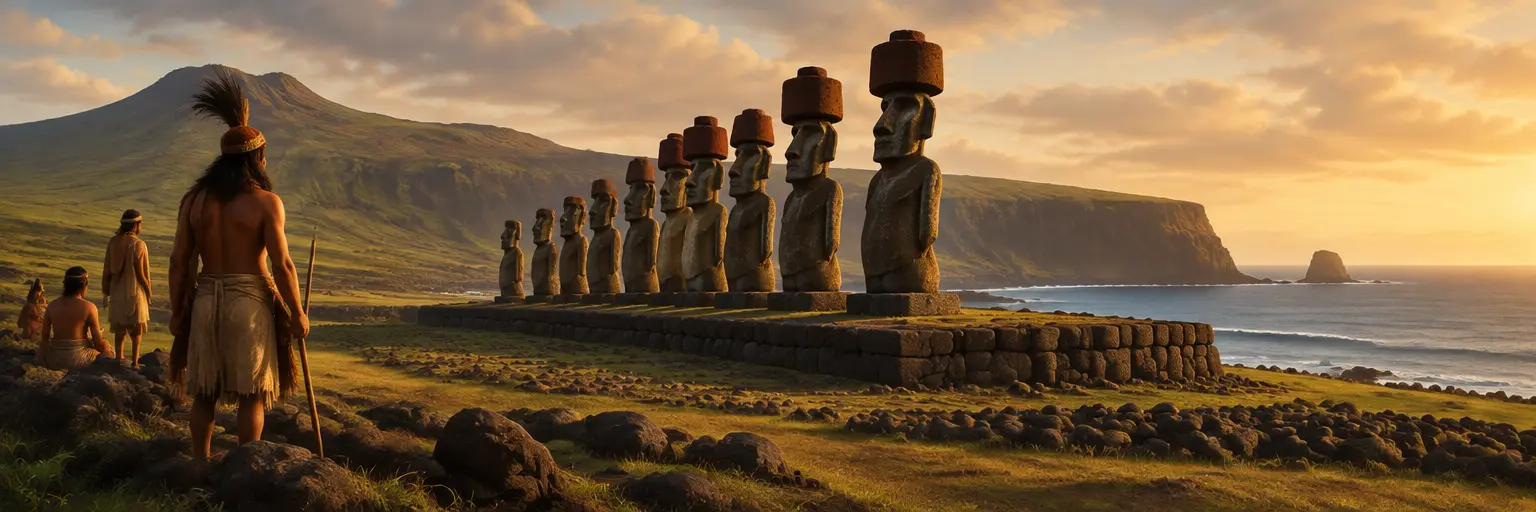
Unlock the mysteries of Rapa Nui, where the iconic Moai statues stand sentinel over ancient ceremonial platforms known as Ahu. These colossal volcanic stone figures, carved between 1250 and 1500 CE, represent the island’s ancestral chiefs and deities, embodying a remarkable feat of engineering, social organization, and spiritual belief. Explore how the islanders transported these multi-ton megaliths across rugged terrain, erected them with precision, and aligned them with astronomical and coastal orientations. From the restored Ahu Tongariki with its fifteen towering moai to the quarry of Rano Raraku where many statues remain unfinished, this subcategory offers a deep dive into the archaeology, cultural significance, and ongoing conservation debates of one of the world’s most remote inhabited islands. Perfect for enthusiasts of Polynesian history, megalithic architecture, and island ecology.
🌄 Ahu platforms serve as vital markers of lineage territories, underpinning Rapa Nui ancestral territory claims. These monumental structures reveal insights into…
Read article
🌿 Discover how to attach moai with precision, revealing the sophisticated reconstruction techniques used by ancient Rapa Nui artisans. This detailed analysis…
Read articleWelcome to the definitive guide on Oceanian Sites, focusing exclusively on Rapa Nui (Easter Island) and its iconic Moai & Ahu Platforms. Here at ArchaeologyHub.org, we dive deep into the remote Pacific, unraveling the engineering marvels, cultural significance, and enduring enigmas of these colossal stone figures. This subcategory serves as your digital passport to understanding how a small Polynesian community created monumental architecture against all odds, offering rich content for enthusiasts, students, and researchers alike. Discover the intricate quarrying techniques, ceremonial platform designs, and the socio-political landscape that shaped this UNESCO World Heritage wonder.
In this section, we dissect the remarkable engineering feats behind the nearly 1,000 moai scattered across the island. Learn about the volcanic tuff sourced from the Rano Raraku quarry, the immense logistics of moving statues weighing up to 80 tons, and the experimental archaeology that suggests methods like "walking" the moai using rope and rocking motions. You will explore the precise carving stages, from initial roughing out to final polishing, and understand why some statues were left unfinished—offering a frozen glimpse into ancient production lines.
Our content emphasizes transportation theories, comparing modern replicas with ancient pathways, and the role of pukao (topknots) made of red scoria. We break down the labor organization, suggesting that a combination of family groups and community effort was required, challenging previous notions of autocratic rule. By examining wear patterns on discarded tools and the terraforming of the landscape, you will gain a practical understanding of how these megalithic projects were managed without modern machinery.
Delve into the ceremonial architecture of the ahu, the stone platforms upon which the moai stood, serving as both burial sites and focal points for ancestor worship. This segment covers the evolution of ahu design, from simple earth mounds to the massive, precisely fitted stonework seen at Ahu Tongariki and Ahu Akivi. You will learn about the astronomical alignments—such as the equinox sunrise at Ahu Huri a Urenga—and how these orientations connected the islanders to seasonal cycles and navigational knowledge.
Expect detailed analyses of the architectural components, including the sloped ramps (ahu moai), retaining walls (pachina), and the white coral eyes that were inserted during major ceremonies. We also examine the post-construction modifications and the famous "toppling" of the moai during inter-clan conflicts, revealing a dynamic history of use, abandonment, and re-contextualization. This insight helps you appreciate not just the static ruins, but the living cultural landscape of Rapa Nui.
Here, we interpret the spiritual and social role of the moai beyond mere statues. These figures represented deceased high-ranking ancestors, believed to provide mana (spiritual power) and protection to their descendants. Uncover the rituals of tapu (sacred prohibitions) that governed access to ahu sites, and how the birdman cult (Tangata Manu) gradually shifted religious focus, leading to the cessation of moai carving. We contextualize these practices within broader Polynesian traditions, comparing them with marae in Tahiti and heiau in Hawaii.
You will also explore the oral histories and legends, particularly those concerning the first settler Hotu Matu’a and the long-eared vs. short-eared people. By analyzing ethnographic records from early European contact, we reconstruct ceremonies involving fire, offerings, and feasts. Our interpretive essays emphasize the moai as living memorials, not abandoned relics, providing a respectful lens on contemporary Rapa Nui culture that still reveres these ancestral guardians.
This section offers a comprehensive map-based overview of key excavation zones, from the famous coastal platforms to isolated inland ahu. We highlight lesser-known sites like Ahu Vinapu with its striking stone masonry, and the quarry cliffs of Rano Raraku with hundreds of unfinished moai. You will learn about the conservation challenges facing these fragile structures, including erosion, tourism impact, and climate change, alongside the collaborative efforts of the Chilean government and local communities to preserve them for future generations.
We provide practical visitor guidance, including how to respectfully navigate the Rapa Nui National Park, permit requirements, and optimal times for photography. Our data-driven articles also detail reconstruction projects, such as the restoration of Ahu Tongariki after a tsunami, illustrating the technical and ethical dilemmas of restoring ancient monuments. By understanding the geography and management policies, you become an informed traveler and advocate for cultural heritage protection.
Stay up-to-date with cutting-edge archaeological findings from ongoing excavations and LiDAR surveys that have revealed hidden pathways and soil chemistry indicating ancient agriculture. We highlight debates around the "ecocide" theory versus more nuanced accounts of resilience and adaptation, using dendrochronology and pollen analysis to reconstruct deforestation timelines. This section also covers DNA studies of the moai carvers, linking them to specific Polynesian haplogroups, and modern 3D scanning efforts to document minute carvings and petroglyphs.
Expect reviews of interdisciplinary approaches, from geophysical prospecting to ethnographic collaborations, that challenge prior assumptions. We feature interviews with leading Rapa Nui specialists and summarize recent symposia. By synthesizing these advances, you will grasp how technology is rewriting the story of this isolated civilization, showcasing not just collapse but inventive survival strategies. This ensures that your knowledge remains current in a rapidly evolving field.
Current consensus supports the "walking" method, where moai were upright and rocked side to side using ropes, a technique proven by experimental archaeology. Teams of 15-20 people could move statues this way, as demonstrated by the 2012 walk replica. This method used less wood than lateral sledging, requiring fewer resources, and aligns with oral traditions of "making the ancestors walk."
The pukao, or topknots, were carved from red scoria at the Puna Pau quarry. They symbolized the top-knot worn by male chiefs and added height, representing political authority and status. Weighing up to 11 tons, their placement atop a moai required elaborate ramps, and their presence likely denoted a particularly revered deceased leader.
No, most moai on the coast face inland, overlooking villages and crops, to protect and bless the community. However, at Ahu Akivi, seven moai face the sea, aligned with the spring equinox and believed to represent the seven explorers sent by King Hotu Matu’a. This exception highlights deliberate solar orientation rather than simple guard duty.
Historical and archaeological evidence suggests that during the Bouguerres (wars between clans) in the mid-1700s, rival groups intentionally toppled moai to symbolically break the power of their enemies. This was a political act to destroy ancestors' mana, and many statues were left lying face down until 20th-century restoration efforts re-erected them.
Yes, Rano Raraku is accessible with an entrance ticket to Rapa Nui National Park. Visitors can walk among scattered and standing moai, including the largest unfinished statue. However, due to conservation, some pathways are fenced, and climbing on the statues is strictly prohibited to prevent damage to this ancient wonder.







