The Act of Breaking: Ritual Destruction of Objects in European Votive Offerings
✨ Explore the significance of ritual destruction in European votives, revealing how breaking objects served as a powerful act of devotion and…
Read article
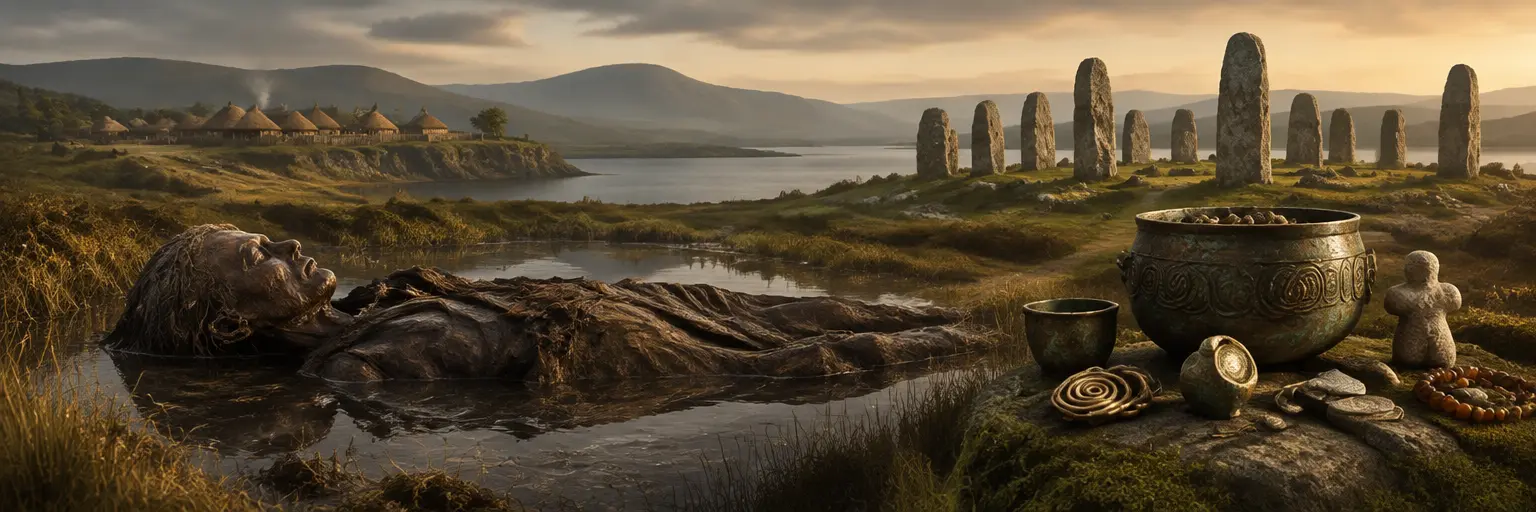
Delve into the enigmatic world of European ritual sites, where ancient bogs and sacred waters preserved the ultimate offerings to the gods. From the hauntingly well-preserved bog bodies—Iron Age individuals who met ritualized ends, their skin, hair, and even last meals intact for millennia—to shimmering votive deposits of weapons, jewelry, and cauldrons cast into lakes and marshes, this collection unveils a profound spiritual landscape. Explore how prehistoric communities in Scandinavia, the British Isles, and Central Europe navigated the liminal boundary between the living and the divine, revealing complex beliefs in sacrifice, kingship, and renewal. Unearth the latest forensic analyses, isotopic studies, and excavation breakthroughs that bring these mysterious figures and their watery sanctuaries back to life, offering a riveting glimpse into the minds of our ancestors.
Delve into the enigmatic world of prehistoric spirituality where wetlands served as sacred thresholds between the living and the divine. This subcategory on ArchaeologyHub.org uncovers the chilling yet fascinating practice of depositing human bodies and treasured objects into bogs—a ritual spanning the Bronze and Iron Ages across Northern Europe. Discover how anaerobic peat preserved these offerings for millennia, offering rare windows into ancient belief systems, social structures, and even dietary habits.
Bog bodies are naturally mummified human remains recovered from peat bogs in countries like Denmark, Germany, Britain, and Ireland. Unlike typical burials, their remarkable preservation—including skin, hair, and stomach contents—makes them invaluable for archaeologists. The acidic, oxygen-free environment halts decomposition, effectively freezing a moment from ancient life. Explore famous examples like Tollund Man and Grauballe Man, whose serene expressions mask the violence often associated with their deaths.
Beyond forensic intrigue, these remains offer profound insights into ritualized killing, sacrifices to fertility gods, or punishments for social transgressions. Chemical analyses of isotopes in bones and teeth reveal their geographic origins and childhood diets, while pollen and moss in stomachs indicate seasonality of the ceremonies. By cross-referencing with neighboring bog finds, researchers reconstruct complex ceremonial landscapes, where bogs were perceived as portals to the underworld—demanding offerings of the ultimate value: human life.
Adjacent to human sacrifices, thousands of objects—from ornate bronze cauldrons to simple wooden carvings—were deliberately cast into bogs and lakes as votive deposits. These were not casual discards but deliberate, often spectacular, acts of devotion intended to secure favors or give thanks. Sites like Denmark’s Illerup Ådal yielded over 15,000 weapons, broken to “kill” them, ensuring they reached the supernatural realm. This practice spanned millennia, evolving from Neolithic axes to Roman-period coin hoards.
Studying votive deposits reveals the economic and psychological priorities of ancient communities. The deliberate destruction of high-status goods—swords bent, shields slashed—suggests a belief that offerings must be rendered useless for humans to be acceptable to deities. Spatial analyses show that certain bog zones were “hotspots” for specific offerings, possibly tied to local shrine traditions. Furthermore, these deposits act as chronological storehouses, allowing archaeologists to date other find layers through typological sequences, making them anchors for regional chronologies.
While the bog ritual tradition appears pan-European, regional peculiarities enrich our understanding. In Britain and Ireland, weapons and animal bones dominate, while Scandinavia favors personal ornaments and human remains. The German-Danish borderlands feature the richest concentration of bog bodies, suggesting a core cultural zone. Conversely, Baltic regions show an emphasis on amber and flint, reflecting trade networks and local resource richness.
Chronological shifts are equally telling—body deposits peak around 400–100 BC, coinciding with increased social stratification and climatic cooling. Remote northwestern Russia and the Alps exhibit alternative “watery depositions” in rivers, implying a broader Celtic-Germanic-Slavic spiritual continuum. The spread of these customs into the Roman period hints at resistance to Romanization, with bogs serving as bastions of indigenous rites. By mapping these variations, researchers build a mosaic of interconnected yet diverse belief systems, adapting to local environments and historical pressures.
Excavating bog bodies and deposits demands cutting-edge methodology due to their fragility. Upon exposure to air, preserved skin blackens and bones degrade within days. Archaeologists now employ invasive imaging (CT scanners) and controlled excavation under waterlogged conditions, often working with rapid-response teams to stabilize and conserve finds. Non-invasive geophysical surveys like ground-penetrating radar locate hidden deposits without disturbance, preserving future research potential.
Advanced biomolecular tools revolutionized the field—ancient DNA (aDNA) extraction from bog bodies provides genetic profiles, noting their prevalence of Y-haplogroups and rare alleles, hinting at kinship networks. Lipid analysis of potsherds within deposits confirms food offerings, while stable isotope ratios (δ¹⁵N and δ³⁴S) distinguish marine versus terrestrial diets, illuminating sacrificial selection criteria. Experimental archaeology recreates peatification processes to understand preservation dynamics, enhancing in-situ conservation strategies. Every bob of the bog yields data, making each excavation a multidisciplinary seminar in real-time.
Bog bodies occupy a unique ethical space—they are neither typical human remains nor artifacts; they are individuals who were likely executed or sacrificed, carrying cultural trauma. Indigenous communities and modern pagans often claim spiritual connection to these sites, arguing against display in museums. Institutions like the Silkeborg Museum have responded with respectful curation, separating remains from objects to honor their sanctity while educating the public.
Climate change poses an urgent threat: rising temperatures and draining wetlands accelerate peat decay, compromising sites before excavation. Heritage management now integrates predictive modeling to prioritize at-risk bogs, while drone-based monitoring detects illegal peat cutting that destroys deposits. Legal frameworks like the European Landscape Convention mandate preservation, yet budget constraints frequently pit tourism revenue against conservation. Engaging descendant communities through co-curation and repatriation agreements is key to ethical stewardship, ensuring these ancient rituals remain meaningful, not merely macabre curiosities.
Bog deposits are rarely solitary; they cluster within broader ritual landscapes encompassing burial mounds, stone alignments, and seasonal assembly sites. Geographic information systems (GIS) mapping reveals that bogs were often deliberately chosen for their liminal qualities—places where the sun’s reflection vanished at noon, where mist rose unpredictably, and where no human would dare settle. Such environments facilitated altered states, reinforcing the awe and dread that made sacrifices meaningful.
Analyzing the scale of offerings—from a single pot to weapon hoards—showcases hierarchically organized ritual participation, where elites strategized public spectacles to cement power. The presence of imported goods (e.g., Roman glass in Danish bogs) demonstrates dynamic trade networks and diplomatic exchanges embedded within ritual obligations. Ethnographic parallels from Saami and Finnish traditions inform interpretations of household-level vs. communal deposits, suggesting that ritual practices bridged public and private spheres. This holistic view transforms bog bodies and deposits from isolated oddities into keystones for reconstructing the sociopolitical fabric of ancient Europe.
Peat bogs are highly acidic (pH 3.5–4.5), cold, and oxygen-free. This environment prevents microbial decay while tannins and sphagnum moss acids, which contain phenolic compounds, effectively “tan” the skin and internal organs. Bones are often decalcified, but skin, hair, and stomach contents endure, offering unmatched forensic detail. The cold temperature also slows enzymatic breakdown, enabling preservation for up to two millennia.
No. While many show fatal violence (throat slits, garroting, bludgeoning), some may be executed criminals or individuals who drowned accidentally. Criteria like their insertion method—weighed down with pegs—and contemporaneous artifacts suggest ritual intent, but not all cases are clear-cut. Modern DNA and dietary analyses help distinguish between local settlers and outsiders, yet the consensus remains that a significant majority were deliberate, ceremonial deposits.
Radiocarbon dating is the primary tool, calibrated against dendrochronology for precision. For organic remains like wood and leather, AMS (accelerator mass spectrometry) provides narrower date ranges. Additionally, stratigraphic layering within bogs, pollen zones, and the typology of associated metalwork (e.g., brooches or spearheads) refine chronological placement. In some deposits, coins or inscriptions offer a terminus post quem, anchoring them to historical events.
Bogs were liminal zones—neither land nor water—making them perceived gateways to supernatural worlds. Their unpredictability (rising mists, treacherous ground) fostered awe, while the preservation of organic materials may have been observed as a sign of divine power. Symbolically, marshlands were associated with fertility and renewal, as they regenerated peat and sustained unique flora, reinforcing their role as places to communicate with deities and ancestors.
Yes. Museums like the Tollund Man’s permanent exhibition at Silkeborg Museum (Denmark) and the National Museum of Ireland display preserved bodies and votive hoards with contextual panels. Several original sites, such as the Huldremose bog in Denmark, are accessible via walking trails with interpretive signs. Organized tours from regional heritage centers occasionally include live reconstructions of ritual scenes, albeit with strict conservation safeguards.







