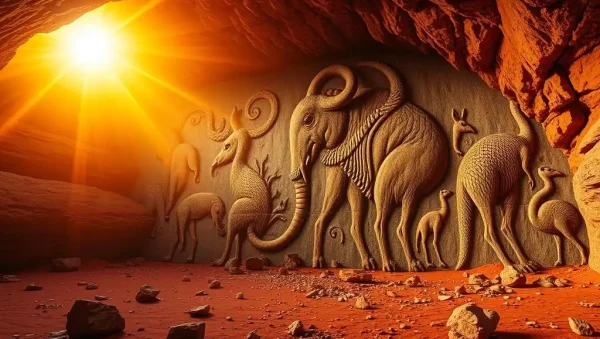
Rock Art as a Record of Extinct Species: Evidence from Kakadu and Murujuga
🌍 Discover how Kakadu and Murujuga rock art provides vital evidence of extinct species, offering unique insights into ancient biodiversity and human…
Read article
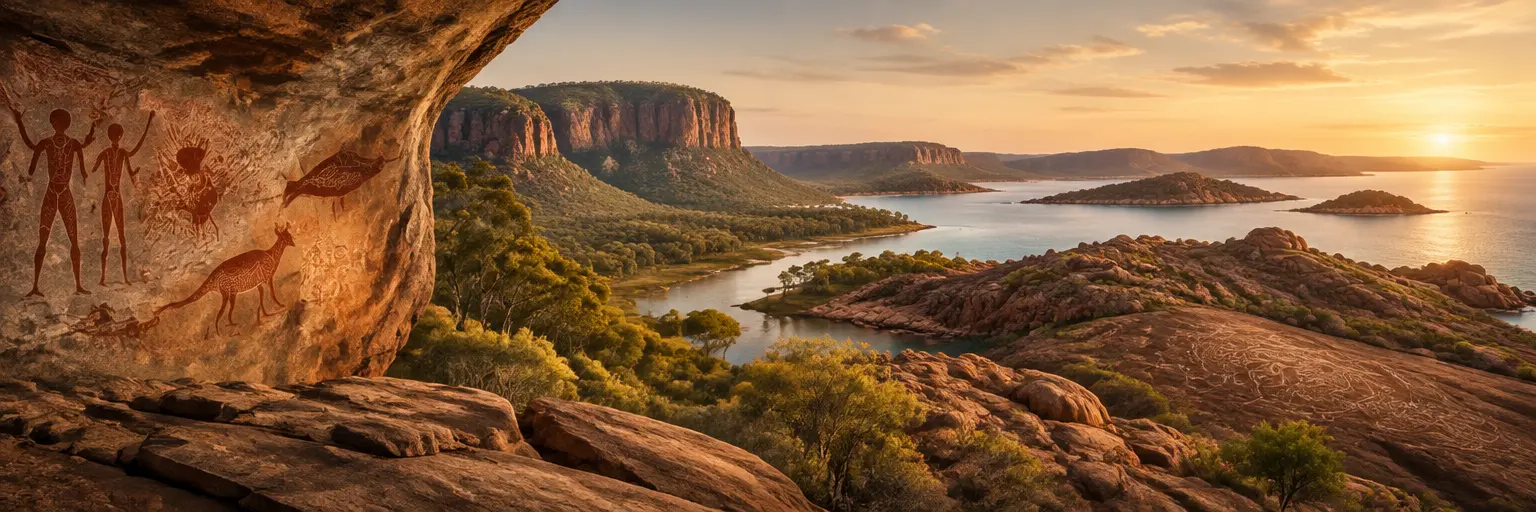
Discover the world’s oldest surviving outdoor art galleries in Australia’s rugged north, where the rock art of Kakadu National Park and the Burrup Peninsula (Murujuga) chronicles over 50,000 years of human connection to the land. From the ancient, towering mimi spirits and dynamic X-ray paintings of Kakadu’s sandstone escarpments to the dense, enigmatic petroglyphs carved into Murujuga’s iron-rich boulders—the planet’s largest and oldest collection of rock engravings—these World Heritage sites offer a profound window into Indigenous cosmology, survival, and ceremony. Explore the geological, climatic, and cultural shifts recorded in ochre and stone, unravelling how these fragile masterpieces have survived millennia and why they remain sacred to living Aboriginal custodians today. Whether you’re an archaeology enthusiast, a traveler, or a researcher, this guide brings you up close to the continent’s most significant archaeological treasure troves.
Explore one of the world’s most extraordinary collections of ancient human expression: the rock art of Kakadu National Park and the Burrup Peninsula (Murujuga). These Australian sites preserve tens of thousands of paintings and engravings, offering a profound window into Indigenous cultural heritage, spiritual belief systems, and environmental adaptation over millennia. This subcategory at ArchaeologyHub.org provides detailed archaeological analysis, dating evidence, and interpretive context for these globally significant rock art provinces.
Kakadu’s sandstone escarpments shelter some of the oldest and most diverse rock art on Earth, with sites like Ubirr and Nourlangie revealing layered artistic traditions. The paintings depict creation ancestors, hunting scenes, and changing environments, including extinct megafauna. Archaeological dating suggests continuous artistic activity for over 20,000 years, making this a key locality for understanding human evolution in Australia.
Visitors and researchers can examine distinct stylistic phases—from naturalistic early forms to the dynamic “X-ray” paintings—that document shifts in climate, technology, and social complexity. The art is not static; it remains a living tradition for Aboriginal custodians, whose oral histories provide invaluable interpretive frameworks. This subcategory highlights conservation efforts and the UNESCO World Heritage status that protects these fragile masterpieces.
The Burrup Peninsula, also known as Murujuga, in Western Australia hosts over one million petroglyphs (engravings), making it the densest rock art concentration globally. These engravings range from geometric designs to elaborate depictions of animals, human figures, and mythological beings. Dating back at least 30,000 years, they record a long span of Indigenous occupation and adaptation to coastal and arid environments.
The archaeological significance lies in its sheer scale and stylistic diversity, offering a unique dataset for studying symbolic behavior and social networks across deep time. However, this site faces major industrial threats from nearby gas and iron ore development. Our content details the ongoing advocacy for UNESCO protection, alongside cutting-edge digital documentation techniques, including 3D scanning, used to preserve these irreplaceable carvings.
Determining the age of rock art is notoriously challenging, but Australian archaeologists have pioneered methods such as optically stimulated luminescence (OSL) and radiocarbon dating of mud wasp nests. These techniques provide minimum ages for underlying art, while uranium-series dating of mineral crusts offers additional constraints. For Burrup, stratigraphic relationships with excavated sediment layers help correlate engravings with archaeological deposits.
Recent breakthroughs include the dating of a Kakadu painting to 17,000 years ago, and the identification of the oldest known Australian rock art at 28,000 years, found in the Arnhem Land region. This subcategory explains the strengths and limitations of each method, empowering readers to critically assess the evidence. We also cover non-invasive techniques, like portable X-ray fluorescence, that help identify pigment composition without damaging the artwork.
Both regions are set within deeply significant ecological and spiritual landscapes. Kakadu’s wetlands and sandstone plateaus support rich biodiversity, while Burrup’s arid coastal setting provides insights into human adaptation during sea-level changes. Rock art here often reflects seasonal subsistence patterns, ceremonial rituals, and the Dreaming (creation) narratives that still guide local communities today.
Understanding the environmental context is crucial for interpreting why certain motifs appear and how societies responded to climate shifts. For example, the rise in depictions of saltwater species in Kakadu correlates with post-glacial sea-level rise. This section integrates paleobotany, paleofauna, and ethnographic records to build a holistic picture of ancient lifeways, emphasizing that these sites are not just prehistoric relics but active cultural anchors.
Preserving Kakadu and Burrup rock art involves complex balance between accessibility, scientific study, and Indigenous custodianship. Threats include natural weathering, introduced species, and industrial pollution—particularly acid rain from nearby emissions harming Burrup’s engravings. Effective management requires stringent environmental monitoring, legal protection under Australian heritage laws, and active collaboration with Traditional Owners.
ArchaeologyHub.org provides case studies on successful conservation projects, such as the use of silicone moldings for replication and the installation of protective barriers. We also discuss the ethical debates around photography, public access, and the repatriation of cultural knowledge. These sections offer practical insights for heritage professionals and students, while highlighting the vital role of Indigenous-led stewardship in ensuring these wonders endure for future generations.
Kakadu’s oldest dated art is around 20,000–28,000 years old, with some painting phases possibly older. Burrup engravings are estimated to span 30,000 years or more, though exact dating is difficult. Radiocarbon and OSL methods provide minimum ages, while stylistic and stratigraphic correlations extend these timelines significantly.
Because it contains over one million individual petroglyphs, far exceeding any other known concentration. The area’s hard igneous rocks preserved engravings exceptionally well, and the long continuous occupation by Indigenous peoples created a high-density, diverse gallery covering an area of roughly 40 square kilometers.
Yes, many sites require permits or guided tours, particularly in Kakadu’s culturally sensitive areas. The Burrup’s main sites are accessible via public roads, but visitors must not touch or deface engravings. Always respect local Aboriginal protocols, including photography bans at certain locations, and check current access notices.
Natural weathering, particularly from wind and temperature extremes, is a constant force. Human-induced threats include industrial development on Burrup, rising storm intensity, and uncontrolled fires near Kakadu. Acidic pollutants from nearby industries are accelerating erosion, prompting urgent conservation advocacy and mitigation efforts.
Support Indigenous-led organizations like the Murujuga Aboriginal Corporation and the Kakadu Aboriginal Traditional Owners. Advocate for stronger environmental regulations, participate in citizen science monitoring programs, and educate others about the cultural and scientific value. Avoid purchasing or sharing unauthorized replicas that may encourage vandalism.







