Exploring the Americas Sites: Cahokia & Mississippian Mound Centers
Welcome to ArchaeologyHub.org’s dedicated subcategory on Cahokia & Mississippian Mound Centers, the heart of ancient North American urbanism. Within our global coverage of archaeological sites, this section focuses on the monumental earthen architecture, complex chiefdoms, and vibrant trade networks that flourished along the Mississippi River and its tributaries from roughly 800 to 1600 CE. Here, you will uncover the secrets of a civilization that built the largest pre-Columbian city north of Mexico, with content optimized for students, researchers, and history enthusiasts seeking deep, authoritative insights.
🏛️ The Rise and Layout of Cahokia: North America’s First Metropolis
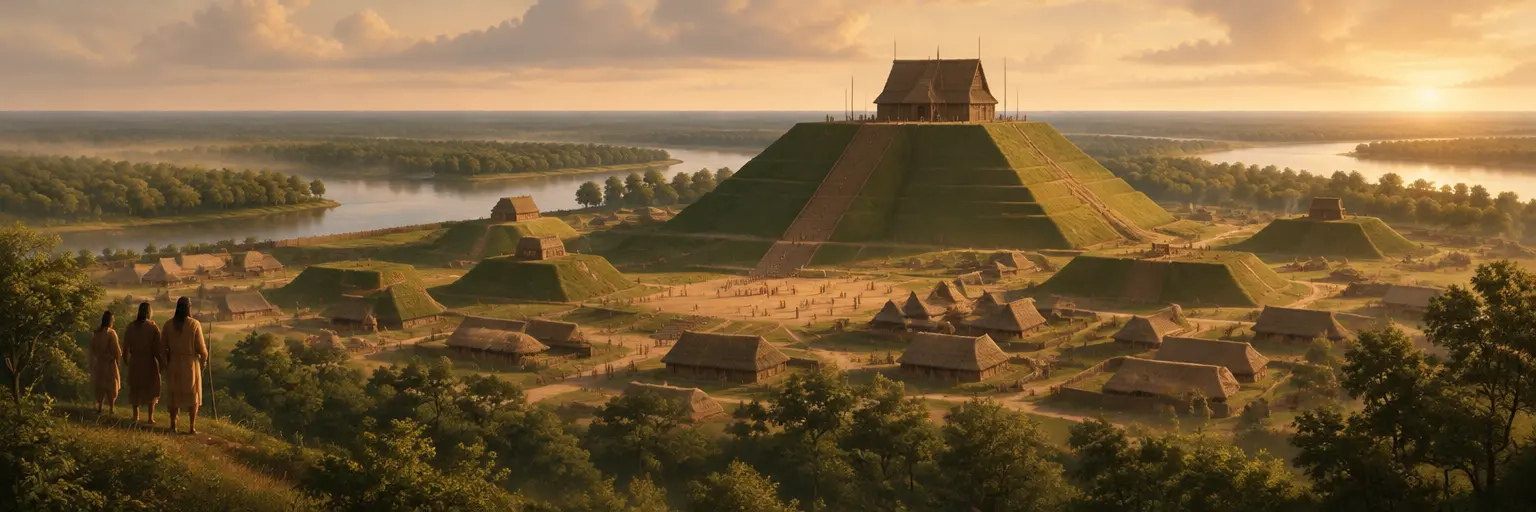
Discover how Cahokia, located near modern-day St. Louis, transformed from a small farming village into a sprawling urban center of 10,000 to 20,000 inhabitants. Our detailed articles explain the city’s precise grid-like layout, its central plaza, and the iconic Monks Mound—the largest prehistoric earthen structure in the Americas, rising 100 feet with a base larger than the Great Pyramid of Giza. Learn about the woodhenges (solar calendars) and how the city’s orientation aligned with celestial events, reflecting sophisticated astronomical knowledge.
Expect to explore settlement patterns, including residential zones, elite compounds, and defensive palisades that enclosed the core. We break down archaeological evidence from excavation trenches, soil stratigraphy, and radiocarbon dating to reconstruct daily life, social hierarchy, and the logistical mastery required to move millions of cubic feet of earth using only woven baskets and human labor. Whether you’re tracing the city’s rise after 1050 CE or its mysterious decline around 1350 CE, this section offers a chronological narrative supported by the latest LiDAR and geophysical survey data.
🌾 Mississippian Culture and Subsistence: Maize, Mounds, and Midden Analysis
Delve into the economic engine of Mississippian societies, where maize agriculture became the dietary staple, supplemented by beans, squash, nuts, and wild game. Our content examines flotation techniques used to recover charred plant remains from hearths and storage pits, revealing seasonal harvesting patterns and food storage strategies. We also profile the role of the Mississippi River as a superhighway for trade, with artifacts like marine shell beads, copper from the Great Lakes, and mica from the Appalachians found at mound centers.
This subcategory dives into paleoethnobotany and zooarchaeology, where every seed, bone fragment, and coprolite contributes to a fuller picture of diet and health. You’ll read case studies on how feasting at mound summits reinforced political power, as evidenced by massive refuse pits filled with deer bones and broken pottery. Additionally, we cover craft specialization—from pottery style seriation to chert tool production—showing how surplus food enabled artisans and priests to flourish, creating a hierarchical society with distinct occupational classes.
🏺 Iconic Mound Centers Beyond Cahokia: Etowah, Moundville, and Spiro
While Cahokia dominates popular imagination, this section broadens your perspective to include other major Mississippian sites. Explore Etowah in Georgia, famous for its six earthen mounds and exquisite copper plates depicting warriors and mythological beings. Then, journey to Moundville in Alabama, the second-largest Mississippian center, featuring 29 mounds arranged around a central plaza—a hub for elite burials and ritual goods. Finally, uncover Spiro in Oklahoma, where the Craig Mound yielded an extraordinary cache of engraved shell cups and textiles, linking Great Plains and Southeastern traditions.
Each site profile offers comparative analyses of mound size, layout, and artifact assemblages, helping you understand regional variations in political organization and ceremonial life. We integrate GIS mapping and legacy excavation reports to highlight how each center functioned as a pilgrimage destination, burial ground, and administrative hub. By contrasting these sites, you’ll grasp the dynamic reach of Mississippian culture from the Atlantic coast to the Great Plains, fostered by riverine connections that facilitated both trade and shared ideological beliefs.
🛠️ Mortuary Practices and Social Stratification in Mound Burials
Unearth the complex funerary rites that defined Mississippian elites, where mounds often served as platforms for charnel houses and mass burials. Our articles detail high-status graves containing shell beads, polished stone pipes, and exotic flint, contrasted with simpler interments of commoners in village cemeteries. We analyze osteological evidence such as stable isotopes and dental pathologies to infer diet and health disparities, revealing how elites consumed more protein while commoners suffered from maize-related nutritional stress.
Learn about the “warrior cult” reflected in the Southeastern Ceremonial Complex (SECC), where engraved iconography on copper and shell depicts falcon-dancers, severed heads, and supernatural serpents. We interpret these symbols through ethnographic analogy and mortuary context, arguing they legitimized hereditary chiefs. Detailed case studies from Mound 72 at Cahokia—where over 270 individuals were buried, including a central figure on a bed of over 20,000 shell beads—illustrate ritual human sacrifice and the elaborate staging of political theater. This subsection gives you a forensic lens to understand power, gender, and identity in prehistoric North America.
📉 Decline, Abandonment, and Environmental Pressures on Mississippian Centers
Why did these thriving cities collapse? This section evaluates competing theories, from climate change (the Medieval Warm Period’s droughts) to resource depletion and internal social unrest. We cite paleoclimate proxies like tree rings and lake sediment cores to demonstrate a “Little Ice Age” onset around 1300 CE, which may have triggered maize crop failures. Additionally, we explore evidence of palisade reinforcement and mass graves, pointing to inter-polity warfare and possibly disease as contributing factors.
We also discuss the “Mississippian shatter zone” concept, where the arrival of European diseases in the 1500s, though later than the primary decline, acted as a final blow. Our interpretation does not frame collapse as inevitable but as a series of adaptive failures and migrations, with populations dispersing into smaller farmsteads. Through settlement archaeology and abandonment studies, we trace the last phases of mound building, showing a gradual cessation of monumental construction. You’ll leave with a nuanced understanding of resilience and vulnerability in complex societies, relevant to contemporary debates on sustainability.
Frequently Asked Questions
What is the significance of Monks Mound at Cahokia?
Monks Mound is the largest prehistoric earthwork in the Americas, standing 100 feet tall and covering over 14 acres. It served as the political and religious center of Cahokia, with a massive flat summit that once supported a grand building, likely a chief’s residence or temple. Its construction required the movement of roughly 22 million cubic feet of soil, demonstrating immense labor organization and societal coordination.
How were Mississippian mound centers connected to each other?
Mississippian centers were linked by an extensive network of riverways, particularly the Mississippi, Ohio, and Tennessee rivers. These waterways facilitated the exchange of raw materials (copper, shell, chert) and finished ritual objects. Shared iconography, such as motifs from the Southeastern Ceremonial Complex, suggests political alliances, intermarriage, and pilgrimage networks that tied distant regions into a common cultural sphere.
Did Mississippian societies have written records or writing systems?
No, Mississippian peoples did not develop a writing system. Our knowledge comes exclusively from archaeological excavation, including artifact analysis, settlement patterns, and bioarchaeology. However, some have argued that engraved shell gorgets and copper plates may have functioned as mnemonic devices, recording cosmological myths or historical events through iconographic sequences, though these are not true writing.
What is the Southeastern Ceremonial Complex (SECC)?
The SECC is a term used to describe a shared set of artistic motifs and ritual practices found across Mississippian sites from the southern Appalachians to Oklahoma. It includes iconic images like the falcon dancer, serpent, and eye-hand motif, often carved on shell, copper, or stone. Researchers view it as a religious-political ideology that unified elites, possibly spread through pilgrimages and gift exchange.
Can visitors see Cahokia Mounds today?
Yes, Cahokia Mounds State Historic Site in Illinois is open to the public and designated a UNESCO World Heritage Site. Visitors can climb Monks Mound, walk trails, and explore the interpretive center with museum exhibits. The site offers guided tours and recreated prehistoric gardens, providing an immersive experience. Other accessible mound centers include Moundville Archaeological Park in Alabama and Etowah Indian Mounds in Georgia.