
Dispilio Tablet and the Neolithic Lake Village of Dispilio, Greece: A Window to the Past


Welcome to ArchaeologyHub.org, your gateway to uncovering the mysteries of the past. Delve into the fascinating world of archaeological discoveries, excavation techniques, and historical sites meticulously curated for your exploration.
Have you ever wondered about the origins of written language? Our comprehensive analysis of the Dispilio Tablet's archaeological significance, found within the Neolithic Lake Village of Dispilio in Greece, offers a compelling glimpse into a potential precursor to writing systems. Join us as we unravel the secrets held within this ancient artifact and explore how it reshapes our understanding of early civilization. What untold stories will you discover?
- The Enigmatic Dispilio Tablet: Deciphering its Archaeological Significance
- Interpreting the Dispilio Tablet: Exploring Potential Meanings
- The Archaeological Significance of the Dispilio Tablet
-
Frequently Asked Questions
- How old is the Dispilio Tablet and what makes it significant?
- What is the Dispilio Lake Village and why is it important to archaeology?
- What are some of the challenges in interpreting the markings on the Dispilio Tablet?
- How does the Dispilio Tablet contribute to our understanding of the development of writing?
- Where can I find more information about the Dispilio Tablet and the Dispilio Lake Village?
- Final Reflection: Unearthing Ancient Voices
- Unearth Your Own Discoveries!
The Enigmatic Dispilio Tablet: Deciphering its Archaeological Significance
What is the Dispilio Tablet? An Overview of the Artifact
The Dispilio Tablet is a wooden tablet, approximately 36 cm long, 24 cm wide, and 2 cm thick, unearthed in 1993 by Professor George Hourmouziadis at the Neolithic lake settlement of Dispilio, near the city of Kastoria in northern Greece. This remarkable artifact is inscribed with a series of linear markings, often described as abstract symbols or ideograms, arranged in a structured manner across its surface. Its discovery sent ripples through the archaeological community, as it represents one of the earliest known examples of inscribed artifacts in Europe, potentially predating Mycenaean Linear B script by millennia.
The tablet's unique markings have fueled intense debate and research regarding their purpose and meaning. While not definitively deciphered as a true writing system, the organized nature of the incisions suggests a deliberate attempt at conveying information or recording data. Its presence within a well-preserved Neolithic settlement provides invaluable context, suggesting that the inhabitants of Dispilio possessed a sophisticated level of cognitive ability and potentially a complex system for communication or record-keeping, thereby highlighting the profound Dispilio Tablet archaeological significance.
Carbon Dating the Dispilio Tablet: Establishing its Age
Radiocarbon dating, a precise scientific method, was employed to ascertain the age of the Dispilio Tablet. Analysis of the wooden material confirmed that the tablet dates back to approximately 5260 BC, placing it firmly within the Late Neolithic period. This dating makes the Dispilio Tablet considerably older than the earliest known writing systems from Mesopotamia, such as Sumerian cuneiform, which emerged around 3400-3200 BC, and even older than the Linear A and Linear B scripts of Minoan and Mycenaean civilizations in the Aegean, which date to the 2nd millennium BC.
The antiquity of the Dispilio Tablet significantly alters our understanding of the timeline for the development of complex symbolic communication in Europe. Its age implies that structured systems of signs or proto-writing were being developed independently, or at least in parallel, much earlier than previously assumed for the region. This chronological placement is a cornerstone of the Dispilio Tablet archaeological significance, challenging established narratives about the origins of literacy and information recording.
Materials and Construction of the Dispilio Tablet: Analysis of the Artifact
The Dispilio Tablet is crafted from a piece of wood, specifically identified as oak, which contributed significantly to its remarkable preservation. Submerged in the anoxic (oxygen-depleted) mud of Lake Kastoria for millennia, the tablet was shielded from the destructive forces of decay that would normally obliterate organic materials. This anaerobic environment effectively created a natural time capsule, allowing for its discovery in a relatively intact state. The choice of wood, a readily available material in the lakeside environment, also speaks to the resourcefulness of the Neolithic inhabitants.
The inscriptions on the tablet were meticulously incised into the wooden surface, indicating a deliberate and skilled crafting process. While the tools used for carving are not definitively known, they were likely made of flint, bone, or obsidian, common materials for cutting and engraving during the Neolithic era.
The precision of the markings suggests that these were not random scratches but rather purposeful symbols. The preservation of the material and the clarity of the incisions are crucial for ongoing analyses, offering a tangible link to the cognitive and technical abilities of the Dispilio community and underscoring the Dispilio Tablet archaeological significance as a material artifact.
Interpreting the Dispilio Tablet: Exploring Potential Meanings
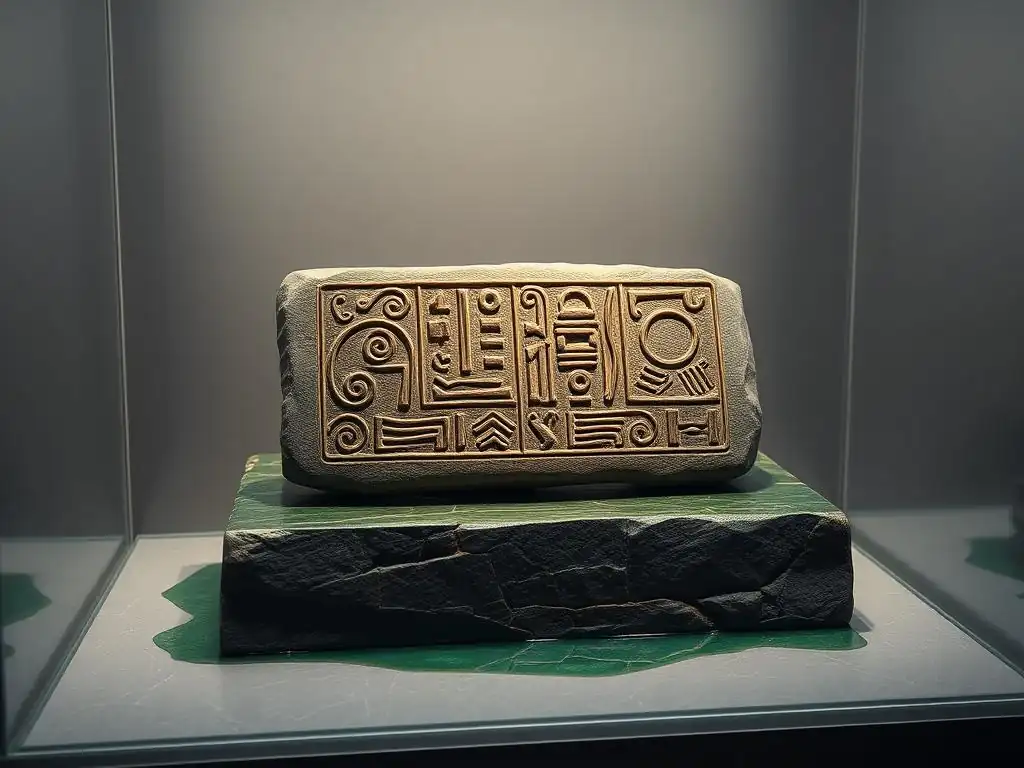
Potential Script or Symbolic Representation on the Dispilio Tablet
The marks on the Dispilio Tablet have been the subject of intense scholarly debate, with theories ranging from a rudimentary form of writing to a system of symbolic representations or even a mnemonic device. The linear incisions exhibit a certain regularity and repetition, suggesting they are not arbitrary doodles but rather a deliberate sequence of signs.
Some researchers propose that these symbols could represent a proto-script, a precursor to full writing systems, where each sign might correspond to a concept, an object, or even a phonetic sound. The patterns observed hint at an underlying structure, possibly indicating a system for recording inventories, astronomical observations, or ritualistic information vital to the Dispilio community.
Alternatively, the markings might function as ideograms or pictograms, where the symbols directly represent ideas or objects without necessarily forming a linguistic structure. They could also serve as a form of symbolic communication, perhaps for ritualistic purposes, clan identification, or as a teaching aid. The absence of a clear parallel or a "Rosetta Stone" equivalent makes definitive decipherment challenging, yet the structured nature of the inscriptions undeniably points to a sophisticated level of abstract thought among the Neolithic inhabitants of Dispilio. This potential for early symbolic communication is a key aspect of the Dispilio Tablet archaeological significance.
Comparing the Dispilio Tablet to Other Neolithic Inscriptions
The Dispilio Tablet is not an isolated phenomenon in Neolithic Europe; it finds intriguing parallels with other inscribed artifacts from the period, most notably the Vinca symbols found predominantly in the Balkan region, particularly at sites like Tartaria in Romania. The Vinca symbols, dating to a similar timeframe (c. 6000-4000 BC), also consist of linear and geometric marks on clay tablets and pottery. While there are no direct identical symbols, the general concept of incising structured signs onto portable objects for potential communication or record-keeping suggests a broader cultural trend across parts of Neolithic Europe.
Comparing the Dispilio Tablet to these other finds allows archaeologists to explore regional variations in symbolic expression and the diffusion of ideas. Unlike the Tartaria Tablets, which are made of clay, the Dispilio Tablet's wooden material offers insights into the preservation capabilities of different environments. The comparative analysis strengthens the argument that these were not isolated occurrences but part of a developing cognitive landscape where complex symbolic systems were emerging. This comparative context further elevates the Dispilio Tablet archaeological significance within the broader study of European prehistory.
The Debate Surrounding the Dispilio Tablet: Linguistic and Archaeological Perspectives
The interpretation of the Dispilio Tablet has ignited a vigorous debate among linguists and archaeologists. One school of thought, championed by its excavator Professor Hourmouziadis, posits that the tablet represents an early form of writing, a system capable of conveying complex messages, thereby pushing back the origins of literacy in Europe by thousands of years. Proponents of this view often highlight the systematic arrangement of the symbols and their recurring patterns as evidence of a structured communicative intent, suggesting the potential for a proto-alphabetic or syllabic system.
Conversely, many scholars adopt a more cautious approach, arguing that while the tablet is undoubtedly significant, there is insufficient evidence to classify its markings as a true writing system in the linguistic sense. They suggest that the symbols might be purely mnemonic devices, decorative patterns, property marks, or symbols used in rituals.
The challenge lies in the absence of a large corpus of similar inscriptions or a bilingual text that could provide a key to decipherment. This ongoing scholarly discourse, despite the lack of a definitive conclusion, underscores the profound Dispilio Tablet archaeological significance as a catalyst for rethinking the timeline and nature of early human communication.
The Archaeological Significance of the Dispilio Tablet
Dispilio Tablet's Contribution to Understanding Neolithic Communication
The Dispilio Tablet stands as a pivotal artifact in our quest to understand Neolithic communication. Its age, dating to approximately 5260 BC, provides compelling evidence that sophisticated forms of symbolic expression and perhaps even proto-writing were present in southeastern Europe far earlier than previously assumed. Before its discovery, the prevailing view largely placed the genesis of complex record-keeping and structured symbolic systems in the Near East, with Mesopotamia often cited as the cradle of writing. The tablet challenges this Eurocentric bias, suggesting independent or parallel developments in distinct geographical regions.
The very existence of such an artifact implies a societal need for recording or conveying information beyond simple oral tradition. This could have been for administrative purposes, tracking resources, ritualistic knowledge, or even early forms of historical narrative. The Dispilio Tablet archaeological significance lies in broadening our perspective on the cognitive capabilities of Neolithic societies, demonstrating that these communities possessed the intellectual capacity and cultural impetus to develop complex systems for sharing and preserving information, long before the advent of established civilizations.
Dispilio Tablet and the Development of Early Writing Systems
While not definitively classified as a full writing system, the Dispilio Tablet offers invaluable insights into the developmental trajectory of early writing. It represents a potential stepping stone in the long evolutionary process from simple marks to complex scripts. The structured nature of its incisions, with apparent repetitions and sequences, suggests a deliberate attempt to encode meaning, even if that meaning remains elusive to modern scholars. This artifact prompts archaeologists and linguists to reconsider the various forms that pre-literate communication might have taken and the diverse paths that eventually led to formalized writing.
The tablet serves as a tangible example of human cognitive ingenuity in the face of evolving societal complexities during the Neolithic period. It demonstrates an early human inclination towards abstract representation and systematic recording, which are fundamental precursors to any true writing system. Therefore, the Dispilio Tablet archaeological significance is profound: it provides a rare glimpse into the very early stages of symbolic communication, bridging the gap between purely oral traditions and the later emergence of fully developed scripts.
Dispilio Tablet as Evidence of Neolithic Cognitive Abilities
The creation of the Dispilio Tablet, with its carefully incised symbols, is a testament to the advanced cognitive abilities of Neolithic people. It signifies a capacity for abstract thought, planning, and systematic organization that goes beyond basic survival needs. The deliberate act of carving specific symbols onto a durable medium suggests a desire to convey or preserve information over time and space, indicating a level of societal complexity that required more than just spoken language. This artifact challenges any notion of prehistoric humans as intellectually unsophisticated.
Furthermore, the context of the tablet within a thriving lake settlement implies a community with established social structures and possibly specialized roles, including individuals or groups responsible for creating and interpreting such symbolic records. The Dispilio Tablet archaeological significance lies in its ability to illuminate the intellectual landscape of the Neolithic era, showcasing that these early agricultural communities were capable of sophisticated symbolic reasoning, which formed the bedrock for future innovations in human communication and cultural development.
Frequently Asked Questions
How old is the Dispilio Tablet and what makes it significant?
The Dispilio Tablet, discovered in Greece, dates back to around 5260 BC, making it approximately 7,500 years old. Its archaeological significance lies in the fact that it bears markings that some researchers interpret as a form of proto-writing or symbolic communication, pre-dating other known writing systems.
What is the Dispilio Lake Village and why is it important to archaeology?
The Dispilio Lake Village was a Neolithic settlement built on a platform over Lake Kastoria in Greece. Its importance stems from its well-preserved remains, providing invaluable insights into the daily life, architecture, and technology of Neolithic communities in Southeastern Europe. It offers a rare glimpse into prehistoric lake dwelling.
What are some of the challenges in interpreting the markings on the Dispilio Tablet?
Interpreting the markings faces challenges due to the lack of a Rosetta Stone equivalent, hindering definitive decipherment. The symbols are unique and not directly relatable to known established writing systems, leading to various speculative interpretations.
How does the Dispilio Tablet contribute to our understanding of the development of writing?
The Dispilio Tablet, if indeed a form of writing, suggests that the development of writing might have occurred earlier and in more diverse locations than previously thought. It challenges the conventional view of writing originating solely in Mesopotamia, potentially indicating a parallel or earlier development in Europe.
Where can I find more information about the Dispilio Tablet and the Dispilio Lake Village?
For more information, visit ArchaeologyHub.org, your digital encyclopedia of archaeological discoveries. You'll find detailed timelines, artifact profiles, and interpretive analyses, including content specifically on the Dispilio Tablet and its archaeological significance along with details of the Neolithic Lake Village of Dispilio.
Final Reflection: Unearthing Ancient Voices
The journey through the Neolithic village of Dispilio and the enigma of its inscribed tablet reveals more than just archaeological data; it unveils a profound connection to our ancestors and the very origins of symbolic thought. The Dispilio Tablet's archaeological significance lies not only in its age but in its potential to rewrite our understanding of early communication and cognitive development. Its existence challenges conventional timelines and compels us to reconsider the sophistication of Neolithic societies.
This glimpse into the past profoundly impacts our present, reminding us that the seeds of our complex world were sown millennia ago. The Dispilio Tablet, a small piece of wood, carries the weight of untold stories and the echoes of a civilization striving to express itself. It underscores the enduring human desire to communicate, to record, and to leave a mark on the world. The past is never dead. It's not even past.
- William Faulkner. This quote resonates deeply when considering Dispilio, as the tablet's message, though undeciphered, continues to speak to us across the ages.
As we close this window to the past, let us carry the lessons of Dispilio forward. Let us appreciate the ingenuity and resilience of those who came before us, and let us be inspired to create a future worthy of their legacy. Consider the power of communication, the importance of preserving our history, and the enduring human spirit that connects us all. What will your mark on the world be?
Unearth Your Own Discoveries!
Thanks for diving into the mysteries of Dispilio with us! We hope you've found a new appreciation for the echoes of the Neolithic era. Now, it's your turn to connect with the past.
Here are a few ways you can continue the adventure:
- Visit your local museum and see what ancient artifacts are on display. You might be surprised at the hidden histories right in your own backyard!
- Explore resources online to learn more about the Dispilio Tablet.
- Share this article with a friend who loves history and spark a conversation about the origins of writing!
What other ancient mysteries have captured your imagination recently?