
The Royal Tombs and Great Ziggurat of Ur: An Archaeological Overview

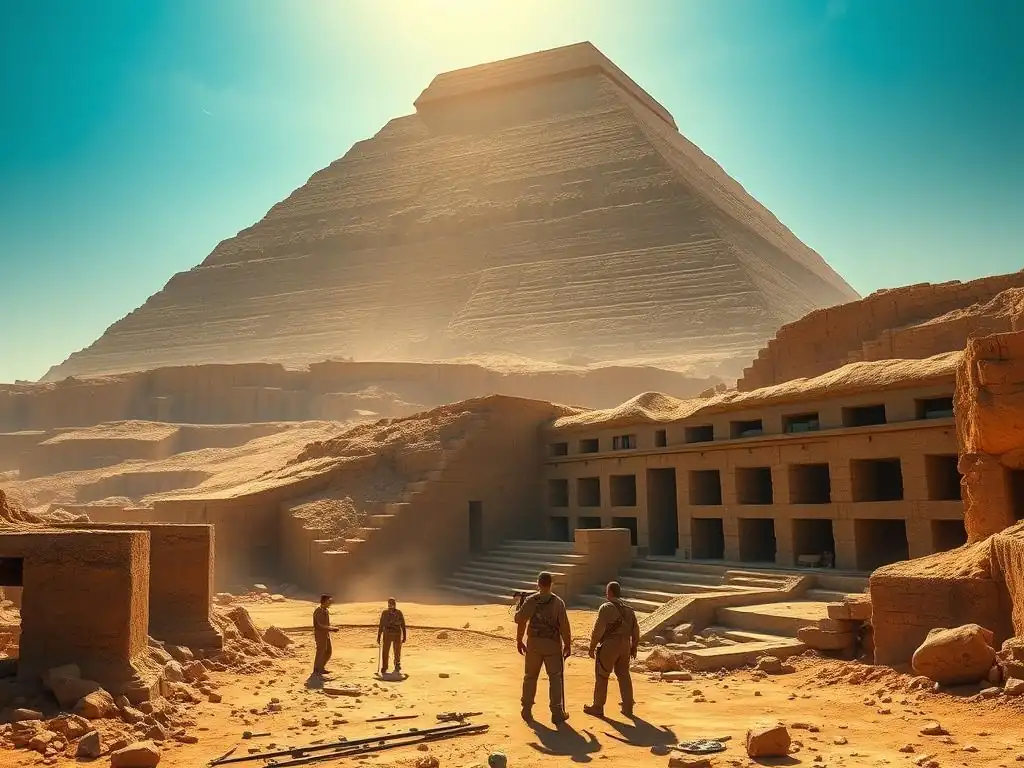
Welcome to ArchaeologyHub.org, your gateway to unraveling the mysteries of the past. Delve into the sands of time as we embark on a journey to explore the monumental Ur royal tombs ziggurat, a testament to the power and artistry of ancient Mesopotamia. But what secrets lie buried beneath its imposing structure? Unearth the answers and more as we delve deeper into this fascinating archaeological overview.
- Introduction to Ur: A Mesopotamian Powerhouse
- Unveiling the Royal Tombs of Ur
- Treasures of the Royal Tombs: Artifacts and Grave Goods
- The Great Ziggurat of Ur: A Monument to the Gods
- Comparing the Royal Tombs and the Ziggurat: Contrasting Purposes, Shared Legacy
- The Decline and Rediscovery of Ur
- Preservation and Future Research at Ur
-
Frequently Asked Questions
- What is the significance of the Royal Tombs of Ur?
- Where is the Great Ziggurat of Ur located, and what was its primary function?
- What archaeological discoveries were made within the Royal Tombs?
- How does ArchaeologyHub.org organize information about the Royal Tombs and the Ziggurat?
- What excavation techniques were used to uncover the Royal Tombs and Ziggurat of Ur?
- Final Reflection: Echoes of Ur, Whispers of Time
- Unearth Your Inner Archaeologist: Take the Next Step!
Introduction to Ur: A Mesopotamian Powerhouse
The Significance of Ur in Ancient Mesopotamia
Ur stood as one of the most powerful and influential city-states in ancient Mesopotamia, particularly during the Early Dynastic III period (circa 2600-2350 BCE) and later during the Third Dynasty of Ur (Ur III, circa 2112-2004 BCE). It served as a vital political, economic, and cultural hub, demonstrating remarkable advancements in urban planning, administration, and art. At its zenith under the Ur III dynasty, Ur controlled a vast empire, implemented a sophisticated bureaucratic system, and witnessed a flourishing of literature and monumental architecture, including the iconic Ur royal tombs ziggurat complex.
The city's prominence is evidenced by its estimated population, which could have reached between 25,000 and 65,000 inhabitants within its walls during its peak, making it one of the largest cities in the world at the time. Ur's complex societal structure, evidenced by its elaborate legal codes like the Code of Ur-Nammu (predating Hammurabi's), its extensive trade networks reaching as far as the Indus Valley, and its monumental building projects, provides invaluable insights into the origins of statehood and urban civilization in the ancient Near East.
Locating Ur: Geographical Context and Environment
The ancient city of Ur was strategically located in southern Mesopotamia, within the fertile floodplain between the Tigris and Euphrates rivers, approximately 300 kilometers south of modern-day Baghdad, Iraq. While today the ruins lie far from the Persian Gulf coastline, in antiquity, Ur was situated much closer, benefiting from access to maritime trade routes. The Euphrates River itself flowed directly past the city, providing essential water for irrigation, agriculture, and serving as a crucial artery for riverine trade and transport.
This geographical setting, characterized by its rich alluvial soil deposited by the annual floods of the rivers, allowed for highly productive agriculture, primarily based on barley cultivation. The abundance of food resources supported a dense population and facilitated the specialization of labor, contributing directly to Ur's economic prosperity and its ability to undertake massive construction projects like the Great Ziggurat and the elaborate Ur royal tombs. The challenging environment, lacking in stone and timber, also spurred innovation in the use of mud-brick and bitumen as primary building materials.
ArchaeologyHub.org Focus: Ur in the Near East Sites Collection
ArchaeologyHub.org features Ur prominently within its Near East Sites collection due to its unparalleled archaeological significance. The site offers a comprehensive window into Sumerian civilization, showcasing critical developments in urbanism, religious practices, and social hierarchy. The Ur royal tombs and the Great Ziggurat, in particular, provide tangible evidence of the sophistication and complexity of ancient Mesopotamian society.
The detailed analyses of artifacts from the Ur royal tombs, such as the Standard of Ur and Queen Puabi's headdress, allow for in-depth interpretive analyses of artistic expression, craftsmanship, and burial rituals. Furthermore, the architectural study of the Great Ziggurat of Ur offers insights into ancient engineering and the profound religious beliefs that shaped the urban landscape. Ur's inclusion underscores its status as a foundational site for understanding early human civilization and serves as a prime example of the rich archaeological heritage of the Near East.
Unveiling the Royal Tombs of Ur
Discovery and Excavation of the Royal Cemetery at Ur
The Royal Cemetery at Ur, a collection of approximately 2,000 burials, including 16 truly remarkable "royal" or "death pit" tombs, was uncovered during the joint expedition of the British Museum and the University of Pennsylvania Museum between 1922 and 1934. Led by the renowned archaeologist Sir Leonard Woolley, the discovery of these tombs, particularly those designated PG/580 (Tomb of Meskalamdug), PG/755 (Tomb of Puabi), and PG/1237 ("The Great Death Pit"), sent shockwaves through the archaeological world. Unlike many previously looted ancient burials, several of these Ur royal tombs were found largely intact, preserving their extraordinary contents.
The excavation process was meticulous for its time, with Woolley and his team painstakingly documenting each layer and artifact. The sheer volume and opulence of the grave goods, coupled with the startling discovery of numerous human attendants buried alongside the principal deceased, presented an unprecedented glimpse into the funerary practices and social stratification of Early Dynastic Sumer. The systematic approach to uncovering the Ur royal tombs allowed for detailed reconstruction of their layout and the interpretation of the elaborate burial rituals performed.
Sir Leonard Woolley's Pioneering Work at Ur
Sir Leonard Woolley's work at Ur stands as a landmark achievement in the history of archaeology. His methodology, though predating modern stratigraphic techniques in their full form, was remarkably advanced for the early 20th century. Woolley employed a disciplined approach to excavation, meticulously recording the position of every artifact, even using plaster of Paris to cast fragile objects like the lyres and harps before they could be removed, preserving their delicate forms. This careful documentation was crucial for understanding the context of the dazzling finds within the Ur royal tombs.
Beyond the technical aspects of excavation, Woolley's interpretations of the "death pits," suggesting ritualistic human sacrifice rather than mass execution, profoundly influenced scholarly understanding of Early Dynastic Sumerian society. His published works, such as "Ur of the Chaldees" (1929) and "The Royal Cemetery" (1934), not only presented the raw data but also offered compelling narratives that captured the public imagination, cementing Ur's place in popular consciousness and academic discourse. His legacy continues to inform studies of Mesopotamian archaeology and the ethical considerations surrounding the interpretation of ancient burial practices.
Dating the Royal Tombs: Chronological Placement within Mesopotamian History
The Ur royal tombs are firmly dated to the Early Dynastic III period, specifically between approximately 2600 and 2500 BCE. This chronological placement is based on a combination of archaeological evidence, including the distinct pottery styles, cylinder seal iconography, and stylistic characteristics of the metalwork found within the burials. The presence of artifacts like the gold helmet of Meskalamdug and the elaborate jewelry of Queen Puabi aligns perfectly with the material culture of this specific phase of Sumerian civilization.
This period immediately precedes the rise of the Akkadian Empire under Sargon the Great and represents a zenith of independent city-state power in Mesopotamia. The wealth and sophistication evident in the Ur royal tombs reflect a highly developed socio-political structure, capable of mobilizing vast resources for funerary rituals. The dating allows archaeologists to contextualize these unique burials within the broader narrative of early Mesopotamian history, providing insights into the evolving concepts of kingship, divinity, and the afterlife before the unification of the region under a single empire.
Treasures of the Royal Tombs: Artifacts and Grave Goods
Gold, Silver, and Precious Stones: Material Wealth in the Ur Tombs
The Ur royal tombs yielded an astonishing array of artifacts crafted from gold, silver, lapis lazuli, carnelian, and other precious materials, testifying to Ur's immense wealth and extensive trade networks during the Early Dynastic III period. Among the most iconic finds is the gold helmet of Meskalamdug, a meticulously hammered piece depicting strands of hair and individual ears, weighing approximately 1.5 kilograms of pure gold. Queen Puabi's tomb alone contained an elaborate headdress adorned with thousands of lapis lazuli beads, gold leaves, and carnelian flowers, alongside intricate necklaces, earrings, and finger rings.
The sheer volume of these precious materials indicates not only the personal wealth of the deceased but also the advanced metallurgical skills of Sumerian artisans. For instance, the lapis lazuli, a vibrant blue stone, was sourced from distant mines in Badakhshan, Afghanistan, over 3,000 kilometers away, demonstrating Ur's far-reaching commercial connections and its central role in ancient global trade routes. The presence of such valuable imports underscores the economic power that allowed Ur's elite to commission and acquire these extraordinary treasures for their eternal rest within the Ur royal tombs.
The Standard of Ur: A Masterpiece of Mesopotamian Art
Discovered in one of the largest Ur royal tombs (PG/779), the Standard of Ur is perhaps the most famous artifact, an intricately inlaid wooden box, approximately 21.7 cm high and 49.5 cm long. Its two main side panels, known as the "War" side and the "Peace" side, are adorned with intricate mosaic scenes made from shell, lapis lazuli, and red limestone set in bitumen. The "War" side depicts a Sumerian army, chariots trampling enemies, and soldiers presenting captives to a kingly figure, illustrating the military might and hierarchical structure of Ur.
The "Peace" side, in contrast, portrays a royal banquet, with figures bringing tribute, musicians playing lyres, and a seated king leading a celebratory feast. This side offers a vivid glimpse into the prosperity and social customs of Ur, including the consumption of food and drink, and the role of entertainment. While its exact function remains debated—possibly a soundbox for a musical instrument, a standard carried in processions, or a treasury box—the Standard of Ur is an invaluable primary source for understanding Sumerian society, art, and narrative depiction, providing a visual chronicle of life and conflict in ancient Mesopotamia.
Royal Attendants and Sacrificial Burials: Ritual Practices in the Tombs
One of the most striking and controversial aspects of the Ur royal tombs was the discovery of numerous human bodies buried alongside the principal deceased, often referred to as "royal attendants." In the largest tomb, PG/1237, dubbed "The Great Death Pit," Woolley found the remains of 74 individuals, including soldiers, musicians, and female attendants, along with two oxen and their drivers. Queen Puabi's tomb (PG/800) contained 25 individuals, all seemingly accompanying her into the afterlife.
The evidence, including the presence of cups near their hands and the lack of signs of struggle, led Woolley to hypothesize that these individuals participated in a ritualistic sacrifice, perhaps willingly, by drinking poison or being asphyxiated, to serve their monarch in the next world. While the exact nature of their demise remains a subject of scholarly debate, these mass burials underscore the immense power of Ur's rulers and the profound belief in an afterlife that necessitated such elaborate and costly funerary rituals.
The Ur royal tombs thus offer a unique, albeit somber, insight into the extreme social stratification and religious convictions of Early Dynastic Sumer.
The Great Ziggurat of Ur: A Monument to the Gods
Construction and Purpose of the Ziggurat
The Great Ziggurat of Ur, a monumental stepped temple tower, is arguably the most imposing structure at the site and a defining feature of the ancient city. It was primarily constructed by King Ur-Nammu, the founder of the Third Dynasty of Ur, around 2100 BCE, and later completed by his son Shulgi. Built from millions of sun-dried mud-bricks for its core and faced with meticulously laid baked bricks set in bitumen mortar, the ziggurat originally rose to an estimated height of approximately 30 meters.
The primary purpose of the ziggurat was not for public worship within its lower levels, but rather to serve as a sacred platform for a temple dedicated to the city's patron deity, Nanna, the Moon God, situated at its summit. It symbolized a cosmic mountain, a bridge between the earthly and divine realms, providing a direct connection for the priests and the king to communicate with the gods. This massive undertaking reflected the centralized power of the Ur III kings and their role as intermediaries between humanity and the divine, embodying both religious devotion and royal authority.
Nanna, the Moon God: Dedication of the Ur Ziggurat
The Great Ziggurat of Ur was explicitly dedicated to Nanna (also known as Sîn in Akkadian), the Sumerian Moon God and the tutelary deity of the city of Ur. As the city's divine protector and provider, Nanna held immense significance in the religious life of Ur. The ziggurat served as the primary cultic center for his worship, housing the "gipar," the sacred temple or shrine at its uppermost level, where daily rituals and offerings were presented.
The construction and maintenance of such a colossal structure underscored the city's devotion to Nanna and its belief that his favor was essential for Ur's prosperity and survival. Offerings of first fruits and other valuable goods were brought to the ziggurat, symbolizing the reciprocal relationship between the people and their deity. The ziggurat, therefore, was not merely an architectural marvel but a vital spiritual axis around which the entire city revolved, reinforcing the bond between the divine and the terrestrial realm.
Architectural Features and Reconstruction Efforts
The Great Ziggurat of Ur originally consisted of three massive terraces, each receding upwards, with a grand central staircase of 100 steps leading to the first terrace, flanked by two other staircases ascending from the sides. All three converged at a monumental gatehouse on the first terrace, from which another staircase led to the second, and presumably, a final staircase to the temple at the summit. The base of the ziggurat measures approximately 64 meters in length and 45 meters in width.
The structure incorporated sophisticated drainage systems to prevent water damage to the mud-brick core. Over millennia, the ziggurat suffered significant erosion and damage.
In the 1980s, under the direction of Saddam Hussein, substantial, albeit controversial, reconstruction efforts were undertaken, primarily on the lower levels, using modern materials and techniques to stabilize and partially restore the first terrace and its staircases. While these efforts have been criticized for not strictly adhering to archaeological conservation principles, they have ensured the survival of this magnificent structure, allowing visitors to appreciate the scale and engineering prowess of the ancient builders of the Ur royal tombs ziggurat complex.
Royal Power vs. Religious Devotion: Divergent Functions
While both the Ur royal tombs and the Great Ziggurat of Ur are monumental structures that define the ancient city, they served fundamentally different purposes, reflecting distinct facets of Sumerian society. The Ur royal tombs, dating to the Early Dynastic III period, were expressions of immense royal power, personal wealth, and a belief in the necessity of elaborate funerary rituals to secure the monarch's passage and status in the afterlife. They were private, hidden chambers designed to contain the deceased and their vast grave goods, along with their retinue, in perpetuity.
In contrast, the Great Ziggurat, built centuries later during the Ur III period, was a public monument dedicated to the city's patron deity, Nanna. Its purpose was to facilitate religious devotion, serve as a symbolic link between the heavens and earth, and provide a sacred dwelling for the god. While constructed by kings, its function was communal, representing the spiritual heart of Ur and the collective worship of its citizens. Thus, the tombs emphasized individual royal authority and the afterlife, while the ziggurat highlighted collective religious piety and the city's relationship with its divine protector.
Building Materials and Construction Techniques: Parallels and Differences
Both the Ur royal tombs and the Great Ziggurat showcase the advanced engineering and construction capabilities of ancient Sumerians, despite their different scales and functions. A key parallel lies in the predominant use of locally sourced materials: mud-brick for the core structures and bitumen as mortar and waterproofing. The scarcity of stone in Mesopotamia forced builders to master the art of brick-making, utilizing the abundant clay from the riverbanks.
However, significant differences in construction techniques are also evident. The Ur royal tombs, being underground or semi-subterranean, involved complex earthmoving and the construction of vaulted chambers using mud-brick arches, demonstrating an understanding of load-bearing structures. The ziggurat, on the other hand, was an immense above-ground edifice, requiring massive quantities of baked bricks for its exterior facing (over 720,000 baked bricks for the first terrace alone) to withstand erosion and provide a durable facade. Its stepped design and integrated drainage systems represent a different set of engineering challenges compared to the subterranean complexity of the Ur royal tombs.
The Enduring Symbolism of Ur's Royal Tombs and Ziggurat
Despite their contrasting purposes and construction timelines, the Ur royal tombs and the Great Ziggurat collectively form the enduring symbolic core of ancient Ur, representing the apex of Sumerian civilization. The tombs symbolize the raw power, wealth, and belief systems of the Early Dynastic elite, offering a tangible connection to the lives and deaths of its early rulers. They speak to a society capable of mobilizing vast resources and adhering to profound, albeit sometimes brutal, ritual practices.
The ziggurat, conversely, symbolizes the enduring religious fervor and architectural ambition of the Ur III period, showcasing a centralized state's ability to undertake monumental public works for divine veneration. Together, the Ur royal tombs ziggurat complex encapsulates the sophistication of Sumerian society—its mastery of organization, its artistic and technological prowess, and its deep spiritual and cosmological beliefs. They stand as powerful testaments to Ur's legacy as a foundational civilization in human history.
The Decline and Rediscovery of Ur
Factors Contributing to the Decline of Ur
The once-mighty city of Ur experienced a protracted decline following its peak under the Third Dynasty of Ur. The primary catalyst for the collapse of the Ur III empire around 2004 BCE was a combination of external pressures and internal weaknesses. Invasions from the Elamites from the east and the Amorites from the west fragmented the empire, leading to the destruction of Ur and the capture of its last king, Ibbi-Sin. This event is vividly recounted in the "Lamentation over the Destruction of Ur," an ancient Sumerian literary text.
While Ur saw periods of reoccupation and some rebuilding under later dynasties, such as the Kassites and the Neo-Babylonians (notably by Nabonidus in the 6th century BCE), it never regained its former prominence. Over centuries, factors like the shifting course of the Euphrates River, which moved away from the city, severely impacted its agricultural base and trade routes. Additionally, increasing salinization of the irrigated fields likely reduced agricultural yields. By the 4th century BCE, Ur was largely abandoned, slowly becoming a desolate mound buried under sand.
Rediscovering Ur: From Forgotten City to Archaeological Treasure
For nearly two millennia, the once-glorious city of Ur lay buried and forgotten, its monumental structures, including the Ur royal tombs ziggurat, reduced to a series of tells (mounds) in the Mesopotamian desert. European travelers and explorers began to identify the site as early as the 17th century, but systematic archaeological investigation only commenced in the mid-19th century. J.E. Taylor, the British Vice-Consul in Basra, conducted the first excavations in 1853-1854, identifying the ziggurat and finding cylinder seals and inscriptions.
However, it was the extensive joint expedition of the British Museum and the University of Pennsylvania Museum, led by Sir Leonard Woolley from 1922 to 1934, that truly brought Ur back into global consciousness. Woolley's meticulous excavations uncovered the magnificent Ur royal tombs, the Great Ziggurat, and countless artifacts, revealing the extraordinary sophistication of Sumerian civilization. His work transformed Ur from a forgotten ruin into one of the most important archaeological sites in the world, providing invaluable insights into humanity's earliest urban cultures.
The Legacy of Ur: Lessons from a Mesopotamian Civilization
The archaeological legacy of Ur provides profound lessons about the origins and development of human civilization. Its extensive cuneiform archives offer insights into early administration, law (like the Code of Ur-Nammu), literature, and economic systems. The Ur royal tombs illustrate complex social hierarchies, belief in the afterlife, and the mobilization of vast resources for ritual purposes. The Great Ziggurat stands as a testament to early monumental architecture and the central role of religion in urban life.
Ur’s history, from its rise as a powerful city-state to its eventual decline, offers a microcosm of the cycles of ancient civilizations, highlighting the interplay of political power, environmental factors, and cultural shifts. The artifacts and structures unearthed at Ur continue to inform our understanding of early urbanism, the development of writing, and the artistic and technological achievements of the Sumerians. The Ur royal tombs ziggurat complex remains an indispensable source for studying the human experience in the ancient Near East.
Preservation and Future Research at Ur
Conservation Efforts at the Ur Archaeological Site
The archaeological site of Ur faces significant conservation challenges, primarily due to its exposure to harsh desert elements, including wind erosion, sand encroachment, and occasional heavy rains that can damage mud-brick structures. Furthermore, the site's location in a region prone to conflict has added layers of complexity to preservation efforts. During the Iraq War (2003-2011), the site was within the perimeter of a military base, which inadvertently offered some protection from looting but also led to some damage from military activities.
Post-conflict, international organizations like the World Monuments Fund, in collaboration with the Iraqi State Board of Antiquities and Heritage, have initiated various conservation projects. These efforts focus on stabilizing the vulnerable mud-brick structures, particularly the Great Ziggurat of Ur, through careful restoration using traditional materials and techniques where appropriate. The primary goal is to mitigate further decay and ensure the long-term survival of this irreplaceable heritage site, including the structures of the Ur royal tombs ziggurat.
Ongoing Research and Future Excavation Plans
While the major discoveries at Ur, particularly the Ur royal tombs, largely concluded with Woolley's work in the 1930s, archaeological research at the site continues. Modern investigations often involve non-invasive techniques such as ground-penetrating radar (GPR) and magnetometry to map unexcavated areas and understand the broader urban layout without disturbing the ground. These surveys help identify potential new areas for future, more targeted excavations.
Contemporary archaeological projects at Ur, often in collaboration between Iraqi and international teams, also focus on environmental archaeology, aiming to reconstruct ancient landscapes, river courses, and the impact of climate change on the city's fortunes. There is also a renewed interest in re-examining Woolley's extensive records from the Ur royal tombs and other areas with modern analytical techniques, such as DNA analysis of human remains or detailed material analysis of artifacts, to glean new insights that were not possible a century ago. The potential for uncovering more of Ur's secrets, beyond the known Ur royal tombs ziggurat, remains.
The Importance of Protecting Ur's Archaeological Heritage
Protecting Ur's archaeological heritage is of paramount importance due to its status as a UNESCO World Heritage site (inscribed in 2016 as part of "The Ahwar of Southern Iraq: Refuge of Biodiversity and the Relict Landscape of the Mesopotamian Cities"). Ur represents one of the earliest and most significant urban civilizations in human history, offering unparalleled insights into the origins of cities, writing, law, and complex social structures. The Ur royal tombs ziggurat complex, in particular, provides a tangible link to the Sumerian people's beliefs, artistic achievements, and societal organization.
Its preservation is not only crucial for scientific research and education but also for the cultural identity of Iraq and the shared heritage of humanity. Safeguarding Ur ensures that future generations can learn directly from the physical remnants of this ancient powerhouse, allowing continued study of its unique contributions to civilization and serving as a reminder of the fragility and resilience of human endeavors across millennia.
Frequently Asked Questions
What is the significance of the Royal Tombs of Ur?
The Royal Tombs of Ur are significant due to their extraordinary wealth and the evidence of ritual sacrifice found within. They provide invaluable insights into the early dynastic period of Mesopotamian civilization.
Where is the Great Ziggurat of Ur located, and what was its primary function?
The Great Ziggurat of Ur is located in present-day Iraq, near the city of Nasiriyah. Its primary function was as a temple dedicated to the moon god Nanna, serving as a religious and administrative center for the city.
What archaeological discoveries were made within the Royal Tombs?
Significant archaeological discoveries within the Royal Tombs include elaborate jewelry, weapons, and musical instruments, all crafted from precious materials. These artifacts showcased the advanced craftsmanship and social stratification of Ur society.
How does ArchaeologyHub.org organize information about the Royal Tombs and the Ziggurat?
ArchaeologyHub.org organizes information about the Royal Tombs and the Ziggurat by geographic region (Mesopotamia) and time period (Early Dynastic Period). This facilitates a comprehensive understanding of the site within its historical context.
What excavation techniques were used to uncover the Royal Tombs and Ziggurat of Ur?
Excavation techniques used to uncover the Royal Tombs and Ziggurat involved careful stratigraphic excavation, documentation of artifact locations, and analysis of burial contexts. These methods are crucial for understanding the original arrangement and purpose of the structures.
Final Reflection: Echoes of Ur, Whispers of Time
The exploration of the Royal Tombs and Great Ziggurat of Ur, as we've seen, is not merely an archaeological exercise; it's a vital connection to the roots of civilization. Understanding the societal structures, artistic achievements, and religious beliefs of ancient Ur offers invaluable insights into the very foundations upon which our modern world is built. The echoes of Sumerian innovation and power resonate even today, reminding us of the enduring human capacity for creativity and organization.
The legacy of Ur continues to shape our understanding of early urban development and the complexities of ancient societies. Personally, I find the sheer scale of the Ziggurat, and the opulence of the Royal Tombs, profoundly moving – a testament to human ambition and the enduring quest for meaning. The past is never dead. It's not even past.
- William Faulkner. This quote encapsulates the enduring relevance of Ur, a civilization whose influence continues to ripple through time, shaping our cultural and social landscape in ways we may not even fully realize.
As we conclude this journey through the sands of time, I invite you to consider the lessons learned from Ur. What can we glean from their successes and failures? How can we apply their innovations and organizational skills to address the challenges of our own era? Let the grandeur of the Ziggurat and the treasures of the Royal Tombs inspire you to build your own legacy, to contribute to the ongoing story of human civilization, and to leave your own indelible mark on the world.
Unearth Your Inner Archaeologist: Take the Next Step!
Thanks for delving into the fascinating world of Ur with us. We hope you enjoyed exploring the Royal Tombs and Great Ziggurat. Now it's time to take that newfound knowledge and put it into action!
Here are some ways you can continue your archaeological adventure:
- Become a Citizen Scientist: Contribute to real archaeological research by participating in online projects that help analyze data from Ur and other ancient sites.
- Explore Related Cultures: Research other Mesopotamian civilizations like Sumer or Akkad, or discover a new civilization entirely by expanding the scope of research.
- Share the Discovery: Spread the word about Ur! Share this article with friends and family who might be interested in ancient history.
What other ancient sites are now on your must-explore list after learning about Ur?