
Inariyama Kofun Sword: Deciphering the Inscription and its Historical Impact

Welcome to ArchaeologyHub.org, your gateway to unlocking the secrets of the past.
Delve into the captivating world of archaeological discovery, where every artifact whispers tales of forgotten civilizations. In this article, we embark on a journey to decipher one such whisper, exploring the profound implications of the Inariyama Kofun sword inscription. What secrets does this ancient artifact hold, and how does it reshape our understanding of its era? Prepare to uncover the fascinating story behind this pivotal find and its enduring historical impact.
- Introduction to the Inariyama Kofun and its Significant Sword
- Unveiling the Inariyama Kofun Sword Inscription
- Deciphering the Ancient Script: Translating the Inariyama Sword's Message
- Historical Significance of the Inariyama Kofun Sword Inscription
- Comparing the Inariyama Sword with Other Inscribed Artifacts from the Kofun Period
- The Inariyama Kofun Sword Inscription and its Impact on Japanese Historiography
- Preservation and Study of the Inariyama Kofun Sword
- Conclusion: The Enduring Legacy of the Inariyama Kofun Sword Inscription
-
Frequently Asked Questions
- What is the significance of the Inariyama Kofun sword inscription?
- Where was the Inariyama Kofun sword discovered?
- What language is the Inariyama Kofun sword inscription written in?
- What kind of information does the Inariyama Kofun sword inscription provide about the individual buried in the kofun?
- How does the Inariyama Kofun sword inscription contribute to our understanding of Japanese history?
- Final Reflection: Echoes of Ancient Authority
- Unearth History: Respond to the Echoes of the Inariyama Sword!
Introduction to the Inariyama Kofun and its Significant Sword
Overview of the Inariyama Kofun: A Keyhole-Shaped Tomb
The Kofun period, spanning roughly from the 3rd to the 7th century AD, represents a pivotal era in Japanese history, characterized by the construction of massive burial mounds known as kofun. Among these, the distinctive keyhole-shaped zenpō-kōen-fun are particularly emblematic, signifying the emergence of powerful regional chieftains and the gradual consolidation of political authority. The Inariyama Kofun, located within the Sakitamakofun-gun (Sakitama Ancient Burial Mounds Park) in Gyoda City, Saitama Prefecture, stands as a prime example of these monumental tombs, estimated to have been constructed in the late 5th century AD.
This particular kofun is not only significant for its impressive scale, measuring approximately 120 meters in length, but also for its exceptionally rich array of grave goods. These artifacts provide invaluable insights into the material culture, social hierarchy, and external influences that shaped early Japanese society. The Inariyama Kofun is part of a larger cluster of burial mounds, forming a necropolis that speaks to the concentration of power and wealth in this region during the Kofun period.
Discovery of the Inscribed Sword: A Pivotal Archaeological Find
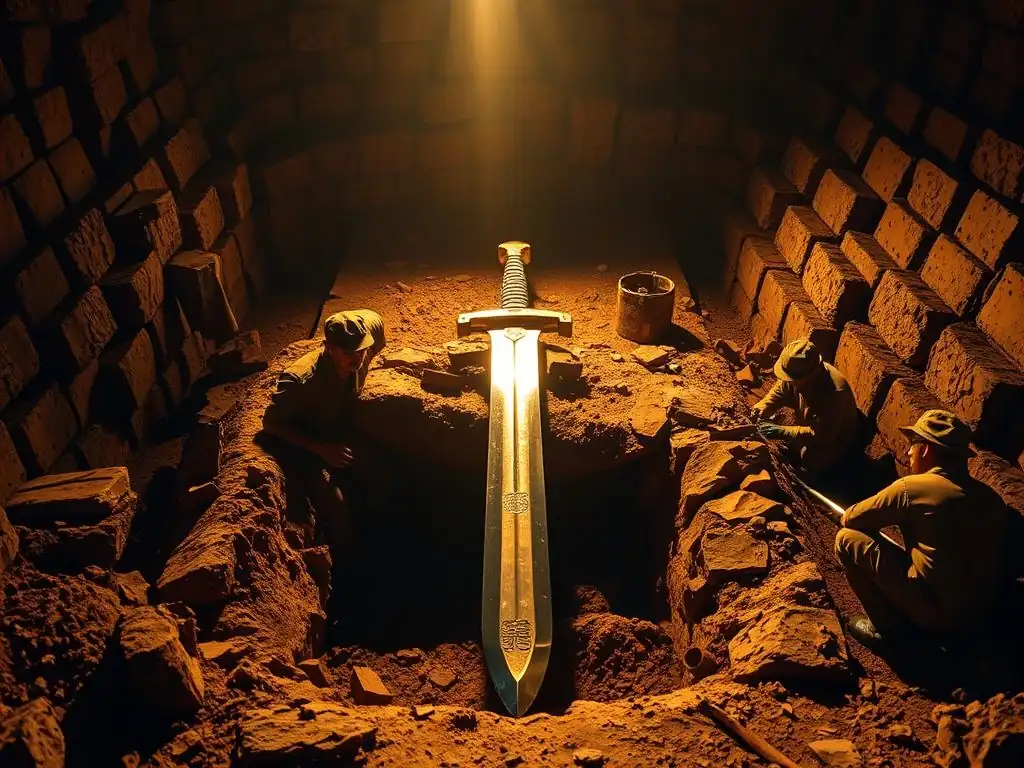
The archaeological excavation of the Inariyama Kofun in 1968 yielded one of the most significant discoveries in Japanese archaeology: an iron sword bearing a lengthy inscription. Found within the main burial chamber, this tachi-style sword immediately captivated researchers due to the rarity of such extensive written artifacts from the Kofun period. Prior to this discovery, direct textual evidence from this era was exceptionally scarce, often limited to very short inscriptions on mirrors or other objects.
The unveiling of the Inariyama Kofun sword inscription provided an unprecedented window into the political landscape and social structures of 5th-century Japan. Its content promised to corroborate or challenge existing historical narratives primarily derived from later chronicles like the Kojiki and Nihon Shoki. This single artifact became a cornerstone for understanding the early Yamato court and the spread of its influence across the archipelago.
Unveiling the Inariyama Kofun Sword Inscription
The Sword's Physical Description and Context of Discovery
The Inariyama Kofun sword is an iron blade, classified as a tachi (a type of long sword), measuring approximately 73.5 centimeters in length. While remnants of its hilt and scabbard were also recovered, it is the blade itself that holds the extraordinary historical value. The sword was discovered in the stone burial chamber of the Inariyama Kofun, positioned alongside the remains of the interred individual, who is believed to have been a high-ranking chieftain.
This placement among other elaborate grave goods, including gilded bronze horse trappings, armor, and various ceremonial items, underscores the immense status of the tomb's occupant. The presence of the Inariyama Kofun sword inscription on such a prominent artifact further emphasizes its significance, suggesting it was a personal item of great importance, possibly commissioned to commemorate the achievements and lineage of its owner.
A Detailed Look at the Inscription: Characters and Layout
The defining feature of the Inariyama Kofun sword is its remarkable inscription, composed of 115 Chinese characters meticulously engraved along the length of the blade. These characters are arranged in two distinct lines, running parallel to the sword's edge, a layout that highlights the deliberate and significant nature of the text. The script represents an early form of Chinese characters (kanji) adopted and adapted for use in Japan during this period, often with a mix of phonetic and semantic applications.
The sheer length and detail of this inscription set it apart from virtually all other contemporary artifacts found in Japan. It stands as one of the longest and earliest continuous texts discovered, offering a unique linguistic and historical challenge. The clarity of many of the characters, despite centuries of burial, allowed for extensive scholarly analysis, making the Inariyama Kofun sword inscription a critical piece of evidence for understanding early Japanese literacy.
Deciphering the Ancient Script: Translating the Inariyama Sword's Message
Challenges in Interpreting the Kofun Period Inscription
Deciphering the Inariyama Kofun sword inscription presented significant challenges to epigraphers and historians. The primary difficulty lies in the archaic nature of the Chinese characters used, many of which had different forms, meanings, or phonetic values in the 5th century compared to later periods. Furthermore, the inscription lacks punctuation or clear sentence breaks, making the segmentation of phrases and the identification of grammatical structures particularly complex.
Another layer of complexity arises from the mixed usage of characters—some are used phonetically to represent Japanese names or sounds, while others convey semantic meaning. This requires a deep understanding of both classical Chinese and early Japanese linguistic patterns. The inherent challenges of corrosion and wear on the iron blade also meant that some characters were less distinct, necessitating careful comparative analysis and expert judgment to arrive at a consensus translation.
Linguistic Analysis and Possible Translations of the Inscription
Despite the formidable obstacles, extensive linguistic analysis by leading scholars has led to a widely accepted translation of the Inariyama Kofun sword inscription. The inscription is understood to be a biographical account, detailing the lineage and service of an individual named Wowake. It outlines how Wowake's ancestors served the Yamato court for eight generations, culminating in Wowake himself holding a significant administrative position.
The text reveals that Wowake was a kasade (granary supervisor) who served a "Great King" (Okimi) named Waka Takeru. This specific reference is crucial, as "Waka Takeru Okimi" is widely identified by historians as Emperor Yūryaku, a powerful ruler of the Yamato court whose reign is traditionally placed from c. 456 to 479 AD. The inscription therefore offers a rare, contemporary account of a high-ranking official's life and his direct connection to the imperial line.
Identifying Key Figures and Events Mentioned in the Inscription
The Inariyama Kofun sword inscription explicitly names several key figures and alludes to significant historical events. The central figure is "Wowake" (or Waka Takeru), the individual for whom the sword was commissioned, described as a hereditary chieftain or high-ranking official. His family's long-standing service to the Yamato court over "eight generations" highlights the enduring nature of loyalty and the development of a hierarchical bureaucratic structure.
Most importantly, the inscription refers to "Waka Takeru Okimi" (or King Bu), a name that strongly correlates with Emperor Yūryaku, a prominent figure in the Kojiki and Nihon Shoki. The mention of Wowake serving under this Great King, specifically as an official managing granaries, provides concrete evidence of the Yamato court's administrative reach and the roles of regional elites within its system. This direct connection between an archaeological artifact and figures from historical chronicles makes the Inariyama Kofun sword inscription a cornerstone for understanding early Japanese imperial history.
Historical Significance of the Inariyama Kofun Sword Inscription
The Inscription's Contribution to Understanding Kofun Period Society
The Inariyama Kofun sword inscription offers an unparalleled glimpse into the social and political fabric of Kofun period Japan. It provides tangible evidence of a highly stratified society with a clear hierarchy, where powerful regional clans like that of Wowake were integrated into the centralized system of the Yamato court. The inscription explicitly details administrative roles, such as the kasade (granary supervisor), indicating a sophisticated level of governance and economic management within the burgeoning state.
Furthermore, the emphasis on ancestral service over multiple generations underscores the importance of lineage and hereditary positions in securing social status and political influence. This artifact demonstrates that by the late 5th century, the Yamato court was not merely a ceremonial power but an active governing entity, utilizing regional elites to manage its resources and extend its authority. The inscription, therefore, is a vital primary source for reconstructing the complex societal structure of early Japan.
Implications for Yamato Kingdom History and Political Power
The most profound historical implication of the Inariyama Kofun sword inscription lies in its corroboration of the existence and influence of Emperor Yūryaku. Prior to its discovery, Yūryaku, known as "King Bu" in Chinese records, was primarily a figure from later, potentially embellished, Japanese chronicles. The sword's direct reference to "Waka Takeru Okimi" provides contemporary archaeological proof of a powerful Yamato ruler whose authority extended far beyond the immediate Kinai region, reaching as far as the Kanto plain where the Inariyama Kofun is located.
This evidence significantly bolsters the narrative of the Yamato court's expansion and consolidation of power during the 5th century. It suggests that by this time, the Yamato polity had established a system of alliances and control over regional chieftains, integrating them into its administrative framework. The Inariyama Kofun sword inscription thus serves as a critical piece of evidence for understanding the formation and early political geography of the nascent Japanese state.
The Sword as Evidence of Early Writing and Literacy in Japan
The Inariyama Kofun sword inscription is arguably the most important artifact demonstrating the early adoption and use of writing in Japan. With its 115 characters, it stands as one of the earliest and longest continuous texts discovered on Japanese soil, predating the widespread use of written Japanese. It unequivocally proves that Chinese characters were being utilized by the Japanese elite during the Kofun period, albeit by a limited number of individuals for specific administrative, commemorative, or ritualistic purposes.
This discovery sheds light on the process by which writing was introduced and disseminated from the Asian continent, likely through Korean intermediaries, and adapted to the Japanese context. While literacy was not widespread, the inscription indicates that a functional writing system existed and was employed by high-ranking officials to record significant events and personal histories. The Inariyama Kofun sword inscription is a foundational piece of evidence for tracing the origins of literacy and the development of written culture in Japan.
Comparing the Inariyama Sword with Other Inscribed Artifacts from the Kofun Period
Analysis of Similar Inscriptions on Bronze Mirrors and Other Swords
While the Inariyama Kofun sword inscription is unique in its length and biographical detail, it is not the sole example of inscribed artifacts from the Kofun period. Other notable discoveries include the iron sword from the Eta Funayama Kofun in Kumamoto Prefecture, which also bears an inscription mentioning "Waka Takeru Okimi." This parallel inscription provides crucial corroboration for the identity of Emperor Yūryaku and the extent of his influence across Japan. However, the Eta Funayama inscription is somewhat shorter and less detailed than that on the Inariyama sword.
Numerous bronze mirrors from the Kofun period also feature inscriptions, though these are typically much shorter, often consisting of just a few characters. These mirror inscriptions frequently contain dedicatory phrases, auspicious wishes, or references to the mirror's origin, often in a more formulaic or ritualistic context. Unlike the extensive narrative of the Inariyama Kofun sword inscription, these shorter texts rarely provide specific historical or biographical details, highlighting the distinctiveness of the Inariyama sword's content.
Contextualizing the Inariyama Sword within Broader Kofun Period Material Culture
The Inariyama Kofun sword, with its remarkable inscription, must be understood within the broader context of Kofun period material culture. Grave goods from this era, including elaborate armor, weaponry, horse trappings, and various ceremonial objects, consistently reflect the high status of the interred individuals and their connections to a burgeoning centralized power. These artifacts often showcase advanced ironworking techniques and the adoption of continental technologies and artistic styles, indicative of cultural exchange with Korea and China.
What makes the Inariyama Kofun sword inscription particularly distinct is its shift from purely symbolic or functional artifacts to one that carries explicit historical narrative. While other grave goods communicate status through their material value or craftsmanship, the Inariyama sword directly communicates a personal history and political allegiance through written text. This textual element elevates it from merely an object of material culture to a primary historical document, offering a rare textual window into the lives of the Kofun elite and their relationship with the Yamato court.
The Inariyama Kofun Sword Inscription and its Impact on Japanese Historiography
How the Inscription Changed Our Understanding of Early Japanese History
The discovery and deciphering of the Inariyama Kofun sword inscription fundamentally reshaped the understanding of early Japanese history. Before its unearthing, much of the knowledge about the 5th-century Yamato court and its rulers relied heavily on the Kojiki (Records of Ancient Matters) and Nihon Shoki (Chronicles of Japan), compiled in the early 8th century. While invaluable, these texts were written centuries after the events they describe and often contain mythical elements or reflect later political agendas.
The Inariyama Kofun sword inscription provided independent, contemporary archaeological evidence that corroborated the existence of a powerful ruler known as "Waka Takeru Okimi," who is widely identified as Emperor Yūryaku. This tangible link between an archaeological artifact and a figure from the imperial lineage significantly strengthened the historical credibility of the early imperial narratives, helping to anchor the chronology and political landscape of the Kofun period within a more verifiable framework. It allowed historians to move beyond mere literary accounts and integrate concrete archaeological data into their reconstructions of Japan's formative years.
Debates and Controversies Surrounding the Inscription's Interpretation
Despite the general consensus on the translation and historical significance of the Inariyama Kofun sword inscription, it has not been without its share of scholarly debates and controversies. Initial discussions revolved around the precise dating of the sword and the exact identification of "Waka Takeru Okimi," although the strong correlation with Emperor Yūryaku is now widely accepted. Some scholars have also debated the precise meaning of certain archaic characters or the nuances of the biographical account.
These ongoing discussions reflect the rigorous nature of historical and epigraphic research, where every detail is meticulously scrutinized. For instance, the exact nature of Wowake's relationship with the Yamato court—whether he was a direct vassal or a powerful regional ally—continues to be a subject of academic inquiry. Such debates, rather than diminishing the inscription's value, underscore its complexity and its enduring capacity to stimulate new insights into the intricate processes of early Japanese state formation and the dynamics of its elite class.
The Inariyama Sword as a National Treasure and Symbol of Japanese Heritage
Recognizing its unparalleled historical and cultural value, the Inariyama Kofun sword, along with its inscription, has been designated as a National Treasure of Japan. This designation signifies its profound importance as a testament to the sophistication of Kofun period craftsmanship, the early emergence of a literate society, and the foundational elements of the Japanese state. It is celebrated as one of the most significant archaeological discoveries in the nation's history.
The Inariyama Kofun sword inscription serves as a powerful symbol of Japanese heritage, embodying the intersection of material culture and written history. It represents a tangible link to the imperial past and the complex processes that shaped the archipelago's early political and social identity. Its status as a National Treasure ensures its preservation for future generations and highlights its central role in the ongoing study and appreciation of Japan's ancient origins.
Preservation and Study of the Inariyama Kofun Sword
Conservation Efforts and Ongoing Research on the Sword
The preservation of the Inariyama Kofun sword has been a meticulous and continuous effort since its discovery. Due to its iron composition, the sword was susceptible to corrosion and deterioration. Expert conservators undertook careful processes to stabilize the metal, remove centuries of rust, and ensure the legibility of the delicate inscription. These conservation efforts are crucial to safeguarding the artifact for long-term study and display.
Beyond initial preservation, ongoing research continues to unlock deeper insights from the Inariyama Kofun sword inscription. Advanced imaging techniques, such as X-ray fluorescence and infrared photography, have been employed to further clarify faint characters and analyze the composition of the iron and the engraving process. Epigraphers and historians regularly revisit the text, comparing it with newly discovered artifacts and refining their understanding of Kofun period language and history, ensuring its continued relevance in archaeological discourse.
Exhibitions and Public Access to the Inariyama Kofun Sword
To ensure its educational and cultural impact, the Inariyama Kofun sword is periodically exhibited to the public. It is primarily housed at the Saitama Prefectural Museum of the Sakitama Ancient Burial Mounds, located near the very site of its discovery. This allows visitors to experience firsthand the artifact within its historical landscape, enhancing their understanding of the Kofun period.
The exhibition of the sword, often accompanied by detailed interpretive panels and multimedia presentations, plays a vital role in public education. It allows a broad audience to appreciate the significance of the Inariyama Kofun sword inscription as a tangible link to ancient Japan's rulers, administrative systems, and the dawn of literacy. Its presence in public collections ensures that this invaluable piece of heritage continues to inspire and inform future generations about the richness of Japan's archaeological past.
Conclusion: The Enduring Legacy of the Inariyama Kofun Sword Inscription
The Inariyama Kofun sword, with its extraordinary inscription, stands as an unparalleled archaeological treasure, fundamentally altering our understanding of early Japanese history. Its discovery provided concrete, contemporary evidence that corroborated the existence of key figures like Emperor Yūryaku and shed unprecedented light on the political structure, social hierarchy, and nascent literacy of the Kofun period. The Inariyama Kofun sword inscription is far more than just a series of characters on a blade; it is a direct voice from the 5th century, detailing personal history, administrative roles, and the intricate relationship between regional chieftains and the burgeoning Yamato court.
Its significance extends beyond mere historical confirmation, offering invaluable insights into the spread of Chinese characters and the early development of written culture in Japan. As a National Treasure, the Inariyama Kofun sword continues to be a subject of rigorous academic study and a source of profound national pride. Its enduring legacy lies in its capacity to illuminate the foundational period of Japanese state formation, ensuring its place as one of the most pivotal artifacts in the nation's archaeological record and a continuous inspiration for historical inquiry.
Frequently Asked Questions
What is the significance of the Inariyama Kofun sword inscription?
The Inariyama Kofun sword inscription is significant because it provides direct contemporary evidence about the political landscape of 5th-century Japan, including connections to the Yamato court and its influence. It's a rare glimpse into the past.
Where was the Inariyama Kofun sword discovered?
The sword was discovered within the Inariyama Kofun, a burial mound located in Saitama Prefecture, Japan. The kofun itself is an important archaeological site.
What language is the Inariyama Kofun sword inscription written in?
The inscription is written in Chinese characters (Kanji), which were used to record the Japanese language at the time. Understanding the inscription requires knowledge of classical Chinese.
What kind of information does the Inariyama Kofun sword inscription provide about the individual buried in the kofun?
The inscription details the individual's service to the Yamato court and his lineage. It suggests he was a powerful figure with close ties to the ruling elite, as well as his ancestry.
How does the Inariyama Kofun sword inscription contribute to our understanding of Japanese history?
It offers valuable insights into the political structure and social hierarchies of early Japan. It helps to corroborate and refine our knowledge of the Kofun period, particularly the Yamato state's expansion.
The journey through the Inariyama Kofun sword inscription reveals more than just a historical record; it unveils the complex interplay of power, lineage, and cultural exchange that shaped early Japan. The meticulous deciphering of the inscription, as we've explored, offers a tangible link to the Yamato court and its efforts to consolidate authority, a process whose reverberations are still felt in the cultural and political landscape of modern Japan.
The enduring fascination with the Inariyama Kofun sword speaks volumes about our desire to connect with the past and understand the forces that have shaped our present. The inscription, a seemingly simple series of characters, unlocks a wealth of information about social structures, political ambitions, and the very formation of Japanese identity. History is not the past but a map of the past drawn from a particular point of view.
- David P. Henige. This quote underscores the importance of examining artifacts like the Inariyama Kofun sword inscription from multiple perspectives, acknowledging the biases and interpretations that inevitably shape our understanding.
Now, consider the legacy of the Inariyama Kofun sword inscription. How does this glimpse into the past inform your understanding of power dynamics, cultural identity, and the enduring impact of historical artifacts? Let the echoes of ancient authority resonate within you, inspiring a deeper appreciation for the complexities of history and the stories waiting to be uncovered in the artifacts that surround us.
Unearth History: Respond to the Echoes of the Inariyama Sword!
Thank you for diving deep into the mysteries surrounding the Inariyama Kofun sword and its profound historical inscription. We hope you found the insights enlightening and gained a deeper appreciation for this remarkable artifact. Now, it's your turn to become part of the story.
- Contribute to the Ongoing Debate: Delve into existing research papers about the sword’s inscription and formulate your own theory or interpretation based on the provided information. Share your perspective in the comments below!
- Explore Similar Discoveries: Research other significant archaeological finds from the Kofun period to broaden your understanding of the era's cultural and political landscape.
- Inspire Others: Share this article with fellow history enthusiasts to spark further discussion and exploration of ancient Japan.
What single word or phrase from the Inariyama sword's inscription resonates most strongly with you, and why?