
Interpreting Iconic Jataka Stories and Buddhist Narratives Depicted on Stupa Complexes

Welcome to ArchaeologyHub.org, your gateway to unraveling the past!
Delve into the fascinating world of ancient civilizations and uncover the secrets hidden within the earth. Are you ready to explore the profound symbolism embedded within sacred structures? Our latest article, "Interpreting Iconic Jataka Stories and Buddhist Narratives Depicted on Stupa Complexes," offers a captivating journey into the artistic and spiritual expressions of bygone eras. Discover how these intricate depictions provide invaluable insights into the beliefs and cultural values of those who came before us. Prepare to be captivated by the stories these ancient stones have to tell...
- Introduction: Jataka Tales and their Significance in Buddhist Art at Stupas
- Understanding Jataka Stories: Origins and Core Themes
- Stupa Complexes as Storytelling Canvases: Visualizing Jataka Tales
- Deciphering the Iconography of Jataka Stories on Stupas
- Case Studies: Specific Jataka Stories and their Depiction on Stupa Complexes
- The Evolution of Jataka Story Depictions in Stupa Art Over Time
- Challenges in Interpreting Jataka Stories on Stupas
- The Enduring Legacy of Jataka Stories and Stupa Complexes
- Conclusion: Preserving and Understanding the Visual Narratives of Buddhist Stupas
-
Frequently Asked Questions
- What are Jataka stories and why are they significant in archaeology?
- How are Jataka stories depicted on stupa complexes?
- What information can we glean from studying the Jataka stories depicted on stupa complexes?
- Where can I find notable examples of stupa complexes adorned with Jataka story depictions?
- How does ArchaeologyHub.org contribute to the understanding of Jataka stories and stupa complexes?
- Final Reflection: Echoes of Enlightenment in Stone
- Unveil the Ancient Wisdom: Become a Stupa Explorer!
Introduction: Jataka Tales and their Significance in Buddhist Art at Stupas
Unveiling Buddhist Narratives Through Archaeological Analysis
Archaeological analysis plays a pivotal role in reconstructing and interpreting the complex Buddhist narratives, particularly the Jataka stories, found on ancient stupa complexes. Through meticulous excavation, documentation, and conservation, archaeologists uncover the physical remnants of these monumental structures, such as the elaborate gateways (toranas) and railings (vedikas) of sites like Sanchi and Bharhut. The recovery of thousands of sculptural fragments and architectural elements, often spanning centuries of construction and modification, provides the raw data essential for understanding the visual language of early Buddhism.
The analytical process extends beyond mere excavation to include detailed epigraphic studies, where surviving inscriptions in Brahmi script often label specific Jataka scenes, providing definitive identification. Stylistic analysis of the sculptural panels allows art historians to date the reliefs and trace artistic trends, while comparative studies with canonical Buddhist texts (like the Pali Jataka collection) help to match visual narratives with their literary counterparts. This multi-disciplinary approach is crucial for deciphering the intricate storytelling embedded within the very fabric of these ancient Jataka stories stupa complexes.
The Role of Jataka Stories in Understanding Early Buddhist Beliefs
Jataka stories, tales of the Buddha's previous lives as a Bodhisattva, were fundamental to the dissemination and understanding of early Buddhist beliefs among both monastic and lay communities. These narratives served as accessible parables, illustrating core ethical principles and the paramitas (perfections) such as generosity, compassion, patience, and wisdom, which are essential for attaining enlightenment. By depicting the Bodhisattva's arduous journey through countless existences, the stories provided concrete examples of virtuous conduct and the karmic consequences of actions, making abstract philosophical concepts relatable to everyday life.
The widespread depiction of these Jataka stories on stupa complexes across ancient India, from the Mauryan period onwards (c. 3rd century BCE), underscores their immense importance in propagating the Dhamma. Their visual presence on sacred monuments like Sanchi, Bharhut, and Amaravati transformed these sites into open-air textbooks, reinforcing the core tenets of Buddhism and providing powerful visual aids for devotees engaged in circumambulation (pradakshina). This integration of narrative art with sacred architecture reflects the popular understanding and practice of Buddhism in its formative centuries, making Jataka stories stupa complexes invaluable historical documents.
Understanding Jataka Stories: Origins and Core Themes
Exploring the Previous Lives of the Buddha
Jataka stories are a collection of narratives recounting the previous existences of Siddhartha Gautama, the historical Buddha, before his final birth as Prince Siddhartha. In these tales, the Bodhisattva (future Buddha) appears in various forms, including humans (kings, ascetics, merchants), animals (monkeys, elephants, deer, birds), and even divine beings. Each story typically illustrates a specific virtue or perfection (paramita) that the Bodhisattva cultivated over countless lifetimes, gradually accumulating the merit and wisdom necessary for his ultimate awakening.
The most comprehensive collection of these tales is found in the Pali Canon's Jataka Pitaka, which traditionally comprises 547 stories, although the number and content can vary slightly across different Buddhist traditions and regional versions. These narratives are not merely folklore but are considered didactic tools, demonstrating the long and arduous path to Buddhahood and serving as moral exemplars for practitioners.
The Bodhisattva's actions in these lives, whether as a self-sacrificing monkey king or a generous prince, set the stage for his final enlightenment, providing a rich tapestry of ethical instruction embedded within the fabric of Jataka stories stupa complexes.
Key Themes and Moral Lessons in Jataka Narratives
The Jataka narratives are rich with recurring themes and moral lessons that provided ethical guidance for ancient Buddhist communities. Prominent among these are the ten perfections (dasa paramitas): generosity (dāna), morality (sīla), renunciation (nekkhamma), wisdom (paññā), energy (vīriya), patience (khanti), truthfulness (sacca), determination (adhiṭṭhāna), loving-kindness (mettā), and equanimity (upekkhā). For instance, the Vessantara Jataka, one of the most frequently depicted and elaborate stories, exemplifies the perfection of generosity to an extreme degree, with the Bodhisattva giving away his children and wife.
Other vital themes include compassion (karuṇā), self-sacrifice, non-violence, and the consequences of karma. The Sasa Jataka (Hare Jataka), where the Bodhisattva as a hare offers his own flesh as food to a hungry brahmin, powerfully illustrates boundless compassion and self-sacrifice. These stories often contrast virtuous conduct with negative traits like greed, anger, or delusion, providing clear moral instruction. Their visual representation on stupa complexes reinforced these lessons, making them tangible and inspiring for devotees seeking to cultivate similar virtues in their own lives.
The Transmission of Jataka Stories: From Oral Tradition to Visual Representation
Jataka stories originated and thrived as part of an extensive oral tradition, passed down by Buddhist monks, nuns, and professional storytellers (Jataka-kathikas) for centuries. This oral transmission allowed for their widespread dissemination across diverse regions of ancient India, leading to various adaptations and local interpretations. The narratives were recited during monastic gatherings, public sermons, and festivals, making them a popular and accessible means of teaching Buddhist doctrine to a broad, often illiterate, populace.
As Buddhism gained significant patronage, particularly during the Mauryan period (c. 3rd century BCE) and subsequent Sunga and Satavahana periods (c. 2nd-1st centuries BCE), these narratives began to be monumentalized in stone. The transition to visual representation on stupa complexes transformed these oral tales into enduring works of art. Carved onto the stone railings (vedikas) and gateways (toranas) of stupas like Bharhut and Sanchi, the Jataka stories became permanent fixtures of the sacred landscape, reinforcing their didactic purpose and solidifying their place within the Buddhist canon, thereby transforming these Jataka stories stupa complexes into grand narrative monuments.
Stupa Complexes as Storytelling Canvases: Visualizing Jataka Tales
Sanchi Stupa and Other Prominent Stupa Complexes: A Comparative Overview
Sanchi, located in Madhya Pradesh, stands as one of the most magnificent examples of a stupa complex renowned for its extensive and artistically sophisticated Jataka depictions. Its origins trace back to the Mauryan period (3rd century BCE), with significant expansions, including the iconic gateways of Stupa No. 1, occurring during the Sunga and Satavahana periods (2nd-1st centuries BCE). The four monumental gateways (toranas) are particularly celebrated for their intricate relief carvings that narrate numerous Jataka stories and other events from the Buddha's life.
When compared with other prominent stupa complexes such as Bharhut (Madhya Pradesh, c. 2nd century BCE) and Amaravati (Andhra Pradesh, c. 2nd-3rd century CE), distinct regional and chronological variations emerge. Bharhut is characterized by its earlier, more literal and often labeled Jataka scenes, featuring shallow relief and a direct, almost diagrammatic style. Amaravati, on the other hand, exhibits a later, more dynamic, and naturalistic style, often incorporating the anthropomorphic Buddha. These sites collectively demonstrate the evolving artistic conventions and narrative strategies employed in visualizing Jataka stories stupa complexes over several centuries.
The Use of Relief Sculptures to Depict Jataka Stories on Stupas
Relief sculpture was the primary artistic medium through which Jataka tales were brought to life on ancient stupa complexes. These sculptures, typically carved from locally available sandstone (as seen at Sanchi and Bharhut) or limestone (at Amaravati), adorned various architectural elements, including the monumental gateways, the circumambulatory railings, and sometimes the drum of the stupa itself. Artists frequently employed the technique of continuous narration, where multiple episodes from a single story are depicted sequentially within a single long panel or across adjacent panels, guiding the viewer through the narrative progression.
The artistic skill involved in rendering these complex narratives in stone evolved significantly over time. Early relief sculptures, such as those at Bharhut, often exhibit a shallow, two-dimensional quality with a focus on clear identification of characters and events. Later examples, particularly at Sanchi and Amaravati, demonstrate increasing depth, dynamism, and a greater emphasis on emotional expression and naturalistic detail. The strategic arrangement of these narrative panels along the circumambulatory path (pradakshina) allowed devotees to "read" the stories as they ritually moved around the stupa, thereby integrating the visual narrative with the devotional practice.
Identifying Common Jataka Scenes in Stupa Art: Vessantara Jataka and Mahakapi Jataka
Among the myriad of Jataka stories depicted on stupa complexes, certain narratives appear with remarkable frequency due to their profound moral lessons and popular appeal. The Vessantara Jataka, which recounts the Bodhisattva's ultimate act of generosity by giving away his children and wife, is arguably the most elaborate and widely depicted Jataka. Its extensive narrative often occupies multiple panels, as magnificently illustrated on the gateways of Sanchi Stupa No. 1, where various episodes from Prince Vessantara's life, exile, and reunion are intricately carved, spanning significant sections of the architectural surface.
Another frequently identified narrative is the Mahakapi Jataka (Great Monkey Jataka), which portrays the Bodhisattva's self-sacrifice as a monkey king who forms a bridge with his own body to save his troop from danger. This story is notably found at Bharhut, where it is often accompanied by a clear Brahmi inscription labeling the scene, aiding in its definitive identification. The Mahakapi Jataka is also present at Sanchi. The prevalence of these specific narratives across different Jataka stories stupa complexes underscores their didactic importance and popularity among the Buddhist community, making them key examples for studying early Buddhist visual culture.
Deciphering the Iconography of Jataka Stories on Stupas
Analyzing the Symbolic Language of Buddhist Art: Animals, Humans, and Divine Beings
Buddhist art on stupa complexes employs a sophisticated symbolic language to convey the intricate narratives of the Jataka tales. Animals frequently serve as manifestations of the Bodhisattva, embodying specific virtues: an elephant might symbolize strength and wisdom (as in the Chaddanta Jataka), a monkey leadership and self-sacrifice (Mahakapi Jataka), or a hare boundless compassion (Sasa Jataka). Humans, encompassing royalty, ascetics, commoners, and antagonists, populate the scenes, acting out the moral dilemmas and interactions that drive the narratives.
Divine beings, such as devas (gods) or nāgas (serpent deities), also appear, often witnessing or occasionally intervening in the Bodhisattva's actions, thereby emphasizing the cosmic significance of his journey towards Buddhahood. Crucially, in early stupa art (up to around the 1st century CE), the Buddha himself was typically represented aniconically, through symbols such as the Bodhi tree (representing his enlightenment), the dharma wheel (his first sermon), his footprints, or an empty throne. Understanding this symbolic vocabulary is paramount for accurately interpreting the Jataka stories stupa complexes convey without direct anthropomorphic representations of the Buddha.
The Importance of Context: Understanding the Placement of Jataka Scenes on Stupas
The placement of Jataka scenes on stupa complexes is rarely arbitrary; rather, it often reflects a deliberate and meaningful design strategy. Narratives are frequently arranged to be viewed sequentially as devotees perform pradakshina (circumambulation), guiding them through the story as they move around the sacred monument. For instance, at Sanchi, the elaborate sculptural programs of the four gateways (toranas) are carefully integrated with the circumambulatory path, allowing for a continuous visual narrative experience for those entering and moving around the Great Stupa.
Furthermore, the specific location of a Jataka panel on a railing, pillar, or gateway might relate to the overall decorative scheme, cardinal directions, or even thematic groupings. Scholars meticulously analyze whether certain Jataka stories are intentionally juxtaposed or grouped to convey particular messages or to reinforce specific Buddhist doctrines. This contextual understanding, which considers the architectural framework, ritual function, and spatial relationships of the sculptures, provides crucial insights into the patrons' intentions and the interpretive strategies employed by the artists who created these Jataka stories stupa complexes.
Interpreting the Narrative Flow: How Jataka Stories are Presented Sequentially
Artists adorning stupa complexes utilized various narrative strategies to present Jataka stories, with continuous narration being the most prevalent. In this technique, multiple episodes from a single story are depicted within one long panel or across a series of connected panels, with the same character appearing repeatedly in different moments of the narrative. This method creates a dynamic unfolding of the plot, allowing the viewer's eye to follow the sequence of events and grasp the complete story without interruption.
Less common but also present are monoscenic depictions, where only a single, iconic moment from a Jataka is chosen for representation, or synoptic narratives, which condense key events into a single frame. Deciphering this narrative flow requires careful observation of recurring characters, spatial relationships between figures, and the overall compositional structure of the relief panel. Understanding these visual conventions is essential for accurately interpreting the complex and often lengthy Jataka stories stupa complexes convey, providing a window into ancient Indian storytelling techniques.
Case Studies: Specific Jataka Stories and their Depiction on Stupa Complexes
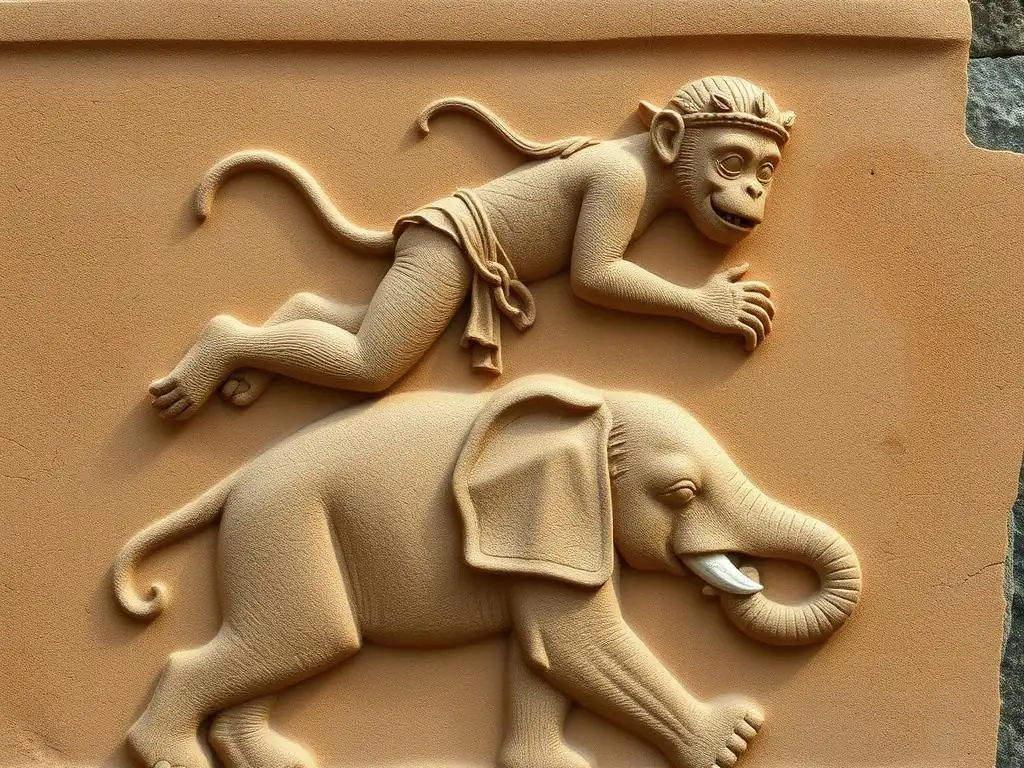
The Mahakapi Jataka at Bharhut
The Mahakapi Jataka, or the Great Monkey Jataka, provides an excellent example of early Jataka depiction, notably found at the Bharhut stupa complex dating to the 2nd century BCE. The surviving relief panel clearly illustrates the Bodhisattva, in the form of a monkey king, sacrificing himself by forming a bridge with his own body across a chasm.
This act allows his troop of monkeys to escape from the pursuing King Brahmadatta of Varanasi and his soldiers. Crucially, this panel at Bharhut is accompanied by a clear Brahmi inscription, "Mahākapi Jātaka," which unequivocally identifies the narrative, making it invaluable for art historical studies.
The depiction at Bharhut is characterized by its shallow relief and a direct, almost diagrammatic representation of the narrative. The figures are rendered with a certain rigidity, but the clarity of the storytelling is paramount, ensuring the moral message of the Bodhisattva's ultimate self-sacrifice, compassion, and leadership is immediately comprehensible to the viewer. This early example from Bharhut sets a foundational standard for understanding how Jataka stories stupa complexes began to visually communicate complex ethical narratives.
The Representation of Chaddanta Jataka in Stupa Art
The Chaddanta Jataka, the tale of a six-tusked elephant Bodhisattva, is another widely depicted narrative across various stupa complexes. One of the most detailed representations can be found on the eastern gateway of Sanchi Stupa No. 1, dating to the 1st century BCE. The elaborate carving illustrates several key episodes from the story: the elephant's peaceful life in the Himalayas, the queen's curse, the hunter Sonuttara's arduous journey to find the elephant, and the elephant Bodhisattva's compassionate act of allowing his tusks to be removed.
Variations of the Chaddanta Jataka are also present at other sites, including Amaravati (2nd-3rd century CE), where the artistic style is more fluid and dynamic, reflecting the later aesthetic conventions of the Deccan region. The consistent appearance of this story across different Jataka stories stupa complexes underscores its importance in illustrating the Bodhisattva's perfection of patience (khanti paramita) and his willingness to sacrifice for the well-being of others, even in the face of immense pain. These depictions provide rich material for comparative analysis of narrative techniques and stylistic developments in Buddhist art.
Comparative Analysis: Variations in Jataka Depictions Across Different Stupa Sites
A comparative analysis of Jataka depictions across major stupa complexes like Bharhut, Sanchi, and Amaravati reveals significant stylistic and narrative variations that reflect regional artistic schools and chronological developments. Bharhut's reliefs, dating to approximately 100 BCE, are characterized by their early, somewhat rigid style, shallow relief, and an emphasis on clear identification, often aided by Brahmi labels. Figures are typically frontal, and compositions are relatively straightforward, designed for direct narrative comprehension.
Sanchi, while also early (1st century BCE), showcases greater artistic sophistication with deeper relief, more complex compositions, and a slightly more naturalistic rendering of figures, though still largely aniconic in its representation of the Buddha. Amaravati, from a later period (2nd-3rd century CE), exemplifies a highly developed, dynamic, and naturalistic style, often incorporating the anthropomorphic Buddha. Its reliefs are characterized by slender, elongated figures, fluid lines, and a sense of vigorous movement. These distinct stylistic differences are crucial for understanding the chronological and regional evolution of art on Jataka stories stupa complexes across ancient India.
The Evolution of Jataka Story Depictions in Stupa Art Over Time
Early Representations of Jataka Tales
The earliest known representations of Jataka tales on stupa complexes, primarily from sites such as Bharhut (c. 100 BCE) and the initial phases of Sanchi (c. 1st century BCE), are characterized by an adherence to aniconism. In this period, the Buddha, even when central to the narrative, is represented by symbols rather than an anthropomorphic form—examples include the Bodhi tree, the Dharma wheel, footprints, or an empty throne. The artistic style is typically flat, with figures rendered in shallow relief, and compositions are straightforward, focusing on clear narrative clarity.
These early Jataka stories stupa complexes often include accompanying Brahmi inscriptions that label the specific Jataka being depicted, which has been invaluable for modern scholarly identification. The narrative technique employed is usually continuous, but the scenes are less elaborate and tend to focus on key, identifiable moments of the story. This foundational period established the visual vocabulary for Jataka narratives that would continue to evolve and diversify over subsequent centuries across various Buddhist art traditions.
Later Developments and Innovations in Jataka Story Iconography
As Buddhist art matured, particularly from the Kushan period (1st-3rd century CE) onwards in regions like Gandhara and Mathura, and subsequently in sites like Amaravati, significant innovations emerged in Jataka story iconography on stupa complexes. The most profound development was the increasing appearance of the Buddha in anthropomorphic form, gradually replacing the earlier aniconic symbols. This shift allowed for new possibilities in depicting the Bodhisattva's direct interaction within the narratives, adding a new dimension to the storytelling.
Artistic styles also became more refined, with a greater emphasis on naturalism, movement, and emotional expression. Reliefs gained more depth, and compositions became increasingly complex, incorporating multiple planes and a larger number of figures within a single scene. These later Jataka stories stupa complexes often demonstrate a more sophisticated understanding of perspective and narrative flow, reflecting a mature phase of Buddhist sculptural art that continued to inspire devotees and convey profound spiritual messages.
The Influence of Regional Styles on the Depiction of Jataka Narratives
The depiction of Jataka narratives on stupa complexes was profoundly shaped by the distinct regional artistic styles that flourished across ancient India. For instance, the art of Gandhara (modern-day Afghanistan and Pakistan), active from the 1st to 5th centuries CE, exhibits strong Greco-Roman influences. This is evident in the draped figures, classical facial features, and a more naturalistic approach to anatomy, which contrast sharply with indigenous Indian styles in their portrayal of Jataka scenes.
In contrast, the Mathura school in northern India, also prominent during the Kushan period, developed a robust, indigenous style characterized by figures with broad shoulders, voluminous forms, and a sense of earthy sensuality. The Amaravati school in the Deccan, flourishing from the 2nd to 3rd centuries CE, is renowned for its dynamic compositions, slender figures, and fluid lines, often depicting scenes with great narrative energy and pathos. These regional variations highlight the diverse artistic interpretations and adaptations of common Buddhist themes across different Jataka stories stupa complexes, demonstrating the adaptive and evolving nature of Buddhist art.
Challenges in Interpreting Jataka Stories on Stupas
The Fragmentary Nature of Archaeological Evidence
One significant challenge in interpreting Jataka stories on stupa complexes is the inherently fragmentary nature of the archaeological evidence. Over centuries, many stupas have suffered extensive damage due to natural weathering, seismic activity, human destruction, or the repurposing of their architectural elements for other constructions. This often means that only isolated panels, broken sculptural fragments, or incomplete sections of narrative friezes survive, making it exceedingly difficult to reconstruct the complete sequence or original context of a story.
For example, while the Bharhut stupa complex yielded invaluable labeled Jataka panels, a substantial portion of the original monument was dismantled, with its surviving parts now dispersed in museums globally. Reconstructing the original placement and narrative flow requires meticulous comparative analysis with other sites and textual sources, often leading to educated hypotheses rather than definitive conclusions. This challenge underscores the critical importance of careful archaeological recording and preservation efforts for these Jataka stories stupa complexes.
The Potential for Multiple Interpretations of Jataka Scenes
Another interpretive challenge arises from the potential for multiple interpretations of Jataka scenes, especially when they lack accompanying inscriptions. Some sculptural panels might depict generic scenes that could conceivably fit several different Jataka narratives, or they might represent common Buddhist motifs rather than specific, identifiable stories. For instance, a scene depicting a king giving alms could illustrate any number of Jataka tales that emphasize the perfection of generosity (dāna paramita).
To overcome this ambiguity, scholars must rely on a deep understanding of Buddhist iconography, extensive knowledge of textual traditions (such as the Pali Jataka collection and various Sanskrit Avadanas), and rigorous comparative analysis with clearly identified scenes from other stupa complexes. This complex interpretive process frequently involves scholarly debate, as different researchers might propose varying identifications for the same sculptural panel, highlighting the ongoing effort required to decipher these Jataka stories stupa complexes.
The Importance of Interdisciplinary Approaches
Overcoming the significant interpretive challenges posed by ancient Jataka stories stupa complexes necessitates a robust interdisciplinary approach. This involves integrating insights from archaeology, art history, epigraphy, and textual studies. Archaeologists provide the crucial physical context, dating, and understanding of the architectural framework, while art historians analyze stylistic developments, iconographic conventions, and narrative techniques employed by the sculptors.
Epigraphists play an indispensable role by deciphering surviving inscriptions, which often provide definitive labels for Jataka scenes or identify patrons. Furthermore, linguistic scholars contribute by translating and interpreting ancient Buddhist texts, which are essential for understanding the literary versions of the Jataka stories and their philosophical nuances. By combining these diverse fields of knowledge, researchers can construct more comprehensive, accurate, and nuanced interpretations of the rich visual narratives found on these ancient Buddhist monuments, enhancing our understanding of Jataka stories stupa complexes.
The Enduring Legacy of Jataka Stories and Stupa Complexes
The Continued Relevance of Jataka Tales in Buddhist Culture
Jataka tales continue to hold profound relevance in contemporary Buddhist culture across various traditions, including Theravada, Mahayana, and Vajrayana. They are regularly recited, read, and performed in Buddhist communities globally, serving as a timeless source of moral instruction, spiritual inspiration, and entertainment. Monks and teachers frequently incorporate Jataka stories into their sermons and teachings to illustrate complex ethical principles, the workings of karma, and the path to spiritual development in an accessible and engaging manner.
Beyond formal monastic settings, these narratives have been adapted into diverse forms of popular culture, including children's books, animated films, television series, and traditional folk theater in many Buddhist countries. This ongoing adaptation ensures their transmission to new generations, demonstrating that the profound themes of compassion, generosity, perseverance, and wisdom, once intricately carved onto ancient Jataka stories stupa complexes, remain vibrant and influential in shaping Buddhist identity and practice today.
Stupa Complexes as Living Testaments to Buddhist History and Art
Ancient stupa complexes such as Sanchi, Bharhut, Amaravati, and Nagarjunakonda are far more than mere historical ruins; they stand as living testaments to the rich history, artistic ingenuity, and spiritual depth of Buddhism in South Asia. These sites represent monumental achievements in ancient Indian architecture and sculpture, providing invaluable insights into the religious practices, social structures, and artistic conventions that flourished during the formative centuries of Buddhism.
These sacred sites continue to attract pilgrims, tourists, and scholars from around the world, serving as active centers for study, worship, and contemplation. Their remarkably preserved sculptural narratives, particularly the Jataka stories, offer a tangible connection to early Buddhist thought and a visual record of how complex philosophical ideas were disseminated to a broad populace. Thus, these Jataka stories stupa complexes remain indispensable for understanding the evolution of Buddhist art, philosophy, and popular devotion.
Future Directions in the Study of Jataka Stories and Stupa Complexes
Future research on Jataka stories and stupa complexes can significantly benefit from the application of advanced digital technologies. Techniques such as 3D scanning, photogrammetry, and virtual reality can enable detailed digital preservation and reconstruction of fragmented panels and architectural elements. This capability allows for more precise analyses of narrative sequences, the original appearance of these monumental works, and their spatial relationship within the larger complex.
Furthermore, interdisciplinary collaborations with digital humanities specialists can lead to the creation of interactive databases, virtual tours, and augmented reality applications, making these rich visual narratives more accessible to a global audience for both academic study and public engagement. Continued comparative studies across different Buddhist regions and traditions will also deepen our understanding of the universal and localized interpretations of Jataka stories stupa complexes, revealing new insights into their cultural and religious significance.
Conclusion: Preserving and Understanding the Visual Narratives of Buddhist Stupas
The Study of South Asian Buddhist Sites
The rigorous and ongoing study of South Asian Buddhist sites, particularly the magnificent stupa complexes, is of paramount importance for comprehending the origins and early development of Buddhist art and iconography. These sites, including Sanchi, Bharhut, Amaravati, and Nagarjunakonda, represent a crucial formative period when Buddhist narratives, especially the compelling Jataka stories, transitioned from an extensive oral tradition to monumental and enduring visual expressions in stone.
Through meticulous archaeological excavation, detailed epigraphic analysis of inscriptions, and comprehensive art historical interpretation, scholars continue to uncover and decipher the complex layers of meaning embedded within these sacred structures. This dedicated research ensures that these invaluable historical records are not only preserved for future generations but also continually reinterpreted, allowing their profound stories to inform our understanding of ancient cultures and the enduring legacy of Buddhism.
The Ongoing Significance of Jataka Stories in Understanding Buddhist Philosophy and Art.
Jataka stories, as vividly depicted on stupa complexes, remain an indispensable resource for comprehending the core tenets of Buddhist philosophy and the evolution of Buddhist art. They provide a vivid and accessible means by which abstract ethical principles such as karma, generosity, and compassion, along with the arduous path of the Bodhisattva, were communicated to a diverse populace in ancient India through compelling and relatable narratives of self-sacrifice and wisdom.
The visual representation of these tales on monumental architecture demonstrates their central role in early Buddhist pedagogy and popular devotion, serving as visual sermons that reinforced the Dhamma. By continuing to interpret, analyze, and preserve these iconic narratives, we gain deeper insights into the enduring power of storytelling in shaping religious belief, ethical conduct, and artistic expression across centuries, particularly within the context of these magnificent Jataka stories stupa complexes.
Frequently Asked Questions
What are Jataka stories and why are they significant in archaeology?
Jataka stories are a vast collection of tales recounting the previous lives of the Buddha, often depicted in art and architecture. They are significant because they offer insights into Buddhist beliefs, moral values, and social structures, providing valuable information about past societies.
How are Jataka stories depicted on stupa complexes?
Jataka stories are often depicted through relief carvings and sculptures on the walls, gateways, and railings of stupa complexes. These depictions served as visual aids for teaching Buddhist principles and reinforcing religious narratives among pilgrims.
What information can we glean from studying the Jataka stories depicted on stupa complexes?
Studying these depictions offers insights into artistic styles, religious practices, and the cultural context of the time. They also help us understand the spread and evolution of Buddhism across different regions and periods.
Where can I find notable examples of stupa complexes adorned with Jataka story depictions?
Notable examples include stupas at Sanchi in India, Borobudur in Indonesia, and Amaravati in India. These sites showcase diverse artistic interpretations of Jataka stories, reflecting local influences.
How does ArchaeologyHub.org contribute to the understanding of Jataka stories and stupa complexes?
ArchaeologyHub.org provides detailed timelines, artifact profiles, and interpretive analyses of these sites. It offers a comprehensive resource for researchers and enthusiasts interested in exploring the historical and cultural significance of Jataka stories and stupa complexes.
Okay, here's a final reflection designed to close your article, "Interpreting Iconic Jataka Stories and Buddhist Narratives Depicted on Stupa Complexes," optimized for the keyword "Jataka stories stupa complexes" and following the structure you provided:
Final Reflection: Echoes of Enlightenment in Stone
The enduring power of Jataka stories stupa complexes lies not just in their historical significance, but in their continued ability to resonate with contemporary audiences seeking wisdom and ethical guidance. These ancient narratives, etched in stone and imbued with profound teachings, offer a timeless roadmap for navigating the complexities of human existence, reminding us of the interconnectedness of all beings and the enduring pursuit of enlightenment.
The exploration of these narratives has profoundly shaped our understanding of Buddhist art and philosophy, highlighting the vital role of visual storytelling in transmitting complex spiritual concepts across generations. The stupa complexes, serving as both physical structures and narrative canvases, underscore the enduring power of art to inspire contemplation and ethical action. The Jataka tales are not just stories; they are mirrors reflecting our own potential for compassion, wisdom, and selflessness.
This quote encapsulates the essence of why these narratives continue to captivate and inspire.
As we conclude this journey through the intricate world of Jataka stories stupa complexes, let us carry forward the lessons embedded within these ancient stones. Consider how the principles of compassion, wisdom, and ethical conduct, so vividly portrayed in these narratives, can inform your own actions and contribute to a more enlightened and compassionate world. Embrace the enduring power of these stories, and allow them to guide you on your own path towards inner peace and understanding.
Unveil the Ancient Wisdom: Become a Stupa Explorer!
Thank you for delving into the captivating world of Jataka tales and Buddhist narratives etched onto stupa complexes. We hope you’ve gained a deeper appreciation for the stories and artistry that bring these ancient structures to life. Ready to take your understanding further?
Here are a few ways to connect with this incredible cultural heritage:
- Visit a local stupa or Buddhist temple: Seek out the narratives we discussed in person! Immersing yourself in the physical space can offer profound insights.
- Research less-known Jataka tales and compare their depictions across different stupa sites.
- Share your favorite Jataka story or stupa complex image on social media with the hashtag #StupaStories and invite others to explore the rich history!
Which Jataka story, now brought to life through the art of stupas, resonates most deeply with you and why?