
Interpreting the 'Barbarian' Threat: Native Tribes Beyond Hadrian's Wall

Welcome to ArchaeologyHub.org, your gateway to unlocking the mysteries of the past.
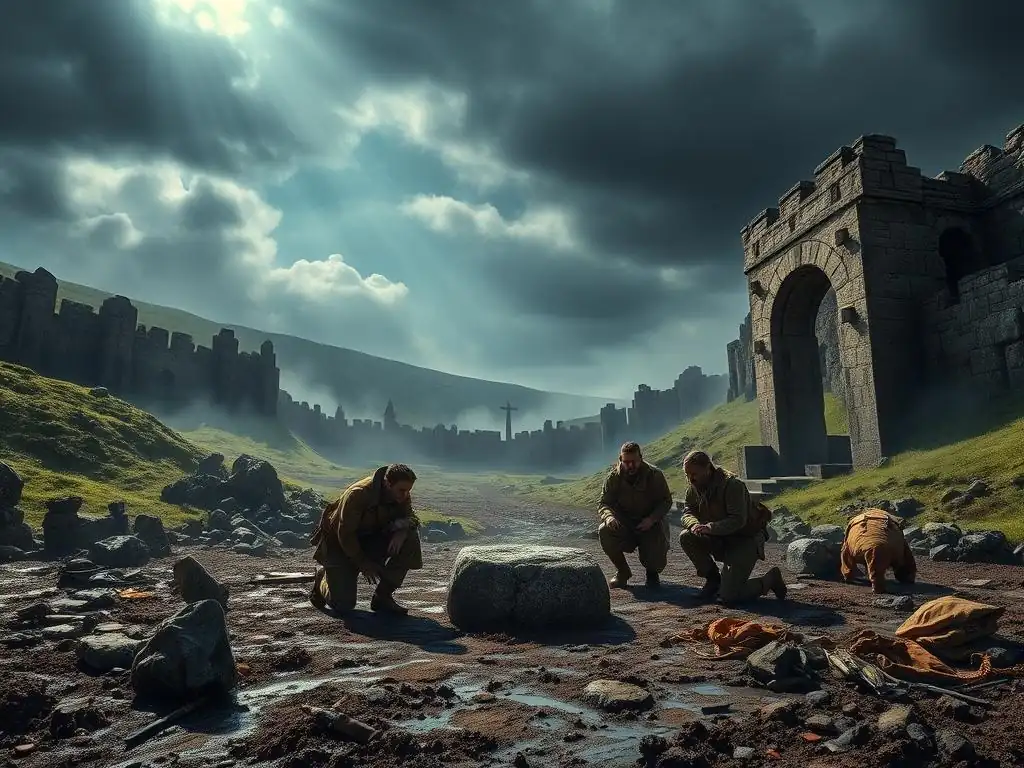
Delve into the fascinating world of archaeological discovery, where every artifact tells a story. This time, we journey to the northern frontier of Roman Britain to explore a less-heard perspective: What did the Native Tribes Beyond Hadrian's Wall really think of the Roman presence? Uncover the nuanced relationships and complex interactions that shaped this pivotal era – and challenge your preconceptions about the so-called 'barbarian' threat. Ready to rewrite history?
The Roman Perspective on the "Barbarian" North
The Roman Empire, through its historians and military strategists, largely depicted the peoples beyond its frontiers as barbari – a term reflecting their perceived lack of Roman civilization, language, and political structure. Accounts from figures like Tacitus in his Agricola or Cassius Dio often characterize the native tribes north of the Wall as wild, uncivilized, and a constant military threat, justifying Rome's expansive military presence and the construction of elaborate defenses. This portrayal served to legitimize Roman domination and the immense resources invested in securing the northern frontier, framing the "Native tribes hadrian’s wall" as a dangerous, unpredictable force.
From the Roman viewpoint, Hadrian's Wall, completed around 128 AD, was not merely a defensive barrier against these perceived threats. It was also a formidable statement of imperial power, a customs boundary, and a means of controlling movement and trade. This strategic rationale shaped Roman interactions with the indigenous populations, oscillating between punitive military campaigns aimed at subjugation and periods of uneasy truce or regulated commerce. The Wall’s very existence was a tangible manifestation of Rome's desire to define and control its relationship with the diverse "Native tribes hadrian’s wall" beyond its stone and turf curtain.
Archaeological Evidence of Native Tribes Near Hadrian's Wall
Unearthing the lives of the native populations near Hadrian's Wall presents a distinct archaeological challenge, as much of the excavated material has historically focused on Roman military installations. However, careful analysis of finds from sites like Birdoswald or Housesteads, often considered purely Roman, reveals subtle yet significant traces of indigenous presence. These include specific types of coarseware pottery, distinctively shaped roundhouses identified through post-holes and foundation trenches, and local tool assemblages that predate or coexist with Roman occupation, indicating a continuous or intermittent presence of "Native tribes hadrian’s wall" in the frontier zone.
Beyond the immediate vicinity of Roman forts, dedicated excavations have begun to shed more light on native settlements. For instance, sites like Chesters, where Roman cavalry was stationed, have yielded evidence of pre-Roman activity, suggesting the military installations were sometimes built over existing native lands.
The discovery of Roman goods, such as coins or fragments of Samian ware, at native sites far from the Wall, conversely, indicates a complex network of interaction, trade, and even raiding. This archaeological dialogue challenges the simplistic Roman narrative of a clear-cut division, instead painting a picture of dynamic and often intertwined relationships between the Romans and the "Native tribes hadrian’s wall".
- The Roman Perspective on the "Barbarian" North
- Archaeological Evidence of Native Tribes Near Hadrian's Wall
- ### What was the primary perception of native tribes living beyond Hadrian's Wall according to Roman accounts?
- ### Did native tribes beyond Hadrian's Wall engage in trade or other forms of interaction with the Romans?
- ### How did Hadrian's Wall impact the lives and cultures of the native tribes living nearby?
- ### What archaeological evidence helps us understand the lives of native tribes beyond Hadrian's Wall, beyond just Roman accounts?
- ### To what extent did the concept of "barbarian" accurately reflect the diverse cultures of native tribes near Hadrian's Wall?
The Tribes Beyond the Wall: A Closer Look at Native Societies
The Caledonians: Resistance and Raids on Roman Britain
The Caledonians represented a powerful confederation of Iron Age tribes, primarily inhabiting the rugged landscapes of what is now central and northern Scotland, beyond the Forth-Clyde line. Their most famous confrontation with Rome came during the campaigns of Gnaeus Julius Agricola in the late 1st century AD, culminating in the battle of Mons Graupius around 83 AD, as recounted by Tacitus. Though a Roman victory, the Caledonians demonstrated significant organizational capacity and fierce resistance, indicating a formidable political and military structure among the "Native tribes hadrian’s wall".
Their resistance was not a singular event but a recurring challenge to Roman authority. Major incursions by the Caledonians into Roman Britain are well-documented, particularly in the late 2nd century AD. For example, a significant invasion around 180 AD caused considerable damage to Hadrian's Wall and forced extensive Roman rebuilding efforts.
These raids were often strategic, aimed at acquiring resources, disrupting Roman control, or exploiting perceived weaknesses in the frontier defenses. The Caledonians' enduring autonomy and their persistent pressure on the Roman frontier underscore their pivotal role in shaping the history of the "Native tribes hadrian’s wall" and Roman Britain.
The Maeatae: Shifting Alliances and Tribal Dynamics
The Maeatae, mentioned by Cassius Dio, were another significant group dwelling immediately north of the Antonine Wall, specifically in the region between the Forth and Tay estuaries. Their relationship with the Roman Empire appears to have been more ambiguous and fluid than that of the Caledonians, oscillating between periods of conflict and, at times, uneasy alliance. This adaptability highlights the complex tribal dynamics prevalent among the "Native tribes hadrian’s wall", where shifting allegiances were often a pragmatic response to the dominant Roman presence and inter-tribal rivalries.
Archaeological evidence, though less definitive in directly attributing sites to the Maeatae, suggests a pattern of fortified settlements and dispersed agricultural communities in their presumed territory. Their strategic location made them crucial players in frontier politics, often serving as intermediaries or targets for both Roman punitive expeditions and diplomatic overtures. Notably, the Maeatae were heavily involved in the major conflicts during the Severan campaigns of the early 3rd century AD, demonstrating their continued influence and military capability in the ongoing struggle between Rome and the "Native tribes hadrian’s wall".
The Votadini: A Buffer State and Roman Allies
The Votadini, known in later Welsh tradition as the Gododdin, occupied the territory stretching from the Firth of Forth southwards into what is now Northumberland, effectively straddling the eastern frontier zone. Unlike their northern neighbors, the Votadini frequently maintained a more cooperative, if not allied, relationship with Rome. This strategic alliance likely provided them with a degree of protection from more aggressive tribes further north, as well as access to Roman trade networks and goods, solidifying their position as a crucial buffer state for Roman Britain against the more hostile "Native tribes hadrian’s wall".
Archaeological excavations at sites like Traprain Law, a prominent hillfort in East Lothian, provide compelling evidence of this interaction. Traprain Law has yielded an extraordinary collection of Roman silver plate, coins, and other luxury goods, far exceeding what might be expected from simple trade. This suggests a deep economic and perhaps political relationship, where Roman material culture was integrated into Votadinian society. The Votadini's enduring political structure and their ability to leverage their relationship with Rome illustrate a different facet of the "Native tribes hadrian’s wall" experience, one of strategic accommodation rather than outright conflict.
Native Settlements and Fortifications: Archaeological Signatures
Hillforts and Crannogs: Defensive Strategies of Native Tribes
Hillforts represent a dominant form of defensive architecture employed by the "Native tribes hadrian’s wall" throughout the Iron Age and into the Roman period. These impressive structures, like Burnswark Hill in Dumfriesshire, which shows evidence of Roman siege works, or the vast complex of Eildon Hill North, were strategically located on elevated ground, offering natural advantages and commanding views. They typically comprised multiple concentric ramparts and ditches, constructed from earth, timber, and sometimes stone, reflecting sophisticated engineering and communal effort for defense and communal living.
Complementing hillforts, particularly in the loch-rich landscapes of Scotland, were crannogs – artificial or semi-artificial islands constructed in lakes and marshes. These unique settlements, accessed via causeways or by boat, offered excellent natural defenses and served as secure refuges for families and livestock. Examples from Loch Tay or Loch Awe demonstrate their long-term use, sometimes for many centuries, providing a secure and self-sufficient environment. Both hillforts and crannogs underscore the ingenuity and resourcefulness of the "Native tribes hadrian’s wall" in adapting their settlement patterns to the challenging terrain and the ever-present need for security.
Material Culture: Insights into Daily Life Beyond the Wall
The material culture recovered from native sites provides invaluable insights into the daily lives, economic activities, and social structures of the "Native tribes hadrian’s wall". Common finds include locally produced coarseware pottery, often handmade and distinctive in style, contrasting with the more standardized Roman wares. Metalwork, such as iron tools (e.g., axes, knives, ploughshares) and bronze personal ornaments (e.g., brooches, armlets), reveals proficiency in metallurgy and adornment. Stone artifacts, including quern-stones for grinding grain and various tools, point to an economy largely based on agriculture and pastoralism.
Beyond utilitarian objects, certain artifacts hint at artistic expression and social hierarchies. Intricately decorated metalwork, such as the Torrs Chamfrein from Galloway or the Stichill Armlet, showcases sophisticated Celtic art styles. Evidence of textile production, through numerous spindle whorls and loom weights found at settlements, indicates the importance of weaving. The selective incorporation of Roman goods, such as fragments of glass vessels or occasional Roman coins found far from the Wall, demonstrates not only trade but also a careful, often prestige-driven, integration of foreign items into the existing material culture of the "Native tribes hadrian’s wall", rather than wholesale adoption.
Trade and Exchange: Interactions Between Romans and Native Peoples
Despite its formidable appearance, Hadrian's Wall was not an impermeable barrier but a porous frontier facilitating various forms of interaction, including trade and exchange. Archaeological evidence consistently points to the movement of goods across the Wall. Roman imports, such as fine Samian ware pottery, wine, olive oil amphorae, and glassware, have been found at native sites north of the Wall, indicating a demand for Roman luxuries. Conversely, native products, including hides, livestock, and possibly slaves, would have been traded south into the Roman zone, supplying the garrisons and civilian settlements.
The nature of these interactions was complex. While trade could be mutually beneficial, it also occurred alongside raiding and military conflict. The establishment of vici, civilian settlements often populated by traders and craftsmen, outside Roman forts, suggests a degree of economic symbiosis where native populations could access Roman markets. The economic pull exerted by the Roman frontier undoubtedly had a profound impact on the indigenous economy, introducing new goods, technologies, and potentially altering traditional subsistence patterns among the "Native tribes hadrian’s wall". This economic interdependence highlights a nuanced relationship far beyond simple antagonism.
Interpreting the Evidence: Reconstructing Native Perspectives
Beyond the Roman Narrative: Challenging Biases in Historical Accounts
Roman historical accounts, while valuable, are inherently biased. Penned by the victors, they often dehumanize the "Native tribes hadrian’s wall", portraying them as a monolithic, savage threat lacking organization, culture, or individual agency. Texts from Tacitus or Cassius Dio frequently employ derogatory language, reducing complex societies to a generic 'barbarian' other. It is crucial for modern archaeologists and historians to critically evaluate these sources, "reading against the grain" to discern underlying realities and challenge the imperialistic lens through which native peoples were viewed.
Archaeological findings frequently contradict or significantly complicate these Roman narratives. For instance, the discovery of sophisticated agricultural systems, complex social hierarchies evidenced by elaborate burials or hillforts, and the sustained, organized resistance demonstrated by groups like the Caledonians, all point to a level of societal development far beyond the simplistic Roman descriptions. The material record provides a vital counter-narrative, revealing the diverse cultures, resilience, and adaptability of the "Native tribes hadrian’s wall" in the face of imperial expansion, offering a more nuanced and accurate understanding of their history.
Ritual and Belief: Understanding Native Religious Practices
Reconstructing the pre-Christian religious practices of the "Native tribes hadrian’s wall" is challenging due to the limited textual evidence and the interpretive difficulties of archaeological finds. However, archaeological sites offer glimpses into their spiritual worlds. Votive deposits, such as collections of metalwork or human remains found in bogs, rivers, or specialized pits (e.g., at the Carlingwark Loch crannog), suggest offerings to deities or spirits associated with natural elements.
Sacred sites, often natural features like springs, groves, or specific hills, likely held profound spiritual significance. Burial practices, though varied, also provide clues about beliefs concerning the afterlife and the treatment of the deceased.
With the Roman presence came a degree of religious syncretism. While Roman gods and cults were introduced, native deities often continued to be worshipped, sometimes even adopted by Roman soldiers or civilians. A notable example is the shrine to the local goddess Coventina at Carrawburgh on Hadrian's Wall, where numerous Roman coins and altars were dedicated to a native water deity. This blending of religious traditions underscores the complex cultural exchange and adaptation that occurred at the frontier, demonstrating that the "Native tribes hadrian’s wall" maintained aspects of their spiritual identity even amidst foreign influence.
The Impact of Roman Presence: Cultural Exchange and Transformation
The Roman presence along Hadrian's Wall profoundly impacted the "Native tribes hadrian’s wall", leading to significant cultural exchange and transformation. This impact was multifaceted, encompassing demographic shifts, as populations were displaced or recruited into Roman auxiliary units; economic changes, with the introduction of coinage and new trade goods like fine pottery and glass; and technological transfers, such as improved agricultural tools or building techniques. The frontier zone became a dynamic crucible of cultures, where indigenous traditions met and sometimes merged with Roman ways.
Native societies adapted to this new reality in diverse ways. Some tribes, particularly those in client relationships like the Votadini, experienced a degree of Romanization, adopting aspects of Roman material culture, administrative practices, or even Latin language use. Others, however, intensified their traditional identities and resistance in direct opposition to Roman encroachment, leading to heightened conflict. Ultimately, the centuries of Roman presence fundamentally reshaped the social, economic, and political landscape of the "Native tribes hadrian’s wall", leaving an indelible mark on their subsequent historical development.
The Legacy of Hadrian's Wall: Native Tribes and the End of Roman Rule
The Decline of Roman Power and the Rise of Native Kingdoms
The gradual decline of Roman power in Britain during the late 4th and early 5th centuries AD created a significant power vacuum, particularly in the northern regions. Events like the "Great Barbarian Conspiracy" of 367 AD, a coordinated assault by various "Native tribes hadrian’s wall" including the Picts (a later term encompassing groups like the Caledonians and Maeatae) and Scotti, demonstrated the persistent threat to Roman authority. As Roman legions were withdrawn to defend other parts of the Empire, the frontier crumbled, paving the way for the emergence of new, independent native kingdoms.
Many of these emerging polities, particularly the Brittonic kingdoms of the "Old North" (e.g., Rheged, Gododdin, Strathclyde), had their roots in the Iron Age tribal structures that had existed prior to and during the Roman occupation. The centuries of interaction, conflict, and adaptation with Rome likely fostered new levels of political organization and military prowess among the "Native tribes hadrian’s wall". The skills developed in resisting or negotiating with the imperial power contributed to their ability to form more complex and enduring political entities in the post-Roman era, laying the foundations for distinct regional identities.
The Enduring Influence of Native Culture on the Landscape
Even after the formal end of Roman rule, the influence of native culture on the landscape and subsequent history of northern Britain remained profound. Archaeological evidence points to a remarkable continuity in certain settlement patterns, agricultural practices, and artistic traditions, demonstrating resilience beyond imperial imposition. Many ancient hillforts, though no longer primary defensive sites, continued to be loci of power or settlement for centuries, their enduring presence a testament to millennia of native occupation.
Furthermore, later historical records and literary traditions provide glimpses into these post-Roman native societies. Early Welsh poetry, such as the Y Gododdin, recounts the deeds of warriors from the kingdom of Gododdin, direct descendants of the Votadini who engaged in battles against Anglo-Saxon invaders, highlighting a continuity of identity and conflict in the region of the "Native tribes hadrian’s wall". Place names across northern England and southern Scotland, often derived from Brittonic or Pictish languages, also serve as linguistic echoes of the deep native cultural roots that outlasted the Roman imperial project.
Future Research Directions: New Excavations and Interpretations
The study of the "Native tribes hadrian’s wall" is an active and evolving field. New archaeological techniques, such as LiDAR (Light Detection and Ranging) and advanced geophysical surveys, are revolutionizing our ability to identify previously unknown native sites, especially those obscured by dense vegetation or later Roman and medieval activity. These technologies allow for non-invasive mapping of extensive settlement patterns and field systems that lie hidden beneath the surface, offering unprecedented insights into the scale and complexity of indigenous societies.
Future research will also increasingly focus on interdisciplinary approaches, combining archaeological data with environmental science, paleobotany, and even ancient DNA analysis to reconstruct diet, health, and population movements among the "Native tribes hadrian’s wall". Crucially, there is a growing imperative to decolonize the narrative, moving beyond a Roman-centric view to fully understand the rich and complex history of these indigenous peoples. This involves re-evaluating existing museum collections, applying new theoretical frameworks to old data, and prioritizing research questions that center the native experience, ensuring a more holistic and accurate understanding of this pivotal period in British history.
Frequently Asked Questions
### What was the primary perception of native tribes living beyond Hadrian's Wall according to Roman accounts?
Roman accounts often portrayed the native tribes as barbarian and a constant threat to the security of Roman Britain, emphasizing their perceived uncivilized nature. This was used to justify the construction and maintenance of Hadrian's Wall.
### Did native tribes beyond Hadrian's Wall engage in trade or other forms of interaction with the Romans?
Despite the wall and the perceived threat, archaeological evidence suggests that trade and other forms of interaction, such as diplomatic exchanges and even military alliances, did occur between the Romans and some native tribes. These interactions were complex and varied.
### How did Hadrian's Wall impact the lives and cultures of the native tribes living nearby?
Hadrian's Wall undoubtedly influenced the lives of the tribes by restricting movement, disrupting traditional trade routes, and creating a physical and psychological barrier. This impact led to adaptation and resistance.
### What archaeological evidence helps us understand the lives of native tribes beyond Hadrian's Wall, beyond just Roman accounts?
Archaeological finds such as settlement remains, burial sites, and artifact distribution patterns provide valuable insights into the daily lives, social structures, and cultural practices of these tribes, offering a more balanced view than Roman narratives alone.
### To what extent did the concept of "barbarian" accurately reflect the diverse cultures of native tribes near Hadrian's Wall?
The term "barbarian" was a Roman construct used to categorize and often denigrate those outside their empire. It oversimplifies the diverse and complex cultures of the various native tribes, who each had their own distinct identities and societal structures.
Final Reflection: Echoes of the Unconquered
The narratives we construct about "others," particularly those beyond perceived borders, continue to shape our present. The echoes of Hadrian's Wall still resonate today, reminding us that the concept of "barbarian" is often a reflection of our own fears and biases, rather than an accurate portrayal of diverse cultures. Understanding how the Romans viewed and interacted with the native tribes beyond the wall offers crucial insights into the dynamics of power, identity, and the enduring human tendency to define ourselves against those we deem "different."
This exploration into the lives and resilience of the native tribes beyond Hadrian's Wall underscores the importance of challenging simplistic narratives and seeking a deeper understanding of history from multiple perspectives. It's a reminder that history is not a monolithic truth, but a collection of stories, each deserving of recognition and respect. History is written by the victors,
as Winston Churchill (often misattributed) is said to have remarked, but it is our responsibility to seek out the voices of the vanquished, to understand their experiences, and to learn from their struggles.
As you reflect on the stories of the native tribes beyond Hadrian's Wall, consider how the lessons of the past can inform our present. How do we define "us" and "them" today? What walls, both literal and metaphorical, do we build? Let us strive to move beyond simplistic labels and embrace the complexity and richness of human experience, recognizing that true understanding comes not from division, but from connection and empathy.
Unveil Your Inner Explorer: Delve Deeper into History!
Thanks for journeying with us into the world beyond Hadrian's Wall! We hope this glimpse into the lives and legacies of the native tribes has sparked your curiosity about the complex tapestry of history. Ready to take the next step?
- Visit a local museum or archaeological site showcasing Roman and native artifacts in your region to connect with history firsthand.
- Explore online databases and academic journals to expand your knowledge of the tribes and cultures mentioned.
- Share this article with a friend and start a conversation about the often-overlooked perspectives of indigenous populations throughout history.
What piece of the past will you uncover next?