Excavation Techniques: Stratigraphy and Context – Unlocking the Archaeological Record
Welcome to ArchaeologyHub.org’s deep dive into Excavation Techniques: Stratigraphy and Context, a foundational subcategory within our Core Concepts, Methods & Theories section. Here, we decode the invisible language of soil layers and the precise spatial relationships that transform a simple dig into a scientific narrative. Understanding stratigraphy and context is essential for anyone—from student to seasoned hobbyist—because it is the framework that grants meaning to every artifact, ecofact, and feature unearthed. This page explores how archaeologists read the earth’s chronicle, manage vertical and horizontal controls, and avoid the pitfalls of data loss, ensuring that each discovery contributes accurately to the timeline of human history.
🔍 Principles of Stratigraphy: The Law of Superposition
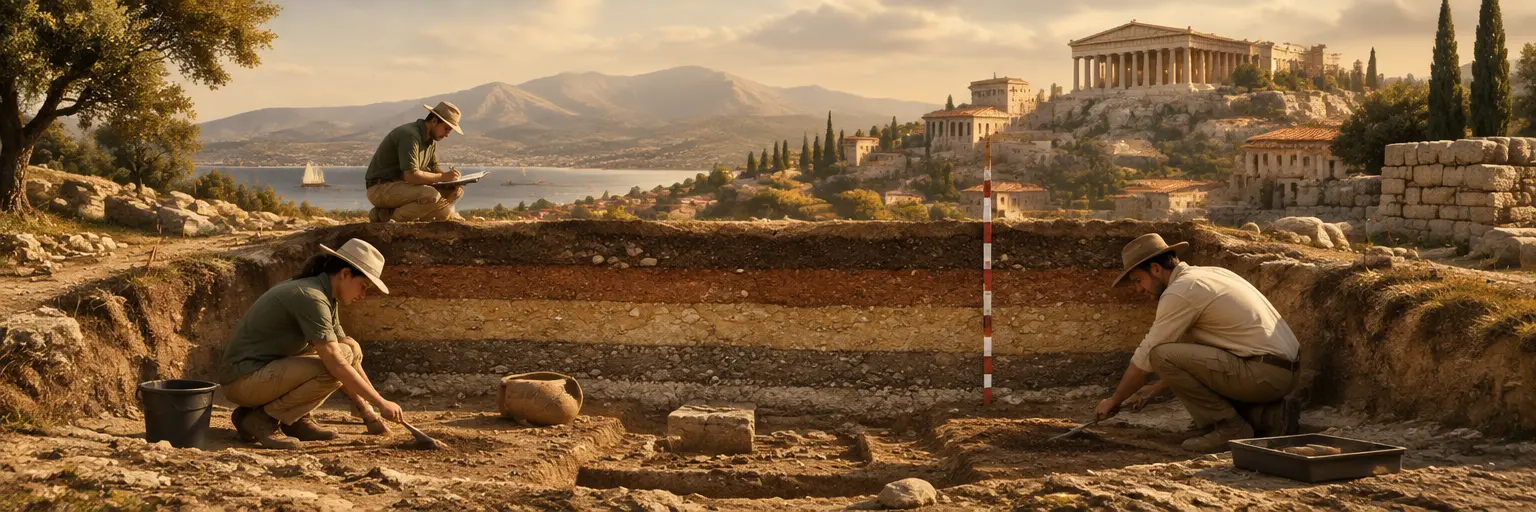
Stratigraphy, in archaeology, operates on the foundational principle that in undisturbed sequences, older deposits lie beneath younger ones—the Law of Superposition. However, unlike geology, archaeological strata are not uniform; they are often composed of deliberate fills, cut features, and collapses. On this page, you’ll learn how archaeologists identify individual layers (strata) by their color, texture, and composition, and how they differentiate between natural soil formation and human-induced deposits. This knowledge is critical because misreading a layer can invert the chronological order of your finds.
Beyond simple layering, you will explore concepts like interface—the surfaces between layers that represent moments of activity or erosion—and how these interfaces are just as important as the soils themselves. We discuss Harris Matrix diagrams, the standard tool for visualizing stratigraphic sequences, which helps archaeologists reconstruct site histories even when layers are discontinuous. By mastering these principles, you’ll appreciate why a single sherd’s stratigraphic position can date an entire building phase, making stratigraphy the backbone of relative dating in excavation.
📦 Understanding Archaeological Context: Provenience and Association
Context is the physical location of an artifact or feature and its relationships to other elements within the same deposit. This subcategory emphasizes that an object’s provenience (its exact three-dimensional coordinates) and its association (what it was found with) are far more valuable than the object alone. Here, we explain the difference between primary context (where an artifact was originally deposited and undisturbed) and secondary context (where it has been moved by natural or human forces), teaching you how to assess the reliability of your data during excavation.
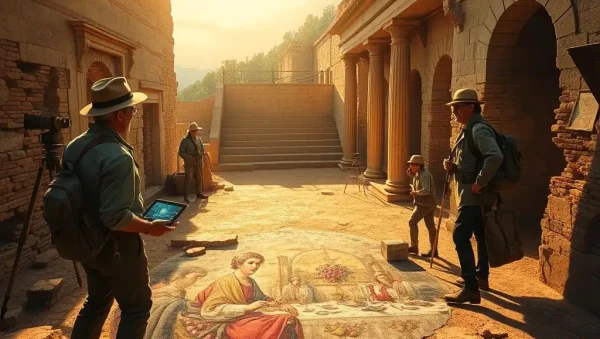
We also cover the critical role of features—non-portable evidence like hearths, postholes, or pits—which can only be understood through their contextual relationships. By examining artifact clusters and ecofact distributions, you’ll learn to infer past activities such as food preparation, tool manufacture, or ritual deposition. This section provides practical checklists for recording context in the field, from soil sampling to photography, ensuring that every removal preserves the web of connections that turns scattered objects into a coherent story.
⛏️ Dating and Sequencing: Relative vs. Absolute Techniques
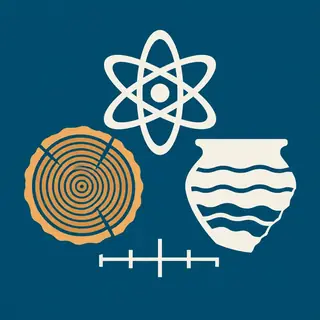
Stratigraphy underpins relative dating, but to build a robust chronology, archaeologists integrate it with absolute dating methods. In this segment, we break down how stratigraphic sequences are combined with radiocarbon dating, thermoluminescence, and dendrochronology to calibrate timeframes. You’ll see practical examples where a stratigraphic layer containing charcoal was sent for C14 analysis, providing a calendrical age that anchors the entire sequence. We also highlight seriation—ordering artifacts based on style changes—and how it complements stratigraphic depth.
Equally important is understanding residuality (older artifacts redeposited in younger layers) and intrusion (younger materials sinking into older strata). These phenomena can confuse dating interpretations if not identified. Through case studies from sites like Pompeii and Tell es-Sultan, we demonstrate how archaeologists use multiple lines of evidence to cross-check stratigraphic sequences, reducing error margins and building more reliable chronologies. This knowledge empowers you to critically evaluate published excavation reports and their dating claims.
🧱 Excavation Methods in Practice: From Test Pits to Open Area
Depending on research questions, excavation employs different strategies. Here, we compare test pitting (small, quick soundings) versus open area excavation (broad horizontal exposure) and trenching (long, narrow cuts for section views). Each method interacts with stratigraphy uniquely: test pits provide vertical profiles but limited contextual space; open areas expose extensive horizontal relationships but require careful stratigraphic control. We offer guidance on choosing the right approach based on site type, depth, and preservation.
You’ll also learn about single-context recording, a meticulous system where each discrete deposit (context) is fully recorded and excavated separately, versus the older arbitrary level method (removing soil in pre-set depths). The former is now standard in professional archaeology because it preserves the natural stratigraphy and prevents mixing. This section includes practical tips on tool selection, from trowels to dustpans, and how to clean sections for photography. By understanding these methods, you’ll appreciate why professional reports emphasize meticulous stratigraphic records over mere artifact counts.
🩺 Challenges and Solutions: Bioturbation, Slumping, and Data Integrity
Natural and human disturbances can scramble stratigraphy, creating false sequences. This H3 covers major challenges like bioturbation (burrowing animals and roots mixing soils) and slumping (sediment collapse after excavation), explaining how archaeologists detect these disruptions through soil micromorphology and grain-size analysis. We also discuss the impact of modern construction or agriculture, which can truncate or redistribute ancient layers, making context unreliable.
To combat these issues, the page introduces geoarchaeology techniques, including sediment chemical analysis and microfossil identification, which aid in distinguishing natural from cultural deposits. We share practical protocols for maintaining stratigraphic integrity during excavation, such as using baulks (unexcavated sections) for vertical reference and implementing rigorous sieving and flotation. Furthermore, we address the ethical dimension of data integrity—how poor stratigraphic control can lead to irreparable loss of information, emphasizing that today’s excavation must be a meticulous, documented process. This ensures that, despite challenges, the archaeological record remains credible and useful for future research.
Frequently Asked Questions
What is the difference between a stratum and a context in archaeology?
A stratum (plural strata) refers to a distinct layer of soil or deposit visible in section, while a context is any single, discreet archaeological event—a layer, cut, fill, or feature—that is recorded individually. A stratum can be composed of multiple contexts, and a context is the basic unit of excavation. Think of strata as the physical layers and contexts as the interpretive units that include not just layers but also interfaces and cuts.
Why is a Harris Matrix important for excavation?
A Harris Matrix is a diagram that orders all contexts in relative sequence, showing which are earlier or later based on their physical relationships. It is essential because it converts the complex 3D reality of a site into a simplified 2D model, enabling archaeologists to identify discontinuous sequences, assess gaps, and establish a site-wide chronology. Without it, correlating finds across different excavation areas becomes nearly impossible.
Can stratigraphy alone provide absolute dates?
No, stratigraphy is a relative dating method—it tells you that one layer is older or younger than another but not the exact age. To obtain absolute dates, archaeologists must submit datable materials (charcoal, bone, or sediment) from specific stratigraphic contexts to radiocarbon, luminescence, or other chronometric techniques. Stratigraphy provides the secure framework, ensuring those samples are not mixed with other periods.
What should I record for each excavated context in the field?
For each context, you should record its unique number, description (color, texture, inclusions), dimensions, shape, boundaries, and relationship to other contexts. Also note the method of excavation, any artifacts or ecofacts recovered, soil samples taken, and photographic or drawn documentation. This detailed log ensures the context can be reconstructed digitally and interpreted accurately later.
How do archaeologists avoid mixing artifacts from different layers?
They use single-context excavation, where each discrete deposit is removed completely before starting the next, and they never dig beyond the boundary into an underlying context. Additionally, strict hygiene rules—such as cleaning tools between contexts and using separate buckets—prevent cross-contamination. Careful supervision and regular section cleaning also help maintain visual clarity of stratigraphic boundaries during excavation.