The Science Behind Luminescence Dating: Principles of TL and OSL
🔍 Thermoluminescence dating methods explained delve into how TL and OSL techniques reveal the age of archaeological artifacts, offering precise insights into…
Read article
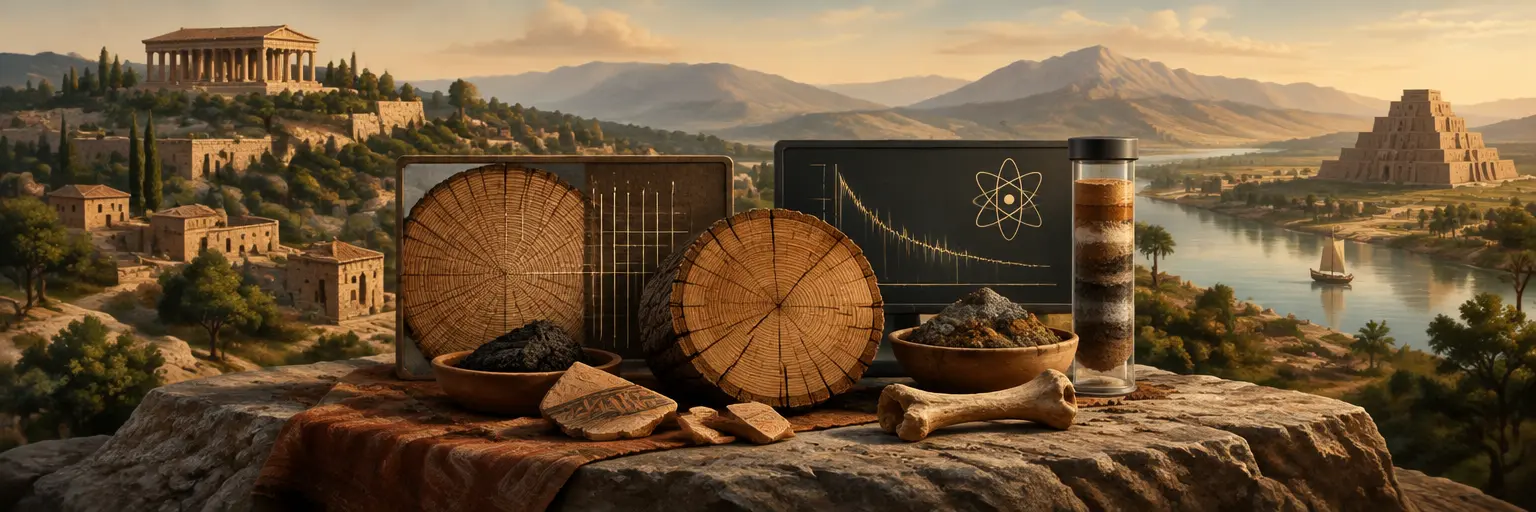
Unlock the secrets of the past with archaeological dating methods—the scientific toolkit that reveals *when* ancient events unfolded. From the revolutionary radiocarbon dating that measures the decay of carbon-14 in organic remains to the precision of dendrochronology, which reads tree rings as nature’s own calendar, this field offers far more than simple age estimates. Explore advanced techniques like thermoluminescence for fired ceramics, obsidian hydration, and stratigraphic analysis that piece together temporal puzzles layer by layer. Whether you’re a student, enthusiast, or professional, mastering these core concepts transforms scattered artifacts into a coherent timeline of human history. Dive into the methods that turn buried clues into dated stories—your gateway to understanding chronology, cultural evolution, and the very fabric of ancient civilizations.
Welcome to ArchaeologyHub.org's comprehensive guide on dating methods—the backbone of archaeological chronology. Here, we demystify how scientists assign absolute and relative ages to artifacts, ecofacts, and features. From the revolutionary radiocarbon decay curve to the precise growth rings of ancient oaks, this subcategory explores the techniques that transform fragments of the past into a structured timeline. Whether you're a student, hobbyist, or professional, these pages equip you with the vocabulary and conceptual frameworks used in modern excavations, enabling you to interpret site reports and scholarly debates with confidence. Dive deep into the science that lets us say, "This pot is 4,500 years old."
Radiocarbon dating, pioneered by Willard Libby in 1949, measures the decay of carbon-14 in organic materials up to ~50,000 years old. Traditional beta counting required large samples, but accelerator mass spectrometry (AMS) now dates tiny fragments like seeds or charcoal. You'll explore calibration curves that correct for atmospheric fluctuations, acknowledging that "radiocarbon years" differ from calendar years. Expect to understand the half-life (5,730 years), contamination risks, and why marine samples need reservoir corrections. This section also covers recent advances in compound-specific dating, which isolates specific molecules (e.g., lipids) to avoid mixed-age errors.
Practical applications include dating the Shroud of Turin controversy, the earliest maize domestication in Mesoamerica, and the collapse of the Maya classic period. You'll learn how archaeologists combine multiple radiocarbon dates into Bayesian models, narrowing overlapping probability distributions for precise event chronologies. We emphasize best practices for sample collection—avoiding roots, charcoal from old wood, and reworked sediments—so you can critically assess published dates. No prior chemistry needed; we explain isotopic fractionation and δ13C corrections in plain language.
Dendrochronology (tree-ring dating) offers absolute calendar-year precision for wood samples, often outperforming radiocarbon in temperate regions. Each ring records annual growth influenced by climate, creating a unique pattern—like a barcode—that cross-matches across overlapping living trees, historical timbers, and archaeological beams. Master builders first used this in the American Southwest in the 1920s, and today, master chronologies extend back over 10,000 years (e.g., Irish oak, bristlecone pine). You'll explore how ring width and density reflect drought or wet years, enabling not just dating but paleoclimate reconstruction.
We cover practical workflows: sampling with increment borers, surface preparation, ring counting under magnification, and statistical cross-dating software like COFECHA. Case studies include the dating of Viking settlements at L'Anse aux Meadows, the reconstruction of Anasazi cliff dwellings, and the calibration of radiocarbon dates using known-age tree rings. Understand the limitations—species with complacent rings (minimal variation) or missing/false rings due to extreme stress—and how dendro-provenance reveals timber trade routes. This method anchors many archaeological chronologies with sub-decade accuracy.
Optically stimulated luminescence (OSL) and thermoluminescence (TL) date the last time minerals (quartz, feldspar) were exposed to sunlight or heat. When buried, minerals accumulate trapped electrons from background radiation; laboratory stimulation releases them as light, proportional to burial time. OSL dates pottery (fired clay resets the signal), sediments (solar bleaching), and even burnt flints, covering ranges from 100 to 300,000+ years—bridging the gap beyond radiocarbon's limit. This method is crucial for dating human evolution sites in Africa and the earliest Australian occupation.
You'll learn about sampling strategies for sediment cores, the importance of dose rate measurements (from uranium, thorium, potassium), and the challenges of partial bleaching in fluvial deposits. We discuss single-grain versus multi-grain analyses to detect mixed-age deposits, plus the use of portable OSL readers for field screening. Expect case studies on the 2022 dated footprints at White Sands (up to ~23,000 years old) and Middle Stone Age tools at Jebel Irhoud (300k years). Learn how to interpret overdispersion and why this "clock" resets with light or heat—making it a versatile companion to radiocarbon.
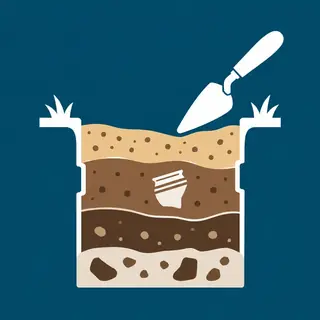
Before absolute techniques, archaeologists relied on relative dating—ordering finds without specific calendar years. Stratigraphy (law of superposition) assumes lower layers are older, but natural and human disturbances (bioturbation, pits, walls) complicate this. Seriation, pioneered by Flinders Petrie, arranges artifact types by stylistic change (e.g., pottery shapes), producing a chronological sequence. Cross-dating uses marker fossils or distinctive imports (like Roman coins) to tie layers to known contexts. These methods remain vital for sites where absolute dating is impossible—poor preservation, no organics, or beyond method ranges.
We detail how Harris Matrix diagrams help visualize stratigraphic relationships, and how typological sequences from flaked stone tools (e.g., Solutrean points) still underpin European Paleolithic studies. Explore the pitfalls of circular reasoning in typologies and how modern Bayesian statistics combine relative sequences with radiometric dates to "wiggle-match" floating chronologies. You'll see how Chinese bronze vessels or Egyptian pottery typologies provide high-resolution relative phasing. This foundational knowledge is essential before jumping into absolute methods—it's the logic that makes absolute numbers meaningful.
This section highlights newer or niche dating methods expanding archaeological horizons. Trapped charge in electron spin resonance (ESR) dates tooth enamel and heated flint (up to 1-2 million years). Uranium-series (U-Th) dates carbonates (speleothems, travertines) associated with ancient bones, as at Atapuerca. Archaeomagnetism uses the Earth's magnetic field recorded in fired clay, offering regional chronological markers. Rehydroxylation (RHX) dates pottery based on the slow rehydration of fired clay, though under validation. Tephrochronology identifies ash layers from known volcanic eruptions, providing time-parallel markers across regions.
We explain the principles, ideal materials, and typical error ranges for each method, plus their integration into multi-method dating projects. For instance, combining U-Th on speleothems with ESR on teeth can cross-check ages of early Homo remains. Understand the growing role of portable X-ray fluorescence (pXRF) not as a dating tool but as a source of chemical fingerprints for tephra correlation. We also touch on cosmogenic nuclides for dating surface exposures (e.g., glaciation). Each technique has niche strengths—learn when to choose one over another and why no single method fits all sites.
Relative dating only orders events or artifacts—for example, saying Layer A is older than Layer B—without assigning calendar years. Absolute dating provides numeric ages, like "this charcoal is 3,800 ± 50 BP." Both are used together; relative methods give a framework, while absolute methods assign real dates to key points.
Beyond ~50,000 years, remaining carbon-14 is tiny, so measurement uncertainty grows, and contamination dominates. Calibration curves also become less precise. For samples older than that, alternatives like uranium-series or luminescence are preferred. Within its range, radiocarbon accuracy is typically within ±20-80 years for well-preserved materials with careful calibration.
No—it requires species with distinct, annual rings that respond to climate, long-lived trees, and a master chronology from the same region. Problematic woods include tropical species with irregular growth rings or those with complacent (uniform) rings. Preservation matters too; waterlogged or charred wood can work, but decayed or crushed rings may be unreadable.
Each method has biases and error ranges; combining them cross-validates results and reduces uncertainty. For example, radiocarbon dates can be offset if the wood is old at burial, while luminescence dates the last light exposure. A consistent age from two independent methods builds confidence, and Bayesian modeling integrates all dates into a refined chronology.
Radiocarbon dates assume constant atmospheric carbon-14, but it varies over time due to solar activity and carbon cycling. Calibration curves, built from tree rings and other records, map radiocarbon years to calendar years. Without calibration, a raw date of 3,000 BP doesn't directly equal 3,000 BC—calibration might shift it by centuries, making it essential for accurate historical correlation.