Childhood Adornment: Amulets, Beads, and Protection in Ancient Cultures
🌟 Explore the fascinating world of childhood adornment in ancient cultures, where amulets and beads served as protective talismans. Delve into ancient…
Read article
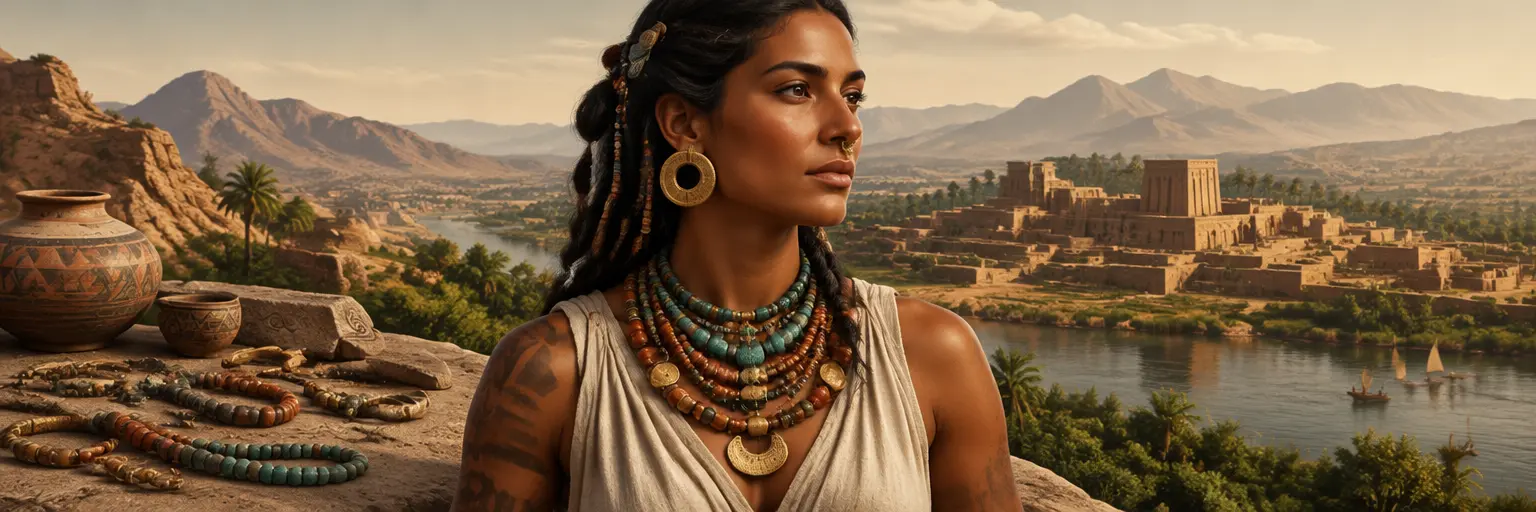
Discover the timeless allure of personal adornment—from intricate jewelry and ancient beads to the cultural significance of body modification—in this curated archaeological journey. 🌍✨ Explore how these artifacts reveal identity, status, and belief systems across civilizations, offering a tactile link to human creativity and social expression. Dive into detailed artifact profiles, excavation insights, and interpretive analyses that decode the symbolism behind every pendant, ring, or ritual scar. Whether you’re fascinated by Egyptian amulets, Viking arm rings, or Polynesian tattoos, this thematic collection illuminates the universal human drive to embellish and transform, enriching your understanding of ancient lifeways and material culture.
Welcome to ArchaeologyHub.org’s dedicated exploration of Personal Adornment, a subcategory within Artifact & Material Culture Studies that reveals how ancient peoples expressed identity, status, and belief through the objects they wore and the ways they altered their bodies. From gleaming gold torcs to humble shell beads and ritual scarification, this thematic collection examines the craftsmanship, trade networks, and social codes embedded in every embellishment. Dive into artifact profiles, excavation case studies, and interpretive analyses that connect a Viking brooch to a Nubian earring, illuminating shared human impulses across time and space.
Jewelry in antiquity was rarely mere decoration; it functioned as a portable declaration of wealth, lineage, and political alliance. Excavations from Mycenaean shaft graves to Mesoamerican royal tombs consistently produce precious-metal ornaments whose placement beside skeletal remains signals rank. For example, the Varna Necropolis in Bulgaria, dating to 4,600 BCE, yielded the world’s oldest gold artifacts—bracelets, diadems, and pectorals—buried with elite males, proving that metallurgical luxury was already tied to social stratification. Here, you’ll find detailed typologies of rings, fibulae, and pendants, alongside strontium isotope analyses that trace gold sources, revealing long-distance exchange routes that linked Egypt, Anatolia, and the Aegean.
Beyond metals, semi-precious stones like lapis lazuli, carnelian, and turquoise carried specific symbolic meanings—blue for divinity, red for blood and vitality. Archaeologists interpret not just the material, but the wear patterns and repair marks, which show heirlooms were curated across generations. Our case study on Roman bullae (amulet capsules) demonstrates how even children’s jewelry broadcast citizenship status, while Byzantine marriage rings engraved with homonoia (harmony) reveal that adornment also encoded interpersonal bonds. Expect micro-photography of granulation and cloisonné techniques, plus comparative charts of adornment styles across contemporaneous cultures.
Beads are the most ubiquitous artifacts on archaeological sites worldwide, yet their analysis unlocks complex narratives of cultural contact and craft specialization. This section zooms in on bead morphology, using microscopic wear analysis and experimental replication to determine whether beads were strung, sewn, or woven into garments. At Indus Valley sites like Mohenjo-daro, vast quantities of steatite and faience beads indicate standardized production, with drilled holes of consistent diameter—evidence of advanced bow-drills. Contrast that with Native American wampum beads, carved from quahog shells, whose purple and white patterns functioned as mnemonic records in treaties and diplomatic exchanges.
Our bead database includes an interactive filter by material (glass, bone, amber, ceramic), period, and geographic origin, allowing you to trace the spread of Indo-Pacific glass beads from India to East Africa between the 1st and 10th centuries CE. Laboratory analyses, including portable X-ray fluorescence, identify elemental fingerprints that distinguish Venetian seed beads from Chinese imitations, exposing colonial trade imbalances. Moreover, the placement of beads in burials—such as necklaces wrapped around infant skulls—offers insights into age and gender roles. Each profile pairs high-resolution imagery with contextual stratigraphy, helping you understand not just what beads were, but what they did.
Body modification—including cranial shaping, dental filing, tattoos, and piercing—represents the most intimate form of material culture, inscribed directly on the human form. Archaeological evidence for these practices comes from skeletal remains, preserved skin (e.g., Ötzi’s 61 tattoos), and artistic depictions. The Paracas culture of Peru practiced elongated skull modification for elite infants, a process that visibly demarcated social class, while ancient Maya elites filed teeth into T-shapes and inlaid jade disks, turning the mouth into a jeweled spectacle. This subcategory explains the biomechanical effects of these procedures, using 3D reconstructions of modified crania and CT scans to show healing evidence, indicating survival and societal approval.
Piercings and labrets (lip plugs) appear in Arctic, African, and Southeast Asian contexts, often linked to puberty rites or marriage eligibility. The famous Chinookan peoples of the Pacific Northwest wore large labrets that flattened the mandible, a practice documented by early European explorers and confirmed by excavated dental wear. We also cover ear spools from Teotihuacan and Nazca, whose tapered shapes required gradual stretching—a testament to patience and communal aesthetics. Ethical considerations are addressed, too, as we distinguish between archaeological fact and modern appropriation. Each article includes primary-source translations (e.g., colonial accounts) and paleopathological data to separate myth from material evidence.
Understanding personal adornment requires familiarity with raw materials and artisan methods. This section provides a material-by-material guide: amber, prized for its electrostatic properties and golden hue, was traded from the Baltic to the Mediterranean by 2000 BCE; obsidian, though primarily utilitarian, was occasionally flaked into ornamental pendants in Mesoamerica. We explore early metallurgy—lost-wax casting for bronze Celts, sheet-gold working for Egyptian broad collars—with step-by-step illustrations of ancient toolkits. Experimental archaeology projects, such as reconstructing a Viking-age glass bead furnace, offer practical insights into temperature control and colorant addition.
Organic materials often survive in waterlogged or arid conditions: we document shell beads from Blombos Cave in South Africa (75,000 years old of human symbolic behavior) and woven plant-fiber necklaces from the Ozette site in Washington State. The interplay of material and meaning is key—why did Sumerians use beryl for cylinder seals, while Parthians favored chalcedony? Our chemical sourcing studies link specific quarries and mines to artifact assemblages, mapping meticulously how a single carnelian bead from Mohenjo-daro might originate from Gujarat’s Ratanpur mines. You’ll also find repair and reuse analyses, showing how scarce materials were recycled, a common practice in times of trade collapse.
Adornment styles are potent cultural markers, often used to trace migrations and cultural diffusion. This comparative section breaks down traditions by region—Europe, Africa, Asia, Americas, and Oceania—with timeline sliders showing shifts across millennia. For instance, Iron Age Celtic torcs (neck rings) evolved from bronze to gold over centuries, mirroring increased Roman contact, while Nubian royal crowns integrated Egyptian motifs with indigenous symbols. By juxtaposing contemporaneous case studies, such as Shang dynasty jade pendants and Zhou dynasty gold work, you’ll discern both localized evolutions and convergent innovations (e.g., spiral motifs appearing independently in Ireland and Peru).
Chronological trends also reflect sociopolitical upheavals: the fall of the Western Roman Empire saw a shift from Mediterranean glass beads to Germanic animal-style brooches, signaling new power structures. The Islamic Golden Age introduced filigree and granulation techniques to Spain and North Africa, which later influenced Gothic jewelry. Our regional pages include downloadable PDFs of site reports and link to museum collections, allowing virtual exploration of original artifacts. For each tradition, we discuss gender, age, and class constraints—who was permitted to wear what, and how sumptuary laws (e.g., in Renaissance Italy) regulated adornment to maintain social hierarchy. This thematic lens turns simple objects into profound historical documents.
They use geochemical analysis like LA-ICP-MS to compare trace element compositions with known source materials. If the bead’s glass matches a Mediterranean recipe but is found in Scandinavia, it was likely imported. Additionally, broken or misfired beads in workshop debris indicate local production, while uniformity across sites suggests centralized manufacture and trade.
Evidence includes pierced shells and bone pendants from ~40,000 years ago, but direct skeletal proof appears with dental filing in Neolithic Morocco (~9000 BCE) and cranial shaping in the Americas (~8000 BCE). Tattooed skin, like Ötzi the Iceman (3300 BCE), provides the oldest preserved tattoo evidence, though organic remains are rare.
No, commoners adorned themselves with readily available materials like bone, shell, and wood. However, precious metals and gemstones were typically reserved for elites, reinforced by laws or customs. Even among non-elites, bead necklaces and simple rings allowed personal expression, though materials and quantity indicated status differences within and between communities.
Before-death modifications show signs of healing, such as bone remodeling around a cranial hole or dental wear on filed teeth. After-death modifications are cut cleanly without healing and often appear on bones with detached flesh. Microscopic analysis can also detect blood residue or infection indicators in living tissue.
Motivations included religious rites, social identity, beauty standards, and adulthood transitions. Pain intensity was likely seen as a test of endurance or a spiritual offering, enhancing the modification’s significance. Ethnographic parallels show that such practices strengthen communal bonds and signal commitment to group values, outweighing perceived health risks.