
The "Great Death Pit" (PG/1237) at Ur: Mass Burials and Ritual Sacrifice

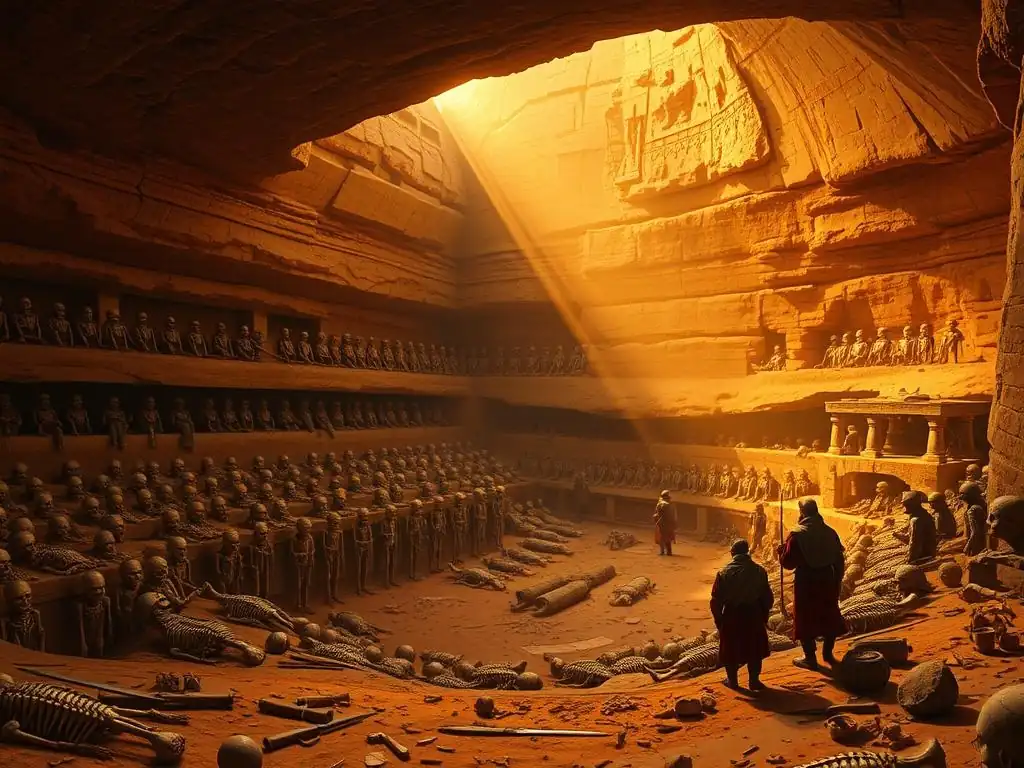
Welcome to ArchaeologyHub.org, your gateway to the past!
Delve into the fascinating world of archaeological discovery. Have you ever wondered about the secrets buried beneath our feet, the rituals and lives of those who came before us? Today, we invite you to explore one of the most intriguing and controversial finds in archaeological history: the "Great Death Pit" (PG/1237) at Ur.
Uncover the mysteries surrounding this mass burial site, and the evidence of ritual sacrifice that continues to spark debate among historians and archaeologists alike. Prepare to embark on a journey through time and uncover the compelling story of this ancient Mesopotamian city – what can the "Great Death Pit" tell us about the beliefs and practices of a long-lost civilization? Read on to find out!
- The Standard of Ur: A Window into Early Mesopotamian Society
- Introduction to the Standard of Ur
- Context: The Royal Cemetery of Ur
- The Standard of Ur: An Overview
- The War Side: Depictions of Conflict and Victory
- The Peace Side: Depictions of Abundance and Celebration
- Artifact Analysis: Insights into Sumerian Society
- Comparative Analysis: Other Sumerian Art and Artifacts
- The Legacy of the Standard of Ur: Understanding Sumerian Civilization
- Conclusion: The Enduring Significance of the Standard of Ur
-
Frequently Asked Questions
- What is the "Great Death Pit" at Ur and where is it located?
- What archaeological evidence suggests ritual sacrifice took place in the "Great Death Pit"?
- Who were the individuals buried in the "Great Death Pit", and what was their status?
- What is the significance of the "Great Death Pit" in understanding the culture of ancient Ur?
- How does the "Great Death Pit" contribute to archaeological knowledge about ancient burial practices?
- Final Reflection: Echoes of Ur, Resonating Through Time
- Unearth Your Inner Archaeologist: Start Exploring Now!
The Standard of Ur: A Window into Early Mesopotamian Society
Introduction to the Standard of Ur
Unveiling the Mysteries: Discovery and Significance
The Standard of Ur, a remarkable artifact from ancient Mesopotamia, was unearthed during the extensive excavations led by British archaeologist Sir Leonard Woolley. Discovered in 1927 within tomb PG 779 of the Royal Cemetery at Ur, its original function remains a subject of scholarly debate, with theories ranging from a standard carried in procession to a soundbox for a musical instrument. Despite this ambiguity, its significance is undeniable, offering an unparalleled visual narrative of Sumerian life, warfare, and celebration from approximately 2500 BCE.
This masterpiece of inlay art provides a vivid snapshot of Early Dynastic Sumer, detailing aspects of society that textual records often omit. Its dual-sided composition, depicting scenes of conflict and triumph alongside those of peace and abundance, serves as a crucial primary source. The Standard's intricate details and sophisticated artistry highlight the advanced cultural and artistic achievements of the Sumerian civilization, making it a cornerstone for understanding the complex social and political structures of early Mesopotamia.
The City of Ur: A Center of Sumerian Power
Ur, situated in modern-day southern Iraq near the confluence of the Euphrates and Tigris rivers, was one of the most prominent and influential city-states in ancient Mesopotamia. Founded around 3800 BCE, it rose to become a major economic and political power during the Early Dynastic Period (c. 2900-2350 BCE), particularly flourishing in the Early Dynastic III phase. The city's strategic location facilitated extensive trade networks, connecting Sumer with distant regions for resources like precious stones and metals.
Beyond its economic prowess, Ur was also a significant religious and cultural center, home to the massive Ziggurat of Ur, dedicated to the moon god Nanna. Its well-preserved archaeological remains, including residential areas, temples, and especially the Royal Cemetery, attest to a highly organized society with sophisticated urban planning and a rich cultural life. The discovery of artifacts like the Standard of Ur underscores the city's role as a hub of artistic innovation and a testament to the enduring legacy of Sumerian civilization.
Context: The Royal Cemetery of Ur
Leonard Woolley's Excavations: Discovering Royal Wealth
Sir Leonard Woolley conducted his groundbreaking excavations at Ur from 1922 to 1934, jointly sponsored by the British Museum and the University of Pennsylvania Museum. His meticulous work unveiled the Royal Cemetery of Ur, a necropolis containing over 2,000 burials, including sixteen exceptionally rich "royal tombs" or "death pits." These unique burial sites, such as PG 755 and PG 789 (the tomb of Queen Puabi), contained astonishing amounts of gold, silver, lapis lazuli, and carnelian artifacts, alongside evidence of human sacrifice.
The Standard of Ur itself was discovered in tomb PG 779, a burial chamber that, while less grand than some of the famous "royal tombs," still yielded significant treasures. Woolley's careful documentation and preservation techniques, remarkable for his time, allowed for an unprecedented understanding of Sumerian funerary practices and the immense wealth accumulated by Ur's elite. His discoveries profoundly reshaped archaeological understanding of the Early Dynastic period in Mesopotamia.
Dating the Artifact: The Early Dynastic Period
The Standard of Ur is firmly dated to the Early Dynastic III period, specifically between approximately 2600 and 2400 BCE. This chronological placement is crucial for understanding its context within the broader history of Mesopotamia. The Early Dynastic III phase represents a zenith of Sumerian civilization, characterized by the emergence of powerful city-states, the development of sophisticated administrative systems, and a flourishing of artistic and architectural achievements.
The artifact's dating is based on stratigraphic evidence from its excavation in the Royal Cemetery, alongside stylistic comparisons with other securely dated objects found in contemporary Sumerian sites like Kish and Uruk. This period immediately precedes the rise of the Akkadian Empire under Sargon the Great, making the Standard a vital visual record of Sumerian society at its peak, just before significant political and cultural shifts reshaped the Mesopotamian landscape.
The Standard of Ur: An Overview
Structure and Layout: Two Sides, War and Peace
The Standard of Ur is a trapezoidal box, measuring approximately 21.7 centimeters in height and 49.5 centimeters in length. Its most distinctive feature is its two main panels, conventionally referred to as the "War Side" and the "Peace Side," which narrate distinct aspects of Sumerian life. Each side is meticulously divided into three horizontal registers, allowing for a sequential reading of the depicted events. The narrative unfolds from the bottom register upwards, with the most important figures often appearing in the uppermost register.
The design is a testament to the Sumerian artistic convention of composite views, where figures are presented with bodies in profile and eyes or shoulders frontal. The rigid structure and clear division of scenes facilitate the storytelling, enabling viewers to follow the progression of military victory on one side and the celebration of prosperity on the other. This structured layout underscores the Sumerian emphasis on order and hierarchy in both their art and their society.
Materials and Craftsmanship: A Masterpiece of Inlay
The Standard of Ur is a prime example of exquisite Sumerian craftsmanship, constructed from a wooden core upon which intricate mosaics are inlaid. The primary materials used for the inlay are shell, lapis lazuli, and red limestone, all meticulously cut and shaped. The shell, likely sourced from the Persian Gulf, was used for the figures' bodies and details, offering a pale contrast against the background.
Lapis lazuli, a vibrant blue metamorphic rock, was imported from distant Badakhshan in modern-day Afghanistan, highlighting the extensive trade networks that linked Ur to remote regions. This precious stone was used for the rich blue backgrounds, representing the sky or the deep earth. Red limestone, probably from the Persian Gulf area, provided accents and borders, adding warmth to the palette.
All these elements were set into the bitumen adhesive that coated the wooden base. The precision and artistry involved in cutting, shaping, and assembling these diverse materials into coherent and detailed narratives demonstrate the sophisticated artistic techniques and resourcefulness of Sumerian artisans.
The War Side: Depictions of Conflict and Victory
Military Scenes: Chariots, Soldiers, and Captives
The "War Side" of the Standard of Ur vividly portrays a series of military engagements and their aftermath, showcasing the power and organization of the Sumerian army. The lowest register depicts four war chariots, pulled by onagers (wild asses), trampling over defeated enemies. These early chariots, heavy and cumbersome, were formidable weapons, indicating advanced military technology for the period. The middle register features a disciplined phalanx of Sumerian soldiers, depicted with cloaks, helmets, and spears, marching in formation. They are followed by other soldiers presenting bound, naked captives, symbolizing the humiliation and subjugation of the enemy.
The uppermost register culminates the narrative with a central, larger figure, widely interpreted as the Sumerian king or ruler, standing tall and overseeing the scene. He is surrounded by his elite soldiers, while naked captives are brought before him for inspection or judgment. This hierarchical scale emphasizes the king's supreme authority and his pivotal role in military triumph. The detailed depiction of armor, weaponry, and battle tactics provides invaluable insights into Early Dynastic Sumerian warfare.
Interpreting the Imagery: Royal Power and Warfare
The imagery on the War Side of the Standard of Ur serves as a powerful propaganda piece, glorifying the military prowess and divine authority of the Sumerian ruler. The systematic depiction of chariots, organized infantry, and the procession of captives underscores the sophisticated military organization of Ur. It visually asserts the king's role as the protector of the city-state and a formidable conqueror of its adversaries. The nakedness of the captives is a deliberate visual trope in ancient Near Eastern art, signifying their complete subjugation and loss of status.
Furthermore, the narrative reinforces the idea that the king's victory is not merely a human achievement but likely divinely sanctioned, legitimizing his rule and inspiring awe among his subjects and fear among potential enemies. The War Side thus functions as a public declaration of royal power, demonstrating the effectiveness of Ur's military might and its ability to maintain order and security through dominance. It is a visual testament to the harsh realities of inter-city-state conflict in early Mesopotamia and the rewards of victory for the ruling elite.
The Peace Side: Depictions of Abundance and Celebration
Feasting and Tribute: Scenes of Royal Prosperity
The "Peace Side" of the Standard of Ur presents a striking contrast to the War Side, illustrating scenes of abundance, tribute, and royal celebration. The lowest register depicts a procession of individuals carrying various provisions, including fish, bundles of goods, and possibly agricultural produce, towards a central gathering. This suggests the bounty of the land and the organized collection of resources. The middle register continues this theme, showing more figures leading a diverse array of animals, such as bulls, sheep, and goats, which are likely intended as offerings or tribute.
The uppermost register is the focal point, portraying a grand royal banquet. Figures are seated on stools, raising cups in a toast, while a lyre player and a singer provide entertainment. The central figure, again depicted larger than the others, is undoubtedly the king or a prominent leader, presiding over the festivities. This scene symbolizes the prosperity and stability achieved by the city-state, allowing for such lavish celebrations. It highlights the economic success of Ur, sustained by its agricultural output and organized labor.
The imagery on the Peace Side offers profound insights into the economic and social fabric of Sumerian society. The procession of tribute bearers and animals underscores the importance of agriculture and animal husbandry to Ur's economy, demonstrating a well-organized system of production and resource management. It also illustrates the hierarchical structure, where commoners contribute to the wealth that supports the elite. The banquet scene at the top is not merely a depiction of leisure; it symbolizes the successful culmination of economic activities and the ruler's role in ensuring the well-being and prosperity of the populace.
This side of the Standard reinforces the king's responsibility as a provider and the guarantor of social order. The harmonious scene of feasting and music suggests a period of peace and stability, achieved through effective governance and the successful management of resources. It reflects the Sumerian value placed on prosperity, communal celebration, and the maintenance of a stable hierarchy, where each member of society contributes to the collective good under the leadership of the king.
Artifact Analysis: Insights into Sumerian Society
The Standard of Ur is a rich tapestry of motifs that illuminate various facets of Sumerian society. Social hierarchy is explicitly communicated through the use of hierarchical scale, where the king is consistently depicted larger than commoners, soldiers, and servants. Different social strata are also distinguished by their attire, activities, and positions within the registers, from the marching soldiers and tribute bearers to the seated elite at the banquet. This visual stratification underscores the rigid social structure of Early Dynastic Ur, with the king at its apex, supported by a complex network of administrators, priests, military personnel, and laborers.
Agricultural practices are prominently featured on the Peace Side through the depiction of livestock—bulls, sheep, and goats—and the bundles of produce being carried. This imagery highlights the agrarian foundation of Sumerian civilization, emphasizing the importance of a productive agricultural economy for sustaining the urban population.
The scenes suggest well-developed farming techniques and animal husbandry, vital for the surplus that supported specialized labor and the elite. While not overtly religious, the prosperity and victory depicted could be interpreted as a reflection of divine favor, suggesting an underlying religious symbolism where the king's success is intertwined with the blessings of the gods, ensuring the city's well-being and stability.
The Symbolism of the Standard: Royal Ideology and Mesopotamian Values
The Standard of Ur functions as a powerful symbolic representation of Sumerian royal ideology and core Mesopotamian values. It encapsulates the dual responsibilities of the Sumerian ruler: to protect the city-state through military might and to ensure its prosperity and well-being through effective governance and resource management. The juxtaposition of the "War Side" and the "Peace Side" vividly illustrates this dual role, portraying the king as both a formidable warrior and a benevolent provider.
The artifact also embodies key Mesopotamian values such as order, hierarchy, and the importance of collective effort. The disciplined soldiers and organized tribute processions reflect a society that valued structure and cooperation. The abundance depicted on the Peace Side symbolizes the ultimate goal of stability and prosperity for the city-state, achieved under the king's wise leadership. Essentially, the Standard served as a visual testament to the legitimacy and power of the ruling elite, reinforcing their divine mandate and their capacity to maintain the cosmic and social order in Ur.
Comparative Analysis: Other Sumerian Art and Artifacts
Parallels in Other Sumerian Sites: Vases, Cylinder Seals, Sculptures
The artistic conventions and thematic elements seen in the Standard of Ur find parallels in various other Sumerian art forms and artifacts discovered across Mesopotamia. The Warka Vase, from the city of Uruk (c. 3200-3000 BCE), is a notable example. Like the Standard, it employs a multi-register narrative structure, depicting a procession of offerings to a deity, reinforcing themes of agricultural bounty and social hierarchy. Both artifacts demonstrate the Sumerian preference for clear, sequential storytelling through visual means.
Cylinder seals, ubiquitous in Mesopotamia from the late 4th millennium BCE, also share thematic and stylistic similarities. These miniature carved cylinders, used to impress designs onto clay, often depict mythological scenes, daily life, or royal activities, including banquets and interactions with deities, mirroring the narrative complexity and focus on authority found in the Standard. Furthermore, votive sculptures from sites like Tell Asmar (c. 2700-2500 BCE) exhibit the characteristic rigid poses, clasped hands, and wide-eyed gazes seen in some figures on the Standard, indicating a shared artistic tradition and aesthetic across different Sumerian city-states during the Early Dynastic period.
Cross-Cultural Comparisons: Contemporary Art in Egypt and the Indus Valley
Examining the Standard of Ur in a broader cross-cultural context reveals both unique characteristics of Sumerian art and shared artistic responses to the challenges of early state formation. In ancient Egypt, contemporary works like the Narmer Palette (c. 3100 BCE) from the Early Dynastic period display striking thematic parallels.
The Narmer Palette also glorifies a ruler through military victory, depicting the unification of Egypt under his power using hierarchical scale and distinct registers, much like the War Side of the Standard. Egyptian tomb paintings from the Old Kingdom (c. 2686-2181 BCE) similarly show scenes of daily life, agriculture, and royal rituals, reflecting a shared emphasis on depicting societal order and prosperity.
In contrast, the Indus Valley Civilization (Harappan, c. 2500-1900 BCE) produced art that, while sophisticated, differed significantly in its narrative approach. Harappan art, primarily seen on intricate seals, focuses more on animal motifs, mythological creatures, and an undeciphered script, with less emphasis on explicit narrative scenes of warfare or royal banquets. While all three civilizations developed complex urban societies, their artistic expressions reflect distinct cultural priorities and visual languages, underscoring the diverse paths of early civilization but also highlighting common themes of power, sustenance, and order.
The Legacy of the Standard of Ur: Understanding Sumerian Civilization
The Impact on Archaeological Interpretation: Insights into Early State Formation
The Standard of Ur has had a profound impact on archaeological interpretation, serving as a cornerstone for understanding the processes of early state formation in Mesopotamia. Its detailed visual narratives provide direct evidence for the sophistication of Sumerian society during the Early Dynastic period. Archaeologists and historians have utilized its imagery to reconstruct aspects of Sumerian military organization, economic systems, social stratification, and even ritual practices, which are often only partially discernible from textual sources or architectural remains.
The artifact's dual portrayal of "War" and "Peace" offers unique insights into the core functions of early urban centers like Ur: the maintenance of security and the provision of sustenance. It helps scholars to understand how early rulers legitimized their power, how resources were managed, and how social cohesion was fostered in the nascent complex societies of the ancient Near East. The Standard thus stands as a crucial visual document, complementing textual and architectural evidence to paint a more complete picture of the transition from simple settlements to complex, organized states in Sumer.
The Standard of Ur in Museums and Education: Discuss its display and educational value
Today, the Standard of Ur is one of the most celebrated and iconic artifacts from ancient Mesopotamia, primarily housed in the British Museum in London. Its prominent display attracts millions of visitors annually, serving as a tangible link to one of the world's earliest civilizations. The artifact's vivid narrative and relatively intact condition make it an exceptional educational tool, widely featured in textbooks, documentaries, and educational programs globally.
Its visual accessibility allows students and the general public to grasp complex historical concepts such as the rise of city-states, the development of social hierarchies, and the nature of early warfare and economic systems. Educators often use the Standard to introduce the concept of propaganda in ancient art, the importance of archaeological discovery, and the enduring legacy of Sumerian culture. Its presence in a major international museum ensures its preservation and continued study, making it an invaluable resource for both academic research and public engagement with the ancient world.
Conclusion: The Enduring Significance of the Standard of Ur
Summarizing the Key Findings and Interpretations
The Standard of Ur stands as an unparalleled visual testament to the complexities and achievements of Early Dynastic Sumerian civilization. Through its intricately inlaid panels, it masterfully narrates the dual aspects of royal power: the successful prosecution of warfare on one side and the celebration of peace and prosperity on the other.
This remarkable artifact provides invaluable insights into the sophisticated military organization, the hierarchical social structure, and the vital agricultural economy that underpinned the city-state of Ur. Its craftsmanship, utilizing precious materials like lapis lazuli and shell, underscores the extensive trade networks and advanced artistic skills of the Sumerian people.
As a piece of royal ideology, the Standard effectively communicated the ruler's divine mandate and his essential role in ensuring both the security and the well-being of his populace. It serves as a microcosm of Sumerian values, emphasizing order, discipline, and the importance of collective contribution to the state's prosperity. The Standard of Ur remains a critical primary source for understanding the dynamics of early state formation and the cultural landscape of ancient Mesopotamia.
Future Research Directions: Potential for Further Analysis and Interpretation
Despite decades of study, the Standard of Ur continues to offer avenues for future research and interpretation. Advances in scientific analysis, such as non-destructive material provenance studies, could further pinpoint the exact origins of its components, providing more detailed insights into Early Dynastic trade routes and resource acquisition. Re-evaluating its original function, perhaps through digital reconstructions of its potential use as a soundbox or a processional standard, could offer new perspectives on its role in Sumerian rituals or public life.
Furthermore, continued archaeological discoveries in Mesopotamia and comparative analyses with newly unearthed artifacts from other ancient civilizations will undoubtedly enrich our understanding of the Standard's place within a broader historical and artistic context. Digital humanities approaches, including 3D modeling and virtual reality reconstructions, could enhance its educational value and allow for deeper engagement with its intricate details. The enduring significance of the Standard of Ur lies not only in what it has already revealed but also in its potential to continue shedding light on the fascinating complexities of early human civilization.
Frequently Asked Questions
What is the "Great Death Pit" at Ur and where is it located?
The "Great Death Pit" (PG/1237) is a mass burial site discovered at the ancient city of Ur, located in modern-day Iraq. It's known for its evidence of ritual sacrifice.
What archaeological evidence suggests ritual sacrifice took place in the "Great Death Pit"?
The presence of numerous bodies, often adorned with elaborate jewelry and arranged in specific patterns, suggests a deliberate and ritualistic killing. Furthermore, the discovery of poisonous substances near the bodies supports the sacrifice theory.
Who were the individuals buried in the "Great Death Pit", and what was their status?
Archaeological evidence suggests those buried were likely members of the royal court or high-ranking officials. They were buried alongside their queen or king, implying they willingly or unwillingly accompanied them into the afterlife.
What is the significance of the "Great Death Pit" in understanding the culture of ancient Ur?
The "Great Death Pit" provides valuable insights into the religious beliefs and social hierarchy of the Mesopotamian civilization of Ur. It highlights the practice of royal burials and the beliefs surrounding the afterlife.
How does the "Great Death Pit" contribute to archaeological knowledge about ancient burial practices?
It showcases the complexity and scale of ancient burial rituals, indicating a sophisticated understanding of death and the afterlife. The site also offers crucial information about the material culture and social organization of the time.
Final Reflection: Echoes of Ur, Resonating Through Time
The exploration of the "Great Death Pit" at Ur, as we've seen, offers a chilling glimpse into the complex beliefs and societal structures of a civilization long past. The sheer scale of the mass burials and the evidence of ritual sacrifice forces us to confront uncomfortable truths about power, faith, and the human condition. These discoveries, though unearthed from millennia ago, remain profoundly relevant today, reminding us of the enduring human capacity for both extraordinary creation and devastating destruction. The echoes of Ur resonate through time, prompting us to examine our own values and the legacies we are building.
The impact of understanding the "Great Death Pit" extends far beyond the realm of archaeology. It compels us to consider the fragility of life and the enduring power of belief systems, even those that seem barbaric to modern eyes. The excavation of this site, and the subsequent analysis of its contents, has fundamentally altered our understanding of early Mesopotamian society. The past is never dead. It's not even past.
- William Faulkner. This quote encapsulates the enduring relevance of the "Great Death Pit," a stark reminder that the past continues to shape our present.
As we conclude this journey into the depths of the "Great Death Pit," let us not simply marvel at the artifacts and shudder at the rituals. Instead, let us use this knowledge to cultivate a deeper understanding of ourselves and the world around us. Reflect on the choices you make, the values you uphold, and the legacy you wish to leave behind. Let the story of Ur serve as a catalyst for empathy, critical thinking, and a renewed commitment to building a more just and compassionate future.
Unearth Your Inner Archaeologist: Start Exploring Now!
Thanks for diving into the mysteries of the "Great Death Pit" with us! We hope you found this journey through ancient rituals as fascinating as we do. Now, let's turn that newfound knowledge into action!
Here are a few ways you can further explore this intriguing topic:
- Delve deeper: Research similar archaeological discoveries of mass burials and ritual practices from different cultures. Compare and contrast these findings with those at Ur.
- Share the discovery: Spread the word about the "Great Death Pit"! Discuss the implications of these findings with friends, family, or on social media, and spark a conversation about ancient civilizations.
- Expand the horizon: Volunteer at your local museum and learn more about similar findings close to home.
What other historical mysteries spark your curiosity the most, and what do you plan to investigate next?