
Core Tools of the Lower Paleolithic: Choppers and Chopping Tools Explained


Welcome to ArchaeologyHub.org, your gateway to the past!
Delve into the fascinating world of ancient civilizations and uncover the secrets they left behind. Curious about the very first tools crafted by human hands? Then prepare to explore the groundbreaking techniques used to create Paleolithic chopper tools. This is just the beginning; join us as we unearth the ingenuity of our ancestors and decipher the stories etched in stone. What can these simple tools tell us about the dawn of human innovation? Read on to find out!
- Introduction to Lower Paleolithic Lithic Technology
- What are Choppers and Chopping Tools? Defining Key Characteristics
- The Lower Paleolithic Period: A Timeline of Early Hominin Tool Use
- Paleolithic Chopper Tool Techniques: A Detailed Examination
- Geographical Distribution of Choppers and Chopping Tools
- Functionality and Use of Lower Paleolithic Choppers
- Case Studies: Notable Chopper Tool Discoveries
- Experimental Archaeology: Replicating and Understanding Chopper Tool Use
- The Legacy of Choppers and Chopping Tools: Their Impact on Human Evolution
- Conclusion: The Enduring Importance of Lower Paleolithic Choppers and Chopping Tools
-
Frequently Asked Questions
- What defines a Paleolithic chopper tool, and how does it differ from a chopping tool?
- What raw materials were typically used to create Paleolithic chopper tools?
- What were the primary uses of Paleolithic chopper tools?
- How did Paleolithic chopper tool techniques evolve over time?
- Where have significant discoveries of Paleolithic chopper tools been made?
- Final Reflection: Echoes of Ancient Ingenuity
- Ignite Your Inner Archaeologist!
Introduction to Lower Paleolithic Lithic Technology
Understanding the Significance of Early Stone Tools
The emergence of stone tools marks a pivotal moment in human evolution, signaling a profound cognitive leap for early hominins. These rudimentary implements, particularly those from the Lower Paleolithic period spanning approximately 3.3 million to 300,000 years ago, represent the earliest tangible evidence of our ancestors' capacity for intentional modification of nature to achieve specific goals. They were not merely extensions of the hand but rather products of foresight, planning, and a developing understanding of material properties, laying the groundwork for all subsequent technological advancements.
The creation and use of these early stone tools had far-reaching implications, fundamentally altering hominin diets, behaviors, and social structures. Access to new food sources, such as bone marrow and tough plant materials, became possible, providing crucial energy for brain development. Furthermore, the systematic production of tools suggests the beginnings of learned behavior and cultural transmission, as knowledge of Paleolithic chopper tool techniques and material selection was likely passed down through generations.
Early Stone Tool Technology: A Foundation for Human Development
Early stone tool technology served as the bedrock upon which human development was built, enabling hominins to adapt to diverse environments and exploit new ecological niches. Before the advent of specialized hunting tools, choppers and chopping tools were instrumental in scavenging and processing animal carcasses left by large predators, allowing access to nutrient-rich tissues previously unavailable. This dietary shift is believed to have played a significant role in the encephalization process, leading to larger and more complex brains.
The oldest known stone tools, discovered at Lomekwi 3 in Kenya and dating back approximately 3.3 million years, predate the earliest known members of the Homo genus, suggesting that tool-making capabilities emerged even earlier than previously thought. These initial forays into lithic technology represent not just a technological breakthrough but also a fundamental shift in how hominins interacted with their environment, transforming it to suit their needs rather than merely adapting to it.
What are Choppers and Chopping Tools? Defining Key Characteristics
Distinguishing Between Choppers and Chopping Tools: Unifacial vs. Bifacial Reduction
Choppers and chopping tools, while often discussed together due to their shared basic form and function, are primarily distinguished by the extent and pattern of flake removal. A chopper is typically defined as a stone core from which flakes have been removed from only one side or face (unifacially) to create a sharp, jagged edge. This often results in a tool with a natural, rounded grip on one side and a working edge on the other, produced by relatively few blows.
In contrast, a chopping tool exhibits bifacial flaking, meaning flakes have been systematically removed from both sides of the core to create a more robust and often more symmetrical cutting edge. This bifacial reduction required a greater degree of control and a more advanced understanding of Paleolithic chopper tool techniques, leading to a more durable and versatile implement. While choppers often appear expedient and simple, chopping tools represent a slight refinement, indicating a progression in early hominin lithic capabilities. Both types typically range in size from about 5 to 15 centimeters, fitting comfortably in the hand.
Raw Materials Used in Lower Paleolithic Chopper Tool Production
The selection of appropriate raw materials was a critical aspect of Lower Paleolithic chopper tool production, directly influencing the effectiveness and durability of the finished implement. Early hominins primarily utilized readily available, hard, and brittle rocks that exhibited conchoidal fracture—a characteristic where the material breaks with a smooth, curved surface, similar to how glass breaks. Common materials included various types of flint, chert, quartz, quartzite, and basalt.
These raw materials were often sourced from riverbeds, exposed geological outcrops, or naturally occurring cobble deposits. The ability to identify and procure suitable stones, sometimes requiring short journeys of a few kilometers from a living site, demonstrates a developing understanding of their environment and the properties of different stone types. The choice of material directly impacted the Paleolithic chopper tool techniques employed, as different stones required varying degrees of force and precision to flake effectively.
The Lower Paleolithic Period: A Timeline of Early Hominin Tool Use
The Oldowan Industry: The Earliest Evidence of Chopper Tool Creation
The Oldowan industry represents the earliest widely recognized stone tool tradition, dating back from approximately 2.6 million to 1.7 million years ago. Named after Olduvai Gorge in Tanzania, where many significant discoveries were made, Oldowan tools are characterized by their simplicity and expediency. The primary tools in this assemblage are choppers, created by striking a few flakes from a cobble to produce a sharp working edge, alongside the detached flakes themselves, which were also used for cutting.
Key sites for Oldowan discoveries include Gona, Ethiopia, which has yielded tools dating back 2.6 million years, and Koobi Fora, Kenya. These tools are primarily associated with early Homo species like Homo habilis ("handy man"), though recent evidence suggests that species like Australopithecus garhi or even earlier hominins might have also engaged in rudimentary tool-making. The Oldowan toolkit, while basic, was revolutionary, enabling early hominins to process food more efficiently and access new dietary resources.
The Acheulean Industry: Evolution of Chopping Tool Technology
Following the Oldowan, the Acheulean industry emerged around 1.7 million years ago and persisted until approximately 300,000 years ago, marking a significant leap in stone tool technology. While the simple choppers of the Oldowan continued to be made, the Acheulean is most renowned for the advent of the handaxe—a more sophisticated, bifacially flaked tool that represents an evolution from basic chopping tools. These tools typically exhibit a teardrop or almond shape, with a pointed end and a rounded base.
The Acheulean industry is primarily associated with Homo erectus, a hominin species known for its wider geographical spread across Africa, Asia, and Europe. The Paleolithic chopper tool techniques employed during this period became more refined, involving a greater number of blows and more precise control over flake removal to achieve a standardized form. Sites like Saint-Acheul in France, from which the industry takes its name, and various locations in Africa like Olduvai Gorge and Olorgesailie, Kenya, showcase the widespread adoption and development of these advanced chopping tools.
Paleolithic Chopper Tool Techniques: A Detailed Examination
Direct Percussion Method: Shaping the Core
The fundamental Paleolithic chopper tool technique employed during the Lower Paleolithic for shaping stone cores was direct percussion. This method involves striking a stone core, known as the "blank" or "nodule," directly with another harder stone, referred to as a "hammerstone." The impact generates a shockwave that travels through the core, causing a flake to detach from the point of impact. The goal was to remove flakes in a controlled manner to create a sharp, functional edge on the core.
The success of direct percussion relied heavily on the knapper's ability to select the right hammerstone, apply the correct amount of force, and strike the core at the precise angle. An incorrect strike could shatter the core or produce unusable flakes. This technique, though seemingly simple, required considerable skill and understanding of lithic mechanics, passed down through observation and practice within early hominin groups.
Hard Hammer Percussion: Achieving Desired Flake Scars
Within the direct percussion method, hard hammer percussion was the predominant Paleolithic chopper tool technique for the initial shaping of choppers and chopping tools. This involved using a hammerstone made of a dense, durable material such as quartzite, basalt, or a robust river cobble. The use of a hard hammer allowed for the removal of large, broad flakes from the core with relatively few powerful blows.
Hard hammer percussion typically produces flakes with a pronounced bulb of percussion (a convex swelling on the ventral surface of the flake), a large striking platform, and often visible ripple marks. This technique was highly effective for rapidly reducing the size of a raw cobble and creating the primary working edge of a chopper. While it offered efficiency in material removal, it provided less control over the precise shape and thickness of the detached flakes compared to later, more refined methods.
Retouching and Sharpening Techniques in Early Stone Tools
While many Lower Paleolithic choppers were expedient tools, used briefly and then discarded, there is evidence of rudimentary retouching and sharpening techniques being applied, particularly in the later stages of the Lower Paleolithic. Retouching involves striking smaller flakes from the working edge of an already detached flake or a core tool to refine its shape, sharpen a dull edge, or create a more durable serrated edge. This indicates a growing sophistication in Paleolithic chopper tool techniques.
For choppers, retouching primarily focused on maintaining or improving the sharpness of the active edge. This might involve carefully striking off small flakes using a smaller hammerstone or even by pressing against another hard surface. Although less common and less elaborate than the fine retouch seen in Middle Paleolithic tools, the presence of resharpening suggests that early hominins understood the concept of tool maintenance and sought to prolong the utility of their implements.
Geographical Distribution of Choppers and Chopping Tools
Africa: The Cradle of Hominin Tool Use and Chopper Discoveries
Africa stands as the undeniable cradle of hominin tool use, with the earliest and most extensive archaeological evidence of choppers and chopping tools. The oldest confirmed stone tools, dating to approximately 3.3 million years ago, were found at Lomekwi 3 in Kenya, predating the Oldowan industry. Subsequently, sites like Olduvai Gorge in Tanzania and Gona in Ethiopia have yielded vast assemblages of Oldowan choppers, dating back as far as 2.6 million years, providing crucial insights into the initial stages of Paleolithic chopper tool techniques.
These African discoveries demonstrate a continuous tradition of tool-making, evolving from simple choppers to more complex Acheulean handaxes, which spread across the continent by 1.7 million years ago. The sheer volume and chronological depth of African lithic sites underscore its central role in the development and diversification of early stone tool technologies, reflecting the long and intricate history of hominin occupation and technological innovation on the continent.
Asia: Chopper Tool Assemblages in the Far East
The distribution of choppers and chopping tools extends significantly into Asia, presenting a distinct pattern often referred to as the "Movius Line." This theoretical line, proposed by archaeologist Hallam Movius, broadly separates regions where Acheulean handaxes are common (west of the line, including Africa, Europe, and parts of India) from regions where chopper-chopping tool traditions persisted without the widespread adoption of handaxes (east of the line, including East Asia and Southeast Asia).
Notable Asian sites include Zhoukoudian in China, associated with Homo erectus (Peking Man), where chopping tools made from quartz and sandstone date back approximately 700,000 to 200,000 years ago. Other significant discoveries have been made at Sangiran and Mojokerto in Indonesia, with tools dating possibly as far back as 1.8 million years. The prevalence of these chopper-dominated assemblages in Asia suggests either independent technological development or a localized continuation of earlier Paleolithic chopper tool techniques adapted to regional raw materials and needs.
Europe: Evidence of Early Hominin Occupation and Lithic Technology
The presence of choppers and early lithic technology in Europe indicates the expansion of hominin populations out of Africa, though their arrival was later than in Asia. The earliest securely dated evidence of hominin presence and tool use in Europe comes from sites in Spain, such as Sima del Elefante at Atapuerca, where Oldowan-like choppers and flakes have been found dating to approximately 1.2 million years ago. Other early sites include Fuente Nueva 3 and Barranco León in Spain, and Pirro Nord in Italy, all yielding simple chopper assemblages.
These initial European tools largely resemble the Oldowan industry, characterized by expedient choppers and sharp flakes. While Acheulean technology eventually arrived in Europe, spreading around 600,000 to 500,000 years ago, the earliest European sites primarily showcase the foundational Paleolithic chopper tool techniques. The relatively sparse and simple nature of these earliest European assemblages compared to Africa suggests that hominin populations were initially small and their technological repertoire was still evolving in these northern latitudes.
Functionality and Use of Lower Paleolithic Choppers
Butchering and Processing Animal Carcasses
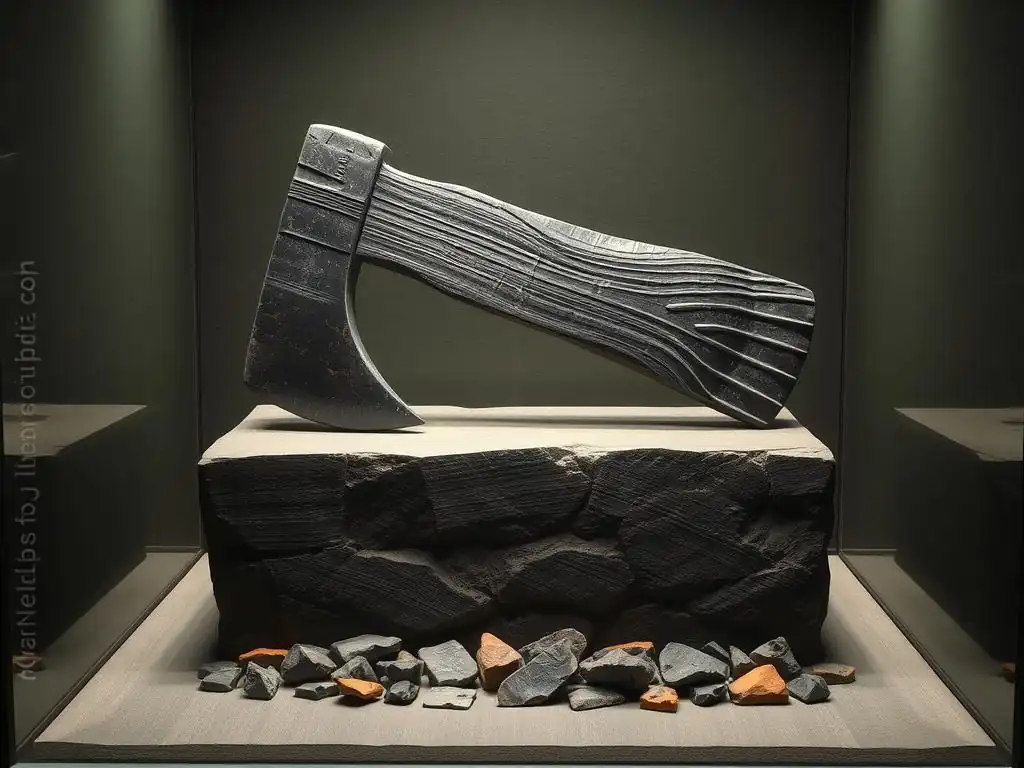
The primary hypothesized function of Lower Paleolithic choppers and chopping tools revolves around the processing of animal carcasses. Evidence from cut marks on fossilized bones found alongside these tools strongly suggests their use in disarticulating joints, defleshing bones, and breaking open long bones to access nutrient-rich marrow. Experimental archaeology, where researchers replicate ancient Paleolithic chopper tool techniques and use them on animal carcasses, has consistently demonstrated their effectiveness for these tasks.
For early hominins, who were likely scavengers rather than proficient hunters for much of the Lower Paleolithic, these tools provided a crucial advantage. They allowed access to high-quality protein and fat from large animal remains, which would have been inaccessible using only teeth and hands. This ability to efficiently process meat and marrow was a significant step in dietary evolution, contributing to the energy demands of a developing hominin brain.
Woodworking and Plant Processing with Choppers
Beyond butchery, choppers and chopping tools likely served a broader range of functions, including woodworking and the processing of tough plant materials. While direct archaeological evidence for these uses is scarcer due to the perishable nature of wood and plants, use-wear analysis on some choppers has indicated traces consistent with working fibrous materials. For instance, the robust edges of chopping tools would have been effective for stripping bark, shaping branches, or even digging for tubers and roots.
The versatility of these early tools meant they could be adapted to various tasks essential for survival. A single chopper could potentially serve multiple purposes: processing a carcass, then being used to sharpen a digging stick, or to break open hard-shelled fruits or nuts. This multi-functionality highlights the ingenuity of early hominins and the foundational role of these simple yet effective implements in their daily lives.
The Role of Choppers in Early Hominin Survival Strategies
Choppers and chopping tools played a fundamental role in the overall survival strategies of Lower Paleolithic hominins. By enabling efficient food processing, they expanded dietary options and provided a more consistent supply of high-energy nutrients, which was critical for physical development and cognitive growth. This technological innovation allowed hominins to exploit a wider array of resources within their environment, moving beyond simple foraging.
Moreover, the creation and use of these tools represent an early form of niche construction, where hominins began to actively modify their environment to improve their chances of survival. The development of Paleolithic chopper tool techniques was not just about making a sharp edge; it was about enhancing foraging efficiency, reducing processing time, and ultimately increasing the caloric intake necessary to support larger brains and more complex social behaviors, setting the stage for future evolutionary successes.
Case Studies: Notable Chopper Tool Discoveries
The Olduvai Gorge Chopper Tools: Evidence of Early Hominin Activity
Olduvai Gorge in Tanzania is arguably the most iconic site for understanding Lower Paleolithic choppers and early hominin activity. The extensive excavations led by Louis and Mary Leakey in the mid-20th century unearthed a wealth of Oldowan tools, including numerous choppers, dating back approximately 1.8 to 1.7 million years ago. These discoveries, often found in association with fossilized hominin remains (such as Homo habilis) and butchered animal bones, provided irrefutable evidence of systematic tool production and use by early members of our genus.
The Olduvai choppers, typically made from basalt or quartz, are characterized by their simple unifacial or bifacial flaking, demonstrating the foundational Paleolithic chopper tool techniques. Their presence alongside cut-marked animal bones revolutionized the understanding of early hominin subsistence, indicating that these tools were instrumental in accessing meat and marrow, challenging the previous notion of early humans as purely vegetarian.
The Zhoukoudian Chopping Tools: Unveiling Peking Man's Toolkit
The site of Zhoukoudian, China, famous for the discovery of Homo erectus fossils known as "Peking Man," has also yielded significant assemblages of chopping tools. These tools, dating from approximately 700,000 to 200,000 years ago, are predominantly choppers and chopping tools made from locally available raw materials like quartz, sandstone, and limestone. Unlike many contemporary sites in Africa and Europe, Zhoukoudian's lithic assemblage lacks the characteristic Acheulean handaxes, reinforcing the concept of a persistent chopper-chopping tool tradition in East Asia.
The Zhoukoudian chopping tools reveal insights into the adaptive strategies of Homo erectus in a temperate environment. Their robust nature suggests a variety of uses, likely including butchering, woodworking, and possibly processing plant materials. The study of these tools, combined with faunal remains and evidence of controlled fire, contributes significantly to our understanding of the technological capabilities and daily life of early hominins in the Far East, showcasing regional variations in Paleolithic chopper tool techniques.
Experimental Archaeology: Replicating and Understanding Chopper Tool Use
Creating Replica Choppers: A Hands-On Approach
Experimental archaeology plays a crucial role in understanding Lower Paleolithic choppers by allowing researchers to replicate ancient Paleolithic chopper tool techniques using similar raw materials and methods. This hands-on approach, known as flintknapping, provides invaluable insights into the skill, effort, and cognitive processes required to create these early implements. By attempting to produce choppers using direct hard hammer percussion, experimenters gain a deeper appreciation for the ancient knappers' understanding of stone properties, angles of force, and control.
For instance, replicating a simple Oldowan chopper might involve selecting a river cobble and striking it with a quartzite hammerstone to detach a few large flakes, creating a sharp edge. Such experiments reveal that even seemingly "simple" tools require a precise sequence of actions and an intuitive grasp of physics. This practical experience helps to demystify ancient technologies and provides a tangible link to the past, informing interpretations of archaeological finds.
Analyzing Use-Wear Patterns on Experimental Tools
A key aspect of experimental archaeology involves the analysis of use-wear patterns on replica tools. After creating replica choppers, researchers use them in simulated ancient activities, such as butchering animal carcasses, chopping wood, or processing plants. The microscopic wear patterns that develop on the edges of these experimental tools—such as polish, striations, and microscopic fractures—are then carefully documented.
These experimentally derived use-wear patterns are then compared to similar traces found on actual archaeological artifacts. By matching the wear on ancient choppers to the wear produced by known activities on replicas, archaeologists can infer the specific functions of the prehistoric tools with a higher degree of certainty. This method provides empirical data that complements morphological analysis, offering concrete evidence about how ancient Paleolithic chopper tool techniques translated into practical daily tasks for early hominins.
The Legacy of Choppers and Chopping Tools: Their Impact on Human Evolution
The Cognitive Development Required for Tool Creation
The invention and consistent production of choppers and chopping tools represent a monumental leap in hominin cognitive development. Unlike simply using a found object, manufacturing a tool requires foresight—the ability to envision a desired outcome (a sharp edge) and then execute a series of planned actions to achieve it. This involves selecting appropriate raw materials, understanding their fracture mechanics, and controlling the force and angle of blows.
This capacity for intentional tool production indicates an enhanced level of abstract thought, planning depth, and problem-solving abilities. The development of Paleolithic chopper tool techniques fostered improved hand-eye coordination, fine motor skills, and spatial reasoning, all of which contributed to the expansion and reorganization of the hominin brain. These early technological innovations were not just about survival; they were catalysts for significant cognitive evolution.
The Transmission of Tool-Making Skills Across Generations
The consistent form and widespread distribution of Oldowan and Acheulean choppers over vast geographical areas and immense spans of time strongly suggest the cultural transmission of tool-making skills across generations. It is highly probable that early hominins learned these Paleolithic chopper tool techniques through observation, imitation, and direct instruction within their social groups. This implies a level of social learning and communication that goes beyond simple genetic inheritance.
The ability to teach and learn complex manual skills, such as how to effectively flake a stone to create a chopper, signifies a foundational aspect of human culture. This transmission of knowledge was crucial for the persistence and evolution of tool technologies, laying the groundwork for cumulative culture—where improvements and innovations can build upon previous generations' discoveries. Without this ability to pass on learned skills, each generation would have to rediscover tool-making anew, severely limiting technological progress.
Conclusion: The Enduring Importance of Lower Paleolithic Choppers and Chopping Tools
Further Research and Excavation: Unveiling More About Early Stone Age Technology
The study of Lower Paleolithic choppers and chopping tools continues to be a vibrant and critical area of archaeological research. These foundational implements, representing humanity's earliest technological endeavors, offer unparalleled insights into the cognitive abilities, survival strategies, and evolutionary trajectory of early hominins. While much has been learned from sites like Olduvai Gorge and Zhoukoudian, ongoing excavations worldwide continue to unearth new evidence, pushing back the timeline of tool use and refining our understanding of early Paleolithic chopper tool techniques.
Future research, particularly through interdisciplinary approaches combining archaeology with paleoanthropology, geology, and experimental studies, promises to unveil even more about the subtle variations in chopper forms, their precise functions in diverse environments, and the social contexts of their production and use. Each new discovery contributes to a more complete picture of how these simple stone tools profoundly shaped the course of human evolution, underscoring their enduring importance in the grand narrative of our past.
Frequently Asked Questions
What defines a Paleolithic chopper tool, and how does it differ from a chopping tool?
A Paleolithic chopper tool is a core tool created by removing flakes from one side of a stone, forming a unifacial cutting edge. A chopping tool, conversely, features a bifacial cutting edge, formed by flaking from both sides.
What raw materials were typically used to create Paleolithic chopper tools?
Early hominins primarily utilized readily available local materials such as river cobbles, volcanic rock, and flint to fashion chopper tools. The choice depended on hardness and availability.
What were the primary uses of Paleolithic chopper tools?
Chopper tools served a variety of purposes including processing plant materials, butchering animals, and working wood. They were essential for early hominin survival and adaptation.
How did Paleolithic chopper tool techniques evolve over time?
Early techniques involved simple percussion flaking, resulting in crude edges. Over time, hominins developed more refined methods, allowing for greater control and sharper, more efficient edges.
Where have significant discoveries of Paleolithic chopper tools been made?
Important finds have been made in locations across Africa, Asia, and Europe, including Olduvai Gorge (Tanzania) and sites in China. These discoveries provide vital insights into early hominin technology.
Final Reflection: Echoes of Ancient Ingenuity
The exploration of Paleolithic chopper tool techniques, as we've seen, is more than just an archaeological exercise; it's a window into the very genesis of human ingenuity. The enduring simplicity and effectiveness of these early tools speak volumes about our ancestors' resourcefulness and their profound connection to the natural world. These seemingly rudimentary objects represent the foundation upon which all subsequent technological advancements were built, reminding us of the power of observation, adaptation, and the drive to shape our environment.
The legacy of the Paleolithic chopper tool extends far beyond the dusty shelves of museums. It serves as a potent reminder of our shared human heritage and the fundamental skills that allowed our species to thrive. It also prompts us to consider the environmental impact of our tools, both past and present. The stone age did not end for lack of stone, and the oil age will end long before the world runs out of oil.
- Sheikh Yamani. This quote underscores the importance of sustainable practices and mindful innovation, lessons we can glean even from the simplest of Paleolithic tools.
As we contemplate the Paleolithic chopper tool, let us also contemplate our own capacity for innovation and adaptation. What simple solutions can we devise to address the complex challenges of our time? What fundamental skills can we cultivate to better connect with our environment and each other? Embrace the spirit of the Paleolithic innovator, and let us strive to build a future where ingenuity and sustainability walk hand in hand.
Ignite Your Inner Archaeologist!
Thank you for diving into the world of Lower Paleolithic tools! We hope you've gained a deeper appreciation for the ingenuity of our early ancestors. Now, it's time to take that newfound knowledge and put it into action!
Here are a few ways to continue your archaeological journey:
- Visit a local museum with Paleolithic artifacts to see these tools up close and personal, and connect with the history right in front of you!
- Share this article with a friend or colleague who is interested in archaeology and invite them to explore the world of ancient tools together.
- Delve deeper: Research experimental archaeology projects where researchers are recreating and using these tools to understand their function – you might even find a workshop!
What specific feature of choppers or chopping tools surprised you most, and how does it change your perception of early human capabilities?