
Neolithic Axes and Adzes: Innovations for Deforestation, Woodworking, and Construction

Welcome to ArchaeologyHub.org, your gateway to unraveling the mysteries of the past!
Delve into a world of ancient civilizations and groundbreaking discoveries. This article explores the fascinating story of Neolithic axes and adzes, revealing how these seemingly simple tools revolutionized deforestation, woodworking, and construction in prehistoric times. How did early humans transform landscapes and build their world with stone tools? Read on to uncover the ingenious woodworking techniques that shaped the Neolithic era.
- Introduction: The Dawn of Polished Stone Tool Technology
- Deforestation and Land Clearance
- Adzes: Precision Woodworking Tools for Early Construction
- Axe and Adze Production Techniques
- Comparative Analysis: Axes vs. Adzes in Neolithic Toolkits
- Archaeological Discoveries and Analysis
- Legacy: Shaping Human Development
- Conclusion: The Enduring Importance
-
Frequently Asked Questions
- How were Neolithic axes and adzes used in deforestation during the Neolithic period?
- What were the primary materials used to create Neolithic axes and adzes?
- What woodworking techniques were enabled by Neolithic axes and adzes?
- How did the development of polished stone axes impact Neolithic society?
- Can archaeological finds demonstrate the specific woodworking techniques employed?
- Final Reflection: Shaping Civilizations, One Swing at a Time
- Unearth Your Inner Archaeologist: Start Digging Now!
Introduction: The Dawn of Polished Stone Tool Technology
The Neolithic Revolution and the Rise of Polished Stone Tools
The Neolithic Revolution, often termed the "First Agricultural Revolution," marked a profound shift in human history, transitioning from nomadic hunter-gatherer lifestyles to settled agricultural communities. This fundamental change, which began around 10,000 BCE in the Fertile Crescent and spread globally, necessitated new technological advancements to support a sedentary existence and food production. Among the most pivotal innovations were polished stone tools, particularly axes and adzes, which provided unprecedented efficiency in manipulating the natural environment.
Unlike the chipped or flaked tools of the Paleolithic era, Neolithic stone tools underwent a meticulous process of grinding and polishing after initial shaping. This grinding process produced a much sharper, more durable edge and a smoother surface, significantly reducing friction during use. This enhanced efficiency was critical for tasks associated with the new agricultural economy, such as clearing forests for fields, constructing permanent dwellings, and crafting a wide array of wooden implements, thereby laying the groundwork for complex Neolithic axes woodworking techniques.
Defining Neolithic Axes and Adzes: Function and Form
Neolithic axes and adzes, while superficially similar due to their polished stone heads, served distinct primary functions dictated by their morphology and hafting orientation. A Neolithic axe is characterized by a cutting edge that is parallel to its handle. This orientation makes it ideal for felling trees, splitting logs, and rough shaping of timber through powerful, splitting blows. Axes were the primary tools for large-scale timber reduction and initial land clearance.
Conversely, a Neolithic adze features a cutting edge that is perpendicular to its handle. This unique orientation allows for a scooping or planing action, pulling material towards the user. Adzes were specialized tools for precision woodworking, excelling at tasks such as hollowing out logs for canoes, smoothing timber surfaces, and shaping wooden components for construction or other uses. Understanding these functional distinctions is key to appreciating the diverse Neolithic axes woodworking techniques employed by early agricultural societies.
Deforestation and Land Clearance
Neolithic Deforestation Strategies: Impact on Early Agriculture
The adoption of agriculture required vast tracts of land for cultivation and pasture, leading to the first significant human-induced deforestation on a global scale. Neolithic communities employed various strategies to clear forests, with "slash-and-burn" agriculture being a prevalent method. This involved felling trees and undergrowth, allowing the timber to dry, and then burning it to clear the land and enrich the soil with ash. Axes were indispensable for these large-scale land transformations, enabling the conversion of dense woodlands into arable fields.
The impact of these deforestation strategies was profound, fundamentally altering landscapes across Europe, the Near East, and beyond. For instance, in regions occupied by the Linearbandkeramik (LBK) culture in Central Europe (c. 5500-4500 BCE), extensive pollen analysis reveals a drastic reduction in forest cover, particularly of elm and lime, coinciding with the spread of agricultural settlements. This systematic clearance, facilitated by robust Neolithic axes, not only provided land for crops but also supplied timber for housing and fuel, demonstrating the direct link between tool technology and environmental modification.
Axe Design and Efficiency in Clearing Woodland Environments
The design of Neolithic axes was optimized for efficiency in clearing dense woodland. Their characteristic wedge-shaped bodies and finely ground, sharp edges allowed them to penetrate timber effectively. The polished surface reduced friction, enabling the axe head to glide through wood more smoothly than rough-flaked tools, thereby increasing the speed and ease of felling. While the exact time required to fell a tree varied greatly based on species, diameter, and individual skill, experimental archaeology has shown that a skilled individual using a replica polished Neolithic axe could fell a tree with a 30 cm diameter in approximately 15-30 minutes.
Different stone types were selected for axe heads based on their toughness and ability to hold a sharp edge, such as basalt, jadeite, and various forms of flint and chert. The robust construction and efficient design of these axes made them formidable tools for confronting the challenging task of converting primeval forests into productive agricultural land. This efficiency was a cornerstone of the Neolithic transition, allowing communities to expand their agricultural base and support growing populations.
Archaeological Evidence of Neolithic Deforestation Practices in Star Carr
While Star Carr is primarily known as a significant Mesolithic site in North Yorkshire, England, its detailed paleoenvironmental record provides crucial insights into early human interactions with forest environments, which prefigure later, more extensive Neolithic deforestation. Pollen analysis from the site, dating to around 9,000 BCE, shows evidence of localized forest clearance, particularly of birch and willow, indicating human manipulation of the landscape for access to resources or creation of open spaces.
Although not Neolithic in its primary occupation, the methods of environmental analysis employed at Star Carr, such as pollen and charcoal studies, are precisely what inform our understanding of the scale and impact of Neolithic land clearance.
For direct evidence of widespread Neolithic deforestation, later sites provide clearer examples. For instance, in the Somerset Levels of England, the construction of Neolithic trackways like the Sweet Track (c. 3800 BCE) required immense quantities of timber, indicating substantial felling activities. Similarly, in Denmark, evidence from bogs shows extensive forest clearance and the deposition of numerous polished flint axes, directly linking the presence of these tools with large-scale land transformation for agriculture during the Neolithic period. These archaeological findings, combined with paleoenvironmental data, unequivocally demonstrate the transformative role of Neolithic axes in shaping the ancient landscape.
Adzes: Precision Woodworking Tools for Early Construction
Understanding the Functionality of Neolithic Adzes in Timber Shaping
Neolithic adzes were indispensable tools for precision woodworking, fundamentally differing from axes in their operational mechanics. Unlike the axe, which chops with a motion parallel to the handle, the adze's blade is mounted perpendicularly. This orientation allows the user to swing or pull the blade downwards and towards their body, removing wood in chips or shavings. This action is exceptionally effective for hollowing, scooping, and smoothing surfaces, enabling far greater control and finesse than an axe could provide.
The adze's specialized functionality made it crucial for tasks requiring careful shaping and finishing of timber. From creating flat surfaces on logs to hollowing out the interiors of canoes or troughs, the adze allowed for the production of more refined and structurally sound wooden components. This precise control over wood removal was a key aspect of advanced Neolithic axes woodworking techniques, enabling the construction of more sophisticated structures and implements.
Adze Technology and the Construction of Neolithic Longhouses
The development of adze technology was pivotal to the architectural innovations of the Neolithic period, particularly the construction of large, communal dwellings known as longhouses. These impressive structures, characteristic of cultures such as the Linearbandkeramik (LBK) in Central Europe (c. 5500-4500 BCE), often measured between 20 to 45 meters in length and 5 to 7 meters in width. Their construction required significant quantities of precisely shaped timber for load-bearing posts, wall planks, and roof beams.
Adzes were essential for shaping these large timbers, ensuring flush joints and stable foundations. Archaeological excavations of LBK settlements have revealed post-holes indicating massive wooden uprights, and in some cases, preserved timber fragments bearing distinct adze marks. These marks confirm the systematic use of adzes to plane and flatten surfaces, create mortise-and-tenon joints, and prepare the structural elements necessary for these monumental buildings. The ability to process timber with such precision allowed for the construction of durable, long-lasting settlements, a hallmark of the Neolithic lifestyle.
The Significance of Adzes in Crafting Wooden Tools and Implements
Beyond monumental architecture, adzes played a crucial role in the everyday lives of Neolithic communities by enabling the creation of a diverse array of wooden tools and implements. Their precision allowed for the crafting of items that required careful shaping, such as agricultural tools like wooden spades and ards (early plows), which were essential for cultivating crops. Adzes were also used to fashion wooden bowls, containers, and furniture, enhancing domestic comfort and utility.
Furthermore, adzes were indispensable for making dugout canoes, which were vital for transport, fishing, and trade in many Neolithic societies. The hollowing out of large logs required the systematic removal of wood from the interior, a task for which the adze's scooping action was perfectly suited. The sophisticated Neolithic axes woodworking techniques facilitated by adzes demonstrate a mastery over wood that extended far beyond simple felling, supporting a complex and evolving material culture.
Axe and Adze Production Techniques
Raw Material Selection for Neolithic Axe and Adze Production
The effectiveness and durability of Neolithic axes and adzes depended heavily on the careful selection of raw materials. Communities sought out specific types of stone that possessed qualities ideal for tool manufacture: toughness, a fine grain, and the ability to take a sharp, durable edge and a high polish. Common choices included fine-grained igneous rocks like basalt and dolerite, metamorphic rocks such as jadeite and amphibolite, and high-quality cryptocrystalline quartz rocks like flint and chert.
These raw materials were often sourced from specific geological outcrops, sometimes hundreds of kilometers from where the finished tools were used. Notable examples include the "axe factories" in the Cumbrian mountains of Great Langdale in England, where fine-grained tuff was quarried extensively, and the Alpine regions of Europe, famous for their jadeite axes. The existence of these specialized quarry sites and the widespread distribution of their products indicate sophisticated networks of trade and exchange for these valuable resources across Neolithic Europe.
Stages of Production: From Roughout to Polished Axe Head
The production of a polished Neolithic axe or adze was a multi-stage, labor-intensive process that demanded considerable skill. The first stage, quarrying or collecting, involved extracting suitable stone from outcrops or gathering river cobbles. Next came rough flaking or pecking, where the raw stone was initially shaped into a basic form, known as a "roughout," using hammerstones. This removed excess material and established the general shape of the future tool.
The most distinctive stage was grinding and polishing. Roughouts were systematically abraded against abrasive stones, typically sandstone or gritstone, often with the aid of water and sand as an abrasive slurry. This process, which could take dozens or even hundreds of hours for a single tool, gradually refined the shape, sharpened the edge, and produced the characteristic smooth, polished surface. Finally, the cutting edge received a final sharpening, often by finer grinding, to achieve maximum keenness. This meticulous process not only created highly functional tools but also, in many cases, aesthetically pleasing objects.
Hafting Techniques: Securing the Axe Head for Optimal Use
Securing the stone axe or adze head to a wooden handle, known as hafting, was a critical step in creating a functional tool. A poorly hafted tool would be inefficient, prone to breakage, and potentially dangerous. Several ingenious Neolithic hafting techniques were employed, designed to provide a secure and shock-absorbing connection. One common method involved inserting the stone head into a carefully carved socket in a wooden or antler sleeve, which was then attached to the main handle. The sleeve provided a cushion against impact and a strong bond.
Another technique involved splitting the end of a wooden handle, inserting the axe head into the split, and then binding the handle tightly with plant fibers, leather thongs, or animal sinew to hold the head firmly in place. Some larger axe heads might have been secured by wedging them into a naturally occurring hole in a branch or a specially carved socket.
The choice of hafting material and method often depended on the size and shape of the stone head, the available resources, and the intended use of the tool, all contributing to the overall effectiveness of Neolithic axes woodworking techniques.
Comparative Analysis: Axes vs. Adzes in Neolithic Toolkits
Distinguishing Features: Axe Morphology vs. Adze Morphology
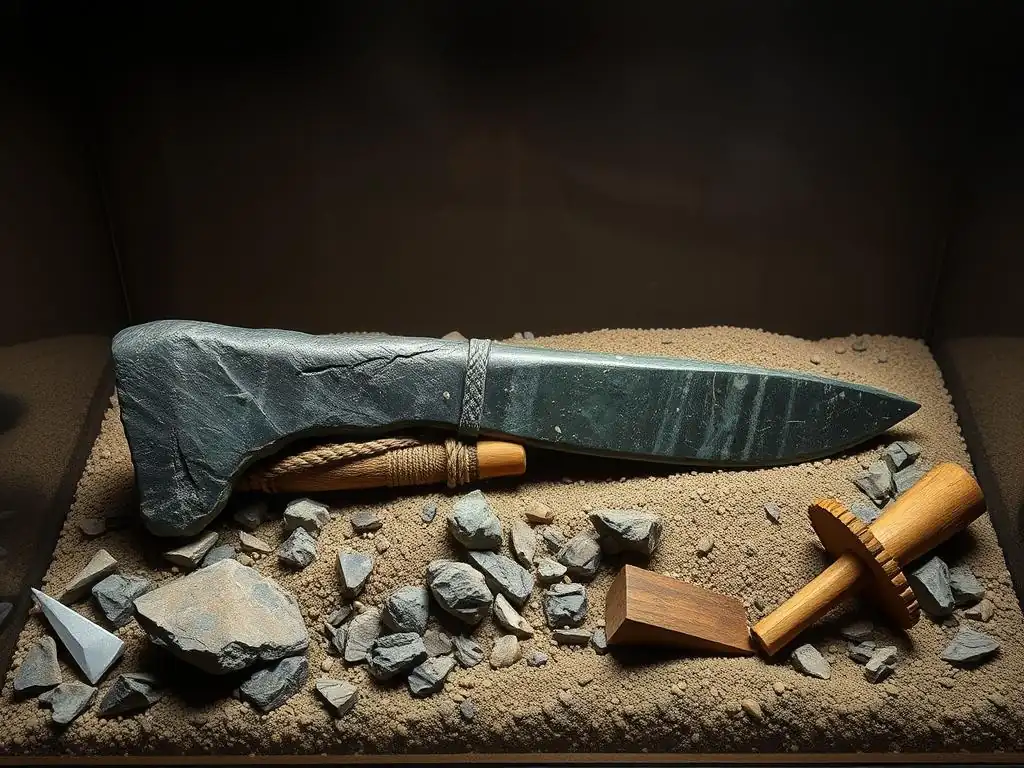
While both axes and adzes are ground stone tools designed for working wood, their morphological differences are crucial indicators of their distinct functions. The most defining feature of a Neolithic axe head is its symmetrical, often biconvex or lenticular cross-section, and a cutting edge that is parallel to the long axis of the tool (and thus, when hafted, parallel to the handle). This design provides a strong, wedge-like action suitable for splitting and felling.
In contrast, a Neolithic adze head typically exhibits an asymmetrical cross-section, often plano-convex or triangular. Its cutting edge is perpendicular to the long axis of the tool (and thus, perpendicular to the handle when hafted). This asymmetry and orientation are specifically engineered for a scooping or planing motion, allowing the user to remove thin layers of wood with precision. These subtle yet significant differences in morphology allowed Neolithic craftspeople to select the exact tool required for specific woodworking tasks, showcasing advanced Neolithic axes woodworking techniques.
Functional Differences: Chopping vs. Adzing Applications
The morphological distinctions between axes and adzes directly translate into their functional applications. Axes were primarily used for heavy-duty tasks involving forceful, percussive blows. Their main applications included felling trees, splitting large logs into smaller sections, and rough shaping of timber by cleaving away significant chunks of wood. An axe strike delivers force along the grain of the wood, making it efficient for breaking down large pieces.
Adzes, on the other hand, were precision tools used for more controlled and refined woodworking. Their perpendicular blade orientation allowed for a scraping or planing motion, making them ideal for hollowing out objects (like canoes or bowls), smoothing rough surfaces, and shaping curves. The adze removes wood across or at an angle to the grain, enabling fine control over the material. This division of labor between the robust chopping of axes and the precise shaping of adzes highlights the diverse and sophisticated Neolithic axes woodworking techniques employed by early societies.
Regional Variations in Axe and Adze Styles: Europe and the Near East
Neolithic axe and adze styles exhibited significant regional variations, influenced by local raw material availability, cultural traditions, and specific environmental needs. In Northern Europe, particularly Scandinavia and Britain, large, robust flint axes were common, often exquisitely polished and sometimes traded over long distances. The "Group VI" axes from Langdale in the Lake District, England, made from volcanic tuff, were widely distributed across Britain, indicating extensive trade networks.
In Central Europe, particularly among the Linearbandkeramik (LBK) culture, highly standardized shoe-last celts (a type of adze) made from various local stones were prevalent, reflecting their intensive use in timber construction. In the Near East, early Neolithic communities often utilized basalt and obsidian for their ground stone tools, reflecting the volcanic geology of the region. Furthermore, rare and beautiful jadeite axes from the Alpine regions of Europe were traded across vast distances, often appearing in contexts suggesting their value as prestige items rather than purely utilitarian tools, showcasing the diverse applications and cultural significance of Neolithic axes woodworking techniques.
Archaeological Discoveries and Analysis
Case Study: The Sweet Track and its Axe and Adze Assemblage
The Sweet Track, located in the Somerset Levels of England, is one of the oldest known engineered timber trackways in Northern Europe, dating to approximately 3800 BCE. Its construction involved laying thousands of split oak planks and pegs over a distance of nearly 2 kilometers across a boggy landscape. The sheer volume of timber required for this project provides compelling evidence of large-scale Neolithic woodworking capabilities and the efficiency of their tools.
Archaeological analysis of the preserved timbers from the Sweet Track has revealed distinct cut marks left by Neolithic axes and adzes. The felling of trees and the initial splitting of logs would have been accomplished with axes, leaving deep, powerful marks. Subsequent shaping of planks and pegs, including trimming and smoothing, show characteristic marks from adzes, indicating precision work. The discovery of numerous discarded or lost axe and adze heads along the trackway further underscores their integral role in this massive construction effort, offering direct insight into Neolithic axes woodworking techniques.
Microscopic Analysis of Neolithic Axe Heads: Revealing Woodworking Techniques
Microscopic analysis, specifically microwear analysis, has revolutionized our understanding of how Neolithic axes and adzes were used. By examining the microscopic polishes, striations, and damage patterns on the working edges of these stone tools, archaeologists can infer the type of material worked (e.g., wood, bone, hide) and the motion employed (e.g., chopping, scraping, planing). For instance, woodworking tools typically exhibit a characteristic "wood polish" – a smooth, bright luster that forms from repeated contact with wood fibers.
Studies on Neolithic axes from various sites have revealed distinct wear patterns consistent with felling trees and splitting logs. Adzes, conversely, show wear patterns indicative of shaping and smoothing timber surfaces, often with a distinctive "scooping" or "planing" polish. For example, analyses of adze blades from Swiss lake dwellings have shown consistent wear from prolonged contact with softwoods, confirming their use in carpentry. This detailed microscopic evidence provides invaluable, direct insights into the specific Neolithic axes woodworking techniques practiced by ancient artisans.
The Role of Experimental Archaeology in Understanding Neolithic Tool Use
Experimental archaeology plays a vital role in understanding the practical capabilities and limitations of Neolithic tools, including axes and adzes. By replicating ancient tools using authentic materials and methods, and then using them to perform tasks believed to have been carried out in the past, researchers can gain firsthand experience of their efficiency, the effort required, and the types of marks they leave.
For example, experimental felling of oak trees with replica polished Neolithic axes has demonstrated that a single individual can fell a substantial tree (e.g., 20-30 cm diameter) in under an hour, challenging earlier assumptions about the difficulty of such tasks.
Furthermore, experiments with replica adzes have provided insights into the time and skill required for hollowing out canoes or shaping timbers for construction. These experiments not only validate archaeological interpretations of tool function but also help identify characteristic use-wear patterns that can then be sought on excavated artifacts. The combination of archaeological excavation, microscopic analysis, and experimental replication provides a comprehensive understanding of Neolithic axes woodworking techniques and their profound impact on early human societies.
Legacy: Shaping Human Development
The Impact of Stone Tool Technology on Neolithic Societies
The development and widespread adoption of polished stone axe and adze technology had a transformative impact on Neolithic societies, acting as fundamental enablers of the agricultural revolution. These tools allowed for the systematic clearance of forests, creating arable land for crops and pasture for domesticated animals, which in turn supported larger and more settled populations. The ability to efficiently process timber also facilitated the construction of permanent dwellings, villages, and even early monumental structures, fundamentally altering human settlement patterns.
Beyond direct utility, the production and exchange of these tools fostered new social and economic complexities. Specialized quarrying sites and the extensive trade networks for high-quality stone indicate a sophisticated division of labor and inter-regional interaction. The tools were not just instruments of labor but also catalysts for the evolution of more complex social structures, contributing directly to the growth and stability of early agricultural communities.
Neolithic Axes and Adzes as Symbols of Power and Status
While primarily utilitarian, some Neolithic axes and adzes transcended their functional role to become significant symbols of power, wealth, and status. This is particularly evident with axes made from rare and exotic materials like jadeite, sourced from the Alps. These "prestige axes" were often exquisitely polished to a mirror-like finish, too fragile or impractical for everyday use, and frequently found in burials or hoards, suggesting their importance as grave goods or ceremonial items.
The immense effort involved in their production, coupled with the long-distance trade required to obtain the raw materials, made these objects incredibly valuable. Their possession likely conferred prestige upon individuals or groups, signifying access to distant resources, specialized knowledge, or high social standing. The dual nature of Neolithic axes and adzes – as both essential tools for survival and potent symbols of social hierarchy – underscores their multifaceted importance in ancient societies.
The Transition from Stone Axes to Bronze Axes: A Technological Shift
The advent of metallurgy marked a new technological frontier, initiating a gradual transition from stone axes to metal axes, first copper and then bronze. This shift began during the Chalcolithic (Copper Age) and became more widespread in the Bronze Age (starting around 3300 BCE in the Near East). Bronze axes offered several advantages over their stone predecessors: they could be cast into more complex shapes, maintained a sharper edge, were less brittle, and could be easily re-sharpened by hammering or grinding.
However, the transition was not immediate or universal. Stone axes continued to be produced and used alongside metal tools for centuries, particularly in regions where metal was scarce or expensive. The initial investment in metal technology was high, and the skills for stone tool production were deeply ingrained. Ultimately, the superior performance and recyclability of bronze tools led to their eventual dominance, but the enduring legacy of the Neolithic stone axe as a foundational technology remained undisputed, profoundly shaping human development for millennia.
Conclusion: The Enduring Importance
Summarizing the Significance in Deforestation, Woodworking, and Construction
Neolithic axes and adzes stand as monumental achievements in early human technology, serving as the indispensable tools that underpinned the transformative Neolithic Revolution. Their efficiency in deforestation enabled the conversion of vast woodlands into fertile agricultural lands, supporting the growth of sedentary communities.
In woodworking, these tools, through sophisticated Neolithic axes woodworking techniques, facilitated the construction of durable longhouses and the creation of a diverse array of essential wooden implements, from agricultural tools to dugout canoes. They were not merely instruments but catalysts for fundamental societal changes, enabling unprecedented control over the environment and the development of complex material cultures.
Future Research Directions
Despite extensive research, there remain fertile grounds for future exploration into Neolithic axes and adzes. Further high-resolution microwear analysis on more diverse assemblages can yield even more granular data on specific woodworking techniques and regional variations.
Advances in paleoenvironmental studies, combined with precise dating methods, can refine our understanding of the scale and pace of Neolithic deforestation and its long-term ecological impacts. Additionally, exploring the social and symbolic roles of these tools, particularly through isotopic analysis of raw materials and contextual studies of burial finds, can illuminate more about ancient trade networks, social hierarchies, and symbolic meanings attributed to these vital artifacts.
Frequently Asked Questions
How were Neolithic axes and adzes used in deforestation during the Neolithic period?
Neolithic axes and adzes, made from polished stone, were crucial for early deforestation efforts. They enabled communities to clear land for agriculture and settlements, despite being labor-intensive tools.
What were the primary materials used to create Neolithic axes and adzes?
The primary material was finely-grained stone, often basalt, flint, or jadeite. These stones were carefully ground and polished to create sharp, durable cutting edges, then hafted to wooden handles.
What woodworking techniques were enabled by Neolithic axes and adzes?
These tools facilitated a range of woodworking techniques, including felling trees, shaping timbers, and creating planks for housing. They were also used for crafting wooden tools and utensils.
How did the development of polished stone axes impact Neolithic society?
The development of polished stone axes led to significant societal changes. Increased woodworking efficiency improved house construction and tool production, allowing for larger settlements and more specialized labor.
Can archaeological finds demonstrate the specific woodworking techniques employed?
Yes, archaeological sites reveal tool marks on preserved wood, providing evidence of specific cutting and shaping techniques. Analysis of wear patterns on the axes themselves also informs about their use and maintenance.
Final Reflection: Shaping Civilizations, One Swing at a Time
The exploration of Neolithic axes and adzes reveals more than just ancient tools; it unveils the very foundations upon which early civilizations were built. The impact of these seemingly simple implements on deforestation, woodworking, and construction is undeniable, shaping landscapes and enabling the creation of structures that defined early human settlements. Understanding these Neolithic axes woodworking techniques provides a tangible connection to our ancestors and their ingenuity in harnessing the power of stone.
The legacy of these tools extends far beyond the archaeological record. They represent a pivotal moment in human history, a shift towards a more sedentary and technologically advanced lifestyle. The ability to manipulate wood with precision, facilitated by these early axes and adzes, fundamentally altered the cultural and social landscape, allowing for the creation of homes, boats, and countless other essential items. The axe was the instrument of man's first conquest, the tool by which he subdued the forest and made the earth his own.
- Henry David Thoreau, reflecting on the enduring power of this fundamental tool.
As we reflect on the ingenuity of our Neolithic ancestors, let us consider the enduring power of innovation and the profound impact that even the simplest tools can have on shaping our world. Take a moment to appreciate the legacy of these early woodworking techniques and consider how you, too, can contribute to a more sustainable and innovative future, building upon the foundations laid by those who came before us.
Unearth Your Inner Archaeologist: Start Digging Now!
Thanks for exploring the fascinating world of Neolithic axes and adzes with us! We hope you've gained a deeper appreciation for the ingenuity of our ancestors and their groundbreaking woodworking techniques. Ready to take your exploration further?
Here's how:
- Go beyond the article and start a personal research! Visit your local museum or archaeological society. Examine real Neolithic tools or replicas firsthand to truly grasp their craftsmanship and scale.
- Share this knowledge with your community! Host a small presentation for your friends or family about Neolithic technology and its impact.
- Consider experimenting with replica tool making. Can you fashion a simple adze using stone and wood? Document your process and share your findings online!
What specific aspect of Neolithic tool technology intrigues you the most, and how might it still influence modern tool design?