
Comparative Study of Late Bronze Age Shield Types: Herzsprung vs. Nordic Designs


Welcome to ArchaeologyHub.org!
Delve into the fascinating world of ancient civilizations and uncover the secrets hidden beneath the sands of time. Are you ready to explore the intricate artistry and tactical ingenuity of ancient warfare? This journey begins with a comparative study of Late Bronze Age shield designs, specifically the iconic Herzsprung and Nordic styles. Discover the unique characteristics, construction techniques, and cultural significance of these protective artifacts – and perhaps even unlock a new understanding of the era's conflicts and technological advancements. Intrigued? Read on to unravel the story these shields tell...
- Comparative Study of Late Bronze Age Shield Types: Central European vs. Scandinavian Designs
- Introduction: Exploring Late Bronze Age Shield Designs in Europe
- Understanding Central European Shields: Characteristics and Context
- Exploring Scandinavian Bronze Age Shields: Form and Function
- Comparative Analysis: Central European vs. Scandinavian Shield Designs
- Functionality and Purpose: A Comparative Perspective
- Regional Variations and Cultural Influences on Shield Design
- The Legacy of Late Bronze Age Shields: Implications for Later Periods
- Conclusion: Summarizing the Distinctive Features of Central European and Scandinavian Shield Designs
-
Frequently Asked Questions
- How did Late Bronze Age shield designs vary between the Herzsprung and Nordic regions?
- What were the primary materials used in the construction of Late Bronze Age shields?
- What purpose did the umbo serve in Late Bronze Age Herzsprung shields?
- What can shield designs tell us about the cultural and technological differences between regions during the Late Bronze Age?
- How do archaeologists determine the age and origin of Late Bronze Age shields?
- Final Reflection: Echoes of Bronze, Lessons for Today
- Unearth Your Inner Warrior: Explore Bronze Age Defenses!
Introduction: Exploring Late Bronze Age Shield Designs in Europe
The Significance of Shield Technology in the Late Bronze Age
Shields in the Late Bronze Age were far more than simple defensive implements; they embodied a nexus of technological prowess, social status, and symbolic meaning. As organized warfare became increasingly prevalent, evidenced by large-scale settlements and the development of specialized weaponry, the need for effective protective gear grew.
The construction of these Late Bronze Age shield designs demonstrates sophisticated metallurgical skills, reflecting a period of significant innovation in bronze casting and sheet metal working. Their presence in archaeological contexts, often alongside other high-value artifacts, underscores their importance not only in hypothetical combat scenarios but also as markers of prestige and authority within ancient European societies.
The study of shield technology offers a unique lens into the Late Bronze Age world, revealing insights into military strategies, resource allocation, and the socio-economic structures that supported such specialized craftsmanship. The materials, construction techniques, and decorative motifs employed on these shields provide a rich tapestry of information, allowing researchers to reconstruct aspects of daily life, ritual practices, and inter-regional connections. Understanding the evolution and regional variations of Late Bronze Age shield designs helps to paint a more complete picture of a dynamic era characterized by increasing complexity in social organization and technological advancement.
This article embarks on a detailed comparative analysis of two prominent traditions of Late Bronze Age shield designs: those found in Central Europe, exemplified by the Herzsprung type, and those originating from the Nordic Bronze Age culture of Scandinavia. While both regions produced bronze shields during this period (roughly 1600-800 BCE), their forms, decorative styles, and archaeological contexts reveal fascinating divergences and convergences. By examining these distinct traditions, we aim to highlight the unique cultural expressions and technological adaptations that developed in different parts of Europe, despite shared underlying metallurgical knowledge.
The objective is to meticulously dissect the characteristics of Central European and Scandinavian Late Bronze Age shield designs, including their origins, construction methods, materials, ornamentation, and archaeological discovery patterns. Through this focused comparison, we seek to identify not only the key differences in their physical attributes but also to explore the potential implications for their function, whether practical in combat or primarily symbolic in ritual. This approach will illuminate the rich diversity within Late Bronze Age material culture and deepen our understanding of the complex interplay between technology, art, and society in these ancient European civilizations.
Understanding Central European Shields: Characteristics and Context
Origin and Distribution of Central European Shields
The Central European shield tradition, most famously represented by the Herzsprung type, is characterized by its distinctive circular form, a central boss, and a series of concentric ribs. These Late Bronze Age shield designs are believed to have originated in the Alpine region or northern Germany, with their earliest forms possibly appearing around 1300-1200 BCE.
Their distribution, however, was remarkably widespread, extending across a vast geographical area. Examples and fragments have been discovered from southern Germany and Austria, through Bohemia (modern-day Czech Republic) and Poland, and even reaching as far west as parts of France and the British Isles, suggesting extensive trade networks or the dissemination of specific crafting knowledge.
Notable examples include the eponymous Herzsprung shield from Brandenburg, Germany, discovered in 1844, and fragments from sites like Plzeň-Jíkalce in Bohemia. While complete Herzsprung-type shields are relatively rare, their characteristic design is also reflected in smaller bronze models and rock carvings, indicating their significant cultural presence. This broad distribution underscores the interconnectedness of Late Bronze Age communities and the widespread adoption of certain prestigious artifact types, making these Late Bronze Age shield designs an important marker of cultural interaction across Central Europe.
Construction and Materials of Central European Shields
Central European shields, particularly the Herzsprung type, were primarily constructed from thin sheets of hammered bronze. The typical thickness of the bronze metal rarely exceeds 1.0 millimeter, and in many cases, it is closer to 0.5-0.8 millimeters. To compensate for this inherent fragility and to provide structural rigidity, artisans employed a sophisticated technique known as repoussé.
This involved hammering the bronze sheet from the reverse side to create the prominent central boss and the characteristic concentric ribs or ridges on the front. These raised elements not only served as decorative features but also significantly stiffened the otherwise pliable metal, enhancing its structural integrity.
While the bronze itself was the primary material that survives archaeologically, it is widely believed that these shields incorporated organic backings, such as wood or multiple layers of hardened leather, to provide additional support and shock absorption. These organic components, however, have almost entirely perished over millennia due to decomposition, leaving only the bronze shell.
The bronze alloy used was typically a mix of copper and tin, with tin content varying but generally falling within the range of 8-12%, indicative of a mature bronze metallurgy. The complex manufacturing process, involving annealing (heating and cooling the metal to make it more workable) and cold-working (shaping the metal at room temperature), demonstrates the high level of metallurgical skill achieved by Central European artisans in crafting these intricate Late Bronze Age shield designs.
Decorative Motifs and Symbolism on Central European Shields
The decorative motifs on Central European shields are typically geometric and repetitive, characterized by the prominent central boss and a series of concentric circles or ribs that radiate outwards. These patterns are achieved through the same repoussé technique used for structural reinforcement. Some shields also feature small, carefully placed perforations along the rim or between the concentric rings, which may have been purely aesthetic or served to attach additional elements, though their precise function remains debated. The overall aesthetic is one of striking simplicity and powerful symmetry, emphasizing the circular form.
While direct written records from the Late Bronze Age are absent, the symbolism embedded in these Late Bronze Age shield designs is widely interpreted through the lens of prevalent cosmological beliefs. The concentric circles and the central boss strongly evoke solar symbolism, a pervasive theme in Late Bronze Age European iconography. The sun was a vital deity or force, associated with life, warmth, growth, and the cyclical nature of time.
Thus, these shields might have been more than mere protective gear; they could have been potent cultic objects, imbued with divine protection or representing a connection to celestial powers. Their visual impact would have been considerable, suggesting a dual role as both a physical and spiritual barrier, reflecting the owner's status and perhaps their alignment with cosmic forces.
Archaeological Context: Where Central European Shields Were Found
The archaeological context of Central European shields provides crucial insights into their function and significance beyond hypothetical combat. A striking majority of these Late Bronze Age shield designs, particularly complete or well-preserved examples, are not found in battlefields or graves, but rather in hoards or watery contexts such as bogs, rivers, and lakes. For instance, the Herzsprung shield itself was part of a large hoard containing other bronze artifacts, deposited in a bog. Similarly, fragments and complete shields from areas like Plzeň-Jíkalce were also part of ritual hoards.
This pattern of deposition strongly suggests that these shields served a primary role as votive offerings or ritual items, rather than being everyday military equipment lost in conflict. The deliberate placement of valuable bronze objects in seemingly inaccessible or sacred locations indicates a profound ritualistic purpose, perhaps as offerings to deities, part of initiation rites, or as expressions of community wealth and devotion.
While they may have seen some use in ceremonial processions or displays of status, their ultimate destination points to a symbolic function that transcended their potential utility in warfare, making their study vital for understanding Late Bronze Age religious practices and societal values.
Scandinavian Bronze Age shields exhibit a distinct regional character, primarily concentrated in Denmark, southern Sweden, and northern Germany, areas encompassed by the Nordic Bronze Age culture. These Late Bronze Age shield designs typically date from Montelius Period IV to V, roughly spanning from 1100 BCE to 700 BCE, indicating a period of significant cultural flourishing towards the latter part of the Bronze Age. While sharing the general characteristic of being made of bronze and often circular, their aesthetic and structural nuances set them apart from their Central European counterparts.
Key examples include the magnificent Fröslunda shield from Västergötland, Sweden, discovered in a lake in 1959, and numerous fragments and smaller shield-like objects found in bog deposits across the region. The Nebra shields from Germany, while geographically peripheral to Scandinavia, share stylistic affinities and ritual deposition patterns with Nordic types, often being grouped with them for comparative purposes. The localized distribution, combined with a relatively concentrated timeline, suggests a strong regional tradition in the production of these distinctive Late Bronze Age shield designs, reflecting unique cultural preferences and artistic developments within the Nordic sphere.
Like their Central European counterparts, Scandinavian shields were predominantly crafted from bronze sheet metal. However, the craftsmanship often reaches a remarkable level of artistic sophistication, particularly evident in the intricate repoussé work. The bronze, an alloy of copper and tin, was carefully hammered and shaped, often thinner than 1.0 millimeter, yet capable of holding complex, raised patterns. The process would have involved repeated cycles of annealing to soften the metal, followed by meticulous cold-working to define the elaborate designs.
What distinguishes Scandinavian craftsmanship in these Late Bronze Age shield designs is the sheer complexity and density of the ornamentation. Artisans meticulously hammered spirals, concentric circles, and even stylized figures onto the thin bronze, creating a visually dynamic surface. This suggests a highly specialized metalworking tradition, possibly involving dedicated workshops and master craftsmen who possessed an exceptional understanding of bronze's malleability and aesthetic potential. The investment of such skill and labor underscores the significant cultural and symbolic value placed upon these shields, elevating them beyond mere functional objects to true works of art.
The design elements of Scandinavian Bronze Age shields are notably more curvilinear and often more densely ornamented than the geometric simplicity of Herzsprung types. While a central boss and concentric ridges are common features, these are frequently integrated into a larger, more fluid design scheme. Spiral motifs are particularly prevalent, often radiating outwards from the boss or forming intricate patterns across the shield's surface. These spirals, characteristic of Nordic Bronze Age art, create a sense of movement and energy, contrasting with the static symmetry of Central European designs.
Furthermore, some Scandinavian shields incorporate more complex iconography, occasionally featuring stylized animal heads, bird motifs, or even anthropomorphic figures, subtly integrated into the overall ornamentation. For instance, the Fröslunda shield showcases a sophisticated arrangement of concentric rings and radiating lines that evoke a cosmic or solar symbolism, yet with a distinct Nordic artistic vocabulary. These elaborate Late Bronze Age shield designs suggest a rich mythological or religious narrative embedded within their visual language, indicating that their ornamentation served not just aesthetic purposes but also conveyed profound cultural meanings unique to the Scandinavian worldview.
Evidence strongly suggests that Scandinavian Bronze Age shields were primarily used in ritual contexts rather than as everyday combat equipment. A significant number of these Late Bronze Age shield designs have been recovered from wetland environments, such as bogs, lakes, and rivers, echoing the deposition patterns seen in Central Europe. The Fröslunda shield, for example, was found submerged in a lake, a clear indication of intentional, ritualistic deposition. These watery offerings often included other valuable bronze artifacts, implying complex ceremonies or sacrifices.
While their thin bronze construction (often less than 1mm thick) would offer limited protection against a direct, forceful blow from a sword or spear, their presence in warrior burials or alongside other weapons suggests a symbolic connection to martial prowess and elite status. It is plausible that they were used in ceremonial parades, displays of wealth, or as part of funerary rites, symbolizing the deceased's social standing or connection to a warrior elite.
However, their consistent recovery from votive contexts indicates that their primary function transcended mere battlefield utility, emphasizing their role as powerful prestige objects and offerings within the religious and social fabric of the Nordic Bronze Age.
Similarities in Late Bronze Age Shield Designs
Despite their distinct regional characteristics, Central European and Scandinavian Late Bronze Age shield designs share several fundamental similarities, reflecting common technological foundations and possibly shared cultural values across broader Europe. Both traditions primarily utilized bronze as their material, demonstrating a widespread mastery of bronze metallurgy.
The circular form is a dominant feature in both regions, often accompanied by a central boss, which served as a focal point and likely provided a grip for the user. Furthermore, both types employed the repoussé technique to create raised patterns and reinforce the relatively thin metal sheets, indicating a shared understanding of how to add rigidity and aesthetic appeal to bronze artifacts.
Perhaps most strikingly, both Central European and Scandinavian shields are overwhelmingly found in non-settlement, non-burial contexts, particularly in hoards or watery depositions like bogs, lakes, and rivers. This pervasive pattern of ritual deposition suggests a common underlying belief system regarding the sacredness of such objects and the practice of making votive offerings. This shared ritualistic significance, rather than practical combat use, appears to be a defining characteristic of many Late Bronze Age shield designs across diverse European cultures, highlighting a broad cultural continuum in the symbolic treatment of prestige items.
Key Differences in Form and Construction
While sharing core characteristics, the Central European and Scandinavian Late Bronze Age shield designs exhibit notable differences in their form and construction. Central European Herzsprung-type shields tend to be simpler and more robust in their geometry. They typically feature a prominent central boss and a limited number of widely spaced, well-defined concentric ribs that provide structural integrity. The overall impression is one of stark, functional elegance, with an emphasis on clear, strong lines. Their construction often appears to prioritize structural reinforcement through these pronounced ridges.
In contrast, Scandinavian shields, while also featuring a central boss and concentric elements, often incorporate a much more intricate and curvilinear design. The patterns are frequently denser, with spirals, undulating lines, and sometimes even stylized animal or anthropomorphic figures integrated into the overall composition. The repoussé work on Scandinavian shields often creates a more textured and visually complex surface, suggesting a greater emphasis on artistic expression over sheer structural simplicity. This difference in design philosophy indicates varying aesthetic preferences and potentially distinct functional priorities or symbolic meanings within their respective cultural contexts.
Variations in Decorative Style and Symbolism
The decorative styles of Central European and Scandinavian Late Bronze Age shield designs represent two distinct artistic approaches within the broader European context. Central European shields, particularly the Herzsprung type, are characterized by their geometric precision. The concentric circles and radiating lines strongly evoke solar symbolism, a powerful and ubiquitous motif across Late Bronze Age Europe. Their symbolism is direct and potent, likely conveying ideas of divine protection, cosmic order, or a connection to the sun deity, which was central to many prehistoric belief systems.
Scandinavian shields, on the other hand, showcase a more elaborate and dynamic ornamentation. Their designs frequently incorporate spirals, meanders, and sometimes even stylized depictions of animals or human figures, often integrated into complex, flowing patterns. This curvilinear style, characteristic of Nordic Bronze Age art, suggests a richer and potentially more narrative-driven iconography.
While solar symbolism is also present, it is often interwoven with other mythological elements, hinting at a more complex cosmology or a greater emphasis on storytelling through art. These differences in decorative style highlight how diverse cultural narratives and aesthetic preferences were expressed through the highly visible medium of Late Bronze Age shield designs.
Comparative Analysis of Materials and Manufacturing Techniques
While both Central European and Scandinavian Late Bronze Age shield designs relied on bronze as their primary material, subtle variations in manufacturing techniques and perhaps even alloy compositions might have existed. Both traditions demonstrated a high degree of metallurgical skill in hammering thin bronze sheets and employing repoussé to create rigid, decorated surfaces. However, the execution of the repoussé work often differed. Central European artisans focused on creating strong, pronounced ribs for structural reinforcement, suggesting a technique that prioritized durability for the form.
Scandinavian craftsmanship, particularly in the later phases of the Nordic Bronze Age, appears to have pushed the boundaries of the repoussé technique to achieve greater artistic detail and complexity. The intricate spiral patterns and fine curvilinear designs required exceptional control and precision in hammering the thin metal, suggesting a highly refined technique developed to maximize aesthetic impact.
While the exact alloy compositions might have varied regionally based on local copper and tin sources, the distinct artistic outcomes reflect different priorities in the application of shared metallurgical knowledge, with Scandinavian artisans often investing more heavily in the artistic elaboration of their Late Bronze Age shield designs.
Functionality and Purpose: A Comparative Perspective
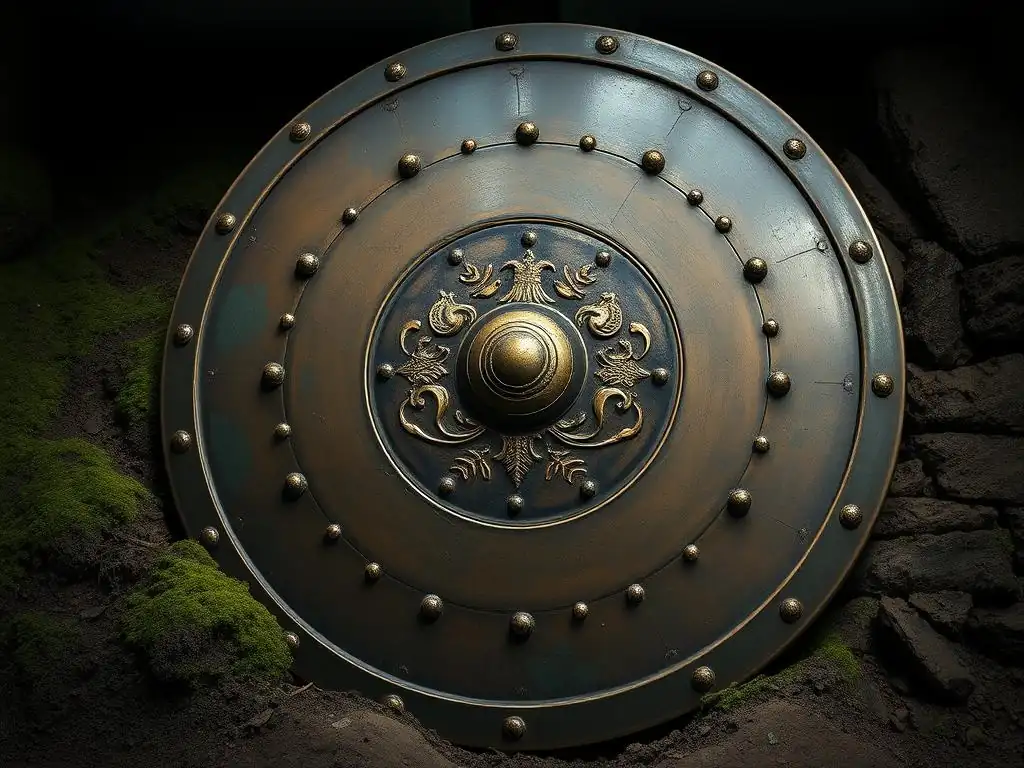
Effectiveness in Combat: A Hypothetical Assessment
When assessing the effectiveness of Central European and Scandinavian Late Bronze Age shield designs in actual combat, a hypothetical evaluation suggests that both types were likely more symbolic or ceremonial than primarily defensive weapons against heavy blows. The thinness of the bronze sheet, typically ranging from 0.5 to 1.0 millimeter, would offer limited protection against a forceful thrust from a bronze sword or spear. While the repoussé work added rigidity, a direct impact could still easily deform or puncture the metal, especially without a substantial organic backing (wood or thick leather), which rarely survives archaeologically.
It is plausible that these shields could have been used for deflecting lighter blows, for parrying, or as a psychological deterrent on a battlefield. However, their delicate construction points towards a role in ritualized combat, displays of martial prowess, or as part of a warrior's ceremonial regalia rather than sustained, heavy-duty engagement. Their primary "effectiveness" might have resided in their visual impact and the social status they conveyed, signaling the owner's wealth and power rather than providing robust physical protection against the full force of Late Bronze Age weaponry.
Both Central European and Scandinavian Late Bronze Age shield designs unequivocally served as objects of immense ritual significance and markers of high social status. The consistent discovery of these shields in hoards, bogs, and other watery contexts across both regions strongly indicates their use in votive offerings or ceremonial depositions. This shared practice underscores a pan-European tradition of ritually depositing valuable artifacts, perhaps to honor deities, ensure prosperity, or commemorate significant events. The bronze itself, a valuable commodity, coupled with the skilled labor required for their creation, made these shields inherently prestigious items.
Beyond their use as offerings, these shields likely played a crucial role in social display. They would have been impressive visual statements, possibly carried in processions, used in ritual performances, or displayed during gatherings to signify the owner's wealth, power, and connection to a warrior elite.
In some cases, their presence in elite burials, even if rare for complete shields, further reinforces their association with high-ranking individuals. Thus, while their form and ornamentation differed, the fundamental symbolic role of these Late Bronze Age shield designs as powerful expressions of status and as conduits for ritual practices remained remarkably consistent across Central Europe and Scandinavia.
The Role of Shields in Late Bronze Age Warfare and Society
While the practical combat utility of these thin bronze shields may have been limited, their existence highlights the complex interplay between warfare, ritual, and social structure in Late Bronze Age Europe. The very presence of such elaborate and resource-intensive defensive artifacts suggests that warfare, or at least the threat of it, was a significant aspect of societal life. These shields, even if primarily ceremonial, represent a substantial investment of community resources—from the mining and trading of copper and tin to the highly specialized labor of skilled bronze smiths.
In a broader societal context, these Late Bronze Age shield designs served as powerful cultural artifacts that communicated more than just defensive capabilities. They were symbols of identity, possibly tribal or lineage affiliation, and certainly indicators of social hierarchy. Their intricate designs and precious material would have conveyed messages of power, prestige, and religious piety.
They were not merely tools of war but integral components of a social system where displays of wealth, martial prowess, and ritual participation were crucial for maintaining status and cohesion. Thus, their study offers a window into the nuanced ways in which technology, art, and belief systems converged in Late Bronze Age societies.
Regional Variations and Cultural Influences on Shield Design
The Impact of Trade and Exchange on Shield Technology
The widespread distribution of certain Late Bronze Age shield designs, particularly the Herzsprung type across Central Europe, strongly suggests the impact of extensive trade and exchange networks. These networks facilitated not only the movement of raw materials, such as copper and tin, but also the dissemination of metallurgical knowledge, design templates, and finished goods. The consistent form of Herzsprung shields over a vast area implies either a highly effective trade system for their distribution or, more likely, the spread of specific manufacturing techniques and artistic conventions that were then adopted by local workshops.
Conversely, the more concentrated distribution of distinct Scandinavian shield types, while still benefiting from broader trade in raw materials, indicates a strong regional artistic identity. While general ideas about bronze shield construction may have diffused, the specific stylistic choices in Nordic Late Bronze Age shield designs suggest a deliberate cultural preference that resisted complete homogenization. This interplay between widespread influence and local adaptation is a hallmark of the Late Bronze Age, where communities were interconnected yet maintained their unique cultural expressions.
Local Adaptations and Regional Styles in Shield Production
Despite the underlying similarities in material and basic form, both Central Europe and Scandinavia developed unique local adaptations and regional styles in their Late Bronze Age shield designs. In Central Europe, the Herzsprung type maintained a relatively consistent and robust geometric aesthetic, characterized by its prominent, widely spaced concentric ribs. This uniformity across a large geographical area suggests a successful and widely replicated design that perhaps prioritized a clear, powerful visual statement and a perception of strength.
In contrast, Scandinavian artisans, drawing from their rich indigenous artistic traditions, developed more ornate and visually complex shield designs. The prevalence of intricate spirals, curvilinear patterns, and sometimes integrated figural representations showcases a distinct regional style that emphasized artistic elaboration. This divergence indicates that while the concept of a bronze shield was shared, local cultural preferences and artistic vocabularies led to significant variations in how these objects were conceived and decorated, reflecting distinct regional identities and perhaps different ritualistic or social functions for their Late Bronze Age shield designs.
Cultural Significance of Shield Depictions in Late Bronze Age Art
Beyond the archaeological finds of actual shields, their cultural significance is further illuminated by their depictions in Late Bronze Age art, particularly in rock carvings (petroglyphs) and on smaller bronze artifacts. In Scandinavia, for example, numerous rock carvings from sites like Tanum in Sweden depict figures, often warriors or deities, carrying shields. These artistic representations provide invaluable context, showing shields as integral elements in scenes of processions, cultic acts, or even hypothetical combat scenarios. The way shields are depicted—sometimes alongside chariots, ships, or solar symbols—reinforces their multifaceted role in the visual culture of the time.
These artistic renderings offer insights into how Late Bronze Age shield designs were perceived and integrated into the broader symbolic landscape. They suggest that shields were not merely physical objects but also powerful symbols within the collective consciousness, representing protection, status, martial prowess, and perhaps even cosmic power. The study of these depictions complements the archaeological record, providing a richer understanding of the cultural narratives and beliefs associated with shields in Late Bronze Age European societies.
The Legacy of Late Bronze Age Shields: Implications for Later Periods
The Evolution of Shield Designs in Subsequent Eras
The Late Bronze Age shield designs, particularly those made of thin bronze, represent a specific technological and symbolic stage in the evolution of defensive equipment. With the advent of the Iron Age (roughly 800-700 BCE onwards), there was a significant shift in shield technology. Iron, being more abundant and capable of producing stronger, more robust forms, gradually replaced bronze as the primary material for shields intended for practical combat. Iron Age shields, such as those used by Celtic warriors, were often larger, heavier, and designed for direct protection against more powerful weaponry.
While the material and construction changed drastically, the Late Bronze Age bronze shields laid the groundwork for the enduring symbolic importance of shields. The concept of a shield as a marker of status, identity, and protection persisted. The transition from ceremonial bronze shields to more functional iron ones reflects an adaptive response to evolving warfare tactics and material availability, yet the fundamental role of the shield as a powerful symbol in European culture continued to evolve and manifest in new forms.
The Enduring Symbolism of Shields in European Culture
The symbolic power of shields, so vividly expressed in the Late Bronze Age shield designs, has resonated throughout European history, transcending material and technological changes. From the intricate bronze creations of prehistory to the robust wooden and iron shields of the Iron Age, and later to the elaborate heraldic shields of medieval knights, the shield has consistently served as a potent emblem. It embodies concepts of defense, strength, honor, and identity, becoming a foundational element in visual language and cultural narratives.
Even in modern times, the enduring symbolism of shields persists. They are seen in national emblems, military insignia, and corporate logos, continuing to represent protection, heritage, and unity. The study of these ancient Late Bronze Age shield designs therefore offers more than just an archaeological understanding of prehistoric artifacts; it provides fundamental insights into the deep-seated cultural archetypes and symbolic meanings that have shaped European societies for millennia. Their legacy lies not just in their physical form, but in the timeless concepts they represent.
Synthesis: Key Findings of the Comparative Study
This comparative study has revealed that while Central European (Herzsprung-type) and Scandinavian Late Bronze Age shield designs share fundamental characteristics—being circular, bronze, and often found in ritual contexts—they exhibit distinct regional identities. Both traditions mastered sophisticated bronze metallurgy, employing repoussé techniques to create rigidity and decorative appeal. A striking commonality is their predominant role as prestige objects and votive offerings, rather than primary battlefield weapons, evidenced by their consistent discovery in hoards and watery depositions. This shared ritualistic function underscores a broad cultural pattern across Late Bronze Age Europe.
However, the key differences lie in their aesthetic and construction nuances. Central European shields tend towards a geometric simplicity, characterized by prominent concentric ribs and a powerful, direct solar symbolism. Scandinavian shields, conversely, display a more intricate, curvilinear ornamentation, often incorporating spirals and more complex iconography, reflecting a richer artistic tradition and potentially more narrative-driven symbolism. These variations highlight how distinct cultural preferences and regional artistic vocabularies shaped the final appearance of these magnificent Late Bronze Age shield designs, even within a shared technological framework.
The Importance of Shield Analysis in Understanding Late Bronze Age Culture
The detailed analysis of Late Bronze Age shield designs extends far beyond mere typological classification; it provides an invaluable window into the complex and dynamic societies of prehistoric Europe. These artifacts are tangible evidence of advanced metallurgical capabilities, intricate trade networks that facilitated the movement of raw materials and ideas, and sophisticated social hierarchies that could command the resources and skilled labor required for their production. Their study offers crucial insights into the evolving nature of warfare, even if their primary role was symbolic rather than practical.
Furthermore, the consistent ritual deposition of these shields illuminates the profound religious beliefs and ceremonial practices prevalent during the Late Bronze Age. They serve as direct links to the spiritual world of these ancient peoples, revealing their cosmological views, their veneration of deities, and their ways of interacting with the sacred. Thus, the comprehensive study of Late Bronze Age shield designs is indispensable for reconstructing the multifaceted cultural landscape of this pivotal period, offering a holistic understanding of technology, art, society, and belief systems in ancient Europe.
Frequently Asked Questions
How did Late Bronze Age shield designs vary between the Herzsprung and Nordic regions?
Herzsprung shields, found primarily in Central Europe, were typically made of bronze and were characterized by a central umbo and concentric ribs. Nordic shields, on the other hand, were often constructed from organic materials like wood and leather, and featured simpler designs.
What were the primary materials used in the construction of Late Bronze Age shields?
The materials depended on the region. While bronze was more common in Central Europe (Herzsprung shields), shields found in the Nordic regions often utilized wood, leather, and other organic substances due to resource availability.
What purpose did the umbo serve in Late Bronze Age Herzsprung shields?
The umbo, or central boss, provided structural reinforcement to the shield and helped to deflect blows. It also offered some protection for the hand holding the shield.
What can shield designs tell us about the cultural and technological differences between regions during the Late Bronze Age?
Shield designs reflect the available resources, technological capabilities, and warfare styles of different cultures. They provide insights into trade networks and the spread of ideas across regions.
How do archaeologists determine the age and origin of Late Bronze Age shields?
Archaeologists use methods like radiocarbon dating of organic materials and typological analysis of the shield's form and decoration to determine its age. Contextual analysis within archaeological sites helps to establish its origin and cultural association.
Final Reflection: Echoes of Bronze, Lessons for Today
The exploration of Late Bronze Age shield designs, specifically the Herzsprung and Nordic types, might seem relegated to the annals of archaeological history. However, understanding these ancient defenses reveals enduring principles of design, adaptation, and cultural exchange that resonate profoundly in our modern world. The ingenuity displayed in crafting these shields, born from limited resources and a pressing need for protection, offers valuable insights into problem-solving and innovation that remain relevant in fields ranging from engineering to strategic planning.
This journey into the past underscores how deeply intertwined our present is with the ingenuity of our ancestors. The careful consideration given to material selection, construction techniques, and decorative motifs speaks volumes about the values and beliefs of these Bronze Age societies. The past is never dead. It's not even past.
- William Faulkner. This quote perfectly encapsulates the enduring influence of these ancient artifacts, reminding us that the lessons learned from the past continue to shape our understanding of human creativity and resilience.
As we conclude this comparative study, let us not simply admire these Late Bronze Age shield designs as relics of a bygone era. Instead, let us embrace the spirit of innovation and resourcefulness that fueled their creation. Consider how the principles of adaptation and cultural exchange, evident in the evolution of these shield types, can inform your own approach to challenges and opportunities. Reflect on the enduring power of human ingenuity and strive to create your own legacy of innovation, inspired by the echoes of bronze.
Unearth Your Inner Warrior: Explore Bronze Age Defenses!
Thank you for delving into the fascinating world of Late Bronze Age shields! We hope this comparative study of Herzsprung and Nordic designs has armed you with new insights into ancient warfare and craftsmanship. Ready to take your archaeological journey further?
Here are a few ways to continue exploring these ancient defenses:
- Recreate history: Try sketching your own interpretation of a hybrid shield, combining elements of both Herzsprung and Nordic designs. Consider how these design choices might influence its effectiveness in battle.
- Dive Deeper: Research specific archaeological sites where these shields were discovered. Understanding the geographical context can provide more in-depth details on cultural connections and warfare in the bronze age.
- Share Your Discoveries: Discuss the most surprising difference between Herzsprung and Nordic shields with fellow history enthusiasts online.
What design element, if incorporated into modern riot shields, do you think would be the most effective and why?