
Religious Beliefs of the Indus People: Interpreting Iconography and Ritual Practices

Welcome to ArchaeologyHub.org, your gateway to unlocking the secrets of the past. Ever wondered what the elaborate symbols of the Indus Valley Civilization really meant? Dive into our detailed exploration of Indus Valley religious iconography and embark on a journey to decipher the beliefs and rituals of this enigmatic culture. Prepare to uncover the hidden meanings behind the artifacts and imagery that offer a tantalizing glimpse into their spiritual world.
- Introduction: Unveiling the Religious Landscape of the Indus Valley Civilization
- Deciphering Indus Valley Religious Iconography: A Multifaceted Approach
- Prominent Deities and Supernatural Figures in Indus Valley Art
- Ritual Practices in the Indus Valley Civilization: Evidence from Archaeological Excavations
- The Role of Seals and Tablets in Indus Valley Religious Practices
- Comparing Indus Valley Religious Beliefs with Contemporary Cultures
- The Decline of the Indus Valley Civilization and its Impact on Religious Practices
- Conclusion: A Glimpse into the Spiritual World of the Indus People
-
Frequently Asked Questions
- How reliable is the interpretation of Indus Valley religious iconography, given the undeciphered script?
- What are some prominent examples of potential religious iconography found at Indus Valley sites?
- How do excavation techniques contribute to understanding Indus Valley religious beliefs?
- What role did geographic regions play in shaping religious practices within the Indus Valley civilization?
- How does the chronology of the Indus Valley civilization inform our understanding of its religious evolution?
- Final Reflection: Unearthing Echoes of the Indus
- Unearth Your Understanding: Explore Indus Valley Mysteries!
Introduction: Unveiling the Religious Landscape of the Indus Valley Civilization
The Indus Valley Civilization, flourishing from around 2500 to 1900 BCE, remains one of the most enigmatic ancient societies, largely due to its undeciphered script. While monumental architecture and intricate urban planning speak volumes about their societal organization, understanding the spiritual world of the Indus people relies heavily on interpreting archaeological findings. Unlike civilizations such as ancient Egypt or Mesopotamia, which left behind extensive religious texts and grand temples, the Indus Valley provides no direct written accounts of its deities, myths, or rituals.
Consequently, scholars must piece together the religious landscape through a meticulous examination of material culture, particularly the rich array of Indus Valley religious iconography found on seals, figurines, pottery, and the layout of their cities. This article delves into the fascinating world of Indus spirituality, exploring the challenges of interpretation, identifying key symbolic elements, and examining the evidence for ritual practices that shaped the daily lives and worldview of this remarkable civilization.
Deciphering Indus Valley Religious Iconography: A Multifaceted Approach
Challenges in Interpreting Indus Religious Symbols
The primary hurdle in comprehending Indus religious symbols is the undeciphered nature of the Indus script. Without the ability to read the accompanying inscriptions on seals and other artifacts, interpretations of Indus Valley religious iconography are largely conjectural, based on comparative archaeology, contextual analysis, and sometimes controversial analogies with later Indian religious traditions. The absence of monumental religious structures, such as dedicated temples or large cultic sites akin to Mesopotamian ziggurats or Egyptian temples, further complicates understanding, suggesting that religious practices might have been integrated into domestic life or public spaces in a unique manner.
Moreover, the ambiguity of many symbols means that what appears to be a religious motif could, in fact, be purely decorative, a clan totem, or a marker of social status. For instance, the omnipresent "unicorn" motif, while intriguing, lacks a clear context for its spiritual significance. The limited scope of excavated sites, relative to the vast geographical spread of the civilization, also means that the available evidence might only represent a partial picture of the diverse religious beliefs across different regions and time periods within the Indus realm.
Key Sources for Understanding Indus Valley Religious Beliefs
The most prolific and informative sources for understanding Indus Valley religious iconography are the thousands of seals and sealings discovered across major sites like Mohenjo-daro, Harappa, and Lothal. Primarily made of steatite, these small, intricately carved objects (over 3,500 have been found) depict a wide array of anthropomorphic, zoomorphic, and composite figures, often engaged in what appear to be ritualistic scenes. These seals offer invaluable glimpses into the pantheon of potential deities, mythical creatures, and ritual practices.
Beyond seals, terracotta figurines, particularly the numerous female figurines, provide significant insights into fertility cults and the worship of a potential Mother Goddess. Pottery, amulets, and other small artifacts also bear symbolic markings that contribute to our understanding. Furthermore, the archaeological context of discoveries, including the layout of urban centers, the presence of specific structures like the Great Bath at Mohenjo-daro, and the arrangement of burial sites, offers crucial clues regarding public and private ritual practices, thereby enriching our interpretation of the material Indus Valley religious iconography.
Prominent Deities and Supernatural Figures in Indus Valley Art
The "Proto-Shiva" Figure: Examining the Pashupati Seal
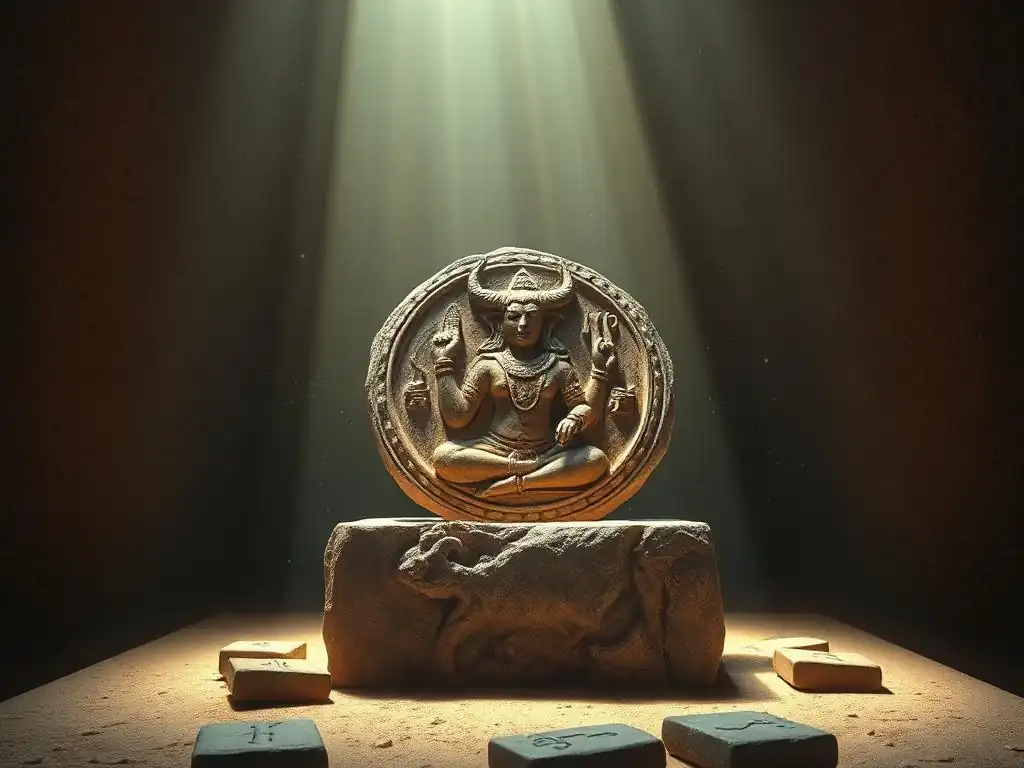
One of the most compelling and debated pieces of Indus Valley religious iconography is the famous "Pashupati Seal" discovered at Mohenjo-daro, dating to approximately 2350-2000 BCE. This steatite seal depicts a multi-headed (often interpreted as three-faced) horned figure seated in a distinctive yogic posture on a low throne.
The figure is surrounded by various animals: an elephant and a tiger to its right, and a rhinoceros and a water buffalo to its left, with two deer beneath the throne. Sir John Marshall, a prominent archaeologist, first identified this figure in 1931 as a "Proto-Shiva," drawing parallels with the later Hindu deity Shiva, particularly his epithets Pashupati (Lord of Animals) and Mahayogi (Great Ascetic).
While the "Proto-Shiva" interpretation remains a subject of considerable scholarly discussion, the seal undeniably represents a powerful deity or a significant spiritual entity. Its unique iconography suggests a figure embodying dominion over the animal kingdom and possibly embodying meditative or ascetic practices, which are central to later South Asian religious traditions. The prominence and detailed depiction of this figure on multiple seals underscore its importance within the spiritual framework of the Indus people, making it a cornerstone for understanding their religious beliefs.
The Mother Goddess: Fertility and Protection in Indus Religion
Another pervasive element in Indus Valley religious iconography is the abundance of terracotta female figurines, found in large numbers (tens of thousands) across various sites, especially Mohenjo-daro and Harappa. These figurines, often small and handmade, frequently depict women with elaborate headdresses, jewelry, and sometimes exaggerated breasts or pregnant bellies. Their widespread distribution, particularly in domestic contexts, leads many scholars to interpret them as representations of a Mother Goddess or a fertility deity, venerated for ensuring successful harvests, childbirth, and overall prosperity.
The sheer number and consistent iconography of these figurines suggest a widespread cult associated with feminine divine power, crucial for an agrarian society dependent on the land's bounty and human procreation. While not monumental like the goddesses of other ancient civilizations, their presence in everyday homes highlights their integral role in the daily spiritual lives of the Indus people. Some figurines also exhibit traces of soot or blackening, hinting at ritualistic burning or offerings made to them, further emphasizing their religious significance within the Indus Valley religious iconography.
Animal Motifs in Indus Religious Symbolism: Bulls, Unicorns, and More
Animals play a profoundly significant role in Indus Valley religious iconography, appearing frequently and prominently on seals, pottery, and figurines. The bull, particularly the humped bull (zebu), is a recurring motif, often depicted with a majestic and powerful presence. It is widely believed to symbolize strength, fertility, or even a specific deity, given its later sacred status in Indian religions.
However, the most ubiquitous animal motif is the "unicorn," a single-horned bovine creature that appears on over 60% of all discovered seals. Its consistent and stylized depiction suggests a deeply symbolic or religious significance, possibly representing a mythical creature, a powerful totem, or a divine being associated with purity or power.
Beyond bulls and unicorns, a variety of other animals—including tigers, elephants, rhinoceroses, and water buffaloes—are depicted, sometimes in composite forms (e.g., human-headed animals) or in association with human or divine figures. These animals likely held sacred significance, perhaps serving as totems for clans, vehicles for deities, or embodiments of natural forces. The meticulous detail in their portrayal reflects a profound observation of the natural world and its integration into the spiritual worldview of the Indus people, making animal imagery a vital component of Indus Valley religious iconography.
Ritual Practices in the Indus Valley Civilization: Evidence from Archaeological Excavations
The Great Bath at Mohenjo-daro: Ritual Purification and Communal Gatherings
One of the most striking structures related to potential ritual practices is the Great Bath at Mohenjo-daro. Located within the "Citadel" mound, this impressive brick structure measures approximately 12 meters long, 7 meters wide, and 2.4 meters deep. It was meticulously constructed to be watertight, with finely fitted bricks and a layer of natural tar (bitumen) to prevent leakage. Steps lead down to the water at both ends, and a series of smaller rooms surround the courtyard. Its prominent location within the most important part of the city strongly suggests a public and significant role.
Scholars widely interpret the Great Bath as a facility for ritual bathing or purification, akin to later Hindu puja or purification rites. The sheer scale of the structure implies communal use, possibly during festivals or specific religious ceremonies. The absence of drains for continuous fresh water inflow, and only one outlet, suggests that water was brought in for specific events rather than being a constantly flowing pool, further reinforcing its use for specific, perhaps infrequent, yet grand ritual gatherings, central to the public expression of Indus Valley religious iconography.
Fire Altars and Sacrificial Practices: Kalibangan and Lothal
Evidence for fire-related rituals has been unearthed at several Indus Valley sites, notably Kalibangan and Lothal. At Kalibangan, a row of seven fire altars was discovered within the citadel area, clearly distinct from domestic hearths. These brick-lined pits contained ash and charcoal, and some yielded remnants of offerings, including animal bones and pottery. This discovery strongly indicates organized fire rituals, potentially involving animal sacrifices, suggesting a different dimension of Indus religious practice compared to the water-based rituals of the Great Bath.
Similar fire altars have also been found at Lothal, both in public spaces and within private houses, suggesting that fire rituals might have been performed both communally and individually within households. The careful construction and arrangement of these altars point to a formalized system of offerings and worship involving fire, a practice that resonates with later Vedic traditions in India. These findings provide crucial insights into the active ritual life of the Indus people, complementing the static nature of Indus Valley religious iconography.
Burial Customs and Beliefs about the Afterlife: Analyzing Indus Valley Grave Goods
Indus burial customs, while not as elaborate as those of contemporary Egyptian pharaohs, offer clues about their beliefs concerning the afterlife. At sites like Harappa and Kalibangan, most bodies were interred in extended positions, typically oriented north-south, and sometimes placed within wooden coffins. Grave goods, though generally modest, were often included. These typically comprised pottery vessels (presumably for food or drink offerings for the deceased's journey), personal ornaments like beads and shells, and occasionally copper mirrors or tools.
The relative simplicity of grave goods, compared to the lavish burials seen in Mesopotamia or Egypt, might suggest a different emphasis on the afterlife, perhaps a belief that material possessions were not crucial for the journey, or a more egalitarian approach to death. Variations in burial practices, such as fractional burials (where only parts of the body are interred) or urn burials, have also been observed, hinting at diverse beliefs or customs across different communities or social strata within the vast Indus civilization.
This evidence, though subtle, contributes to our understanding of the Indus Valley religious iconography related to death and transition.
The Role of Seals and Tablets in Indus Valley Religious Practices
Indus Seals as Amulets: Protection and Divine Connection
The small size of many Indus seals, typically ranging from 2 to 4 centimeters square, along with the presence of a perforated boss on their back, strongly suggests they were worn as amulets or personal identifiers. Made primarily of steatite, their portability and common discovery in domestic contexts support the idea of personal use for protection, good fortune, or as a symbol of identity or affiliation with a particular deity or clan. The intricate Indus Valley religious iconography carved on these seals would have been a constant visual reminder of their spiritual significance.
The figures depicted on these seals, whether powerful deities, mythical creatures, or revered animals, could have been invoked for protection against evil, for prosperity, or to ensure fertility and well-being. The consistent appearance of certain motifs across wide geographical areas suggests a shared understanding of their symbolic power, indicating that seals were not merely administrative tools but potent religious artifacts, integral to the personal spiritual lives of the Indus people.
Depictions of Religious Scenes on Indus Tablets: The Pashupati Seal and Animal Processions
Many Indus seals transcend simple identification marks by depicting complex narrative or iconic scenes of clear religious significance. The "Pashupati Seal," discussed earlier, with its central horned figure surrounded by animals, is a prime example of such a religious tableau. Other seals show figures seemingly engaged in ritualistic acts, such as standing before altars, carrying standards, or interacting with composite beasts, offering glimpses into specific ceremonies or mythical narratives.
Further examples include seals depicting processions of animals or human-like figures interacting with sacred trees, particularly the pipal tree, or standing before altars. A notable seal from Mohenjo-daro depicts a figure emerging from a pipal tree, possibly indicating a form of tree worship or a goddess associated with vegetation and fertility. These detailed narrative scenes are crucial for deciphering the stories and the pantheon that underpin Indus Valley religious iconography, even in the absence of a deciphered script.
Possible Interpretations of Indus Script in Religious Contexts
While the Indus script remains one of archaeology's greatest unsolved mysteries, its consistent presence on nearly all seals, often positioned above the iconographic depictions, strongly suggests a connection to the religious content. Though the average inscription length is short (around 5 signs), it is possible that these short texts convey names of deities, invocations, prayers, titles of priests, or specific ritual formulas. The undeciphered nature of the script means any interpretation is speculative, but its integral pairing with religious imagery points to its crucial role in the ritual and spiritual life of the Indus people.
If the script were to denote names or attributes, it would significantly deepen our understanding of Indus Valley religious iconography by providing linguistic context to the visual symbols. Various theories propose links to Dravidian languages, Indo-Aryan languages, or other language families, but none have achieved widespread acceptance. Nevertheless, the systematic nature of the script and its consistent application on religious artifacts underscore its importance as a medium for expressing or legitimizing the depicted figures and rituals.
Comparing Indus Valley Religious Beliefs with Contemporary Cultures
Parallels with Mesopotamian Religious Practices
Despite geographical separation, the Indus Valley Civilization maintained trade and cultural contacts with Mesopotamia, leading to some intriguing parallels in their religious practices. Both civilizations featured a pantheon of deities, often associated with fertility, nature, and protection. Similar animal motifs, such as bulls and certain composite creatures, appear in the art of both cultures, sometimes carrying analogous symbolic weight. For instance, the bull was a potent symbol of power and fertility in Mesopotamia, echoing its widespread prevalence in Indus Valley religious iconography. The concept of protective deities and the use of amulets were also common to both societies.
However, significant differences exist. Unlike Mesopotamia, with its grand ziggurats and elaborate temple complexes dedicated to specific deities (e.g., the Nanna Ziggurat at Ur), the Indus Valley lacks such monumental religious architecture. Moreover, Mesopotamian religion is well-documented through extensive written texts, including hymns, myths, and ritual instructions, providing a much clearer picture of their pantheon and cosmology. This stands in stark contrast to the enigmatic Indus script, suggesting a fundamentally different approach to public religious expression and priestly organization.
Possible Influences on Later Indian Religious Traditions
One of the most compelling aspects of studying Indus Valley religion is the potential for influences on later Indian religious traditions, particularly Hinduism. The "Proto-Shiva" figure on the Pashupati Seal bears striking resemblances to the Hindu deity Shiva, especially his aspects as Pashupati (Lord of Animals) and Mahayogi (Great Ascetic). Similarly, the widespread terracotta Mother Goddess figurines are often seen as precursors to the reverence for goddesses like Shakti and Devi in later Hinduism. The practice of ritual bathing, exemplified by the Great Bath, also finds clear parallels in Hindu purification rites performed in rivers and temple tanks.
Other potential continuities include tree worship, especially the pipal tree (which is sacred in Hinduism and Buddhism), the reverence for certain animals (like the bull, Nandi, associated with Shiva), and possibly the concept of yoga and meditation, suggested by the yogic posture of the "Proto-Shiva." While direct lineage is debated and complex, these compelling parallels suggest a substratum of religious ideas and Indus Valley religious iconography that might have persisted, evolved, and been absorbed into the rich tapestry of later South Asian spiritual traditions, offering a profound link to the subcontinent's ancient past.
Distinguishing Features of Indus Valley Religion
A key distinguishing feature of Indus Valley religion, when compared to contemporary civilizations, is the apparent absence of monumental temples or a clearly identifiable, dominant priestly class. Unlike Mesopotamia or Egypt, where powerful priestly hierarchies oversaw elaborate state-sponsored cults in grand temples, Indus cities do not feature such structures.
This might suggest a more decentralized, perhaps household-based, or community-led religious practice, or one that was more subtly integrated into daily life and urban planning rather than being expressed through separate, imposing structures. The focus on water rituals and fire altars, rather than elaborate idol worship within dedicated temples, could also be a unique characteristic.
Furthermore, the reliance on an undeciphered script means that the Indus Valley religious iconography stands largely alone, without the textual explanations that illuminate the cosmologies of other ancient religions. The absence of clear evidence for a king-priest figure (unlike the Ensis or Lugals of Sumer) further differentiates it. The pervasive nature of certain symbols (like the unicorn) and figurines across the vast civilization, without apparent central religious authority, points towards a deeply ingrained but perhaps less formalized or institutionalized religious system.
The Decline of the Indus Valley Civilization and its Impact on Religious Practices
Changes in Religious Beliefs During the Late Harappan Period
Around 1900 BCE, the mature Harappan phase of the Indus Valley Civilization began to decline, marked by the abandonment of major urban centers and a shift in settlement patterns. During this Late Harappan period, archaeological evidence suggests a general decline in the quality and quantity of Indus Valley religious iconography found on seals, as well as a reduction in the production of unique artifacts. This might indicate a fragmentation of previously shared religious practices or a shift in focus due to environmental stress, trade disruptions, or socio-political upheaval.
While some core religious elements might have persisted in regional traditions, the centralized, pan-Indus religious symbolism appears to have waned. New pottery styles and artifact types emerge in successor cultures, suggesting significant cultural shifts that likely impacted religious expressions. The eventual disappearance of the Indus script also meant that any religious texts, hymns, or formulas would have been lost, further obscuring the spiritual landscape of the communities that succeeded the great Indus cities.
The Legacy of Indus Valley Religious Iconography
Despite the eventual decline and disappearance of the Indus Valley Civilization, the Indus Valley religious iconography it left behind has an enduring legacy. The powerful figures of the "Proto-Shiva" and the Mother Goddess, along with the pervasive animal motifs and the evidence of ritual practices like sacred bathing, are frequently cited as foundational elements that may have contributed significantly to the rich and diverse tapestry of later Indian religious traditions. These ancient symbols represent some of the earliest expressions of organized spiritual thought in South Asia.
The study of Indus religious beliefs, even with its inherent challenges due to the undeciphered script, is crucial for understanding the deep historical roots of spiritual thought in the Indian subcontinent. It provides a unique, albeit enigmatic, window into a pre-Vedic religious system, offering invaluable insights into how early urban societies conceived of the divine, the sacred, and the afterlife, thereby shaping the spiritual landscape of the region for millennia to come.
Conclusion: A Glimpse into the Spiritual World of the Indus People
Frequently Asked Questions
How reliable is the interpretation of Indus Valley religious iconography, given the undeciphered script?
The interpretation is challenging due to the undeciphered script. However, archaeologists rely on comparative analysis with later Hindu traditions and contextual analysis of archaeological finds.
What are some prominent examples of potential religious iconography found at Indus Valley sites?
Examples include depictions of a "proto-Shiva" figure, the "Mother Goddess" figurines, and images of animals like bulls and unicorns, possibly representing deities.
How do excavation techniques contribute to understanding Indus Valley religious beliefs?
Careful excavation helps reveal the context in which artifacts are found. This context, such as placement within a building or association with specific objects, can provide clues about their religious significance.
What role did geographic regions play in shaping religious practices within the Indus Valley civilization?
While a unified culture existed, there is evidence of regional variations in artifact styles and site layouts. This suggests that local traditions may have influenced religious practices.
How does the chronology of the Indus Valley civilization inform our understanding of its religious evolution?
By studying changes in artifact styles and site layouts over time, archaeologists can trace the development of religious beliefs and practices. This provides insights into how religious concepts evolved within the civilization.
Final Reflection: Unearthing Echoes of the Indus
The exploration of Indus Valley religious iconography reveals more than just ancient symbols; it offers a profound glimpse into the spiritual landscape of a civilization that continues to captivate and mystify us. Understanding their beliefs, however fragmented our knowledge may be, allows us to appreciate the enduring human quest for meaning and connection to something larger than ourselves, a quest that resonates just as strongly today.
The enduring power of these symbols lies in their ability to transcend time, sparking our imagination and prompting us to consider the origins of ritual and belief. The ambiguity surrounding Indus Valley religious practices, rather than diminishing their significance, actually amplifies their allure, inviting us to project our own interpretations and connect with the inherent mystery of human spirituality. The past is never dead. It's not even past.
- William Faulkner. This quote encapsulates the way the Indus Valley civilization, through its iconography, continues to speak to us across millennia, prompting us to question and understand our own place in the grand narrative of human history.
As we reflect on the enigmatic religious beliefs of the Indus people, let us consider the enduring power of symbols and rituals in shaping our own understanding of the world. What beliefs, practices, and symbols resonate most deeply within you? How can we, like the Indus people, strive to create a society that values both material prosperity and spiritual well-being? Let the echoes of the Indus Valley inspire you to explore the depths of your own beliefs and contribute to a more meaningful and connected world.
Unearth Your Understanding: Explore Indus Valley Mysteries!
Thank you for delving into the religious beliefs of the Indus people. We hope this exploration has deepened your appreciation for this fascinating ancient civilization. Now, let's put that knowledge into action:
- Visit a museum or archaeological site displaying Indus Valley artifacts to connect with their world firsthand. This is the most direct path to understanding.
- Share this article with friends or colleagues interested in ancient cultures and spark a discussion.
- Research and compare Indus Valley religious practices with those of contemporary civilizations in Mesopotamia or Egypt – what similarities and differences do you notice?
What aspect of Indus Valley religious beliefs intrigues you the most, and how does it challenge or confirm your existing understanding of ancient religions?