Archaeology of Scotland: From Pictish Stones to Viking Hoards
🌍 Discover Scotland’s rich history through engaging archaeology site tours, exploring Pictish stones and Viking hoards. This digital encyclopedia offers detailed insights…
Read article
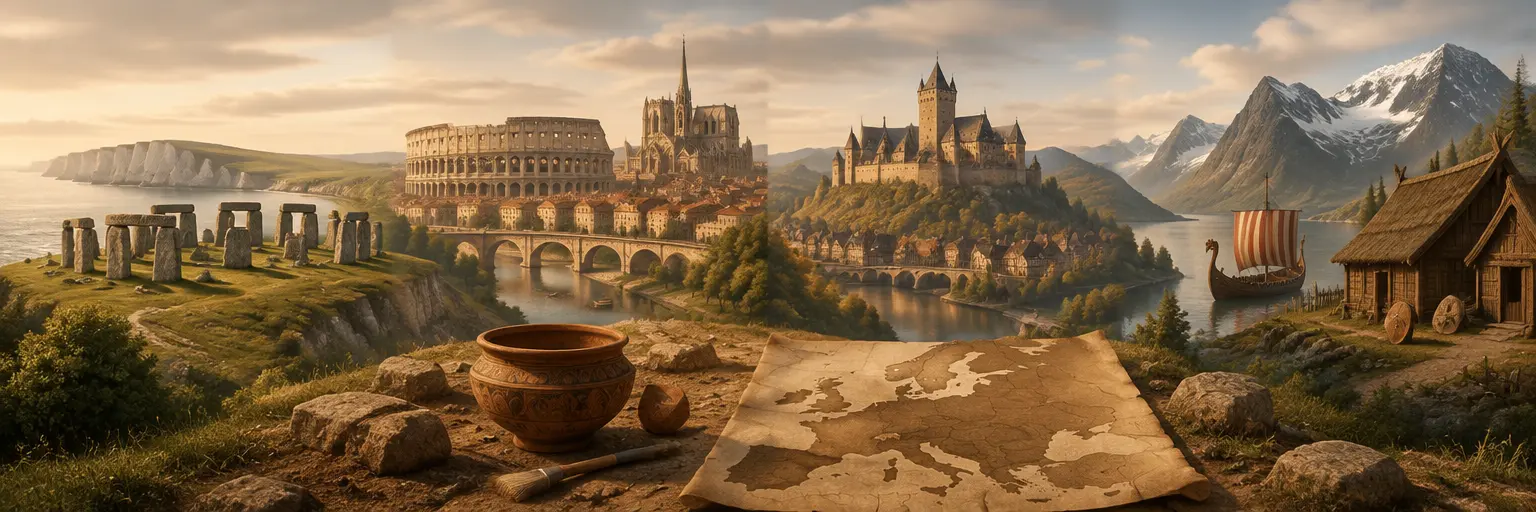
Explore the rich archaeological heritage of Europe’s most influential nations, from the prehistoric megaliths of the UK and the Roman ruins of France to the Iron Age hillforts of Germany and the Viking settlements of Scandinavia. This section of ArchaeologyHub.org offers a deep dive into the distinct yet interconnected archaeological narratives that shaped the continent. Uncover how each nation’s unique landscape and history—from Celtic tribes, Roman conquests, and medieval kingdoms to Nordic expansion—has left a durable imprint on the ground. Ideal for students, history buffs, and travelers, these regional overviews synthesize excavation reports, artifact studies, and chronological timelines to reveal the daily life, trade networks, and cultural transformations across Europe. Whether you’re tracing the Saxon Shore forts in Britain, the Gallo-Roman villas in France, the Carolingian palaces in Germany, or the Oseberg ship burial in Norway, this curated hub enhances your understanding of European national identities through archaeology. Discover how modern research methods, from aerial survey to DNA analysis, continually rewrite what we know about these ancient societies.
🌍 Discover Scotland’s rich history through engaging archaeology site tours, exploring Pictish stones and Viking hoards. This digital encyclopedia offers detailed insights…
Read article
🌟 Explore the fascinating world of AngloSaxon settlement patterns and burial practices, revealing insights into early medieval life through detailed analysis of…
Read articleWelcome to the ArchaeologyHub.org gateway for the Archaeology of European Nations, covering the UK, France, Germany, and Scandinavia. This subcategory is your digital passport to the deep past of Western and Northern Europe, where every mound, ruin, and fjord carries millennia of stories. Here, we synthesize regional archaeological overviews into actionable knowledge—from the Neolithic megaliths of Brittany to Viking longships in Oslo—tailored for students, educators, and heritage travelers. Dive into chronological frameworks, landmark excavations, and material culture analyses that define these national archaeologies.
Explore the archaeology of the United Kingdom and Ireland, a landscape punctuated by iconic monuments and stratified urban sites. Expect comprehensive overviews of the Neolithic and Bronze Age henges, the Iron Age hillforts, and the transformative Roman occupation, including Hadrian’s Wall and the villa economy. We highlight key excavation projects like those at Sutton Hoo and the Thames foreshore, offering artifact-specific insights into Anglo-Saxon and medieval life.
Each overview integrates radiocarbon dating sequences, environmental archaeology, and recent lidar surveys that have reshaped our understanding of settlement patterns. You will learn how British archaeology pioneered stratigraphic methods, and how contemporary research addresses post-colonial narratives and heritage management. This section is essential for grasping how a small island nation’s archaeological record informs global prehistory and historical archaeology.
French archaeology spans the Paleolithic cave art of Lascaux and Chauvet to the Gallo-Roman cities of Lugdunum and the medieval abbeys of Normandy. Our content dissects the region’s Paleolithic and Neolithic transitions, emphasizing the development of agriculture and monumental architecture like the Carnac stones. You will encounter detailed case studies of oppida (Celtic fortified towns) and their trade networks with the Mediterranean world.
Expect structured timelines of the Frankish and Merovingian periods, linking burial practices and coin hoards to broader Euro-Asian exchange. We emphasize the role of preventive archaeology (archéologie préventive) in modern infrastructure projects, which has exponentially increased data on rural settlements and agricultural landscapes. This section provides a continental counterpoint to British archaeology, highlighting differing theoretical approaches and preservation laws.
German archaeological research is renowned for its meticulous chronological control, particularly for the Paleolithic (e.g., the Schöningen spears) and the Bronze Age (e.g., the Nebra Sky Disc). Our overviews cover the Roman limes frontier, the Germanic tribal societies beyond it, and the key Migration Period settlements that shaped early medieval Europe. We also delve into the archaeology of the Hanseatic trading network, using urban excavations in Lübeck and Bremen.
You will find analyses of wetland preservation in northern Germany, which has yielded exceptional organic artifacts like textiles and wooden tools. The section includes methodological guides on how German archaeology integrates geophysical prospection and experimental archaeology to test hypotheses. This national overview is crucial for understanding the central European connections that linked Scandinavia, the Roman world, and the Slavic east.
The Scandinavian archaeology section covers Denmark, Norway, and Sweden, with primary emphasis on the Viking Age (c. 750–1050 CE) but extending into the Stone Age rock carvings and Iron Age bog bodies. Expect detailed narratives on ship burials (Oseberg, Gokstad), the ring fortresses of Denmark, and the runestone culture that spread across the Baltic. We contextualize these within climate and trade dynamics, from the Volga routes to the Atlantic expansion.
Our content breaks down the transition from paganism to Christianity through cemetery and church archaeology, using bioarchaeological data on health and mobility. You will also explore the medieval urban centers like Birka and Lund, and modern research on Sámi archaeology in the subarctic. This overview is your entry point to understanding how Scandinavian archaeology has influenced global narratives of exploration and state formation.
This subcategory goes beyond listing sites; it offers synthetic comparisons across the four nations—examining shared megalithic traditions, divergent Roman responses, and mutual Viking influences. Our regional overviews include meta-analyses of pottery typologies, settlement densities, and burial rites to help you identify pan-European patterns. You will find practical resources such as chronological charts and glossaries of key archaeological periods (e.g., Mesolithic, Nordic Bronze Age) tailored to these nations.
We also highlight the legal and ethical frameworks governing excavations in each country—from the French Code du Patrimoine to the UK’s Planning Policy Guidance. This allows you to understand why some sites are prioritized and how public engagement differs nationally. Whether you are planning fieldwork, writing a thesis, or simply deepening your historical understanding, these comparative tools will prove invaluable.
The oldest generally accepted site is the Boxgrove quarry in the UK, dating to around 500,000 years ago, with early hominin remains. In Germany, the Mauer mandible is about 600,000 years old, while France’s Vallonnet Cave is roughly 900,000 years old. These are crucial for human evolution studies.
Scandinavian bog bodies (e.g., Tollund Man) are naturally mummified due to acidic peat, preserving skin and internal organs. Unlike typical inhumations or cremations, they were often placed in water-based contexts, likely ritual sacrifices or executions. Their preservation allows rare insights into diet and last meals.
Yes, most major sites are accessible, including Stonehenge (UK), Carnac (France), and the Viking Ship Museum (Norway). Many have on-site museums and guided tours. Check national heritage agency websites for opening hours and any excavation open days, which often allow visitor access.
We recommend the interactive timelines on the ArchaeologyHub platform, which integrate calibrated radiocarbon dates and diagnostic artifacts. For printed resources, use the national archaeological atlases (e.g., “Atlas of British Archaeology”) that illustrate period-specific settlement and monument distributions.
LiDAR and ground-penetrating radar have discovered thousands of new features without excavation, while ancient-DNA analysis is rewriting migration narratives across all four nations. These technologies allow for non-invasive research, helping preserve sites for future generations while providing deeper, data-driven insights.