Contemporary Archaeologists & Innovators in Theory/Method
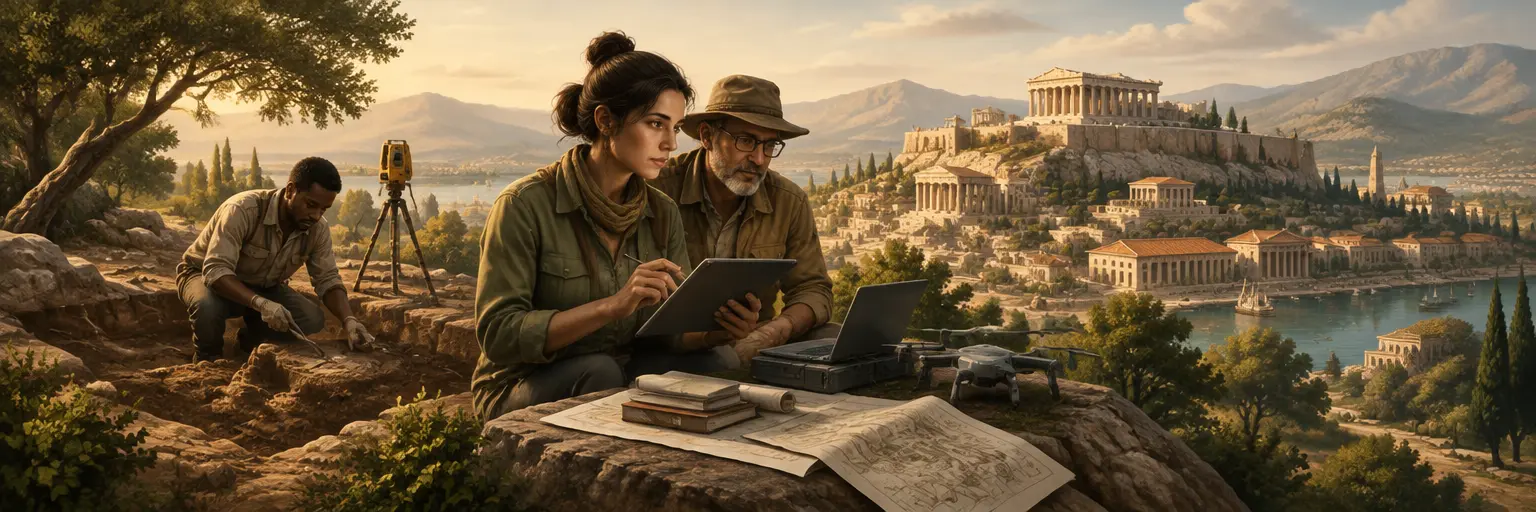
Welcome to the cutting-edge frontier of archaeology, where modern thinkers are reshaping how we unearth and interpret the past. This subcategory on ArchaeologyHub.org profiles the brilliant minds driving methodological revolutions and theoretical breakthroughs—from digital archaeology and remote sensing to post-processualist thought and indigenous archaeologies. Here, you’ll discover how these innovators are integrating genetics, AI, and community-led practices to challenge established narratives and expand our understanding of ancient civilizations. Perfect for students, professionals, and enthusiasts, this collection bridges the gap between traditional excavation and tomorrow’s transformative technologies.
🔬 Pioneers of Digital & Computational Archaeology
Dive into the work of scholars who are transforming archaeology through machine learning, geospatial analysis, and 3D modeling. These innovators use LiDAR to penetrate dense jungles, AI to classify pottery sherds, and predictive algorithms to locate undiscovered settlements. You’ll read about figures like Sarah Parcak, whose satellite imagery has mapped thousands of sites, and those developing open-source databases for global collaboration. Expect practical insights into how computational tools accelerate fieldwork, reduce bias, and provide non-invasive ways to explore fragile heritage.
This section also highlights how digital pioneers are democratizing knowledge, offering virtual reality reconstructions that let the public walk through ancient cities. By integrating quantitative data with qualitative narratives, these archaeologists are not just finding artifacts—they’re creating dynamic, testable models of human behavior. Whether you’re curious about drone surveys or neural network applications, this content will show you how code and clay unite to rewrite history.
🌍 Post-Processual & Interpretive Theorists
Explore the thinkers who moved archaeology beyond mere description into rich, symbolic interpretation. Post-processualism, championed by figures like Ian Hodder, emphasizes agency, gender, and power dynamics, arguing that material culture is a text to be read, not just excavated. Here, you’ll learn how these theorists critique earlier “objective” methodologies, advocating for reflexive, multi-vocal approaches that include marginalized voices. The section offers case studies on how ritual, ideology, and identity are reconstructed from burial practices and domestic spaces.
Expect detailed analyses of how interpretive frameworks engage with contemporary issues, such as climate change and colonialism. These innovators use ethnography and historical analogy to build nuanced narratives, making archaeology a tool for social justice rather than a detached science. For those seeking a deeper philosophical grounding, this H3 provides accessible explanations of complex theories, illustrating how meaning is made from fragments—and why multiple interpretations are not a weakness but a strength of the discipline.
🧬 Bioarchaeology & Ancient DNA Innovators
Meet the geneticists and bioarchaeologists who are rewriting population histories using ancient DNA (aDNA) and stable isotope analysis. Visionaries like Eske Willerslev and David Reich have pioneered techniques to extract genetic material from remains, revealing migrations, admixture, and disease patterns that were once invisible. This section zooms into how these methods complement traditional osteology, linking skeletal stress markers to climate events or dietary shifts. You’ll also see ethical debates around sampling, repatriation, and consent, led by indigenous scholars advocating for respectful collaboration.
Beyond the lab, these innovators are integrating proteomics and microbiomics to explore ancient health and environment. You’ll gain practical knowledge about contamination control, sequencing technologies, and statistical models that trace kinship or population bottlenecks. The content stresses that aDNA is not a magic bullet; it requires tight integration with archaeological context. Here, you’ll appreciate how bioarchaeology humanizes the past, giving voice to individuals who lived millennia ago while prompting vital ethical discussions for modern research.
🛠️ Field Method Revolutionaries in Excavation & Survey
This part highlights innovators who have refined how we physically dig, sample, and record sites. From the introduction of single-context recording by Edward Harris to the development of micro-stratigraphy and micromorphology, these methodologists ensure every soil layer tells a story. You’ll discover advances in geophysics using ground-penetrating radar and magnetometry, which allow archaeologists to “see” beneath the surface without disturbing deposits. Also featured are proponents of community archaeology, who train local volunteers in digital mapping and conservation.
Expect discussions on open-area excavation versus test pits, the role of 3D laser scanning for “digital preservation,” and the integration of photogrammetry for site monitoring. These reformers emphasize rigorous, replicable protocols that balance speed with precision, especially in rescue archaeology. By profiling trailblazers who develop standardized forms, GIS databases, and safe artifact handling, this section offers practical takeaways for both amateurs and professionals. It’s about getting your hands dirty in a smarter, more ethical way.
🤝 Decolonizing Archaeology & Indigenous Leadership
Uncover the influential voices pushing for archaeology that respects indigenous sovereignty and traditional knowledge. Innovators such as Sonya Atalay and Joe Watkins have pioneered collaborative frameworks where communities co-design research questions, control access to sacred sites, and reinterpret museum collections. This section addresses how archaeology is shifting from extractive practices to partnership models, incorporating oral traditions as legitimate evidence. You’ll learn about repatriation successes under NAGPRA and the rise of indigenous monitoring programs.
Beyond policy, this H3 explores how decolonization affects theory—favoring relational ontologies over Western dichotomies of nature/culture. It includes practical guidance on engaging elders, acknowledging historical trauma, and ensuring that benefits flow back to communities. The content underscores that these leaders are not just “consultants” but principal investigators who redefine what archaeology means for heritage stewardship. This transformative movement ensures that ancient histories are told by those who inherit them, fostering shared authority and healing.
Frequently Asked Questions
What is the difference between processual and post-processual archaeology?
Processual archaeology, dominant in the 1960s–80s, focuses on objective, scientific methods to explain cultural change through ecology and systems theory. Post-processualism, emerging later, critiques this as overly deterministic, emphasizing human agency, symbolism, and multiple interpretations. While processualists stress function and adaptation, post-processualists explore power, gender, and meaning. Modern practice often blends both, using scientific rigor while acknowledging subjective perspectives.
How does ancient DNA change our understanding of past populations?
Ancient DNA provides direct evidence of migrations, admixture, and kinship that artifacts alone can’t reveal. It has overturned models of isolation, showing large-scale population movements like the Yamnaya expansion. aDNA also identifies pathogens and hereditary traits, linking biology to cultural shifts. However, it requires careful sampling and ethical review, as contamination and destructive analysis remain challenges.
What are the most game-changing technologies in contemporary field archaeology?
LiDAR (light detection and ranging) has revolutionized site discovery by penetrating forest canopies, exposing urban layouts. Ground-penetrating radar and magnetometry enable non-invasive subsurface scanning. Photogrammetry and 3D scanning create precise digital records. Additionally, drones provide rapid aerial surveys, while machine learning accelerates artifact classification. These tools reduce excavation damage and improve spatial analysis.
Why is decolonization important in archaeology?
Decolonization rectifies historical power imbalances where external researchers extracted knowledge without community consent. It respects indigenous sovereignty over heritage, integrates traditional ecological knowledge, and challenges Eurocentric narratives. This approach improves data quality by including local perspectives and fosters trust, making archaeology more ethical and relevant. It also addresses repatriation of remains and artifacts to rightful communities.
Can I contribute to archaeological research as a non-professional?
Yes! Many projects use citizen science for tasks like artifact sorting, site monitoring, or transcribing historical records. Community archaeology programs train volunteers in excavation and digital documentation. Online platforms like GlobalXplorer invite the public to analyze satellite imagery for looting detection. Always follow ethical guidelines and work under professional supervision to ensure data integrity and cultural sensitivity.