
The Loyalist Teaching: Promoting Allegiance to the Pharaoh in Middle Kingdom Texts

Welcome to ArchaeologyHub.org, your gateway to the past!
Ever wondered how ancient rulers maintained control? Dive into our exploration of Loyalist propaganda Middle Kingdom, specifically examining "The Loyalist Teaching." This text offers a fascinating glimpse into the strategies employed to promote unwavering allegiance to the Pharaoh. Discover how these carefully crafted words shaped the beliefs and behaviors of an entire civilization and what they reveal about the power dynamics of the time. Keep reading to uncover the secrets hidden within this ancient document...
- Royal Propaganda in Middle Kingdom Egypt: Promoting Pharaoh's Authority
- Introduction: Understanding Royal Ideology in the Middle Kingdom
- Historical Context: Instability and the Rise of the 12th Dynasty
- Key Texts of Royal Propaganda: Examples and Analysis
- Themes and Motifs in Royal Propaganda
- Dissemination and Impact of Royal Propaganda
- The Evolution of Royal Ideology: Old Kingdom to Middle Kingdom
- Critiques and Interpretations of Royal Propaganda
- Royal Propaganda and Social Control
- Conclusion: The Significance of Middle Kingdom Royal Propaganda
-
Frequently Asked Questions
- ### What is the Loyalist Teaching, and why is it considered Loyalist propaganda?
- ### How does the Loyalist Teaching reflect the political context of the Middle Kingdom?
- ### What are some of the key themes and arguments presented in Loyalist propaganda from the Middle Kingdom?
- ### Where can I find examples of Loyalist Teaching texts, and what kind of information do they provide about Middle Kingdom society?
- ### How does the Loyalist propaganda of the Middle Kingdom compare to propaganda from other ancient civilizations?
- Final Reflection: Echoes of Enduring Power
- Unearth Your Inner Egyptologist: Take the Next Step!
Introduction: Understanding Royal Ideology in the Middle Kingdom
The Significance of Middle Kingdom Literature
The Middle Kingdom period (c. 2055-1650 BCE) is widely celebrated as a golden age of ancient Egyptian literature, marking a significant evolution in textual forms and thematic depth. Unlike the monumental inscriptions and biographical accounts that largely characterized the Old Kingdom, this era witnessed a flourishing of papyrus-based texts, including didactic wisdom literature, pessimistic prophecies, and deeply reflective narratives. These literary works were far more than mere entertainment; they served as crucial instruments for shaping societal values, reflecting the collective anxieties of the time, and articulating the prevailing ideologies of the newly re-centralized state.
This rich literary output, often encompassing what scholars refer to as "Loyalist Teaching" or Middle Kingdom loyalist propaganda, played a pivotal role in defining and disseminating the core tenets of royal authority. These texts provided moral guidance, offered historical justifications for the rise of the new dynastic order, and meticulously reinforced the pharaoh's unique and indispensable position as the linchpin of both cosmic and social order. Their widespread copying and study within scribal schools ensured their enduring influence across generations of the elite.
Royal propaganda in the Middle Kingdom context can be understood as the deliberate and systematic dissemination of information, ideas, and narratives designed to influence public perception and behavior, primarily with the aim of legitimizing and strengthening the pharaoh's authority. It was not "propaganda" in the modern, pejorative sense of deceptive manipulation, but rather a sophisticated system of ideological articulation and control, encompassing literary works, monumental inscriptions, and strategic royal decrees. Its primary function was to re-establish the pharaoh's image as an omnipotent, benevolent, and divinely ordained ruler.
The central objective of this Middle Kingdom loyalist propaganda was to restore faith in the institution of kingship following the decentralization and chaos of the First Intermediate Period. Texts consistently emphasized the pharaoh's critical role in maintaining Ma'at (cosmic order, truth, and justice), ensuring national prosperity, and safeguarding Egypt from both internal chaos and external threats. By portraying the pharaoh as the sole guarantor of stability and well-being, the loyalist teaching aimed to cultivate unwavering allegiance to the throne and prevent any return to the perceived disorder of the preceding era.
Historical Context: Instability and the Rise of the 12th Dynasty
The Decline of the Old Kingdom and the First Intermediate Period
The Old Kingdom, particularly in its later stages after the lengthy reign of Pepi II, experienced a gradual but profound decline marked by several key factors. Among these were the increasing autonomy and power of regional nomarchs (provincial governors) and a corresponding weakening of the central royal authority.
This decentralization led to significant economic hardship, localized social unrest, and a perceptible erosion of public faith in the pharaoh's divine capabilities and his ability to maintain cosmic order. This period culminated in the First Intermediate Period (c. 2181-2055 BCE), an era characterized by severe political fragmentation, with multiple local rulers vying for control of Egypt, and a pervasive sense of disarray that deeply impacted the Egyptian psyche.
Archaeological evidence from this tumultuous period, such as the proliferation of local cemeteries, the marked decrease in the scale and quality of royal building projects, and the emergence of distinct regional artistic styles, strongly supports the literary accounts of famine, civil strife, and a breakdown of centralized administration. The collective trauma of this period, where the traditional, divinely ordained order seemed to collapse, created a fertile ground for the subsequent rise of powerful, unifying rulers.
These new leaders understood the critical imperative to not only reassert a strong central government but also to systematically rebuild the image of the divine kingship, a task often achieved through sophisticated Middle Kingdom loyalist propaganda.
Mentuhotep II and the Eleventh Dynasty Reunification
The monumental task of reunifying Egypt after the First Intermediate Period was ultimately achieved by Mentuhotep II of the 11th Dynasty, whose origins lay in the southern city of Thebes. Following decades of intermittent conflict between the Herakleopolitan kings ruling from the north and the ambitious Theban rulers in the south, Mentuhotep II launched a series of decisive military campaigns. His efforts culminated in the defeat of the northern forces around year 39 of his reign (circa 2040 BCE), a victory that definitively marked the end of the First Intermediate Period and heralded the dawn of the Middle Kingdom.
Mentuhotep II's reign (c. 2055-2004 BCE) was not solely defined by military conquest; it was also a period of profound symbolic rebirth and ideological innovation. He adopted a complex and significant royal titulary, including epithets such as "He of the Two Lands" and "Uniter of the Two Lands," explicitly signifying his pivotal role as the restorer of national unity and cosmic order.
His mortuary complex at Deir el-Bahari, though later overshadowed by Hatshepsut's grander temple, represented a new architectural approach, blending traditional elements with innovative terracing. This design symbolically bridged the gap between Egypt's glorious past and its newly envisioned future of stability, laying foundational elements for the loyalist propaganda Middle Kingdom would later refine.
Amenemhat I and the Establishment of the 12th Dynasty
The 12th Dynasty, founded by Amenemhat I (c. 1985-1955 BCE), successfully consolidated the reunification initiated by Mentuhotep II and ushered in an era widely regarded as one of Egypt's most stable and prosperous periods. Amenemhat, who may have served as a vizier under the preceding 11th Dynasty king Mentuhotep IV, ascended to the throne through a period of astute political maneuvering.
A strategic move early in his reign was relocating the capital from Thebes to a newly established site, Itjtawy (near modern Lisht). This new capital was strategically positioned between Upper and Lower Egypt, allowing for more effective centralized control over the entire country and providing a degree of political distance from the powerful and sometimes independent Theban nomarchs.
To secure his lineage and ensure a smooth and uncontested succession, Amenemhat I introduced the innovative and highly effective practice of co-regency, formally appointing his son Senusret I as co-ruler during his own lifetime. This unprecedented formalization of succession aimed to prevent a recurrence of the succession crises that had plagued earlier periods and contributed to the fragmentation of the First Intermediate Period.
His reign, and those of his powerful successors, saw the systematic development and widespread deployment of royal propaganda, particularly through literary works, to firmly embed the 12th Dynasty's legitimacy and the pharaoh's absolute authority in the minds of the elite and, by extension, the broader populace.
Key Texts of Royal Propaganda: Examples and Analysis
The Prophecy of Neferti: Legitimizing the Amenemhat Dynasty
The Prophecy of Neferti stands as a quintessential example of Middle Kingdom loyalist propaganda, masterfully crafted to legitimize the nascent 12th Dynasty. The text is presented as a prophecy delivered by the sage Neferti to King Sneferu of the Old Kingdom, looking forward to a future period of immense chaos and decline—a thinly veiled and vivid depiction of the First Intermediate Period.
This period of turmoil is then followed by the glorious arrival of a savior king, identified as "Ameny," a clear and unmistakable reference to Amenemhat I, the founder of the 12th Dynasty. This ingenious literary device, framing the new dynasty's founder as a long-awaited messianic figure, served to retroactively imbue his rule with divine legitimacy and inevitability.
The text vividly portrays the suffering and disarray during the "chaotic" period, lamenting, "The land is utterly perished, there is no remnant of it, the sun is veiled and shines not." It then transitions to a message of profound hope, declaring, "A king will come from the South, Ameny by name... He will receive the White Crown, and he will wear the Red Crown."
By attributing this prophecy to an esteemed Old Kingdom sage, the text effectively connected Amenemhat I's reign with Egypt's glorious past, imbuing it with a sense of divine predestination and continuity. This sophisticated piece of pharaonic propaganda reinforced the idea that his rule was the divinely ordained solution to Egypt's troubles, a cornerstone of Middle Kingdom loyalist teaching.
The Instructions of Amenemhat: A Pharaoh's Warning and Justification
The Instructions of Amenemhat is another extraordinarily powerful and unique piece of loyalist propaganda Middle Kingdom, distinguished by its format: a posthumous address from the assassinated Amenemhat I to his son and co-regent, Senusret I. In this deeply personal and cautionary text, the deceased pharaoh warns his son against trusting anyone, even close family members, recounting his own betrayal and assassination: "I gave to the poor, I nourished the orphan...
He who ate my food raised opposition." This narrative of betrayal serves as a potent cautionary tale for future rulers and simultaneously provides a chilling justification for the pharaoh's necessary isolation and the imperative for absolute, unyielding power.
Beyond its stark warning, the Instructions also functions as a profound justification for Amenemhat I's reign and a comprehensive guide for royal conduct. It emphasizes the immense burdens of kingship and the pharaoh's solitary responsibility for maintaining order ( Ma'at) in a treacherous world.
The text meticulously reinforces the concept of the pharaoh as the sole protector of Egypt, whose vigilance and unwavering authority are paramount. This particular piece of pharaonic propaganda aimed to solidify the concept of a strong, centralized monarchy, highlight the ever-present dangers of disloyalty, and underscore the pharaoh's arduous, yet indispensable, role in ensuring the nation's survival and prosperity.
The Hymn to Senusret III: Deifying the Warrior King
The Hymn to Senusret III stands out as a remarkable testament to the increasing deification of the living pharaoh during the Middle Kingdom, particularly in the context of a warrior king. Composed either during or shortly after his formidable reign (c. 1878-1841 BCE), this hymn extensively extols Senusret III's military achievements, most notably his decisive campaigns into Nubia, and portrays him not merely as a victorious human ruler but as a powerful, protective deity.
Lines such as "He has come to us that he might carry off Egypt... He has come to us that he might make Egypt live" exemplify this elevation of the king to a divine status.
The hymn transcends simple praise for his martial prowess, explicitly asserting his divine nature and cosmic significance: "He is the Khnum of all lands, who fashions them." It attributes to him the inherent power to bring about prosperity and security, directly linking his military success and administrative acumen to the overall well-being of the land.
This form of loyalist propaganda was absolutely crucial for projecting an image of an invincible and divinely sanctioned ruler, one capable of defending Egypt's extensive borders, expanding its influence, and ensuring its enduring prosperity. It effectively solidified the pharaoh's role as a divine guardian and the ultimate source of stability and national strength.
Themes and Motifs in Royal Propaganda
The Pharaoh as Divine Representative: Divine Right to Rule
A foundational and pervasive theme in Middle Kingdom loyalist propaganda was the unequivocal portrayal of the pharaoh as the divine representative on Earth. Texts consistently depicted the king not merely as a mortal ruler invested with authority, but as the living embodiment of the god Horus, and implicitly, the son of the sun god Ra. This inherent divine connection granted the pharaoh absolute and unquestionable authority, rendering his decrees sacred and his person inviolable. For instance, the Hymn to Senusret III explicitly elevates the king to deity status, proclaiming, "He is the God, by whose command one lives."
This concept of divine right was strategically crucial for re-establishing and legitimizing the pharaoh's centralized power after the fragmentation and ideological crisis of the First Intermediate Period. By asserting his divine mandate, the pharaoh could demand absolute obedience and unwavering loyalty from his subjects, from the highest official to the lowliest peasant.
The underlying message was clear: challenging the pharaoh was not merely an act of political rebellion against a human ruler, but an act of sacrilege against the gods themselves, thereby threatening the very fabric of cosmic order ( Ma'at). This divine basis underpinned much of the Middle Kingdom loyalist teaching.
Ma'at and Order: Justifying Royal Power
The concept of Ma'at, representing truth, justice, cosmic balance, and harmonious order, was utterly fundamental to the ancient Egyptian worldview. Its meticulous maintenance was consistently presented as the pharaoh's paramount duty and raison d'être. Middle Kingdom loyalist propaganda relentlessly emphasized that the pharaoh was the sole guarantor of Ma'at on Earth, the one who prevented the world from descending into chaos ( Isfet). By upholding Ma'at, the pharaoh ensured the vital annual inundation of the Nile, bountiful harvests, and the overall well-being and prosperity of the entire land.
Texts like the Instructions of Kagemni and, more explicitly, the Instructions for Merikare, subtly but powerfully reinforce this profound connection, linking good governance (which only the pharaoh, through his divine mandate and wise administration, could truly achieve) directly to the flourishing of society. Any deviation from or challenge to royal authority was consequently depicted as an existential threat to Ma'at itself, inevitably plunging the land into the very chaos and suffering so vividly portrayed in the Prophecy of Neferti.
This strategic alignment of royal power with cosmic order made loyalty to the pharaoh not just a political act, but an inescapable moral and existential imperative for every Egyptian.
The Threat of Chaos: Consequences of Disobeying the Pharaoh
To powerfully underscore the absolute necessity of a strong, centralized royal rule, Middle Kingdom loyalist propaganda frequently and vividly employed the motif of chaos ( Isfet) as the dire and inescapable consequence of disobeying the pharaoh. The historical memory of the First Intermediate Period served as an exceptionally potent and terrifying precedent for this narrative, depicted in texts as a time of widespread famine, devastating civil war, and profound cosmic disarray.
The Admonitions of Ipuwer, although its precise dating remains a subject of scholarly debate, vividly portrays a world turned completely upside down, where "the poor are rich, and the rich are poor," and "the land spins like a potter's wheel," illustrating a complete reversal of established order.
This stark and terrifying portrayal of a world without a strong, divinely appointed pharaoh served as an exceptionally potent deterrent, constantly reminding the populace that only the king could prevent such widespread catastrophe. The message conveyed was unequivocally clear: unwavering allegiance to the pharaoh was not merely a political choice but a fundamental matter of survival, ensuring the continued existence of an ordered, prosperous, and stable Egypt. This fear-based aspect of pharaonic propaganda aimed to effectively suppress any latent discontent or potential for future rebellions, thereby securing absolute and unquestioning fealty to the throne.
Prosperity Through Allegiance: Royal Power and Economic Stability
A highly significant and persuasive element of Middle Kingdom loyalist propaganda was the direct and explicit correlation drawn between the pharaoh's reign and the nation's economic prosperity. The pharaoh was consistently depicted as the ultimate provider, whose benevolence, astute administration, and divine favor ensured the abundance of resources, successful agricultural seasons, and overall national wealth. Texts like the Instructions of Amenemhat, for instance, directly attribute the well-being of the populace to the king's efforts, speaking of the pharaoh providing "grain to the hungry and water to the thirsty," highlighting his role as the sustainer of life.
This theme of prosperity was not merely rhetorical; the powerful 12th Dynasty oversaw major land reclamation projects, most notably the extensive irrigation works in the Faiyum region, which significantly increased arable land and boosted agricultural output. The demonstrable success of such large-scale infrastructure projects, directly attributed to royal initiative and oversight, served as tangible and undeniable proof of the pharaoh's ability to bring about concrete benefits for his people.
Therefore, loyalty to the pharaoh was presented not just as a moral imperative, but as a pragmatic choice leading directly to personal and national well-being, a powerful and tangible incentive deeply embedded within the Middle Kingdom loyalist teaching.
Dissemination and Impact of Royal Propaganda
Scribal Schools and Ideological Transmission
Scribal schools constituted a central and indispensable mechanism for the systematic dissemination of Middle Kingdom loyalist propaganda. These vital educational institutions, frequently affiliated with temples, royal palaces, or administrative centers, were far more than mere places for literacy training; they served as crucial centers for ideological indoctrination. Core texts of royal ideology, such as the Instructions of Amenemhat and the Prophecy of Neferti, were integral parts of the standard curriculum. Students painstakingly copied and studied these works repeatedly, ensuring that the future elite—the administrators, priests, and officials—internalized the fundamental tenets of royal authority and their civic duty.
The curriculum within these schools meticulously instilled in students a profound respect for the pharaoh and the established state order. By mastering these foundational texts, scribes not only became proficient in writing and administration but also transformed into active agents in the propagation of royal authority throughout Egyptian society.
Upon graduation, they would go on to serve in various administrative capacities across the land, further spreading the pharaonic propaganda through their official duties, their personal conduct, and their direct interactions with the populace. This systematic approach ensured that the pharaoh's image as the indispensable and legitimate ruler was deeply ingrained across all levels of the bureaucratic hierarchy.
Royal Monuments and Public Inscriptions
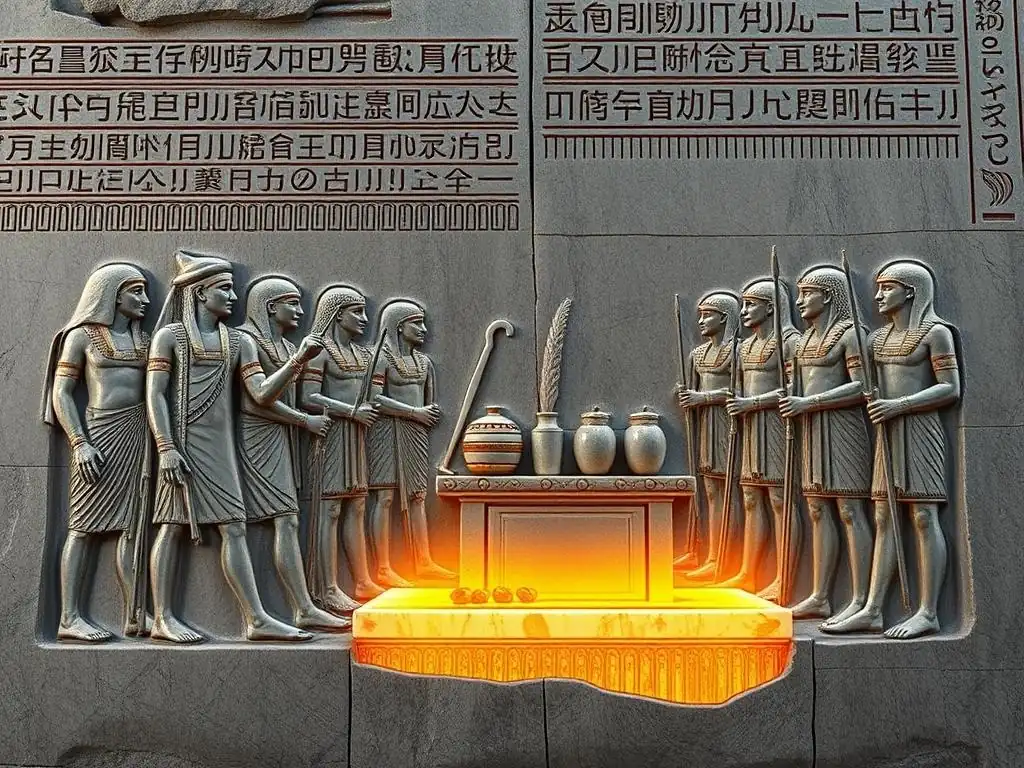
Beyond the realm of literary texts, royal monuments and public inscriptions served as exceptionally powerful visual and textual forms of Middle Kingdom loyalist propaganda. Temples, commemorative stelae, and rock inscriptions, strategically placed throughout Egypt and its newly conquered territories like Nubia, prominently displayed the pharaoh's idealized image, his elaborate titulary, and detailed accounts of his triumphs and accomplishments. For instance, the numerous stelae erected by Senusret III at the formidable Second Cataract forts in Nubia, such as those at Semna and Uronarti, loudly proclaimed his military might and his unwavering role as the vigilant protector of Egypt's southern borders.
These monumental displays were not merely decorative embellishments; they were deliberate and imposing statements of power, legitimacy, and divine favor. They were strategically situated in highly visible public spaces, along vital trade routes, and within prominent cult centers, ensuring broad exposure to the pharaoh's carefully crafted message.
Even if the general populace was largely illiterate, the sheer scale, artistic grandeur, and prominent placement of these structures—often depicting the pharaoh triumphing over his enemies or communing directly with the gods—conveyed an undeniable and overwhelming message of absolute royal authority and divine sanction, reinforcing the core tenets of royal propaganda Middle Kingdom sought to instill.
Elite Officials and the Promotion of Royal Ideology
The extensive and highly centralized bureaucracy of the Middle Kingdom played a crucial and active role in the daily promotion and enforcement of royal ideology. High-ranking officials, including the remaining provincial nomarchs (whose power was significantly curtailed during this period), and numerous local administrators, were not only expected to obey the pharaoh's will but also to actively embody and disseminate it.
Their unwavering loyalty was frequently rewarded with prestigious titles, significant land grants, and elaborate funerary monuments, which, in turn, often depicted their allegiance to the king and their service to the state, thereby reinforcing the very system that elevated them. The Loyalist Teaching (often attributed to the vizier Kheti) specifically admonishes officials to serve the king faithfully, promising tangible rewards for loyalty and dire consequences for insubordination.
These elite officials acted as indispensable intermediaries between the distant pharaoh and the general populace. Through their meticulous administration of justice, their efficient collection of taxes, and their organization of large-scale public works projects, they directly implemented royal policies that consistently reinforced the pharaoh's image as the ultimate source of order, prosperity, and national stability.
Their own success, status, and personal well-being were inextricably linked to the pharaoh's power and favor, making them highly motivated and active proponents of the prevailing loyalist propaganda. This ensured its pervasive reach, extending its influence down to the most local levels of Egyptian society.
The Evolution of Royal Ideology: Old Kingdom to Middle Kingdom
Contrasting Old and Middle Kingdom Royal Ideals
The perception and presentation of kingship underwent a significant and discernible evolution from the Old Kingdom to the Middle Kingdom. In the Old Kingdom, the pharaoh was primarily viewed as an aloof, transcendent god-king, whose inherent divinity was largely unquestioned. His role was to maintain cosmic order through his very being, and the monumental pyramids served as eternal testaments to his singular, unchallengeable, and almost entirely abstract divine status, derived solely from his birthright. The emphasis was on his remote, unapproachable perfection.
In stark contrast, Middle Kingdom loyalist propaganda presented a more nuanced, and arguably more relatable, image of the pharaoh. While still undeniably divine, he was now also portrayed as a vigilant shepherd of his people, burdened by the immense responsibilities of kingship, and even susceptible to human frailties and the pains of betrayal, as powerfully seen in the Instructions of Amenemhat.
This significant ideological shift directly reflected the profound trauma of the First Intermediate Period, where the previous model of an aloof, divine kingship seemed to have failed. This necessitated a new form of pharaonic propaganda that emphasized the pharaoh's active role in governance, his personal sacrifices, and his arduous struggle to maintain Ma'at in a world constantly threatened by chaos.
Adapting Propaganda to Address Middle Kingdom Challenges
The Middle Kingdom emerged from and subsequently faced a unique set of challenges, including the lingering psychological impact of the First Intermediate Period's widespread chaos and the pressing need to firmly re-establish a strong, centralized state. Royal propaganda ingeniously adapted to these new realities by directly addressing and assuaging these collective anxieties.
Texts like the Prophecy of Neferti provided a compelling narrative of past suffering and future salvation, explicitly promising stability and restoration through the advent of the new dynasty. This narrative offered a powerful message of hope and a clear path to renewed order under the pharaoh's benevolent rule, serving as a direct and comforting response to the collective trauma experienced by the populace.
Furthermore, the deliberate emphasis on the pharaoh as a "Good Shepherd" or a "weary ruler" in texts such as the Instructions of Amenemhat served to subtly humanize the king, making him more accessible, while simultaneously highlighting the immense burden he bore for the nation's well-being and security. This subtle yet profound shift in the loyalist propaganda Middle Kingdom aimed to foster a deeper, more empathetic connection between the ruler and the ruled.
By demonstrating the pharaoh's personal struggles and sacrifices, the ideology sought to encourage loyalty not merely through divine awe, but also through a sense of understanding, gratitude, and a shared commitment to the stability he provided.
Critiques and Interpretations of Royal Propaganda
Potential for Dissent and Resistance
While Middle Kingdom loyalist propaganda was undeniably pervasive and sophisticated, it is crucial for modern scholarship to consider the potential for dissent and resistance, even if direct evidence is scarce. Although the textual record, largely controlled by the state and the elite, contains little explicit mention of widespread rebellion against the pharaoh, the very existence and intensity of such an elaborate propaganda system strongly suggest an ongoing need to constantly reinforce legitimacy and suppress potential challenges.
The Instructions of Amenemhat, with its stark warning against betrayal and its recounting of the pharaoh's assassination, implicitly acknowledges the very real possibility of disloyalty, even from within the highest echelons of the royal court.
Historical instances, such as the assassination of Amenemhat I, serve as potent reminders that royal power, despite its ideological claims, was not always absolute or immune to internal threats. While the official texts present a largely unified and obedient front, the practical realities of governance likely involved ongoing negotiation, the suppression of powerful local nomarchs, and the management of various vested interests.
The heavy emphasis on the dire consequences of chaos ( Isfet) in pharaonic propaganda can also be interpreted not just as a general warning, but as an attempt to actively suppress latent discontent by invoking fear, suggesting that the ideological battle for absolute loyalty was not always easily or universally won.
Intended Audience of Royal Propaganda
The primary intended audience for much of the sophisticated Middle Kingdom loyalist propaganda was undoubtedly the literate elite of Egyptian society: scribes, high-ranking officials, priests, and members of the royal court. These individuals formed the backbone of the state administration and were crucial for maintaining the intricate hierarchical structure. Texts like the Instructions of Amenemhat and the Prophecy of Neferti were complex literary works, replete with subtle allusions and sophisticated rhetorical devices, requiring a high level of education and cultural literacy to fully appreciate and internalize their nuanced messages. These texts were central to their training and professional identity.
However, the overarching message of royal authority and the pharaoh's indispensable role also permeated down to the general populace, albeit in simpler, more visual, and less text-dependent forms. Public monuments, grand religious ceremonies, and the daily actions of local officials all served to convey the pharaoh's immense might, divine favor, and benevolent provision.
While the intricate subtleties of the literary works might have been lost on the largely illiterate masses, the overarching and powerful message of a divinely sanctioned, all-powerful ruler who ensured order, stability, and prosperity was effectively communicated through these various channels, making the loyalist teaching a multi-layered and broadly disseminated phenomenon.
Limits and Effectiveness of Royal Power
Despite the elaborate and pervasive system of loyalist propaganda, royal power in the Middle Kingdom, while significantly re-established, still had its practical limits. The pharaoh remained reliant on a vast network of officials and local administrators to effectively implement his will across the entire land, and their efficiency, competence, and loyalty could vary considerably. The very need for constant and explicit reinforcement of the pharaoh's divine image and authority through an extensive body of literature and monumental art suggests that his power, while strong and centralized, was not inherently unquestionable and required continuous ideological maintenance and active propagation.
Nonetheless, the effectiveness of Middle Kingdom loyalist propaganda can be clearly measured by the period's remarkable stability, sustained prosperity, and profound cultural flourishing, which endured for over two centuries under the 12th Dynasty. The ideology successfully re-established a strong central government and fostered a profound sense of national unity and purpose after a period of fragmentation.
However, the eventual decline leading to the Second Intermediate Period demonstrates that even the most sophisticated and deeply ingrained propaganda could not entirely prevent the cyclical nature of Egyptian history, where central authority would eventually wane due often to a combination of internal administrative weaknesses and external pressures.
Middle Kingdom loyalist propaganda played a highly significant role in systematically shaping the social norms and expectations of Egyptian society. Didactic texts, commonly referred to as "Instructions," such as the Instructions of Ptahhotep (though originating in the Old Kingdom, its themes and influence persisted) and the Loyalist Teaching itself, emphasized and promoted virtues deemed essential for a stable society: obedience to authority, humility, diligence, personal integrity, and respect for one's superiors and the established hierarchy.
These texts, widely copied and studied in scribal schools, instilled a profound sense of duty towards the state and, crucially, towards the pharaoh, portraying adherence to these values as the definitive path to personal success, social harmony, and professional advancement.
The pervasive narratives of chaos versus order, and the stark contrast between good governance under the pharaoh and the suffering caused by misrule, reinforced a collective understanding of right and wrong, with the pharaoh positioned as the ultimate arbiter of Ma'at. This comprehensive ideological framework actively encouraged conformity and strongly discouraged any actions or thoughts that could potentially destabilize the social fabric. By doing so, it functioned as a powerful mechanism of social control, ensuring that individuals understood and accepted their predetermined place within the divinely ordained hierarchy, a core and enduring objective of all pharaonic propaganda.
Royal propaganda in the Middle Kingdom explicitly and consistently reinforced the existing social stratification, firmly placing the pharaoh at the absolute apex of the societal pyramid. Below him, the hierarchy descended through the elite officials, scribes, and priests, followed by the general populace.
The loyalist texts often emphasized the divine distance and unique status of the king, separating him from even the highest-ranking subjects, while simultaneously advocating for a system of meritocracy within the elite, where loyalty, competence, and diligent service to the pharaoh led to personal advancement and reward. This system, however, always remained entirely subservient to the pharaoh's ultimate and unquestionable authority.
The Loyalist Teaching provides a clear illustration of this dynamic, praising those who serve the king well ("The loyal man is the one who puts the king in his heart") and issuing stern warnings against those who do not. It powerfully suggests that an individual's success, well-being, and very existence are directly tied to their faithful service to the pharaoh, thereby legitimizing the rigid hierarchical structure and channeling aspirations within the established system rather than encouraging any challenge to it.
This aspect of the Middle Kingdom loyalist teaching served to solidify the social order, prevent disruptive upward mobility, and safeguard royal prerogatives against any potential threats.
The Legacy of Royal Ideology in Ancient Egypt
The royal ideology meticulously crafted, refined, and widely disseminated during the Middle Kingdom left an indelible and profound legacy on all subsequent periods of ancient Egyptian history. Many of the literary forms and thematic elements that characterized Middle Kingdom propaganda, such as the didactic "Instructions" genre, the prophetic warnings, and the emphasis on the pharaoh as the vigilant "shepherd of his people," continued to profoundly influence New Kingdom literature, statecraft, and religious thought.
Furthermore, the concept of the pharaoh as a powerful, divine warrior king, particularly reinforced by the formidable reign of Senusret III, became a dominant and celebrated motif, directly inspiring the imperial ambitions of the New Kingdom rulers.
The sophisticated methods of loyalist propaganda developed in the Middle Kingdom, encompassing the strategic use of literary works, grand monumental art, and systematic administrative dissemination, provided a comprehensive blueprint for how future pharaohs would legitimize their rule, maintain social order, and project their power. While specific historical contexts and political landscapes evolved, the core principles of divine kingship, the imperative to maintain Ma'at, and the stark portrayal of chaos as the inevitable alternative to strong royal rule remained central to Egyptian political and religious thought for millennia.
This enduring influence demonstrates the remarkable and lasting power of Middle Kingdom loyalist teaching.
Conclusion: The Significance of Middle Kingdom Royal Propaganda
Summarizing Key Elements
Middle Kingdom loyalist propaganda represented a sophisticated and multifaceted ideological system meticulously designed to re-establish and firmly cement the pharaoh's authority following the profound decentralization and chaos of the First Intermediate Period. This system strategically utilized a diverse array of mediums, including influential literary texts such as the Prophecy of Neferti and the Instructions of Amenemhat, alongside imposing monumental art and pervasive administrative practices, to effectively convey its core messages to various segments of society.
The central themes woven throughout this body of Middle Kingdom loyalist propaganda included the pharaoh's explicit portrayal as a divine representative on Earth, his indispensable role as the sole guarantor of Ma'at (cosmic order), the dire and terrifying consequences of chaos ( Isfet) in the absence of strong royal rule, and the tangible promise of prosperity and national well-being through unwavering allegiance to the throne. This comprehensive ideological system successfully shaped social norms, reinforced the established hierarchy, and provided a powerful, enduring foundation for the remarkable stability and profound cultural flourishing characteristic of the 12th Dynasty.
Impact on Middle Kingdom Society and Politics
The impact of this pervasive and intricately woven loyalist propaganda on Middle Kingdom society and politics was undeniably profound and far-reaching. It fostered a renewed sense of national unity and collective purpose, effectively channeling the widespread anxieties about past chaos into a powerful reaffirmation of centralized royal power.
The consistent emphasis on individual loyalty and service to the pharaoh contributed significantly to a more cohesive and obedient state, which in turn enabled the successful execution of ambitious national projects, such as the extensive land reclamation and irrigation schemes in the Faiyum and the construction of a formidable chain of fortresses in Nubia.
Politically, the robust system of pharaonic propaganda successfully legitimized the 12th Dynasty's rule, ensuring a remarkably long period of stability and a relatively smooth succession for many reigns, a stark contrast to earlier periods of fragmentation. The ideological framework it meticulously established became deeply embedded in the Egyptian psyche, contributing significantly to the enduring nature and longevity of pharaonic kingship as an institution. This robust system of Middle Kingdom loyalist teaching proved absolutely essential in navigating the complex challenges of a post-First Intermediate Period world, laying the groundwork for Egypt's resurgence.
Further Research: Exploring Royal Ideology
Further research into Middle Kingdom loyalist propaganda could fruitfully delve deeper into the regional variations in its reception and interpretation, examining how consistently the message was absorbed and understood across different nomes and social strata. Investigations into private tomb inscriptions, biographical texts of officials, and other non-royal documents might offer alternative perspectives or subtle forms of dissent and negotiation that are not readily apparent in the more overtly state-controlled official literature.
Comparative studies with royal ideologies from other ancient civilizations, such as Mesopotamia or the Near East, could also illuminate both the unique aspects and the universal themes present in Egyptian royal propaganda, highlighting cross-cultural patterns of legitimization. Furthermore, applying modern critical discourse analysis to the linguistic and rhetorical strategies employed in these ancient texts could provide fresh and nuanced insights into their persuasive power, their intended effects, and their enduring legacy on the very concept of governance and the role of the ruler in ancient Egypt.
Frequently Asked Questions
### What is the Loyalist Teaching, and why is it considered Loyalist propaganda?
The Loyalist Teaching refers to a collection of Middle Kingdom texts designed to promote allegiance to the Pharaoh. It's considered propaganda because it presents a highly idealized view of royal authority and the benefits of obedience.
### How does the Loyalist Teaching reflect the political context of the Middle Kingdom?
The Middle Kingdom followed a period of instability. The Loyalist Teaching aimed to reinforce the Pharaoh's legitimacy and prevent a return to that era, highlighting the consequences of disloyalty.
### What are some of the key themes and arguments presented in Loyalist propaganda from the Middle Kingdom?
Key themes include the Pharaoh's divine right to rule, the benefits of social order under royal authority, and the dangers of rebellion. The texts emphasize the Pharaoh's role in maintaining maat (cosmic order).
### Where can I find examples of Loyalist Teaching texts, and what kind of information do they provide about Middle Kingdom society?
Many texts are preserved on papyri and tomb walls. They provide valuable insights into Middle Kingdom values, social hierarchies, and the importance of royal power in maintaining stability.
### How does the Loyalist propaganda of the Middle Kingdom compare to propaganda from other ancient civilizations?
Like other ancient societies, the Middle Kingdom used propaganda to legitimize its rulers. However, the Loyalist Teaching's emphasis on maat and the Pharaoh's essential role in maintaining it is uniquely Egyptian.
Final Reflection: Echoes of Enduring Power
The exploration of Loyalist propaganda in Middle Kingdom texts reveals more than just ancient political strategies; it illuminates the timeless human desire for stability and order, a desire that resonates deeply in our own complex world. The carefully crafted narratives designed to solidify the Pharaoh's authority offer a fascinating glimpse into the mechanisms of power and the enduring appeal of strong leadership, even when achieved through carefully managed messaging.
This examination of ancient Egyptian loyalty programs underscores the enduring power of narrative in shaping societal values and maintaining social cohesion. The messages embedded within these texts, designed to foster allegiance and obedience, continue to echo through history, reminding us of the potent influence of storytelling on collective identity. Words are mightier than weapons,
a sentiment that, though not explicitly stated in Middle Kingdom texts, is undeniably reflected in their strategic deployment of language and imagery.
As we close this exploration of Loyalist teachings, let us reflect on the lessons learned from the Pharaohs of the Middle Kingdom. How do we, in our own lives and communities, navigate the complexities of power, loyalty, and truth? Let us strive to cultivate a critical awareness of the narratives that shape our world, ensuring that our allegiance is earned through genuine merit and not simply demanded through persuasive propaganda. Let the wisdom of the past guide us toward a future where leadership is defined by integrity and service, not by the manipulation of hearts and minds.
Unearth Your Inner Egyptologist: Take the Next Step!
Thank you for delving into the fascinating world of Middle Kingdom Egypt and the strategies used to cultivate loyalty. Now that you've explored these ancient texts and their insights into royal authority, it's time to connect with the past in a more active way.
Here are a few ways to continue your journey:
- Imagine yourself as a scribe in the Pharaoh's court and create a short, modern-day "teaching" emphasizing the importance of civic responsibility. How would you adapt the ancient message for today's world?
- Explore online databases of Egyptian artifacts. Seek out examples of art or inscriptions that depict the Pharaohs and their power. Share your most interesting find with a friend.
- Research a specific Pharaoh from the Middle Kingdom. What unique challenges did they face, and how did they reinforce their rule? Share your insights in the comments below.
What modern-day "teaching" would be most effective in fostering a sense of community and shared purpose?