
Statuary of Kushite Pharaohs and Meroitic Rulers: Iconography, Power, and Artistic Traditions

Welcome to ArchaeologyHub.org, your portal to the past!
Delve into the fascinating world of archaeological discovery and unearth the secrets of ancient civilizations. Ever wondered how power was expressed through art in ancient Nubia? Today, we unravel the captivating story behind Kushite pharaoh statuary iconography. Explore the symbolism, artistic traditions, and political messages embedded within these remarkable artifacts, and begin to understand the profound impact of Meroitic rulers. What stories do these statues tell, and how do they shape our understanding of this powerful kingdom? Keep reading to uncover the answers...
- Introduction: Unveiling Kushite Pharaoh Statuary
- The Kingdom of Kush: A Historical Context for Royal Sculpture
- Iconographic Elements in Kushite Royal Statuary
- Power and Propaganda: The Message Behind the Statues
- Artistic Traditions and Influences on Kushite Sculpture
- Materials and Techniques Used in Kushite Statuary Production
- Notable Examples of Kushite Royal Statuary
- The Legacy of Kushite Statuary: Influence and Interpretation
- Conclusion: The Enduring Significance of Kushite Pharaoh Statuary
-
Frequently Asked Questions
- What is the primary focus of the statuary of Kushite pharaohs and Meroitic rulers?
- How did Kushite pharaoh statuary iconography differ from that of Egypt?
- What role did statuary play in the political landscape of the Kingdom of Kush?
- What are some key elements of Kushite pharaoh statuary iconography?
- Where can I find examples of Kushite pharaoh statuary?
- Final Reflection: Echoes of Kushite Majesty
- Unveil the Secrets of Kushite Royalty!
Introduction: Unveiling Kushite Pharaoh Statuary
The ancient Kingdom of Kush, located in what is now modern-day Sudan, was a formidable civilization that flourished for over two millennia. Its rulers, particularly those of the Napatan and Meroitic periods, left behind a rich legacy of monumental art, with royal statuary standing as a powerful testament to their might, piety, and distinct cultural identity. These sculptures, often crafted from durable stone, served not merely as artistic expressions but as potent tools of political legitimation and religious devotion, reflecting a unique blend of indigenous Nubian traditions and adopted Egyptian conventions.
This article delves into the intricate world of Kushite pharaoh statuary iconography, exploring the historical context that shaped its development, the specific iconographic elements that conveyed royal power, and the artistic traditions that defined its distinctive style. We will examine how these statues communicated messages of divine kingship and military prowess, and analyze the materials and techniques employed in their creation. Ultimately, understanding Kushite pharaoh statuary provides invaluable insights into one of Africa's most significant ancient empires.
The Kingdom of Kush: A Historical Context for Royal Sculpture
Nubia's Ancient Legacy and the Rise of Kush
Nubia, the land stretching south of ancient Egypt, boasts a profound history of civilization predating the rise of the Kingdom of Kush. From as early as 2500 BCE, powerful indigenous cultures like the Kerma kingdom established complex societies with sophisticated artistic and architectural traditions, including monumental burial mounds and unique pottery styles. This long-standing cultural foundation provided a rich substrate upon which the later Kushite state would emerge, drawing upon centuries of local development even as it interacted with its powerful northern neighbor.
The Kingdom of Kush itself began to consolidate its power around 1000 BCE, with its early capital likely located at Napata, near the sacred mountain of Jebel Barkal. This period saw the gradual reassertion of Nubian independence after centuries of Egyptian domination during the New Kingdom (circa 1550-1070 BCE). The Kushite rulers, deeply reverent of Egyptian religious practices, particularly the cult of Amun, began to project their authority through monumental construction and, crucially, royal statuary that would soon rival, and in some aspects, surpass the grandeur of their Egyptian predecessors.
The Kushite Conquest of Egypt and the 25th Dynasty
The zenith of Kushite power arrived with the establishment of the 25th Dynasty, often referred to as the "Black Pharaohs," who ruled over a reunited Egypt and Kush from approximately 747 to 656 BCE. Under charismatic leaders such as Piye, Shabaka, and Taharqa, Kushite pharaohs extended their dominion northward, bringing stability and a renewed emphasis on traditional Egyptian piety after a period of fragmentation. This monumental achievement profoundly influenced Kushite pharaoh statuary iconography, as these rulers adopted and adapted Egyptian royal titles, regalia, and artistic conventions to legitimize their rule over the ancient land of the pharaohs.
The statuary from this period, particularly of pharaohs like Taharqa, often depicts them in traditional Egyptian poses and attire, but with distinctive Kushite features and regalia, such as the double uraeus. For instance, the colossal granite statue of Taharqa from Karnak, now in the Egyptian Museum, Cairo, stands as a prime example of this synthesis. It showcases the pharaoh in a striding pose, wearing the royal kilt and various crowns, but distinctly featuring the double cobra on his forehead, a clear marker of his Kushite identity and dual kingship over both Upper and Lower Egypt.
Meroe: The Southern Flourishing of Kushite Culture
Following their retreat from Egypt around 656 BCE due to Assyrian incursions, the Kushite capital gradually shifted southward from Napata to Meroe, located between the Fifth and Sixth Cataracts of the Nile. This move ushered in the Meroitic period (circa 300 BCE – 350 CE), a time of remarkable cultural independence and innovation. While still acknowledging their Egyptian heritage, the Meroitic rulers developed a distinct script, an iron industry, and a unique artistic style that diverged significantly from earlier Napatan works.
Meroitic royal statuary reflects this cultural evolution, exhibiting a greater emphasis on indigenous Nubian features and less direct adherence to Egyptian artistic canons. For example, the statues of rulers like Natakamani and Amanitore from sites such as Temple B 500 at Jebel Barkal showcase robust physiques, elaborate Meroitic jewelry, and a unique blend of idealization and stylized realism. This period saw the flourishing of pyramid fields at Begrawiya, where many royal tombs included chapels adorned with reliefs and statuary depicting the deceased rulers, further solidifying the distinct identity of Meroitic Kush.
Iconographic Elements in Kushite Royal Statuary
Royal Regalia and Symbols of Power in Kushite Art
Kushite pharaoh statuary iconography is replete with specific royal regalia and symbols, each meticulously chosen to convey the ruler's divine authority, legitimacy, and dominion. These elements were not merely decorative; they were powerful visual declarations understood by the populace and the elite alike. The careful depiction of crowns, scepters, and other royal attributes provided an immediate visual language of power, linking the Kushite kings to a long tradition of divine rulership in both Nubia and Egypt.
The strategic placement and consistent representation of these symbols across various statues served to reinforce the king's status as a living god and the legitimate heir to ancient royal traditions. Whether carved in colossal stone or cast in precious metals, every detail of the royal adornment contributed to the overall message of absolute authority. This deliberate use of iconographic elements made the statuary a potent medium for political and religious propaganda, ensuring the visual recognition and acceptance of the Kushite rulers' authority.
The Double Uraeus: Symbol of Kushite Kingship
One of the most distinctive and emblematic features in Kushite pharaoh statuary iconography is the double uraeus, a pair of rearing cobras adorning the forehead of the royal crown. In traditional Egyptian iconography, a single uraeus symbolized the unified Upper and Lower Egypt and served as a protective emblem for the pharaoh. The Kushite innovation of the double uraeus is widely interpreted as a deliberate statement of their dual sovereignty over both Kush and Egypt, emphasizing their control over the two lands.
This unique symbol is prominently featured on the crowns of 25th Dynasty pharaohs such as Taharqa and Aspelta. For instance, the magnificent statue of Aspelta from Temple B 700 at Jebel Barkal, now housed in the Museum of Fine Arts, Boston, clearly displays the double uraeus, signifying his authority over a vast realm stretching from the Egyptian Delta to deep into Nubia. The consistent presence of this dual cobra motif on nearly all royal Kushite headwear unequivocally distinguishes their kingship from that of their Egyptian predecessors and successors.
Crowns and Headdresses: Defining Royal Identity
The choice and style of crowns and headdresses in Kushite pharaoh statuary were critical in defining royal identity and asserting legitimacy. Kushite rulers adopted many traditional Egyptian crowns, including the White Crown (Hedjet) for Upper Egypt, the Red Crown (Deshret) for Lower Egypt, and the Double Crown (Pschent) symbolizing the unified kingdom. They also utilized the Atef Crown, often associated with Osiris, and the Blue Crown (Khepresh), a war crown.
However, the Kushites often combined or adapted these crowns in unique ways, sometimes incorporating distinct Nubian elements or wearing them in conjunction with specific Kushite regalia. For example, some Meroitic rulers are depicted with elaborate composite crowns incorporating elements of ram's horns, linking them to the ram-headed god Amun, a deity highly revered in Kush. This adaptation showcased their reverence for Egyptian traditions while simultaneously asserting their own cultural distinctiveness within the broader context of their Kushite pharaoh statuary iconography.
Scepters and Ankhs: Emblems of Authority and Life
Beyond crowns, the scepters and ankhs held by Kushite pharaohs in their statuary were potent emblems of their authority and divine connection. The crook and flail, traditional symbols of pharaonic power, representing kingship and fertility respectively, were frequently depicted in the hands of Kushite rulers. The Was scepter, a long staff with an animal head and forked base, symbolized power and dominion, while the Sekhem scepter represented control and strength.
The Ankh, the Egyptian hieroglyphic symbol for "life," was also a ubiquitous motif in Kushite royal sculpture. Often depicted being held by the king, or presented to him by deities, the Ankh underscored the pharaoh's role as the giver of life and prosperity, and his divine connection that ensured the well-being of his realm. The inclusion of these specific objects within Kushite pharaoh statuary iconography reinforced the ruler's sacred responsibilities and his role as an intermediary between the gods and humanity.
Depiction of Physical Features: Idealization vs. Realism
Kushite royal statuary, while often adhering to the idealized forms prevalent in Egyptian art, also introduced distinctive elements that hinted at a unique blend of idealization and a subtle, perhaps unintentional, realism. The representation of physical features in these sculptures provides a fascinating glimpse into how the Kushites sought to portray their rulers, balancing the timeless, divine perfection expected of a pharaoh with characteristics that might have been perceived as ethnically or individually distinct. This interplay makes the study of Kushite pharaoh statuary iconography particularly rich.
The artistic choices regarding facial features and body proportions reflect a complex interplay of cultural influences and self-representation. While many statues exhibit the youthful, timeless beauty common in Egyptian royal portraiture, others possess a robust strength and specific facial characteristics that have led scholars to debate the extent of "Nubian" representation. This tension between the ideal and the perceived real contributes significantly to the unique character of Kushite sculpture.
Facial Features and Ethnic Representation in Kushite Statues
The facial features depicted in Kushite pharaoh statuary have been a subject of considerable scholarly discussion, particularly concerning their "ethnic" representation. While many early Napatan-period statues closely mimic Egyptian styles, later 25th Dynasty and especially Meroitic works often exhibit distinct characteristics. These include broader noses, fuller lips, and more rounded faces compared to the often narrower, more aquiline features seen in typical Egyptian pharaonic portraiture.
For example, statues of Taharqa, while largely conforming to Egyptian idealization, sometimes display a more robust and less delicate facial structure. In the Meroitic period, exemplified by pieces like the bronze "Head of a Meroitic Ruler" from Meroe (now in the British Museum), these features become even more pronounced and stylized, suggesting a deliberate artistic choice to emphasize a distinct Nubian identity rather than merely replicating Egyptian forms. This shift reflects a growing cultural confidence and a desire to forge a unique visual language for their rulers.
Body Proportions and the Canon of Beauty
The body proportions in Kushite royal statuary largely followed the established Egyptian canon, which dictated an idealized, youthful, and muscular physique, often based on a grid system for consistent representation. This canon aimed to convey divine perfection and timelessness rather than individual likeness. Kushite artists readily adopted this system, ensuring their pharaohs were depicted with the same heroic proportions as their Egyptian counterparts, symbolizing their strength, vitality, and eternal nature.
However, some Kushite statues, particularly from the Meroitic period, occasionally diverge slightly, presenting figures with a more pronounced musculature or a sense of greater physical robustness. While still idealized, these subtle variations can contribute to a perception of a more powerful, grounded presence. The colossal scale of many Kushite statues, such as the numerous colossal statues of Aspelta from Jebel Barkal, also enhanced this sense of overwhelming power and divine presence, making them awe-inspiring testaments to royal might.
Power and Propaganda: The Message Behind the Statues
Statuary as a Tool for Legitimizing Kushite Rule
Kushite royal statuary served as a primary instrument for legitimizing the rule of the pharaohs and Meroitic rulers, both within their own kingdom and in the broader ancient world. These monumental works were strategically placed in temples, public spaces, and royal tombs, acting as permanent declarations of the ruler's divine right, military prowess, and connection to ancient traditions. The sheer scale and quality of these sculptures projected an image of immense wealth and power, undeniable to anyone who encountered them.
By depicting kings in traditional pharaonic poses, adorned with Egyptian and distinctly Kushite regalia, the statuary visually asserted their continuity with the past while simultaneously highlighting their unique authority. For instance, the numerous statues of 25th Dynasty pharaohs found in Egyptian temples, such as those of Taharqa in Karnak, were not just artistic offerings but potent symbols of Kushite control over Egypt, reminding the populace of their legitimate claim to the throne. This deliberate use of Kushite pharaoh statuary iconography transformed stone into a powerful political statement.
Divine Kingship and Religious Iconography
The concept of divine kingship was central to Kushite ideology, and royal statuary was instrumental in reinforcing this belief. Kushite pharaohs were considered living manifestations or direct descendants of the gods, particularly Amun, who was revered as the state deity. Their statues often depicted them in close association with deities, receiving blessings, or offering sacrifices, thereby underscoring their sacred role as intermediaries between the divine and human realms.
Many statues feature the king performing ritual gestures or bearing symbols directly linked to specific gods. For example, the ram-headed Amun, a prominent deity in Kush, is often depicted alongside or in association with the king, symbolizing the pharaoh's divine lineage and protection. The inscriptions on the bases of some statues further elaborate on the king's piety and his role in maintaining cosmic order, aligning his rule with divine will and ensuring the prosperity of the land. This integration of religious themes into Kushite pharaoh statuary iconography was crucial for maintaining social and political cohesion.
Commemorating Military Victories and Royal Achievements
While not always explicitly narrative, Kushite royal statuary often implicitly or explicitly commemorated military victories and significant royal achievements. The very presence of colossal statues in conquered territories or newly established temples served as a testament to the pharaoh's dominion and the strength of the Kushite military. The idealized, powerful physique of the rulers in their statues also conveyed an image of martial strength and unwavering authority.
Although less common than in Egyptian art, some Kushite statuary or associated temple reliefs depicted military campaigns or the subjugation of enemies, further enhancing the king's image as a victorious warrior. For instance, while not a statue, Piye's Victory Stela, detailing his conquest of Egypt, exemplifies the kind of triumphant narrative that royal monuments were designed to convey. The overall impression conveyed by Kushite pharaoh statuary iconography was one of a formidable ruler, chosen by the gods, who brought order and success to his realm through both divine favor and military might.
Artistic Traditions and Influences on Kushite Sculpture
Egyptian Influence on Kushite Art
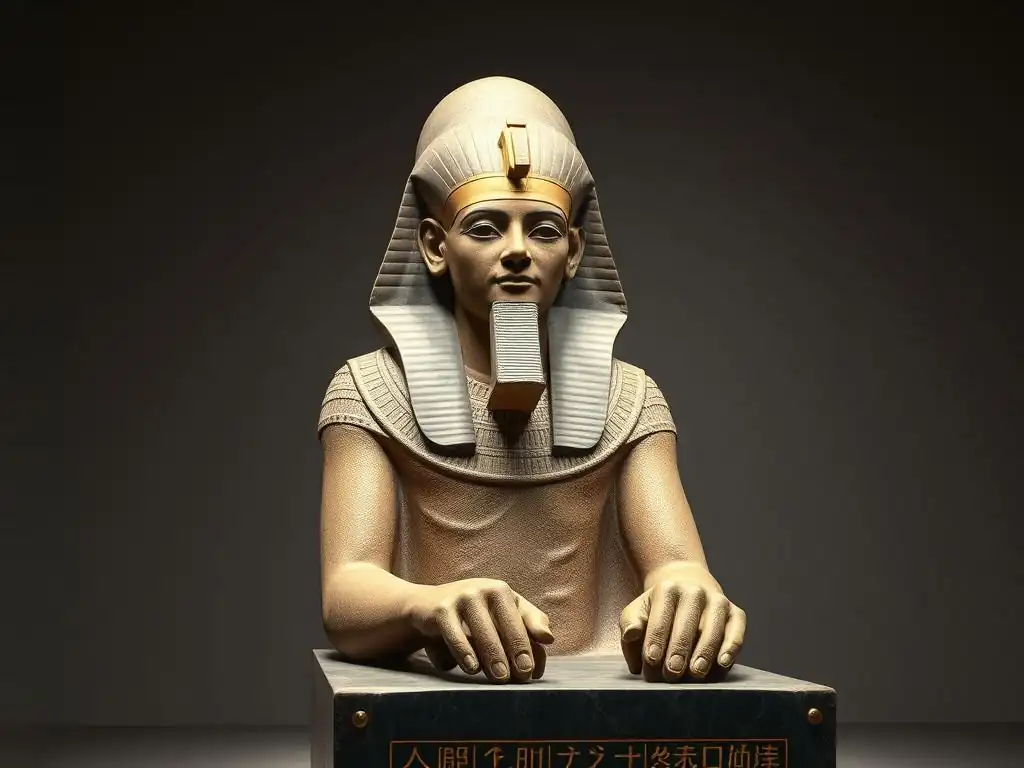
The artistic traditions of ancient Egypt exerted a profound and undeniable influence on Kushite sculpture, a relationship forged over millennia of interaction, trade, and periods of both Egyptian dominance and Kushite rule. Kushite artists, particularly during the 25th Dynasty, consciously emulated and adopted many Egyptian artistic conventions, recognizing their prestige and the powerful messages they conveyed. This artistic exchange was not merely a passive absorption but an active process of selection and adaptation, leading to a unique synthesis.
The adoption of Egyptian forms provided a visual language that was widely understood across the Nile Valley, crucial for rulers who sought to legitimize their authority over both Egypt and Kush. However, this influence was not static; it evolved over time, becoming more selective in the Meroitic period as indigenous Nubian elements gained prominence. The enduring presence of Egyptian stylistic elements, even in later periods, underscores the deep reverence Kushites held for the artistic heritage of the Nile Valley.
Borrowing and Adapting Egyptian Artistic Conventions
Kushite sculptors extensively borrowed and adapted Egyptian artistic conventions, including canonical poses, stylistic idealizations, and the use of specific materials. The standard Egyptian poses—the striding figure with the left leg forward, the seated figure on a block throne, and the block statue—are all frequently observed in Kushite pharaoh statuary. These poses were not just aesthetic choices but conveyed specific meanings of eternal readiness, stability, and divine presence.
Furthermore, the Egyptian emphasis on idealization, portraying rulers as eternally youthful and perfect rather than as individual portraits, was largely maintained. This ensured that the pharaoh was seen as a timeless, divine being. However, Kushite artists often subtly adapted these conventions, for instance, by giving figures a more robust or powerful build, or by incorporating specific Kushite regalia like the double uraeus, creating a distinctive blend within the broader framework of Egyptian artistic tradition.
The Role of Egyptian Craftsmen in Kushite Workshops
It is highly probable that Egyptian craftsmen played a significant role in Kushite workshops, particularly during the 25th Dynasty when Kushite pharaohs ruled Egypt. The skilled artisans of Egypt possessed centuries of expertise in stone carving, metalworking, and monumental sculpture. As the Kushite rulers established their dominion, it is plausible that they either employed Egyptian artisans directly or that Egyptian artistic knowledge and techniques diffused into Kushite workshops through various means, including apprenticeships and the movement of skilled labor.
The remarkable technical proficiency and stylistic consistency observed in many 25th Dynasty Kushite statues strongly suggest the involvement of artists trained in the Egyptian tradition. Evidence such as unfinished statues found at sites like Jebel Barkal and Sanam sometimes reveal carving techniques that align with Egyptian methods. This transfer of knowledge ensured that the early Kushite pharaoh statuary iconography could effectively communicate its message using a visual language familiar and respected throughout the Nile Valley.
Indigenous Nubian Artistic Traditions
Despite the pervasive influence of Egyptian art, Kushite sculpture was far from a mere imitation. It possessed a distinct indigenous Nubian artistic tradition that became increasingly prominent, particularly during the Meroitic period. This unique artistic identity was shaped by centuries of local cultural development, independent of Egyptian styles, and reflected the specific beliefs, aesthetics, and materials available within Kush. The blend of these influences is what gives Kushite art its unique character.
As the Meroitic kingdom flourished, its artists began to assert a more independent vision, moving away from strict adherence to Egyptian canons. This shift is evident in the development of new iconographic elements, a different emphasis on physical features, and the incorporation of locally significant symbols. The emergence of these indigenous traits underscores the dynamic nature of Kushite culture and its ability to synthesize external influences with its own rich heritage.
Distinctive Nubian Elements in Kushite Statuary
Distinctive Nubian elements are evident in Kushite pharaoh statuary, marking it as more than just a provincial offshoot of Egyptian art. Beyond the prominent double uraeus, which is uniquely Kushite, other features contribute to this distinctiveness. Some statues exhibit a more robust and powerful physique, departing from the slender ideal often seen in later Egyptian art, reflecting a different aesthetic of royal strength. The use of specific jewelry, such as large earplugs or elaborate collars, also points to indigenous Nubian styles.
Furthermore, in the Meroitic period, there is a noticeable shift towards a more stylized and, at times, somewhat abstract representation of facial features, moving away from the detailed naturalism or idealization of Egyptian portraiture. This can be seen in the simplification of forms or the emphasis on certain features, creating a unique Meroitic "look." These indigenous elements provide crucial insights into the evolving self-perception and artistic priorities of the Kushite rulers.
Meroitic Innovations in Royal Portraiture
The Meroitic period witnessed significant innovations in royal portraiture, signaling a growing cultural independence from Egyptian artistic dominance. While still acknowledging their Pharaonic heritage, Meroitic artists developed a unique style that emphasized a distinctive Nubian aesthetic. This included a tendency towards a more robust and naturalistic depiction of the human form, along with more stylized and sometimes exaggerated facial features, such as prominent eyes and full lips, which some scholars interpret as attempts at ethnic representation.
A prime example is the bronze "Head of a Meroitic Ruler" found at Meroe, now housed in the British Museum. This piece showcases a departure from strict Egyptian canons, displaying a unique blend of idealization with a specific Meroitic stylistic flair, including a prominent double uraeus and a distinctive headdress. This period also saw an increased use of Meroitic script in statue inscriptions, further reinforcing the kingdom's unique cultural identity and its contribution to the broader Kushite pharaoh statuary iconography.
Materials and Techniques Used in Kushite Statuary Production
Sourcing Materials: Stone, Gold, and Other Resources
The production of Kushite royal statuary required access to diverse and often challenging-to-source materials, reflecting the kingdom's rich natural resources and its extensive trade networks. Stone was the predominant material for monumental statues, with various types utilized depending on availability and desired aesthetic. Greywacke, a hard, dark sedimentary rock, was a favored material, particularly for colossal statues like those of Aspelta. Other stones included granite, often sourced from quarries near Aswan in Egypt or local Nubian sources, sandstone from nearby riverine cliffs, and schist.
Beyond stone, gold played a significant role in Kushite art, reflecting Nubia's ancient reputation as a land rich in this precious metal. While not typically used for large-scale statuary, gold was extensively employed for jewelry, ceremonial objects, and as ornamentation on royal regalia depicted in statues. Copper and bronze were also utilized for smaller figures and for tools essential in the sculpting process, demonstrating a sophisticated understanding of metallurgy within the Kushite kingdom.
Sculpting Techniques and Workshop Practices
Kushite sculptors employed sophisticated techniques largely inherited from Egyptian traditions, adapting them to local materials and artistic preferences. The process typically began with the selection of a suitable stone block, often quarried from sites along the Nile. Artisans would then use a combination of chisels, hammers, and abrasive tools to rough out the basic form, gradually refining the details. Precision was achieved through the use of grids and proportional guidelines, ensuring the canonical proportions were maintained.
Evidence from archaeological excavations, such as unfinished statues and caches of tools found at sites like Jebel Barkal and Sanam, provides insights into workshop practices. These discoveries suggest organized production, likely involving specialized teams of carvers, polishers, and engravers. The final stages involved meticulous polishing using abrasive sands or stones to achieve a smooth, often gleaming surface, enhancing the statue's visual impact and durability. The enduring quality of Kushite pharaoh statuary iconography speaks to the mastery of these ancient craftsmen.
Materials of the Statue of Aspelta from Jebel Barkal
One of the most impressive examples of Kushite royal statuary, the colossal statue of Aspelta from Temple B 700 at Jebel Barkal, exemplifies the mastery of materials and techniques. This monumental sculpture, standing approximately 3.3 meters (over 10 feet) tall, is carved from dark greywacke, a particularly hard and durable stone. The choice of greywacke, known for its fine grain and ability to take a high polish, allowed for the intricate detailing of Aspelta's royal regalia and facial features.
The statue's imposing size and the precise execution of its iconography, including the double uraeus and the detailed royal kilt, demonstrate the advanced sculpting capabilities of the Napatan period. The smooth, almost reflective surface of the finished greywacke would have caught the light dramatically within the temple environment, enhancing its powerful presence. Now housed in the Museum of Fine Arts, Boston, the Aspelta statue remains a prime illustration of the scale and quality achieved in Kushite pharaoh statuary production.
Notable Examples of Kushite Royal Statuary
The Statues of Taharqa: A Study in Royal Representation
The statues of Taharqa, one of the most prominent pharaohs of the 25th Dynasty, offer a comprehensive study in Kushite royal representation, showcasing the height of Napatan artistic achievement and the deliberate blend of Egyptian and Nubian iconography. Numerous sculptures of Taharqa have been discovered, ranging from colossal figures to smaller, exquisitely carved pieces, found at sites across Egypt and Kush, including Karnak, Kawa, and Sanam.
Perhaps the most famous is the colossal granite statue of Taharqa from Karnak, now residing in the Egyptian Museum, Cairo. This imposing sculpture depicts the pharaoh in a traditional striding pose, adorned with the double uraeus and various crowns, asserting his dual sovereignty over Egypt and Kush. Other notable examples include the granite sphinxes of Taharqa, which combine the body of a lion with the king's head, symbolizing his strength and divine power, further solidifying his image within Kushite pharaoh statuary iconography.
The Meroitic Royal Statues from Jebel Barkal
Jebel Barkal, the sacred mountain near Napata, continued to be a significant religious and artistic center during the Meroitic period, yielding important caches of Meroitic royal statues. Among the most notable finds are those from Temple B 500, which include magnificent statues of rulers like King Natakamani and Queen Amanitore, who reigned in the 1st century CE. These sculptures represent a distinct evolution in Kushite art, showcasing the full emergence of the Meroitic style.
The statues of Natakamani and Amanitore are characterized by their robust, almost monumental physiques, often depicted with elaborate Meroitic jewelry, including large, distinctive necklaces and bracelets. Their crowns frequently incorporate the double uraeus alongside uniquely Meroitic elements, such as ram's horns connecting them to Amun. These statues, often carved from local sandstone, exemplify the Meroitic tendency towards a more stylized and powerful representation, distinguishing them from earlier Napatan works while maintaining a link to their pharaonic past.
Analysis of the Head of a Meroitic Ruler from Meroe
The bronze "Head of a Meroitic Ruler," discovered at Meroe and now a prized possession of the British Museum, offers a compelling insight into the unique character of Meroitic royal portraiture. This life-sized head, believed to depict a Meroitic king from the early 1st century CE, exhibits a striking blend of idealized features and distinctively Nubian characteristics, making it one of the most celebrated examples of Kushite pharaoh statuary iconography.
The head features full lips, a broad nose, and prominent eyes, which contribute to its powerful and somewhat stylized expression. Adorning the forehead is the double uraeus, a hallmark of Kushite kingship, while remnants of what was likely a complex crown or headdress further emphasize his royal status. The bronze medium allowed for a finer level of detail and expression than often seen in stone, showcasing the technical prowess of Meroitic metalworkers and their innovative approach to royal representation.
The Legacy of Kushite Statuary: Influence and Interpretation
The Impact of Kushite Art on Later Nubian Kingdoms
The artistic legacy of Kushite statuary extended far beyond the Meroitic period, profoundly influencing subsequent Nubian kingdoms that emerged after the decline of Meroe. The traditions of monumental stone carving, the emphasis on royal regalia, and certain stylistic conventions found echoes in the art of the post-Meroitic and Christian Nubian kingdoms. While these later periods developed their own distinct artistic expressions, the foundational principles established by Kushite sculptors provided a crucial artistic vocabulary.
For instance, the tradition of depicting powerful rulers, often in association with divine symbols, continued to be a feature of royal art in the medieval Nubian kingdoms of Makuria, Alodia, and Nobadia. Although the iconography shifted to reflect Christian beliefs, the concept of art as a tool for legitimizing authority and expressing power, so evident in Kushite pharaoh statuary, persisted. This continuity underscores the enduring impact of Kush on the cultural identity of the broader Nubian region.
Modern Interpretations of Kushite Statuary Iconography
In modern times, the interpretation of Kushite pharaoh statuary iconography has evolved significantly, moving beyond earlier colonial perspectives that often viewed it merely as a derivative of Egyptian art. Contemporary scholarship increasingly recognizes these statues as unique cultural artifacts that reflect a sophisticated and independent civilization. Scholars now focus on understanding the distinct Nubian elements, the deliberate choices made by Kushite artists, and the complex messages conveyed by the blend of influences.
These interpretations contribute to a richer understanding of ancient African history, highlighting the agency and innovation of the Kushite people. Exhibitions in major museums worldwide, such as the Museum of Fine Arts, Boston, and the British Museum, prominently feature Kushite statuary, allowing a global audience to appreciate its artistic merit and historical significance. This ongoing re-evaluation helps to correct historical biases and establish Kushite art in its rightful place as a major contribution to ancient world art.
The Current Location and Preservation Status of Key Statues
Key examples of Kushite royal statuary are primarily housed in major international museums and within the national collections of Sudan and Egypt, reflecting the sites of their discovery. The colossal statues of Taharqa and other 25th Dynasty pharaohs are largely preserved in the Egyptian Museum, Cairo. Significant collections of Napatan and Meroitic statuary, including the monumental statue of Aspelta and numerous other royal figures from Jebel Barkal and other sites, are prominently displayed at the Museum of Fine Arts, Boston, which has a long history of archaeological work in Sudan.
Other important pieces, such as the bronze "Head of a Meroitic Ruler" and various smaller artifacts, are found in the British Museum in London and the Louvre Museum in Paris. In Sudan itself, the National Museum of Sudan in Khartoum holds a vast collection of artifacts from Kush, including many smaller royal statues and reliefs, providing a vital national repository. Preservation efforts involve ongoing conservation work by these institutions to protect these ancient treasures from environmental degradation and the effects of time, ensuring their continued study and appreciation.
Conclusion: The Enduring Significance of Kushite Pharaoh Statuary
The statuary of Kushite pharaohs and Meroitic rulers stands as a profound artistic and historical legacy, offering invaluable insights into one of Africa's most remarkable ancient civilizations. These monumental sculptures, meticulously crafted from durable materials, served as powerful vehicles for expressing divine kingship, legitimizing rule, and commemorating royal achievements. Their intricate Kushite pharaoh statuary iconography, characterized by a unique blend of indigenous Nubian traditions and adapted Egyptian conventions, speaks volumes about the cultural dynamism and political ambition of the Kingdom of Kush.
From the double uraeus symbolizing dual sovereignty to the distinctive facial features that emerged in Meroitic portraiture, every element of Kushite royal statuary tells a story of identity, power, and artistic innovation. Beyond their aesthetic appeal, these statues provide critical evidence for understanding the complex relationship between Kush and Egypt, the evolution of Nubian self-representation, and the enduring impact of this great African empire. Their continued study enriches our understanding of ancient art and the diverse tapestry of human civilization.
Frequently Asked Questions
What is the primary focus of the statuary of Kushite pharaohs and Meroitic rulers?
The statuary primarily focused on projecting power and legitimacy through specific iconographic representations. It also reflects evolving artistic traditions within the Kingdom of Kush.
How did Kushite pharaoh statuary iconography differ from that of Egypt?
While influenced by Egyptian traditions, Kushite statuary developed its own distinct style, often incorporating African features and religious symbols unique to Kush. There was also emphasis on Kushite royal attire.
What role did statuary play in the political landscape of the Kingdom of Kush?
Statues served as powerful tools for asserting royal authority and legitimizing the ruler's claim to the throne. They were prominently displayed in temples and public spaces.
What are some key elements of Kushite pharaoh statuary iconography?
Common elements include the nemes headdress, the uraeus (cobra), and specific jewelry and regalia signifying royal status and divine connection. The kandake also played an important role.
Where can I find examples of Kushite pharaoh statuary?
Many examples are housed in museums around the world, including the British Museum, the Museum of Fine Arts, Boston, and the National Museum of Sudan. Further information is available at ArchaeologyHub.org.
Okay, here's a final reflection designed to close your article on Kushite pharaoh statuary iconography, following your specified structure and aiming for an inspiring and reflective tone:
Final Reflection: Echoes of Kushite Majesty
The exploration of Kushite pharaoh statuary iconography reveals more than just artistic preferences; it unveils a sophisticated understanding of power, legitimacy, and cultural identity that resonates even today. The deliberate choices in depicting these rulers, blending Egyptian traditions with uniquely Kushite elements, offer a powerful reminder that cultural exchange and adaptation can lead to the creation of something truly exceptional and enduring.
The enduring legacy of Kushite statuary continues to fascinate and inspire, challenging conventional narratives of ancient history and highlighting the importance of recognizing the contributions of diverse cultures to the tapestry of human civilization. The meticulous detail and symbolic weight imbued in each statue speak volumes about the Kushite rulers' ambition and their desire to leave an indelible mark on the world. Art is never finished, only abandoned.
– Leonardo da Vinci. This quote reminds us that while the Kushite kingdom eventually faded, their artistic legacy continues to speak, inviting us to interpret and reinterpret their story.
As we conclude this journey through the iconography of Kushite pharaoh statuary, let us carry forward a renewed appreciation for the power of art to transcend time and communicate across cultures. Consider how the lessons learned from the Kushite example – the blending of traditions, the assertion of identity, and the pursuit of lasting legacy – can inform your own creative endeavors and inspire you to leave your own unique mark on the world.
Unveil the Secrets of Kushite Royalty!
Thank you for delving into the fascinating world of Kushite statuary! We hope you’ve enjoyed discovering the intricate details of their art and its reflections of power. Now, it’s time to continue your journey of archaeological exploration!
- Dig deeper: Research a specific Kushite ruler whose statue resonated with you the most.: Uncover more about their reign and the symbolism behind their depiction.
- Share your newfound knowledge: Start a discussion in the comments section on ArchaeologyHub.org, highlighting your favorite aspect of Kushite art and explaining why it captivates you.
- Challenge your perspective: Visit a museum or explore online collections to compare Kushite statuary with that of other ancient civilizations, identifying both similarities and unique characteristics.
What specific element of Kushite iconography will you research further, and how do you think it influenced their perception of power?